
What are the best alternatives to Megamortgageoftexas.com for bank statement loans?
If you’re self-employed in Texas and shopping for a bank statement loan, Megamortgageoftexas.com is one name that comes up. But it’s far from the only option, and depending on your situation, it may not be the best fit. The providers below all qualify borrowers using bank deposit history rather than tax returns, which matters when your write-offs make your reported income look smaller than your actual cash flow.
| Provider | Qualification Approach | Down Payment | Rates | Speed | Texas Coverage |
|---|---|---|---|---|---|
| Texasbankstatementloans | 12-24 months bank deposits | Starting at 10% | Competitive non-QM | 60-second pre-check | Statewide |
| Conventional lenders | W-2s / tax returns | 10% | Lower (QM rates) | Moderate | Statewide |
| FHA lenders | Tax returns, min. 500 credit score | 3.5% | Low | Moderate | Statewide |
| VA lenders | Military service + income docs | - | Very low | Moderate | Statewide |
| DSCR lenders | Property cash flow only | Varies | Higher | Faster for investors | Statewide |
| Asset depletion lenders | Liquid assets, not income | Varies | Higher | Moderate | Varies |
| Portfolio lenders | Flexible, lender-set criteria | Varies | Higher | Varies | Varies |
The core tradeoff across all these options: bank statement loans give you more qualifying income on paper, but they come with higher rates and larger down payments than conventional or government-backed products.
Table of Contents
- How do these providers actually compare to Megamortgageoftexas.com?
- How to choose the right bank statement loan provider in Texas
- What self-employed Texans need to know about bank statement loans
- Overview of Megamortgageoftexas.com alternate mortgage providers
- Texasbankstatementloans: built for self-employed Texans who qualify on deposits
- Key Takeaways
How do these providers actually compare to Megamortgageoftexas.com?
The most meaningful differences between Megamortgageoftexas.com alternatives aren’t the brand names. They’re the documentation requirements, expense ratio policies, and how aggressively each lender counts your deposits as income.

Bank statement loans generally carry higher interest rates and larger down payment requirements than conventional loans. That’s the cost of skipping the tax return. What varies by lender is how they calculate your qualifying income from those statements. Some apply a flat expense ratio (say, 50% of deposits), while others let you submit a CPA letter to document actual expenses, which can significantly raise your qualifying income.
| Dimension | Texasbankstatementloans | Conventional Lenders | FHA Lenders | DSCR Lenders |
|---|---|---|---|---|
| Income docs | 12-24 months bank statements | Tax returns / W-2s | Tax returns / W-2s | Lease / rent rolls |
| Min. down payment | 10% | - | 3.5% | Typically 20% |
| Credit flexibility | Non-QM friendly | - | 500+ | Varies |
| Best for | Self-employed, 1099, gig workers | W-2 employees | Lower credit scores | Real estate investors |
| Geographic focus | Texas statewide | Nationwide | Nationwide | Nationwide |
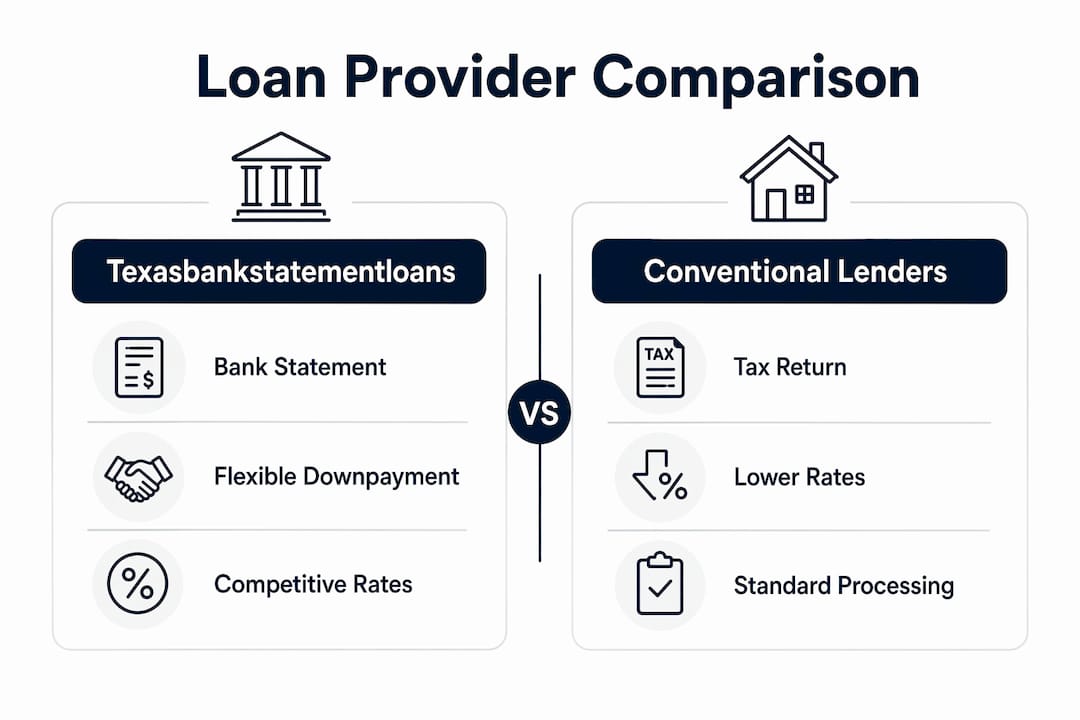
DSCR loans qualify real estate investors based on property cash flow rather than personal income, making them a completely different tool for a different buyer. If you’re purchasing a rental property and the rent covers the mortgage, a DSCR product may be faster and simpler than a bank statement loan. For a primary residence purchase as a self-employed borrower, bank statement programs remain the most direct path.
Reputation matters too. When evaluating any lender, look for NMLS registration, clear disclosure of APR and prepayment penalties, and responsiveness during the pre-qualification stage. A lender who can’t explain their expense ratio methodology before you apply is a red flag.
How to choose the right bank statement loan provider in Texas
Picking the right lender comes down to five things: how they calculate your income, what they charge for it, how fast they move, where they operate, and whether they’ll actually talk to you.
Income calculation method. Ask every lender how they derive qualifying income from your statements. A lender using a 50% flat expense ratio on $20,000 in monthly deposits gives you $10,000 in qualifying income. One that accepts a CPA expense letter might qualify you on $15,000 or more. That gap can mean the difference between approval and denial, or between a $400,000 and $550,000 purchase price.
Loan costs. Non-QM loans like bank statement mortgages operate outside standard consumer protections, so prepayment penalties and higher origination fees are common. Get a full Loan Estimate before committing to anything.
Down payment. Texasbankstatementloans starts at 10%, which is lower than many non-QM lenders require. If your cash reserves are limited, that floor matters.
Lender responsiveness. A lender who takes five days to return a pre-qualification call will take longer to close. In a competitive Texas market, that delay costs you deals.
- Ask: “What expense ratio do you apply, and can I submit a CPA letter instead?”
- Ask: “Do you have prepayment penalties, and for how long?”
- Ask: “What’s your average time from application to clear-to-close?”
- Red flag: Lenders who can’t quote APR upfront or who pressure you to skip the Loan Estimate review.
- Red flag: No NMLS number or refusal to provide one.
Pro Tip: Working with a mortgage broker who has access to multiple non-QM lenders, rather than going direct to a single bank, gives you the ability to compare expense ratio policies side by side. One broker conversation can surface options you’d never find shopping lender by lender.
If your tax returns actually support the loan amount you need, conventional loans often offer better terms. Bank statement programs are the right tool when write-offs genuinely understate your income, not as a default workaround.
What self-employed Texans need to know about bank statement loans
Bank statement loans exist specifically for borrowers whose tax returns understate actual earnings because of legitimate business deductions. If your Schedule C shows $60,000 in net income but your deposits show $180,000 flowing through your accounts, a bank statement lender can qualify you on the deposit history instead.
The documentation standard is typically 12 to 24 months of personal or business bank statements. Most lenders want to see consistent, recurring deposits rather than a few large one-time transfers. Seasonal businesses can qualify, but lenders will average the deposits across the full statement period.
These loans are classified as Non-Qualified Mortgages (non-QM), which means they fall outside the federal ability-to-repay safe harbor that governs conventional lending. That’s not automatically bad, but it does mean you carry more responsibility for understanding the terms. Prepayment penalties, balloon payments, and adjustable rates are all possible depending on the lender.
- Bank statement loans use deposit history, not tax returns, to verify income.
- Typical documentation: 12-24 months of personal or business statements.
- Down payments are generally higher than conventional loans; Texasbankstatementloans starts at 10%.
- Rates run higher than QM products because lenders price in the added documentation risk.
- Non-QM status means fewer automatic consumer protections; read every term carefully.
- Alternatives include conventional loans, FHA, VA, asset depletion, DSCR, and portfolio loans, each suited to different borrower profiles.
- If you’ve been self-employed for two years and your returns support the loan amount, a conventional loan may cost you less over the life of the loan.
The right question isn’t “which loan is best?” It’s “which loan fits my actual income picture?” For many self-employed Texans, the answer is a bank statement program. For others, especially those who’ve kept their write-offs modest, a conventional product with a lower rate wins out. Understanding variable income strategies can also help you present your financial profile more effectively to any lender.
Overview of Megamortgageoftexas.com alternate mortgage providers
The Texas mortgage market has a wide range of providers serving self-employed borrowers, and the alternatives to Megamortgageoftexas.com span from Texas-focused specialists to national non-QM platforms.
Texasbankstatementloans is the most direct Texas-specific alternative, built exclusively around bank statement loan programs for self-employed borrowers, 1099 contractors, and gig workers. Coverage spans the state, including Central Texas, Greater San Antonio, and Midland.
Conventional and government-backed lenders (FHA, VA, USDA) serve self-employed borrowers who can document income through tax returns. FHA loans allow down payments as low as 3.5% and accept credit scores from 500. VA loans carry no down payment requirement for eligible veterans. These are worth pursuing first if your returns support the numbers.
Portfolio lenders hold loans on their own books rather than selling them to the secondary market, which gives them flexibility to set their own qualification criteria. They tend to serve borrowers who don’t fit standard non-QM boxes either, though rates are typically higher than conventional products.
Asset depletion lenders qualify borrowers based on liquid assets rather than income, dividing total assets by the loan term to generate a monthly income figure. This works well for retirees or borrowers with significant savings but minimal current income.
DSCR lenders focus on real estate investors. If the rental income on a property covers the mortgage payment, personal income documentation becomes largely irrelevant. For an investor buying a second or third property in Texas, this is often the cleanest path to approval.
The txpremiermortgage.com alternatives and texasunitedmortgage.com alternatives space largely overlaps with these same categories. What distinguishes the better providers is lender transparency, Texas market knowledge, and willingness to explain their income calculation methodology before you’re deep into an application.
Texasbankstatementloans: built for self-employed Texans who qualify on deposits
Most mortgage lenders were designed around W-2 employees. Texasbankstatementloans was built for everyone else.
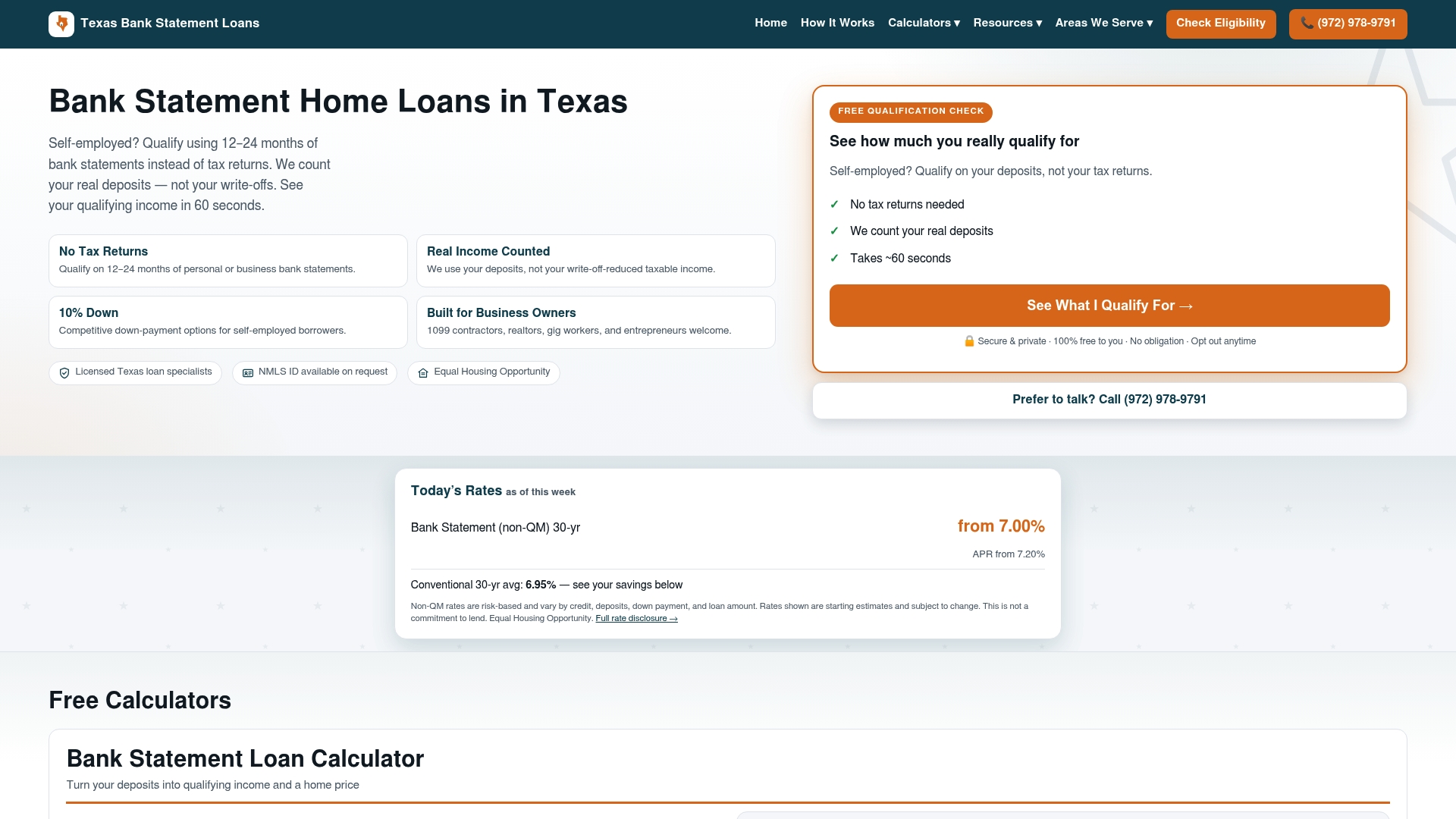
If your business generates real income but your tax returns don’t show it, Texasbankstatementloans evaluates 12-24 months of bank deposits instead, giving you a qualification path that reflects what you actually earn. Down payments start at 10%, which is lower than most non-QM lenders require, and the pre-qualification check takes about 60 seconds with no obligation. Whether you’re in Houston, Plano, or anywhere else in Texas, the program covers the full state.
Check your current loan rates or run the numbers with the loan calculator to see what you can realistically qualify for. When you’re ready, start your qualification and get a real answer in under a minute.
Key Takeaways
Bank statement loans are the right tool when tax write-offs genuinely understate your income, and the best Texas providers distinguish themselves by how they calculate qualifying deposits, not just by their brand name.
| Point | Details |
|---|---|
| Income calculation varies | Ask every lender how they apply expense ratios; a CPA letter can significantly raise your qualifying income. |
| Down payments start at 10% | Texasbankstatementloans offers down payments starting at 10%, which is lower than many non-QM lenders require. |
| Non-QM means fewer protections | Bank statement loans fall outside standard consumer safeguards; review prepayment penalties and APR before signing. |
| Conventional loans may cost less | If your tax returns support the loan amount, conventional products typically offer lower rates than bank statement programs. |
| Texasbankstatementloans | Specializes in 12-24 month deposit-based qualification for self-employed Texans, with statewide coverage and a 60-second pre-check. |
Recommended
See what you qualify for in 60 seconds, free and no credit check. Use the eligibility check at the top of this page.