
Yes, commission income can qualify you for a mortgage in Texas if it is documented and likely to continue. Lenders usually want a history of 12 to 24 months. Programs differ: FHA typically asks for two years of signed tax returns, while many conventional paths accept year-to-date pay stubs and W-2s. Expect lenders to average your commissions and sometimes subtract unreimbursed business expenses.
TL;DR:
- FHA generally averages income across two years and requires signed tax returns; declining earnings may call for reserves, lower debt, or a larger down payment.
- Conventional rules may accept commission income after 12 months in some cases, using a recent pay stub and two years of wage statements.
- When commissions fluctuate, lenders may qualify you using the lower of the average across two years or the latest year, especially if earnings have declined.
- Bank statement loans review 12 or 24 months of deposits, so commission earners should keep payouts traceable and avoid transfers between their own accounts.
- Request Loan Estimates from at least three lenders using identical loan terms, then compare total loan costs, annual percentage rates, fees, and rate lock periods.
Table of Contents
- What counts as commission income, and why continuity matters
- How much commission history lenders require
- How lenders calculate usable commission income
- Documents lenders commonly accept for commission income
- FHA, conventional and bank statement programs: how the rules differ
- How commission income shapes your debt-to-income ratio and why Loan Estimates matter
- Your step-by-step checklist before you apply
- Specific guidelines for qualifying commission income with bank statement loans in Texas
- How commission income is evaluated differently in non-QM and DSCR loan programs
- Fluctuating commission income: how it affects approval and how to steady your file
- Typical down payment requirements and how commission income influences them in Texas
- Tips for improving approval chances with a bank statement loan
- Where we stand on commission income
- See what you can afford with a bank statement qualification
- FAQ
- Sources
What counts as commission income, and why continuity matters
Commission income is pay that rises and falls with your sales or production. It is contingent pay, so a lender cannot simply multiply one paycheck by twelve. Instead, underwriters ask a single question: is this income stable enough to be reasonably likely to continue? Everything else in the process, from the averaging to the paperwork, exists to answer it.
Several kinds of borrowers fall under this heading:
- W-2 commission earners: salespeople in real estate brokerages, car dealerships, insurance, medical devices, software and similar fields who receive a paycheck plus commissions from an employer.
- Mixed-pay employees: workers with a base salary and a variable commission layer, where only the variable layer needs extra proof.
- Self-employed commission earners: independent agents and 1099 contractors who are paid per sale and file a Schedule C.
- Hybrid earners: people who hold a W-2 job and also earn 1099 commissions on the side.
The distinction between W-2 and self-employed matters because it changes the paperwork. A W-2 earner is verified through employer records, while a 1099 earner is usually treated as self-employed and judged largely on tax returns or, for non-QM loans, bank deposits.
Continuity is the heart of the test. HUD’s guidance in Handbook 4155.1 says commission income must be averaged over the previous two years, and that a borrower relying on it must provide signed tax returns for the last two years along with the most recent pay stub. An underwriter reads that history looking for a pattern: steady, rising or at least not collapsing.
Pro Tip: Before you call a lender, label every income stream you have as W-2 commission, 1099 commission or base salary. The label decides which documents you need, and sorting it out up front saves days of back and forth.
How much commission history lenders require
A two-year history is a useful planning benchmark for borrowers relying on commission income. It comes from the way lenders average income: two full years give an underwriter enough data to see whether your earnings are climbing, holding or sliding. FHA is the most traditional on this point. Its handbook language centers on a two-year average and signed returns.
The picture is more flexible on the conventional side. Fannie Mae’s guidance on bonus, commission, overtime and tip income calls for a paystub and two years of W-2s, and it includes a minimum 12-month inclusion rule for this kind of income. Freddie Mac moved in a similar direction. Its bulletins from late 2019 clarified income-history minimums for fluctuating earnings, in some cases requiring at least 12 months of income, and spelled out when employment history must reach two years.
In practice, here is how the timeline tends to play out:
- 24 months or more: the cleanest file. Lenders average both years and you qualify under standard rules in nearly every program.
- 12 to 24 months: often workable on conventional loans, especially when you stayed in the same field or with the same type of employer. Lenders look for continuity in your line of work, not only your current job.
- Under 12 months: difficult. Some underwriters will consider the income when a job change keeps you in the same occupation at similar or better pay, but you should expect more questions and more documentation.
- Recent job change within the same industry: frequently accepted when the compensation structure is comparable and your history in the field is long.
You may also run into the “lesser of” idea in some guidance. When earnings have fluctuated, a lender can end up using the lower of the two-year average or the more recent one-year average, which protects the lender against counting a peak year that has not repeated. If your latest year was your best, do not be surprised if the qualifying figure lands below what you actually earned.
The takeaway: if you are approaching the 12-month or 24-month mark, waiting a few months can change the math. Ask your lender which program fits your timeline before you commit to a house hunt.
How lenders calculate usable commission income
Lenders do not take your best month, or even your best year, at face value. They convert a lumpy income history into one steady monthly number, using a few standard methods.
Two-year averaging. Add the commission income from each of the last two years and divide by 24 months. This is the default when income has been consistent or rising.
Year-to-date annualizing. When you have a current paystub showing commissions earned so far this year, the lender may fold that figure into the calculation to see whether you are keeping pace with prior years.
Expense subtraction. If you pay your own business expenses, such as mileage, client entertainment or a home office, the lender may subtract unreimbursed expenses from your commission income. Freddie Mac’s October 2016 bulletin specified when unreimbursed business expenses must be deducted and described different treatment depending on whether commission is less than or more than 25% of your employment income. Later Fannie Mae announcements removed some of those percentage-based differences and adjusted documentation in response to IRS reporting changes, so the exact treatment depends on the program and the date of your loan.
A simple way to picture the workflow:
- Gather commission totals for each of the last two years from your W-2s or returns.
- Add the current year-to-date amount from your latest paystub and note the number of months it covers.
- Subtract unreimbursed business expenses where the program requires it.
- Divide by the number of months in the averaging window to get a monthly figure.
- Check the trend: stable or rising income is averaged, while declining income is treated more cautiously.
The trend step is where borrowers get surprised, so consider three illustrative scenarios. These numbers are made up for demonstration only.
- Steady rise: say your commission income rose from one year to the next. Averaging the documented income can produce a monthly figure that reflects that trend. Because your income is climbing, the lender is comfortable using the average.
- Steady fall: say your commission income fell from one year to the next. A lender may treat the decline cautiously and assess the more recent income, since the income is trending down.
- Volatile: say your commission income has varied considerably across recent periods. Expect heavy scrutiny, a conservative average and requests for a written explanation of what drove the swings.
Fannie Mae’s guide treats stable or increasing income differently from decreasing income, which mirrors those scenarios. HUD goes further and says decreases in commission require significant compensating factors, such as strong reserves, a low debt load or a larger down payment.
The rule to remember: HUD’s handbook states that commission income must be averaged over the previous two years, which is why one great quarter cannot rescue a weak history.
Documents lenders commonly accept for commission income
The right file gets you through underwriting with fewer follow-up requests. Here is what lenders ask for, roughly in priority order:
- Recent pay stubs: the most recent stub, showing year-to-date commissions, and other pay stubs if requested.
- W-2s: the last two years, which Fannie Mae calls for alongside the paystub when documenting commission income.
- Signed federal tax returns: typically the last two years, especially for FHA and for anyone whose commissions are large or who has unreimbursed expenses.
- IRS transcripts: Freddie Mac’s 2016 bulletin allowed transcripts as an alternative where signed returns are otherwise required, and lenders obtain them using Form 4506-T or Form 8821.
- Verbal verification of employment: a call to your employer shortly before closing to confirm you still hold the job.
- 1099s, a profit and loss statement or bank statements: requested when you are self-employed or have 1099 commission, and sometimes to support a hybrid income picture.
- Employer letters: a written explanation of your pay structure, commission plan and expected earnings can fill gaps.
Loan-file checklists used by seller and servicer teams reflect the same mix: verifications of employment, pay stubs, W-2s or 1099s, tax returns or transcripts, and supporting documents such as leases or P&Ls where relevant, as shown in a Freddie Mac documentation checklist.
On unreimbursed expenses, the clearest path is to present them the way the tax return does. Schedule A items or Schedule C expenses should match what you report to the IRS, and your lender may ask for a short list showing mileage, supplies or other costs you pay yourself. Inconsistent figures between your return and your own spreadsheet are a fast way to trigger extra questions.
Recent updates matter here too. Freddie Mac’s August 2024 bulletin announced income underwriting and documentation changes for notes dated on or after November 8, 2024, including self-employed income and automated income assessment. If you are applying now, ask your lender whether any of those tools can shorten your document list.
Pro Tip: Request your IRS transcripts early. They can take days to arrive, and having them in hand lets your lender confirm your returns without waiting on a signature or a mailed copy.
FHA, conventional and bank statement programs: how the rules differ
The loan type you choose changes how your commissions are judged, sometimes more than the commissions themselves.
- FHA: the traditional approach is a two-year average with signed returns or transcripts. Stability gets heavy emphasis, and if commissions have dropped, underwriters usually want significant compensating factors before approving. FHA’s handbook is explicit on the two-year average and the signed-return requirement.
- Fannie Mae conventional: commission income generally can be documented with a paystub and two years of W-2s rather than tax returns, per the selling guide. The guide has a table of rules separating stable or increasing earnings from declining ones.
- Freddie Mac conventional: similar in spirit, with documentation alternatives such as IRS transcripts and calculation rules aligned across fluctuating income types, according to its 2016 and 2019 updates.
- Non-QM and bank statement loans: instead of tax returns, these programs read your deposits. For a self-employed commission earner who writes off heavy expenses, that can show income that a tax return hides.
Our own bank statement loans for self-employed buyers assess deposit history, so the question becomes how much money actually lands in your account, not how much survives your tax deductions. Plenty of borrowers start with an FHA or conventional conversation and end up here because the tax-return math did not match their real earnings.
Preapproval versus prequalification also matters at this stage. One real estate agency’s explainer walks through the difference, which is worth reading before you let a rough estimate shape your search.
How commission income shapes your debt-to-income ratio and why Loan Estimates matter
Your qualifying monthly income is the denominator in your debt-to-income ratio, so every dollar the lender trims from your commissions raises your DTI. That is why averaging and expense subtraction are not just paperwork. A lower qualifying monthly figure can push you over a lender’s limit.
Two ratios come up in most conversations:
- Front-end ratio: your proposed housing payment divided by gross monthly income. A common guideline is to keep the proposed housing payment within a share of gross monthly income. The CFPB’s toolkit gives a specific rule of thumb.
- Back-end ratio: your housing payment plus all other monthly debts, divided by gross monthly income.
These are guidelines, not hard walls. Lenders may approve higher ratios when compensating factors are present, such as larger reserves, a bigger down payment or a strong credit profile. Because commission income swings, those factors do real work in a borrower’s favor.
The step that most commission earners skip is shopping. The CFPB recommends getting Loan Estimates from at least three lenders, based on the same loan terms, so you can compare total loan costs and APR. The agency also points out that the three-page Loan Estimate is a form every lender must provide, which makes side-by-side comparison practical. A separate CFPB notice on closing costs repeats the advice, noting that borrowers with tricky income structures benefit from comparing fees.
What to ask on each Loan Estimate:
- Total loan costs and APR
- Whether the lender used your averaged income or a lower figure
- Any fees tied to extra documentation
- The rate lock period
CFPB advice: get Loan Estimates from at least three lenders using the same loan terms, so the comparison is fair.
Your step-by-step checklist before you apply
A clean file is the cheapest improvement you can make. Work through these steps in order:
- Pull your paperwork. Gather 12 to 24 months of pay stubs, the last two W-2s, signed tax returns or IRS transcripts, any 1099s, and recent bank statements.
- Request transcripts early. Ordering them at the start avoids last-minute delays.
- Build a one-page income summary. List your yearly commission totals, your two-year average, your year-to-date figure and the monthly number that results. Add a line for unreimbursed expenses if they apply.
- Write a short note about any dip or spike. A job change, a market slowdown or a one-time bonus is easy to explain up front and awkward to explain after underwriting asks.
- Ask the lender the right questions. Which program fits my timeline? Which documents will you accept? How are unreimbursed expenses treated? Is bank statement qualification available if my returns understate my income?
- Protect your account activity. Avoid large unexplained transfers or deposits, since underwriters ask for the source of anything that looks unusual.
- Prepare for verification. Tell your employer’s HR contact that a verification call is coming, so the verbal VOE does not stall closing.
Timing is part of the plan. Pull transcripts before you start house hunting, update your income summary each month and keep your pay stubs organized by date. When a lender asks for a document, you want to reply in an hour, not a week.
Pro Tip: Send your lender the one-page income summary along with your documents. Underwriters appreciate a clear starting point, and a clean summary often prevents the same question from being asked twice.
Specific guidelines for qualifying commission income with bank statement loans in Texas
A bank statement loan swaps tax returns for deposits. Lenders typically review 12 or 24 months of personal or business statements and calculate qualifying income from the money that actually came in. For a commission earner, each payout, whether from a brokerage, an insurer or a client, shows up as a deposit, and the lender averages those deposits across the window.
Keep the account trail clean. Use one primary account where commissions land, keep deposits traceable to a payer or a commission statement, and avoid mixing in transfers between your own accounts, which lenders usually exclude. If you run a business account, expect the lender to apply an expense factor to reflect costs.
For Texas buyers, our bank statement loan calculator gives a quick read on purchase power before you submit anything, and our rates page shows current pricing.
How commission income is evaluated differently in non-QM and DSCR loan programs
Non-QM programs are built for income that does not fit the standard mold. Rather than testing your paystubs against agency rules, the lender builds a picture from your bank deposits, or from a profit and loss statement, and decides whether the cash flow supports the payment.
DSCR loans work from yet another angle. They apply to investment property, and the question is not your personal income but whether the property’s rental income covers its debt service. For a commission earner buying a rental, that means your commissions matter less than the property’s numbers. You still need credit and reserves, but the underwriting leans on the asset.
The practical difference for you:
- Agency loans: your income is documented, averaged and trimmed by expenses.
- Bank statement loans: your deposits tell the story.
- DSCR loans: the property’s rent tells the story, and our DSCR calculator lets you test a rental scenario quickly.
Choosing the right path early prevents you from building a file around the wrong rules.
Fluctuating commission income: how it affects approval and how to steady your file
Variable income does not disqualify you, but it does raise the bar for explanation. Underwriters look at the direction of your earnings and the reasons behind them. A rising or flat trend is easy to approve. A decline requires strong compensating factors, as HUD’s guidance makes clear.
You can reduce the pain in several ways:
- Explain the dip. A short letter covering a slow quarter, a change in territory or a one-time event helps an underwriter see the cause.
- Lean on stability elsewhere. Long tenure in your field, a consistent employer or a stable client base all help.
- Build reserves. Some mortgage payments in savings is a classic compensating factor.
- Consider a larger down payment. Lowering the loan amount lowers the income you need.
- Pick the program that fits. If your deposits look strong but your returns look weak, a bank statement loan may reflect your income more accurately.
Most important, do not apply in the middle of a downturn if you can wait a few months. A better-looking trailing average can be worth the patience.
Typical down payment requirements and how commission income influences them in Texas
Down payment requirements depend more on the program than on how you are paid. Conventional and FHA loans each carry their own minimums, and your lender will quote them based on your credit and the property. What commission income changes is how much cushion the lender wants to see.
For borrowers with variable pay, a larger down payment works as a compensating factor. It lowers the loan amount, lowers your payment and reduces the income needed to qualify, which can offset a shaky or declining history.

On our side, bank statement loans in Texas can begin with a down payment of 10%, which opens the door for self-employed commission earners who have strong deposits but cannot show it on a return. Keep in mind that the actual figure depends on your credit, the property and the loan program, and our qualification check will show where you land. Many buyers also ask whether gift funds or savings count toward the down payment, and your lender can answer based on the specific program.
Tips for improving approval chances with a bank statement loan
A few habits make a bank statement file much easier to approve:
- Deposit consistently into one account. Scattering commissions across several accounts makes averaging harder.
- Keep the account clean. Avoid overdrafts and unexplained large deposits in the months before you apply.
- Document the source of deposits. Keep commission statements or contracts that match your deposits so a lender can trace each one.
- Separate business and personal money. Mixed accounts invite more questions.
- Check your credit first. Pay down revolving balances and fix errors before you apply.
- Know your numbers. Run our self-employed affordability calculator so you know a comfortable payment before you shop.
These small steps add up. Underwriters approve files they can understand quickly.
Where we stand on commission income
Our view is that commission earners are often judged by the wrong yardstick. A tax return reflects what you chose to report after deductions, and for a self-employed person with heavy write-offs, that can understate what actually reaches your account. We evaluate 12 to 24 months of bank deposits, which lets you show your real income instead of a number shaped by your tax strategy.
We also built a quick, no-obligation qualification check, so you can find out where you stand before you spend a weekend at open houses. Low down payment options starting at 10% make that path realistic for buyers who thought homeownership was out of reach. The key is to match the program to how you earn, not to force your income into a box it does not fit.
- Saad
See what you can afford with a bank statement qualification
If you are self-employed, a 1099 contractor, a gig worker or someone whose tax returns do not match your real earnings, a bank statement loan may be the most direct way to a mortgage. Our bank statement home loans were designed for exactly that situation.
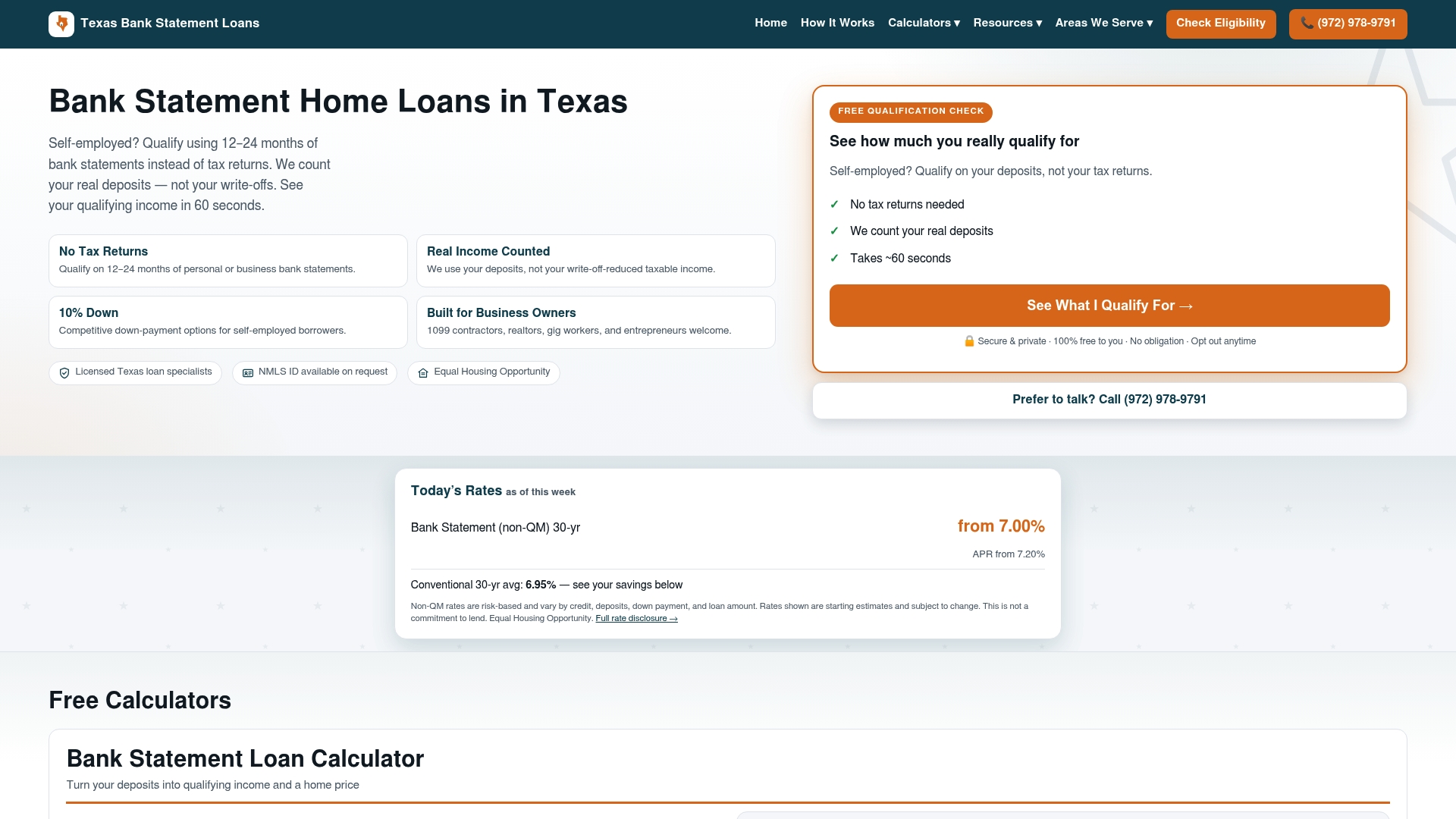
A quick qualification generally needs only a few things:
- Your basic contact details
- Bank statements for an initial estimate
- A short conversation about the home you want to buy and your down payment
From there, our bank statement loan calculator helps you estimate payments and purchase power, and current prices are on our rates page. Run the check, see your number and take the next step when you are ready.
This article is general information, not a substitute for advice from a qualified financial advisor. Consult a qualified financial professional about your own circumstances before acting on anything here.
FAQ
Can you count commission as income for a mortgage?
Yes. Lenders can count commission income when it is documented and likely to continue. They usually average it over a period of up to two years and may subtract unreimbursed business expenses.
What are the FHA guidelines for commission income?
FHA generally requires commission income to be averaged over the previous two years and verified with signed tax returns, as set out in HUD’s handbook. If your commissions have declined, expect lenders to ask for significant compensating factors.
How much commission income can I use to qualify if I only have one year of history?
It depends on the program and your work history. Some conventional guidance allows income with at least 12 months of history in certain cases, as in Freddie Mac’s updates. Lenders also weigh whether you stayed in the same field.
How should I compare lenders when my income is variable?
Request Loan Estimates from at least three lenders using the same loan terms. The CFPB recommends this approach in its Loan Estimate guidance so you can compare total costs and APR.
Sources
- Section D. Borrower Employment and Employment Related Income
- Bonus, Commission, Overtime, and Tip Income | Fannie Mae
- October 27, 2016 Bulletin, Bulletin 2016-19
- Loan Estimate and Closing Disclosure: Your guides as you choose the home loan that’s right for you | Consumer Financial Protection Bureau
- October to December 2019 Freddie Mac Single-Family Seller/Servicer Guide Bulletins
Recommended
- Bank Statement Loans in Austin County, TX | Self-Employed
- Bank Statement Loans in Galveston County, TX | Self-Employed
- Bank Statement Loans in Williamson County, TX | Self-Employed
- Bank Statement Loans in Clay County, TX | Self-Employed
See what you qualify for in 60 seconds, free and no credit check. Use the eligibility check at the top of this page.