
Yes, you can get a competitive mortgage on 1099 income, and the gap between what a conventional lender offers and what you actually qualify for often comes down to two decisions: which loan program you choose and how you’ve arranged your taxes and documentation in the 12-24 months before you apply. Contractors and freelancers who treat mortgage prep as a planning exercise, not a paperwork scramble, routinely qualify for significantly larger loans than those who walk in cold.
When your tax returns already show strong net income, a conventional loan is cheapest. When aggressive write-offs have compressed Schedule C Line 31, a bank-statement or 1099 non-QM program is the practical path.
Key Takeaways
Choosing the right loan program and coordinating your tax strategy 12-24 months before application are the two moves that most reliably increase mortgage borrowing power for 1099 earners.
| Point | Details |
|---|---|
| Program choice drives the ceiling | 1099 non-QM programs count 90-100% of gross income; bank-statement programs use deposits, not Schedule C net profit. |
| Add-backs recover borrowing power | Depreciation and Section 179 are added back; a $30,000 add-back can increase the loan ceiling by roughly $375,000. |
| Plan 12-24 months ahead | Coordinating CPA filings, separate accounts, and documentation before applying consistently produces better outcomes. |
| Credit and DTI matter on non-QM too | Keep utilization below 10% per card, pay down installment debt, and build 3-12 months of PITIA reserves. |
| Texasbankstatementloans | Qualifies Texas borrowers on 12-24 months of bank deposits, with down payments starting at 10% and NMLS-licensed loan officers. |
Table of Contents
- How do lenders calculate qualifying income for 1099 borrowers?
- What documents will lenders ask you to provide?
- Which loan programs accept 1099 income?
- Practical steps to maximize your qualifying income before you apply
- What should you expect from the application timeline and costs?
- Sample calculations: how program choice changes your loan amount
- What mortgage officers actually see 1099 borrowers get wrong
- Texasbankstatementloans: a direct path for 1099 borrowers in Texas
- Sources
How do lenders calculate qualifying income for 1099 borrowers?
The starting point for most conventional lenders is Schedule C Line 31 (net profit), averaged across two years. If income is trending down, many underwriters use the more recent, lower year rather than the average. That single mechanic is where most 1099 borrowers lose ground without realizing it.
From that Line 31 figure, underwriters add back specific noncash or below-the-line items:
- Depreciation and Section 179 expensing, these reduce taxable income but don’t represent cash leaving your account, so lenders typically add them back
- Home office deduction, the portion attributable to depreciation is added back; the direct expense portion usually is not
- Mileage depreciation, the depreciation component of the standard mileage rate is recoverable; the operating cost portion is not
- Business use of a vehicle, similar treatment to mileage
What does not reduce your Schedule C starting point: retirement contributions (solo 401(k), SEP-IRA), self-employed health insurance premiums, half of self-employment tax, and the qualified business income (QBI) deduction. These are below-the-line adjustments on Form 1040 and don’t touch Line 31.
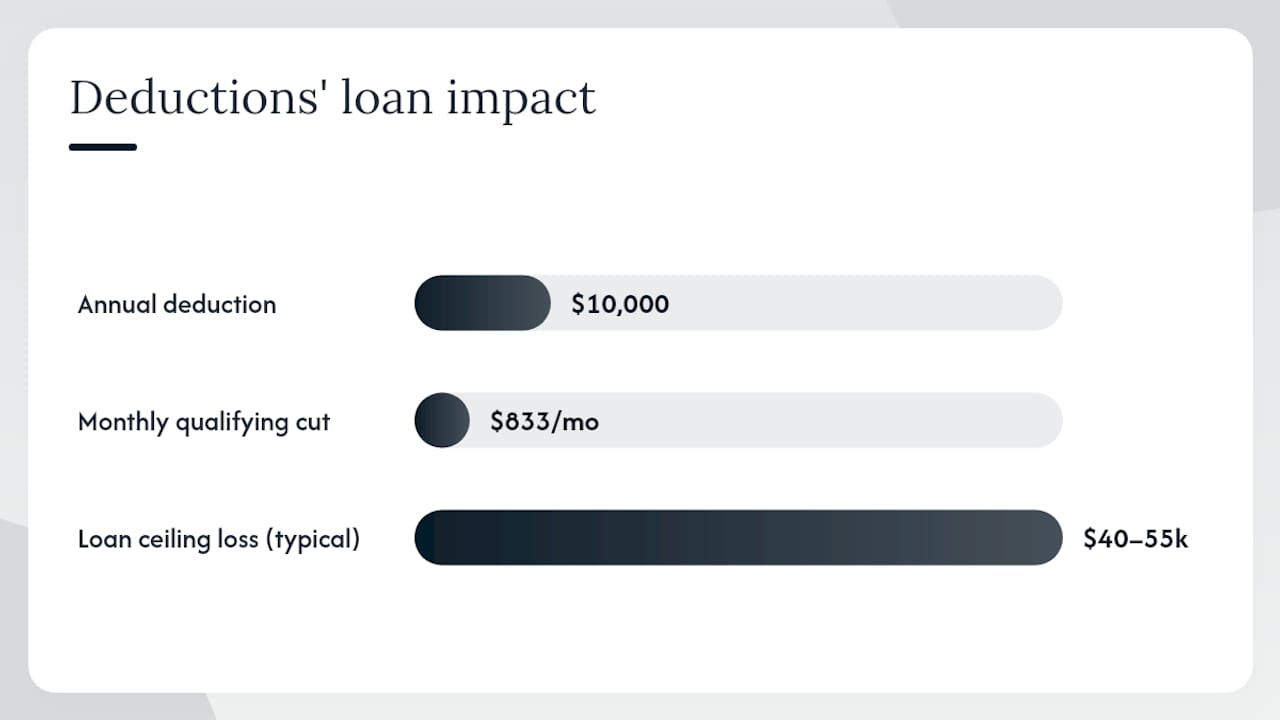
The math here is unforgiving. A $10,000 ordinary deduction can cost roughly $40,000-$55,000 in borrowing power in typical scenarios, because lenders multiply monthly qualifying income into a loan amount. Shave $833 per month off qualifying income and the loan ceiling drops by that same multiple.
Gig workers and independent contractors face an additional layer of scrutiny because their income is often irregular and project-based. Lenders apply smoothing rules (two-year averaging) and trend analysis precisely because income volatility is the norm, not the exception, for this classification.
For borrowers on bank-statement programs, lenders shift their analysis entirely. They identify recurring deposits, strip out owner draws and transfers, and apply an expense ratio to convert gross deposits into qualifying income. A business account with a 50% expense factor and $20,000 in monthly deposits yields $10,000 in qualifying income. Understanding that ratio before you apply lets you model your loan ceiling accurately.
The CFPB’s ability-to-repay rule sets the regulatory floor for all of this: lenders must verify income, assets, and DTI before extending credit. Non-QM programs operate outside the Qualified Mortgage safe harbor but still must document their ability-to-repay analysis.
Pro Tip: Retirement contributions and self-employed health insurance are the cleanest tax moves before a mortgage application. They reduce your tax bill without touching Schedule C Line 31, so your qualifying income stays intact.
What documents will lenders ask you to provide?
Self-employed files take longer in underwriting because every income figure needs a paper trail. Assembling this before you apply cuts weeks off the timeline.
Tax returns and IRS records
- Two years of signed federal 1040s with all schedules (Schedule C, Schedule E if applicable)
- IRS tax transcripts (Form 4506-C), lenders order these directly; having them ready prevents delays
- Business tax returns (Form 1120S or 1065) if you operate as an S-corp or partnership
1099 forms
- 1099-NEC (nonemployee compensation, the most common for contractors)
- 1099-MISC (rents, royalties, prizes, and other income)
- 1099-K (payment card and third-party network transactions, common for gig platforms)
- Year-to-date income statement or client invoices showing the current year’s trend
Profit & Loss statement
- YTD P&L signed by the borrower
- CPA-prepared P&L or balance sheet when available, this carries more weight with underwriters
Bank statements
- 12-24 months of personal and business bank statements for bank-statement programs
- Statements must show consistent deposit patterns; lenders focus on recurring deposits and flag owner draws as non-qualifying
- Explanation letters for large or irregular deposits
Supporting business documentation
- Business license or DBA registration
- Signed client contracts or engagement letters
- Proof of business existence (website, professional license, industry membership)
Lenders require evidence that income is stable and likely to continue, which is why contracts and recurring client relationships matter as much as the deposit totals. A borrower with three long-term clients and documented contracts tells a cleaner story than one with identical deposits but no paper trail.
Keep business and personal accounts completely separate. Commingled accounts are one of the most common reasons self-employed files stall in underwriting. When a lender can’t cleanly identify business income versus personal transfers, they discount or exclude the ambiguous deposits entirely.
| Document | Where to Get It | Format Underwriters Expect |
|---|---|---|
| IRS tax transcripts | IRS.gov Get Transcript tool | PDF, ordered via Form 4506-C |
| 1099-NEC / 1099-MISC / 1099-K | Clients, payers, or platforms | Original or certified copies |
| Bank statements | Your bank’s online portal | PDF, all pages, no alterations |
| CPA-prepared P&L | Your accountant | Signed, dated, on letterhead |
| Business license | State/county licensing office | Copy with current expiration date |
Which loan programs accept 1099 income?
The program you choose determines how your income is measured, which directly sets your loan ceiling. These are the four main paths.
Conventional (agency) loans
Fannie Mae and Freddie Mac guidelines allow self-employed income, but the underwriting is strict: two years of returns, Schedule C averaging, and full documentation. If your net profit after deductions supports the target loan amount, this is the cheapest option by rate. The tradeoff is that aggressive write-offs often make the qualifying income number too low to hit the loan size you need.
1099 non-QM loans
These programs count roughly 90-100% of gross 1099 income rather than Schedule C net profit. A contractor earning $180,000 in gross 1099s who shows only $60,000 in net profit after deductions qualifies on the larger number. The cost: rates typically run about 1%-2% above the conventional baseline, and reserve requirements are higher. Down payments commonly start at around 10% to 20% depending on credit tier.
Bank-statement loans
Qualifying income comes from 12-24 months of bank deposits, with an expense ratio applied. This is the right program when tax returns significantly understate cash flow. Pricing is similar to 1099 non-QM, and lenders will apply an expense factor (often 50% for business accounts, sometimes less for personal accounts with documented business use) to convert deposits into qualifying income.
DSCR loans (investment property)
For investment purchases, debt service coverage ratio (DSCR) loans qualify on the property’s rental income rather than personal income. A DSCR of 1.0 means the rent covers the mortgage; most lenders want 1.1-1.25. No personal income documentation required, which makes these useful for 1099 borrowers building a rental portfolio.
Practical steps to maximize your qualifying income before you apply
The borrowers who qualify for the most are almost always the ones who started planning 12-24 months out. Here’s the ranked sequence that moves the needle most.
-
Choose your program first. Run the numbers on conventional vs. 1099 non-QM vs. bank-statement before you do anything else. The program determines which income figure matters, and that determines every other decision. A 12-24 month coordination plan with your CPA and loan officer is the single highest-leverage move.
-
Align your tax strategy with lender rules. Shift discretionary deductions to below-the-line items where possible. Fund a solo 401(k) or SEP-IRA, these reduce your tax bill without reducing Schedule C Line 31. Prefer Section 179 and depreciation over ordinary expense deductions when both are available, because lenders add those back.
-
Clean up your documentation. Separate business and personal accounts completely. Reconcile your P&L monthly. Keep mileage logs that capture the depreciation component. Maintain signed contracts and invoices for every significant client relationship. Documented assumptions get loans funded; undocumented ones get files suspended.
-
Improve your credit profile. Target credit card utilization below 10% per card. Pay down installment debt to lower your DTI. Avoid opening new credit lines in the 12 months before application. Business spending on personal cards inflates utilization and hurts your FICO score.
-
Build reserves and increase your down payment. A larger down payment lowers your loan-to-value ratio, which reduces the rate premium on non-QM products. Most non-QM lenders want 3-12 months of PITIA reserves; having more documented in liquid accounts strengthens the file. Use the DTI calculator to model how different down payment amounts change your qualifying ratio.
Pro Tip: Before changing your tax strategy, consult a CPA. The goal is to shift deductions, not eliminate legitimate ones. Misclassifying expenses or omitting real deductions creates IRS exposure that far outweighs any mortgage benefit.
What should you expect from the application timeline and costs?
Self-employed files move slower than W-2 files. Plan for it.
- Prequalification: 1-3 days for a soft review if you have documents ready; longer if you’re gathering two years of returns and bank statements
- Document collection and initial underwriting: 2-3 weeks for a complete self-employed file; missing IRS transcripts or unexplained deposits are the most common delays
- Appraisal: 1-2 weeks depending on market and property type
- Clear to close: 1-2 weeks after underwriting conditions are satisfied
- Total timeline: 30-60 days is realistic for a well-prepared file; 60-90 days is common when documentation gaps require back-and-forth
On pricing, 1099 non-QM and bank-statement loans commonly run about 1%-2% above the conventional baseline. That spread narrows with a stronger credit score, larger down payment, and more reserves. A borrower at 740 FICO with 20% down on a bank-statement program will price materially better than one at 660 with 10% down.
Reserve requirements on non-QM products typically run 3-12 months of PITIA. Some lenders require reserves in liquid accounts only; others allow retirement accounts at a discount. Origination fees, processing fees, and lender overlays vary, so get a Loan Estimate from at least two lenders before committing.
What slows files most: missing IRS transcripts, commingled personal and business accounts, unexplained large deposits, and misclassified 1099s or K-1s. Lenders need evidence that income is stable and likely to continue, and anything that clouds that picture triggers conditions.
Sample calculations: how program choice changes your loan amount
These examples are illustrative estimates. Actual underwriting and rates vary by lender and borrower profile.
Scenario inputs: Contractor with $180,000 in gross 1099 income, $120,000 in Schedule C deductions (including $30,000 in depreciation/Section 179), $90,000 in average monthly bank deposits annualized, 720 FICO, 43% DTI cap, no other significant debt.
Note: Loan amount estimates assume a 7% rate, 30-year term, and no other monthly debt obligations. Real PITIA includes taxes and insurance.
The add-back effect in Scenario B illustrates the core point from the CentSense analysis: recovering $30,000 in depreciation and Section 179 add-backs adds $2,500 per month to qualifying income and roughly $375,000 to the loan ceiling. That’s the leverage multiplier at work.
To run your own numbers, the bank-statement loan calculator lets you input deposit averages and expense factors to estimate qualifying income. Verify the expense ratio your specific lender uses, as it varies by program and account type.
What mortgage officers actually see 1099 borrowers get wrong
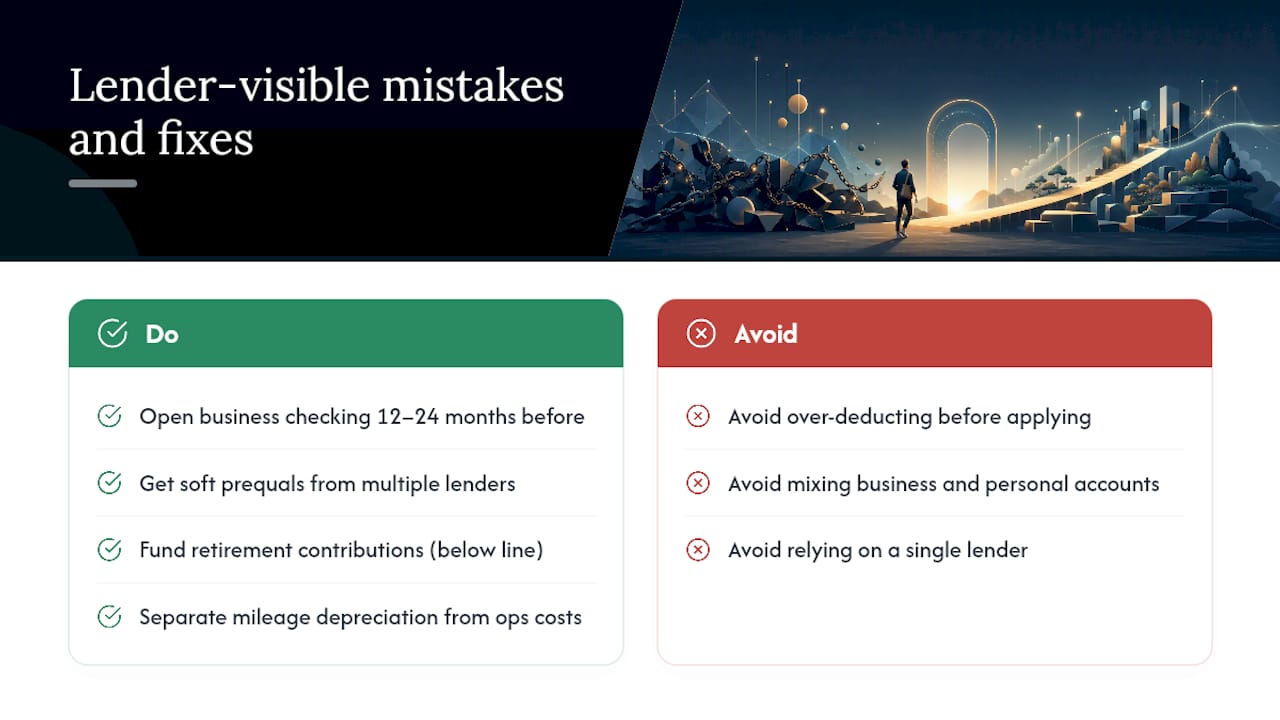
The most expensive mistake is over-deducting in the year before a purchase. A contractor who writes off an extra $30,000 in the application year to reduce taxes saves a few thousand dollars in self-employment tax and potentially loses $375,000 or more in borrowing capacity. The math almost never works in the borrower’s favor.
The second most common problem is mixed accounts. When business income flows through a personal account, lenders can’t cleanly identify qualifying deposits. They discount the ambiguous amounts or exclude them entirely. Opening a dedicated business checking account 12-24 months before application is one of the simplest, highest-return moves available.
A third pattern: borrowers who trust a single lender’s initial assessment without shopping. Non-QM pricing and program overlays vary significantly across lenders. One lender’s expense ratio on a business bank-statement program might be 50%; another’s might be 40%. That 10-point difference on $200,000 in annual deposits is $20,000 in qualifying income and a meaningful change in loan size.
What actually works: fund retirement contributions (below the line, doesn’t touch Schedule C), document mileage depreciation separately from operating costs, move discretionary business spending outside the 12-24 month lookback window when possible, and get a soft prequal from multiple lenders before choosing a program.
Coordinate with a CPA who understands mortgage underwriting, not just tax minimization. Those are different optimization problems, and the right advisor helps you solve both without sacrificing either.
Texasbankstatementloans: a direct path for 1099 borrowers in Texas
When Schedule C net profit caps your borrowing power well below your actual cash flow, the practical answer is a lender that qualifies you on deposits instead of returns.
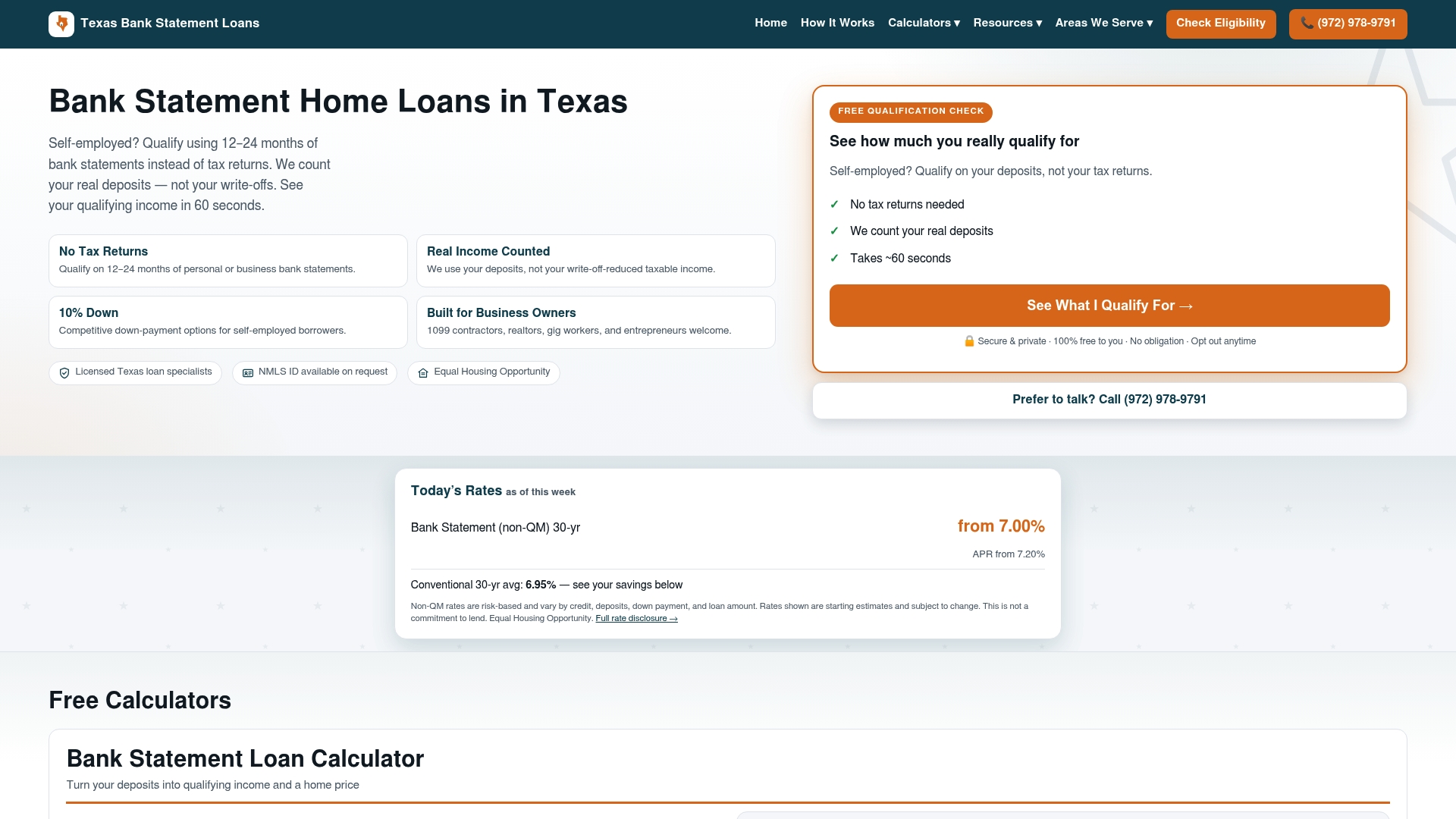
Texasbankstatementloans uses 12-24 months of personal or business bank deposits to calculate qualifying income, which means the income you actually earn, not the income left after write-offs, drives your loan amount. Down payments start at 10%, and the program covers primary residences, investment properties (DSCR), jumbo loans, and ITIN borrowers. Service covers major Texas markets including Greater Houston, Austin, and Plano. Loan officers are NMLS-licensed; verify credentials at any time through NMLS Consumer Access. To see how much you qualify for, run the numbers in 60 seconds with the bank-statement loan calculator or request a soft prequal with no obligation.
Sources
- Self-Employed Mortgage Qualifying Income (2026): Why Your Deductions Cost More Than They Save | CentSense
- Getting a Mortgage as a 1099 Contractor: How to Qualify - LegalClarity
- The 1099 Income Loan Master Guide 2026: Requirements & Rates | LoanWise
- How to Qualify for a Mortgage as a Self-Employed Borrower: The 1099 Credit Strategy
- Ability to repay/Qualified mortgage rule, Consumer Financial Protection Bureau
- How lenders read your bank statements, LenderReady
- Gig worker, Wikipedia
- NMLS Consumer Access
This article provides general information about mortgage qualification for 1099 and self-employed borrowers. It is not financial, tax, or legal advice. Confirm current program guidelines, rates, and eligibility requirements with a licensed mortgage professional and a qualified CPA before making any application or tax decisions.
This article is general information, not a substitute for advice from a qualified financial advisor. Consult a qualified financial professional about your own circumstances before acting on anything here.
See what you qualify for in 60 seconds, free and no credit check. Use the eligibility check at the top of this page.