DSCR (debt service coverage ratio) measures whether a property’s rent covers its own housing payment, known as PITIA, and that ratio drives how much cash a lender demands upfront. Condos, short-term rentals, and deals with thinner cash flow often require higher down payments, sometimes exceeding one quarter of the purchase price.
TL;DR:
- Most Texas DSCR loans require a down payment between 20% and 25%, with higher amounts needed for lower DSCR ratios, condos, or risky property types.
- Loan amounts are heavily influenced by the property’s rental income and property type, with shorter-term rentals and condos typically demanding larger deposits.
- Approval depends on factors like a credit score above 620 to 660, several months of reserves, and proper documentation of down payment funds, without requiring tax returns.
- Property tax reassessments in Texas can significantly affect DSCR calculations, potentially increasing required down payments to compensate for higher PITIA costs.
- Bank statement loan programs offer flexible income verification for self-employed investors, helping them qualify with actual deposit history instead of tax documents.
Table of Contents
- Understanding DSCR Down Payment Requirements in Texas
- Typical Down Payment and LTV Bands for Texas DSCR Loans
- Credit, Reserves, and Documents Texas DSCR Lenders Expect
- How Property Type Changes Your Down Payment Number
- Getting Your Down Payment and Reserves Ready
- Why Texas Property Taxes Change Your DSCR Math
- How Texas Bank Statement Home Loans Fits Into the Picture
- Bigger Down Payment or More Properties? A Texas Investor’s Trade-Off
- Get a Realistic Down Payment Number in 60 Seconds
- Sources
- FAQ
Understanding DSCR Down Payment Requirements in Texas
DSCR loans skip the personal income documentation of a conventional mortgage and instead ask one question: does the property pay for itself? Lenders calculate DSCR by dividing gross monthly rental income by PITIA, the acronym for Principal, Interest, Taxes, Insurance, and Association dues (HOA, if applicable).
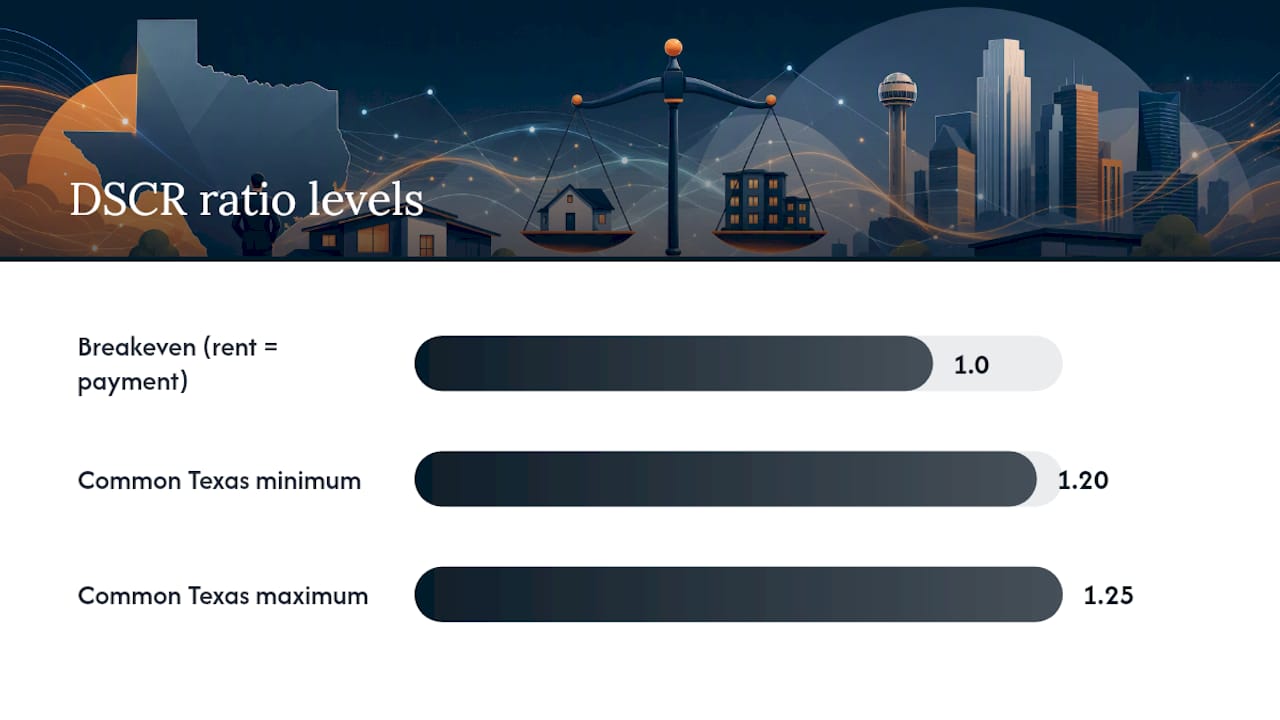
A DSCR of 1.0 means rent exactly covers the payment. Below that, the property runs a monthly deficit on paper, even if it appreciates over time. DSCR loans in Texas commonly require a ratio between 1.20 and 1.25, though some programs will still fund a deal near 1.0 with a bigger down payment as a trade-off.
What counts as rent varies by property:
- Long-term rentals use the signed lease amount or an appraiser’s market-rent opinion, whichever the lender’s guidelines favor.
- Short-term rentals typically rely on projected income from platforms like AirDNA rather than a lease, since there isn’t one.
- Vacant or newly acquired properties often get underwritten using market rent from the appraisal, not a hopeful guess.
The weaker the ratio, the more the lender leans on your down payment to offset the risk.
Typical Down Payment and LTV Bands for Texas DSCR Loans
Down payment percentage and loan-to-value are two sides of the same coin. Most Texas DSCR lenders anchor their standard pricing tier in that 20% to 25% window for single-family investment purchases.
Quick reference: A $300,000 purchase at 20% down means $60,000 out of pocket and an $240,000 loan. At 25% down, that’s $75,000 down against a $225,000 loan, a meaningful swing in cash needed to close.
Several factors push a lender toward the higher end of that band or beyond it:
- A DSCR under 1.0, where rent doesn’t fully cover the payment.
- Credit scores below the mid-600s.
- Non-warrantable condos, rural properties, or unusual construction types.
- First-time real estate investors with no landlord history.
- Cash-out refinances, which typically carry stricter LTV caps than purchases.
On the flip side, a strong file, meaning DSCR above 1.25, a credit score above 720, and healthy reserves, can occasionally unlock LTVs as high as 80% to 85% on certain lender programs. That’s the exception, not the rule, and it’s usually reserved for straightforward single-family purchases rather than condos or short-term rentals.
Credit, Reserves, and Documents Texas DSCR Lenders Expect
Down payment is only one piece of the underwriting puzzle. Lenders also weigh credit, liquidity, and paperwork before they’ll finalize your rate or your required equity.
- Credit score. Most programs set a floor somewhere in the 620 to 660 range, though your actual pricing improves noticeably once you clear 700. A borrower at 640 might still qualify, but expect a higher rate and possibly a bigger down payment demand to compensate.
- Reserves. Expect to show several months of PITIA sitting in reserve, separate from your down payment funds. Lenders want proof you can cover the mortgage if a tenant leaves or a repair bill lands unexpectedly.
- Entity structure. Many Texas DSCR lenders will close in an LLC, which appeals to investors building a portfolio for liability separation. Closing in an LLC can add documentation steps, like an operating agreement and EIN verification, but it rarely changes the down payment math itself.
- Documentation. Expect to submit a signed lease or rent survey, a purchase contract, an appraisal with a rent schedule, a credit authorization, and two to three months of bank statements showing the down payment funds.
None of this requires tax returns or pay stubs, which is the entire point of DSCR underwriting. It’s a property-first, not a borrower-income-first, evaluation.
How Property Type Changes Your Down Payment Number
The 20% to 25% figure is a baseline for a straightforward single-family rental. Move outside that box and the number climbs.
- Single-family homes: Generally the easiest case, sitting at 20% to 25% down for a qualified borrower with a solid DSCR.
- 2 to 4 unit and small multifamily properties: Often priced at 25% or more, since lenders view multiple tenant units as slightly higher operational risk.
- Short-term rentals: Down payment requirements frequently climb to 25% to 35% because income is seasonal and harder to project than a signed 12-month lease.
- Condos: HOA rules matter here. A lender may require extra reserves or a higher down payment if the HOA has high delinquency rates, litigation, or a large percentage of non-owner-occupied units.
Every step up in perceived risk, whether it’s unit count, income volatility, or HOA red flags, tends to translate directly into more cash required at closing.
Getting Your Down Payment and Reserves Ready
Lenders don’t just want the money. They want to see where it came from and that it’s been sitting somewhere traceable for a reasonable stretch of time.
- Confirm your source is acceptable. Gift funds, LLC business accounts, and personal savings are all commonly permitted, but each carries its own paperwork trail. Gift funds usually require a signed gift letter from the donor plus proof the money actually moved from their account to yours.
- Season your funds early. Avoid dropping a large, unexplained deposit into your account right before closing. Underwriters flag sudden inflows and will ask for a paper trail you may not be able to produce on short notice.
- Decide LLC vs. personal funds up front. If you’re closing in an LLC but funding the down payment from personal savings, be ready to show a clear transfer between the two, not just a lump sum appearing in the LLC account.
- If you’re self-employed, lean on bank statements. Programs that evaluate 12 to 24 months of deposits, rather than tax returns, can paint a much more accurate income picture for business owners whose returns are loaded with write-offs.
Pro Tip: Transfer your down payment funds to the account you’ll use for closing at least 60 days before you plan to submit an offer. That single move eliminates most of the “source of funds” questions that stall underwriting at the worst possible moment.
Why Texas Property Taxes Change Your DSCR Math
Property taxes live inside PITIA, and Texas doesn’t make that easy on investors. When a property changes hands, the appraisal district often reassesses it closer to the actual sale price, which can raise the tax bill well above what the seller was paying. That reassessment can quietly tank a DSCR that looked fine during initial underwriting.
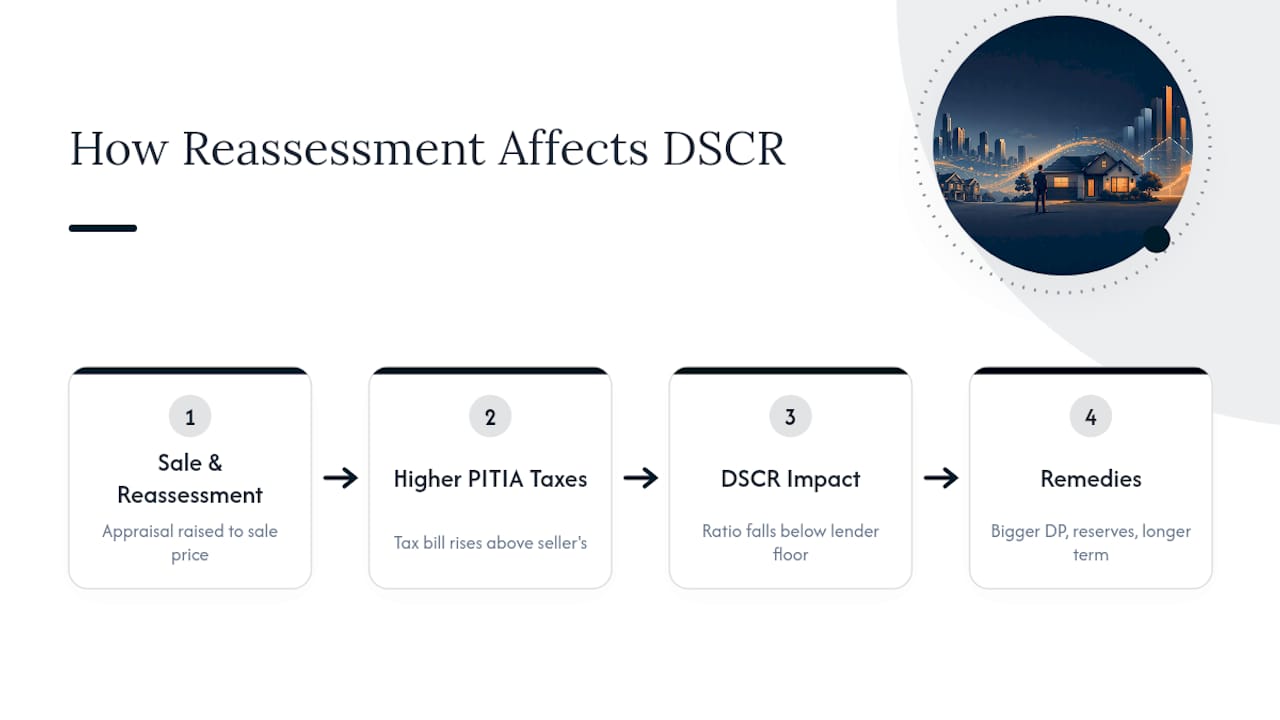
Here’s how that plays out on a hypothetical $350,000 rental generating $2,800 in monthly rent:
That’s the difference between clearing a lender’s 1.20 to 1.25 floor and falling short of it. Check the county appraisal district’s records before you make an offer, and underwrite to the reassessed number, not the seller’s current bill. If the math is tight, a larger down payment, bigger reserves, or a longer amortization can pull the ratio back into range.
How Texas Bank Statement Home Loans Fits Into the Picture
Self-employed investors often run into a frustrating paradox: strong cash flow on paper, but tax returns loaded with deductions that make income look thin to a conventional underwriter. Texas Bank Statement Home Loans built its process around that exact problem, evaluating 12 to 24 months of actual bank deposits instead of tax returns.
That approach matters for DSCR borrowers too, since it affects the personal financial picture lenders review alongside the property’s own numbers. A few specifics worth knowing:
- The DSCR calculator lets you plug in rent and PITIA figures to estimate your ratio before you ever submit an application.
- Low down payment options are available on eligible bank-statement programs, which may contrast with the 20% to 25% norm on standard DSCR files.
- A quick, no-obligation qualification check is offered to help you get an estimate of what you may be able to afford.
For investors juggling multiple income streams or heavy write-offs, that documentation flexibility can open doors a standard file would close.
Bigger Down Payment or More Properties? A Texas Investor’s Trade-Off
Putting more down improves your DSCR immediately, since a smaller loan means a smaller PITIA and, often, a better rate. That’s the right call when you’re buying in a market with tight margins or when Texas property tax reassessment is likely to eat into your cushion. I’d lean toward the larger down payment on any deal where the post-reassessment DSCR sits below 1.15.
But if you’re scaling a portfolio, preserving cash to close a second or third property can outperform stacking equity into one deal. Just model every acquisition against reassessed tax figures first. A thin DSCR compounded across three properties is a much bigger problem than a thin DSCR on one.
- Saad
Get a Realistic Down Payment Number in 60 Seconds
Texas Bank Statement Home Loans is the practical alternative when a conventional DSCR file’s income documentation doesn’t reflect what your business actually earns.
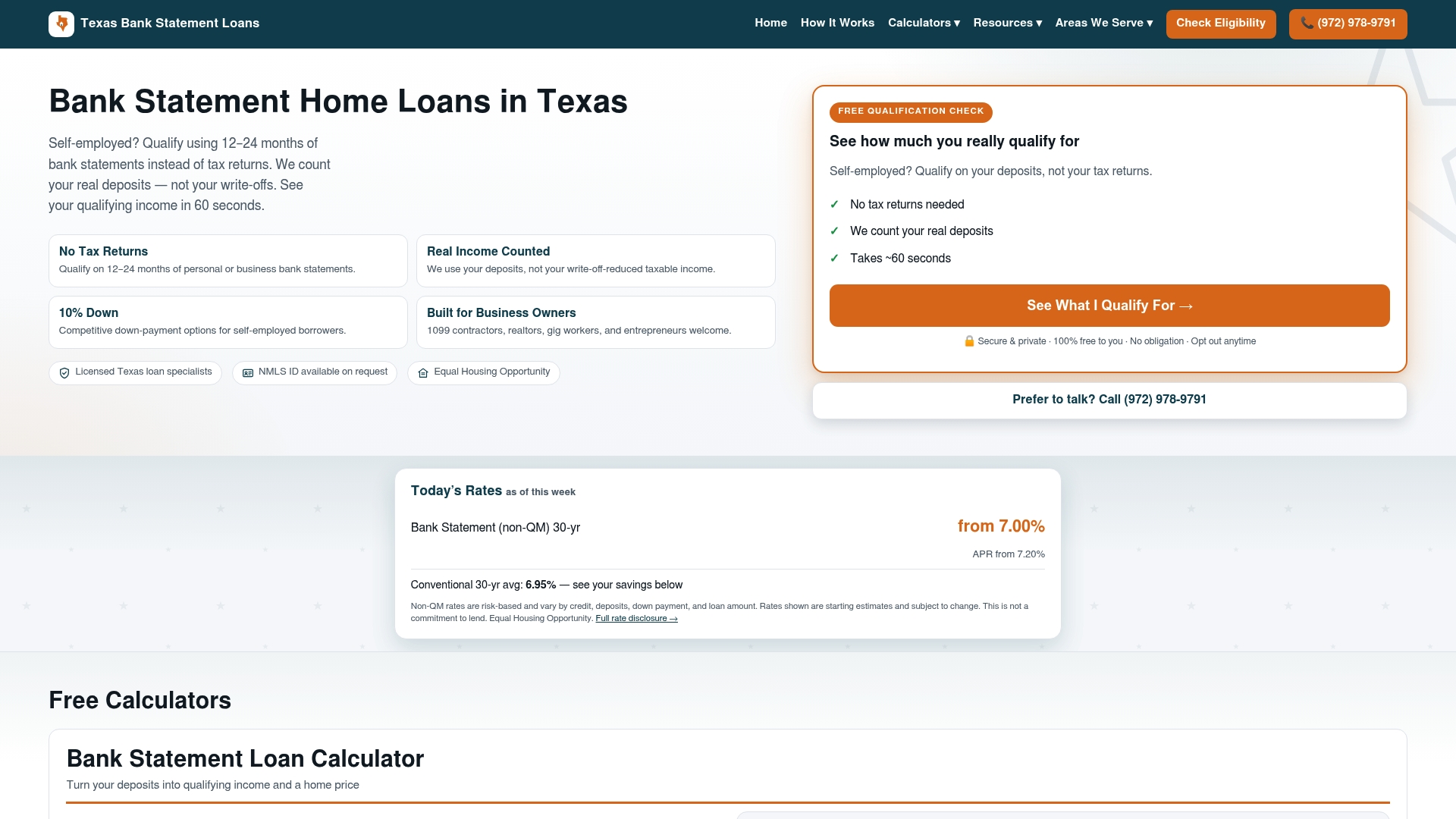
Run your numbers through the DSCR calculator to see where your ratio lands, then check current rates and program details for bank statement loans. If you’re ready to see what you qualify for, the 60-second pre-qualification check on the main site is the fastest next step.
Sources
This article is general information, not a substitute for advice from a qualified financial advisor. Consult a qualified financial professional about your own circumstances before acting on anything here.
FAQ
Do DSCR loans require 20% down?
Most Texas DSCR loans fall in the 20% to 25% down payment range, though the exact figure depends on your DSCR, credit score, and property type.
What is the downside of a DSCR loan?
DSCR loans typically carry higher interest rates than conventional owner-occupied mortgages, since lenders take on more risk by skipping personal income verification. They also usually require larger down payments and cash reserves, and a weak DSCR can force you into a bigger down payment or a less favorable rate.
How do I qualify for a DSCR loan in Texas?
You’ll need a property with rental income that covers or comes close to covering its own PITIA payment, a credit score generally above 620 to 660, and several months of reserves. Lenders will also want a lease or market-rent evidence, a purchase contract, and bank statements documenting your down payment funds.
How much do I have to make to afford a $400,000 house in Texas?
For a DSCR loan, your personal income isn’t the deciding factor; the property’s rental income is.
Recommended
- Bank Statement Loans in Dallas-Fort Worth
- Bank Statement Loans in Tarrant County, TX
- Bank Statement Loans in Greater San Antonio
- Bank Statement Loans in Austin-Round Rock
See what you qualify for in 60 seconds, free and no credit check. Use the eligibility check at the top of this page.