
Texas non-QM lender selection criteria are the specific standards self-employed borrowers and 1099 contractors use to identify which lenders can actually close their loan. Non-QM, short for non-qualified mortgage, refers to any home loan that falls outside the Consumer Financial Protection Bureau’s qualified mortgage rules. These loans do not rely on W-2s or standard tax returns. Instead, lenders use bank statements, profit and loss statements, and 1099s to verify income. Choosing the wrong lender costs you time, money, and approval. The right one understands your business structure, accepts your documentation, and communicates clearly from day one.
1. Why Texas non-QM lender selection criteria start with expertise
Lender expertise with self-employed income is the single most important factor in your selection. Self-employed borrowers earn income through structures that look nothing like a salaried paycheck. A lender unfamiliar with Schedule C deductions, K-1 distributions from S-Corps, or partnership income will misread your financials and underestimate your qualifying income.
Lender knowledge of business structures directly affects how accurately underwriters calculate your income. An experienced lender anticipates documentation gaps before they become delays. They know which tax forms to request, how to read them, and how to present your file to underwriting in the strongest possible light.
- Sole proprietors file Schedule C, which shows net profit after deductions. An expert lender adds back allowable deductions to arrive at a higher qualifying income.
- S-Corp owners receive W-2 wages plus K-1 distributions. Lenders must combine both correctly.
- LLC members may have pass-through income that requires additional documentation.
Pro Tip: Ask your lender directly: “Have you closed loans for borrowers with my exact business structure?” A confident, specific answer tells you everything.
2. How flexible income documentation shapes your lender choice

Flexible income documentation is the defining feature of non-QM lending. Non-QM lenders perform rigorous manual reviews of bank statements, P&L statements, and business licenses to comply with federal Ability-to-Repay rules. This is not a shortcut. It is a different, more detailed path to proving income.
The most common documentation options Texas lenders accept include:
- 12 or 24 months of personal bank statements. Lenders average your monthly deposits and apply an expense factor to estimate net income.
- Business bank statements. Useful when business and personal finances are separate, which is common for LLCs and S-Corps.
- CPA-prepared profit and loss statements. These can reduce the expense factor a lender applies, increasing your qualifying income.
- 1099 income. Lenders accept 1099 forms in place of W-2s for contractors and freelancers.
Bank statement programs apply an expense factor of typically 10%-50% to your deposits, depending on your industry. A restaurant owner faces a higher factor than a consultant because the business carries higher operating costs. Providing a CPA-prepared P&L can persuade a lender to lower that factor. That directly increases the income used to qualify you.
3. Understanding credit scores, DTI ratios, and down payments
These three numbers define the floor of your eligibility and the ceiling of your loan amount. Getting them right before you apply saves weeks of back-and-forth.
Credit scores. Non-QM credit scores typically start at 620, with 660 and above unlocking better rates and more program options. A score below 620 does not automatically disqualify you, but it narrows your lender pool significantly.
Debt-to-income ratios. Non-QM DTI ratios can reach 50%, compared to the 43% ceiling on most conventional loans. That extra room matters when you carry business debt or have irregular monthly obligations. A higher DTI allowance is one of the primary reasons self-employed borrowers choose non-QM over conventional financing.
Down payments. Texas non-QM down payments range from 10% to 30% depending on your credit profile and loan terms. Texasbankstatementloans offers programs starting at 10% down, which is one of the lowest thresholds available for self-employed buyers in the state.
| Criterion | Typical non-QM range | Conventional loan standard |
|---|---|---|
| Credit score minimum | 620-660+ | 620-740 |
| DTI ratio maximum | Up to 50% | Up to 43% |
| Down payment minimum | 10%-30% | 3%-20% |
| Income documentation | Bank statements, P&L, 1099s | W-2s, tax returns |
Pro Tip: Use the self-employed affordability calculator at Texasbankstatementloans before you start lender conversations. Knowing your numbers in advance puts you in a stronger negotiating position.
4. The role of self-employment history in lender qualification
Most Texas non-QM lenders require two years of documented self-employment, though some accept 18 months when your financials are strong. This requirement exists because lenders need evidence that your income is stable, not a one-year spike.
If you are newer to self-employment, your best path is to build a strong reserve of bank statements and maintain consistent monthly deposits. Lenders view erratic deposit patterns as a risk signal, even when your annual total looks healthy. Consistency matters more than peak months.
Some lenders will accept 18 months of history paired with strong credit and six months of cash reserves. That combination signals financial discipline and reduces the lender’s perceived risk.
5. How transparent communication separates good lenders from bad ones
Early, honest communication with your lender prevents the most common delays in non-QM closings. A lender who explains the process clearly from the first call is a lender who will not surprise you at the closing table.
Signs of a trustworthy lender include:
- They explain the expense factor calculation before you submit documents.
- They tell you upfront which months of bank statements they will use and why.
- They identify potential underwriting issues during the pre-qualification call, not after you have submitted a full application.
- They return calls and emails within one business day.
A lender who avoids specific answers or rushes you past documentation questions is a red flag. Non-QM underwriting is detailed and manual. You need a lender who treats that process as a strength, not a burden.
6. Matching your business structure to the right lender program
Your business entity type directly determines which documentation a lender will require. Choosing a lender who specializes in your structure saves time and avoids mismatches.
Sole proprietors file Schedule C and typically qualify using personal bank statements. The lender averages 12 or 24 months of deposits and applies the expense factor. This is the most straightforward non-QM path.
S-Corp owners need a lender who can combine W-2 wages with K-1 distributions. Some lenders only look at W-2 income, which dramatically understates what an S-Corp owner actually earns. Confirm this before you apply.
LLC members may have pass-through income, retained earnings, or both. A lender experienced with Texas LLC structures knows how to document each correctly.
When to prioritize lender expertise over interest rate:
- Your income comes from multiple sources or entities.
- You have significant business deductions that reduce your taxable income.
- You are in your first or second year of self-employment.
- Your credit score is below 680, which limits your program options.
When a bank statement loan beats a tax return loan:
- Your tax returns show low net income due to legitimate deductions.
- Your actual deposits reflect strong cash flow.
- You want to avoid amending returns or waiting for a new filing cycle.
Bank statement loans for self-employed buyers at Texasbankstatementloans are built specifically for these situations.
7. Why non-QM is not a last resort
Non-QM loans comply fully with Ability-to-Repay rules and involve more detailed underwriting than most conventional loans. They are not subprime products. They are purpose-built for borrowers whose income is real but does not fit a W-2 template.
Self-employed borrowers should consider non-QM proactively, not as a fallback after a conventional denial. If your tax returns show low net income because of legitimate business deductions, a non-QM bank statement loan is the correct tool from the start. Waiting for a conventional denial wastes months and can affect your credit score through multiple hard inquiries.
The strongest borrowers approach non-QM lenders with organized documentation, a clear picture of their monthly deposits, and a CPA-prepared P&L. That combination gives any lender the clearest possible view of your actual financial capacity.
Key takeaways
Selecting the right Texas non-QM lender requires matching your business structure, documentation type, and financial profile to a lender with proven expertise in self-employed income verification.
| Point | Details |
|---|---|
| Expertise over rate | Choose a lender who knows your business structure before comparing interest rates. |
| Documentation flexibility | Confirm the lender accepts bank statements, 1099s, or CPA P&L statements for your income type. |
| Know your numbers | Non-QM DTI can reach 50% and down payments start at 10%; know where you stand before applying. |
| Self-employment history | Two years is the standard; 18 months may qualify with strong credit and cash reserves. |
| Communication quality | A lender who explains the expense factor and underwriting process upfront is worth more than a lower rate. |
What I have learned about choosing a Texas non-QM lender
The biggest mistake I see self-employed borrowers make is treating lender selection like rate shopping. They collect quotes, sort by APR, and pick the lowest number. That approach works for W-2 borrowers. For self-employed Texans, it is the wrong framework entirely.
The lender who quotes you 0.25% less but does not understand K-1 income will cost you weeks of delays and possibly the deal. The lender who charges a slightly higher rate but closes your loan in 30 days because they know exactly how to document your S-Corp distributions is the better choice every time.
Tax strategy and mortgage planning need to happen together, at least 12 months before you apply. Over-deducting expenses lowers your taxable income, which is great for your tax bill and terrible for your mortgage qualification. I have seen borrowers with $300,000 in annual deposits qualify for far less than they expected because two years of aggressive deductions made their net income look thin.
Start lender conversations early. Ask hard questions about how they calculate qualifying income for your specific business type. And do not wait until after tax season to find out your returns hurt your application.
- Saad
How Texasbankstatementloans serves self-employed Texas borrowers
Self-employed buyers and 1099 contractors in Texas have a specialized resource in Texasbankstatementloans. The platform evaluates 12-24 months of bank deposits instead of tax returns, which means your actual cash flow drives the qualification, not your deductions.
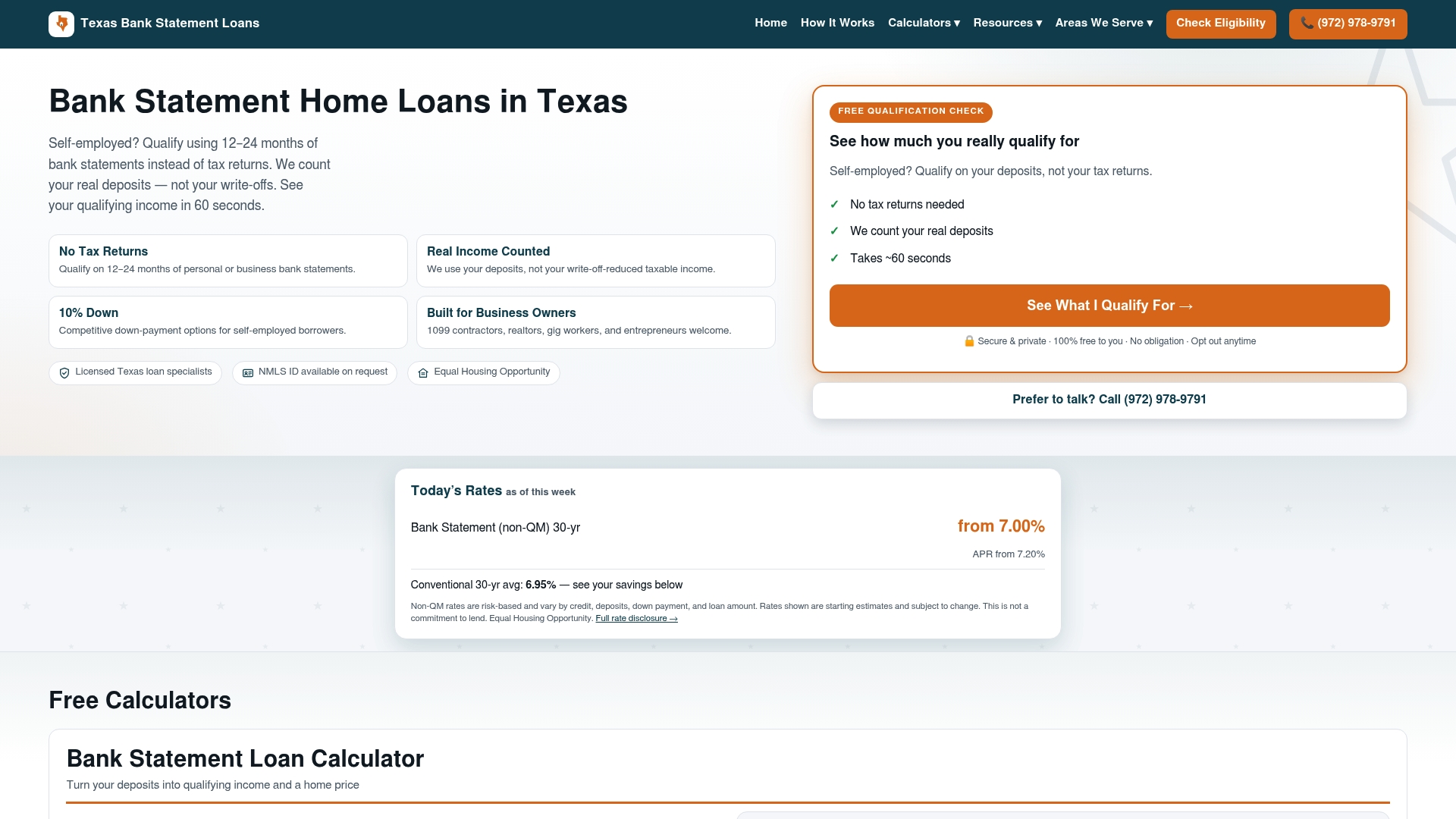
Down payment options start at 10%, and the qualification check takes 60 seconds with no obligation. Whether you are buying in Houston, Plano, or Central Texas, Texasbankstatementloans offers programs built for your income type. Use the bank statement loan calculator to estimate your purchasing power, or check current loan rates to see where you stand today. The team specializes in Texas business structures and knows how to present your file to underwriting correctly.
FAQ
What is the minimum credit score for a Texas non-QM loan?
Most Texas non-QM lenders set the minimum credit score at 620, with 660 and above qualifying for better rates and more program options.
Can I use bank statements instead of tax returns for a non-QM loan?
Yes. Bank statement programs use 12-24 months of personal or business deposits to calculate qualifying income, making them ideal for self-employed borrowers with significant tax deductions.
What DTI ratio do Texas non-QM lenders allow?
Non-QM lenders typically allow DTI ratios up to 50%, which is higher than the 43% ceiling on most conventional loans and gives self-employed borrowers more room to qualify.
How much do I need for a down payment on a Texas non-QM loan?
Down payment requirements range from 10% to 30% depending on your credit score and loan terms. Texasbankstatementloans offers programs starting at 10% down for qualified borrowers.
Do I need two years of self-employment history to qualify?
Most lenders require two years of documented self-employment, though some accept 18 months when paired with strong credit and sufficient cash reserves.
See what you qualify for in 60 seconds, free and no credit check. Use the eligibility check at the top of this page.