
Short-term owners and buyers who can absorb a payment increase usually come out ahead with an adjustable-rate mortgage. Long-term owners who want a payment that never changes should choose fixed. The gap between the two isn’t trivial: Bankrate’s mid-2026 rate context put 30-year fixed loans around 6.4% against roughly 5.6% for a 5/1 ARM, close to an 0.8 percentage point spread.
That statistic only tells half the story. An ARM’s low rate is locked in for a limited window, then it moves based on caps, an index, and a margin you need to understand before signing.
- Choose an ARM if you plan to sell, relocate, or refinance within 3 to 7 years.
- Choose fixed if you’re buying a forever home or can’t stomach payment uncertainty.
- Either way, ask your lender about the fully indexed rate before you commit to anything.
Key Takeaways
Choosing between an ARM and a fixed-rate mortgage comes down to how long you’ll stay in the home and whether your income can absorb a future rate increase.
| Point | Details |
|---|---|
| Mid-2026 rate gap | 30-year fixed averaged about 6.4% versus roughly 5.6% for a 5/1 ARM, an 0.8-point spread. |
| ARM fits short timelines | Borrowers selling or refinancing within the initial period often benefit most from an ARM’s lower start rate. |
| Stress-test at the cap | Always budget for the fully indexed, cap-maximum payment, not the introductory rate. |
| Check three cap types | Initial, periodic, and lifetime caps determine your true worst-case payment on an ARM. |
| Bank-statement loans widen options | Texas Bank Statement Home Loans evaluates 12 to 24 months of deposits, which can qualify self-employed buyers for fixed-rate programs they’d otherwise miss. |
Table of Contents
- ARM vs Fixed Mortgage Rates at a Glance
- How Does an Adjustable-Rate Mortgage Work?
- What Does a Fixed-Rate Mortgage Actually Lock In?
- ARM Pros and Cons vs Fixed Rate Pros and Cons
- Who Should Choose an ARM vs a Fixed-Rate Loan?
- Why Self-Employed Buyers Face a Different ARM vs Fixed Calculus
- Try Bank-Statement Qualification Before You Choose a Loan Type
- Sources
ARM vs Fixed Mortgage Rates at a Glance
A fixed mortgage locks one rate for the entire loan term. An ARM starts with a lower rate for a set period, then adjusts on a schedule tied to a financial index.
- Initial rate: ARMs typically start 0.5 to 1 percentage point below comparable fixed loans.
- Payment predictability: Fixed payments never change; ARM payments can rise (or fall) at each adjustment.
- Common labels: A 5/1 ARM holds its rate for 5 years, then adjusts yearly. A 7/1 holds for 7 years. Look for 3/1 and 10/1 versions too.
- Caps: Nearly every ARM limits how much the rate can jump at the first adjustment, at each later adjustment, and over the life of the loan.
Before you call a lender, run through this:
- What index and margin does this ARM use?
- What are the initial, periodic, and lifetime caps?
- Am I qualified based on the teaser rate or the fully indexed rate?
On a $350,000 loan, an 0.8-point rate gap works out to roughly $180 to $200 less per month during the ARM’s initial period, based on standard amortization math. That’s real money, but it’s temporary.
How Does an Adjustable-Rate Mortgage Work?
Every ARM has two phases: an initial fixed period and an adjustment period. A 3/1 ARM holds its starting rate for 3 years; a 5/1 for 5 years; a 7/1 for 7; a 10/1 for 10. After that, the rate resets on a schedule, usually once a year.
The new rate comes from an index plus a margin. The index is a market rate that moves with broader financial conditions. SOFR (the Secured Overnight Financing Rate) is the most common index used today. The margin is a fixed percentage your lender adds on top and never changes. Index plus margin equals your new rate, subject to caps.
The CFPB explains that three cap types matter most:
- Initial cap: limits the first adjustment after the fixed period ends.
- Periodic cap: limits how much the rate can move at each later adjustment.
- Lifetime cap: the absolute ceiling on your rate for the life of the loan.
These caps are what prevent “rate shock,” the term for a payment jump big enough to strain a household budget. Some ARMs, particularly interest-only and payment-option variants, come with an extra risk: negative amortization, where unpaid interest gets added back to your loan balance instead of reducing it, according to CFPB’s CHARM booklet.
Pro Tip: Ask your lender to show you the maximum possible payment under the lifetime cap, not just the current estimated payment. That number is the one that should shape your decision.

What Does a Fixed-Rate Mortgage Actually Lock In?
A fixed-rate mortgage locks your principal and interest payment for the entire term, whether that’s 15 or 30 years. It does not lock your property taxes or homeowners insurance, both of which can still rise and change your total monthly housing cost.
Term length changes the math considerably. A 15-year fixed loan carries a higher monthly payment than a 30-year fixed on the same balance, but it cuts total interest paid dramatically over the life of the loan. A 30-year fixed keeps payments lower and more manageable for buyers stretching to afford a home now.
- 15-year fixed: higher monthly payment, far less interest paid overall.
- 30-year fixed: lower monthly payment, more total interest, more budget flexibility.
- Refinancing: available on either term if market rates drop meaningfully after closing.
Refinancing is the fixed-rate borrower’s main lever if rates fall. You give up nothing by locking a rate today and refinancing later, aside from closing costs on the new loan. That’s a very different risk profile than an ARM, where the rate moves on its own schedule whether you want it to or not.
ARM Pros and Cons vs Fixed Rate Pros and Cons
Weighing an adjustable rate mortgage’s benefits against a fixed rate mortgage’s advantages comes down to your timeline and your appetite for uncertainty.
ARM advantages:
- Lower initial payment, which helps with short-term affordability or qualifying for a larger loan amount.
- Real savings if you sell or refinance before the first adjustment.
- Often easier to qualify for on a lower starting payment, though lenders may still underwrite to the higher indexed rate.
ARM drawbacks:
- Rate shock risk once the fixed period ends, even with caps in place.
- Cap structures can be confusing, and borrowers frequently misjudge their worst-case payment.
- If your finances or the broader market worsen, refinancing out of an ARM isn’t guaranteed.
Fixed-rate advantages:
- Payment stability makes long-term budgeting far simpler.
- Full protection from rising rates for the entire loan term.
Fixed-rate drawbacks:
- Higher starting rate than a comparable ARM, an 0.8-point gap in mid-2026 terms.
- If rates fall later, you’re stuck paying more unless you refinance.
Who Should Choose an ARM vs a Fixed-Rate Loan?
Match your situation to the checklist, not your gut feeling about where rates are headed.
An ARM tends to fit when you:
- Plan to sell or refinance within the initial fixed period.
- Need the lowest possible payment right now to qualify or stay comfortable.
- Expect meaningful income growth that will absorb a future rate adjustment.
Fixed tends to fit when you:
- Plan to stay in the home 10 years or longer.
- Want guaranteed budgeting with zero payment surprises.
- Have a low tolerance for financial risk or a tight monthly margin.
Whichever way you lean, stress-test your budget against the fully indexed, cap-maximum payment, not the introductory rate. Lenders frequently underwrite ARM borrowers to the fully indexed rate rather than the teaser rate, so don’t assume your approval reflects your future payment.
Pro Tip: Run your numbers twice: once at today’s ARM rate, once at the lifetime cap. If the second number breaks your budget, that ARM isn’t the right fit.
Why Self-Employed Buyers Face a Different ARM vs Fixed Calculus

Self-employed borrowers, 1099 contractors, and gig workers often get pushed toward ARMs not because they want lower initial payments, but because tax returns underreport their real income and shrink what they qualify for on paper.
A bank-statement loan changes that math. Texas Bank Statement Home Loans evaluates 12 to 24 months of personal or business bank deposits instead of tax returns, which often reveals substantially more qualifying income than a return-based lender would ever see.
Stronger documentation can open the door to a fixed-rate program that would otherwise be out of reach, giving self-employed buyers the same predictability salaried buyers take for granted.
That shift matters because it puts fixed and ARM options back on the table as a genuine choice rather than a forced move. With down payments starting at 10%, a 60-second qualification check, and a self-employed affordability calculator, you can see which loan type you can realistically support before you ever talk to a lender.
Author’s Take and Lender Questions to Ask
Insert Saad’s professional credentials or relevant experience. The pattern I keep seeing: borrowers pick an ARM for the lower payment, then get blindsided because nobody made them stress-test the cap-maximum scenario. Ask every lender these five things before signing: what index and margin apply, what the initial, periodic, and lifetime caps are, whether a conversion option exists, and whether you’re qualified at the teaser rate or the fully indexed rate. Run those numbers through a mortgage payment calculator before you decide.
- Saad
Try Bank-Statement Qualification Before You Choose a Loan Type
The right choice between an ARM and a fixed rate often has less to do with rate strategy and more to do with what you can actually qualify for. Texas Bank Statement Home Loans is built specifically for self-employed buyers, 1099 contractors, gig workers, and business owners whose tax returns don’t reflect their real earning power.
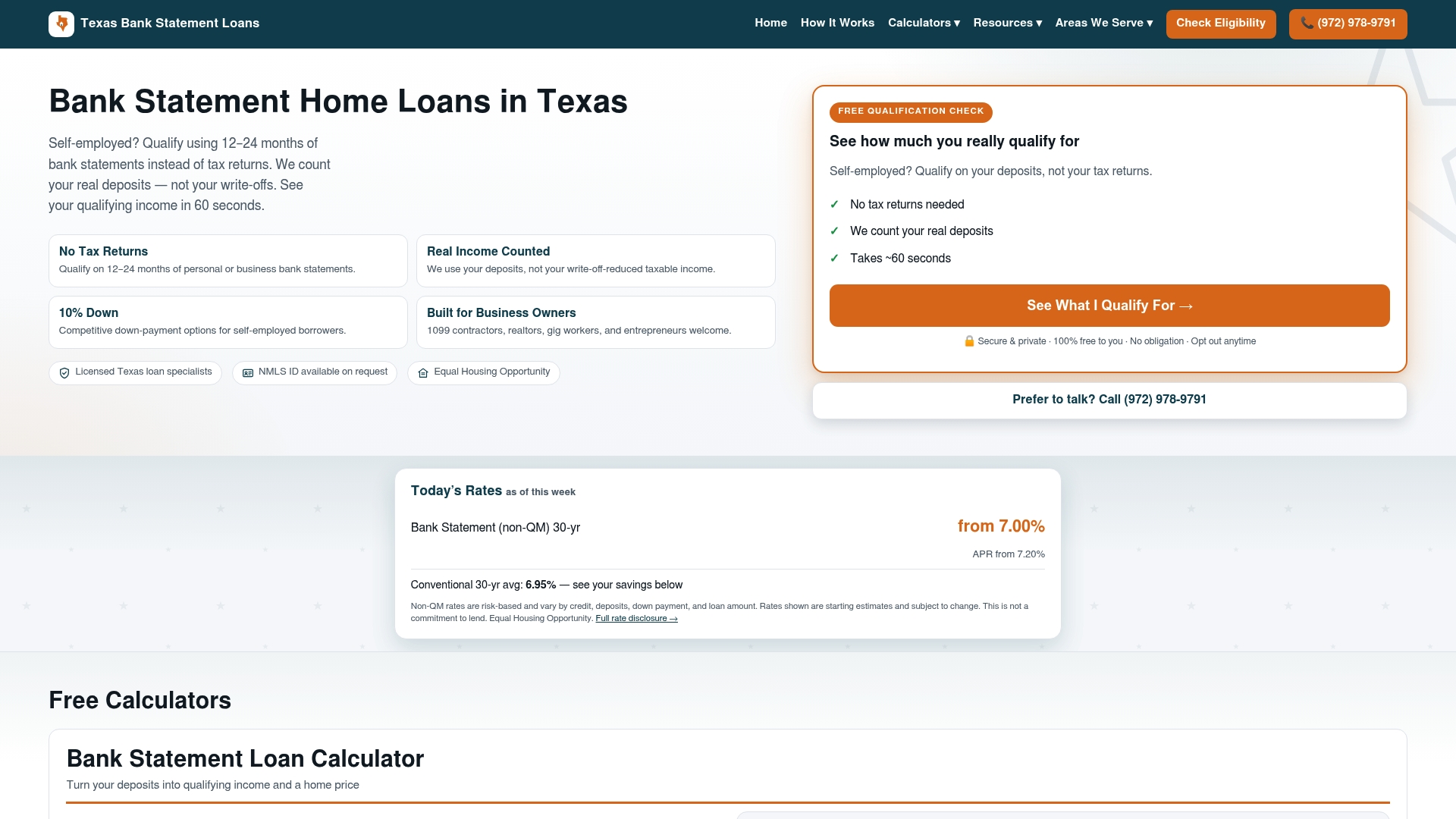
Instead of relying on tax returns, this approach evaluates 12 to 24 months of bank deposits to establish your true qualifying income, which can shift you from an ARM-only path into a fixed-rate program with a payment you can plan around for decades. Check your options on the bank statement loan rates page or run your numbers through the self-employed affordability calculator today.
Sources
- What is the difference between a fixed-rate and adjustable-rate mortgage (ARM) loan? | Consumer Financial Protection Bureau
- Bankrate (rate context / examples)
- CFPB CHARM booklet (ARM disclosures)
This article is general information, not a substitute for advice from a qualified financial advisor. Consult a qualified financial professional about your own circumstances before acting on anything here.
Recommended
- Bank Statement Loan Rates Today | Texas Bank Statement Loans
- Free Mortgage Calculators & Tools | Texas Bank Statement Loans
See what you qualify for in 60 seconds, free and no credit check. Use the eligibility check at the top of this page.