
Yes, you can participate in a mortgage referral program that offers real rewards, but U.S. law draws a hard line around how those rewards are structured. RESPA Section 8 prohibits paying or accepting any fee, kickback, or thing of value for referring settlement services on a federally related mortgage loan. The CFPB enforces this rule actively. What that means in practice: compliant programs deliver rewards as consumer-facing credits at closing, published promotional incentives, or documented marketing services paid at market rate, not secret cash-per-referral to unlicensed third parties.
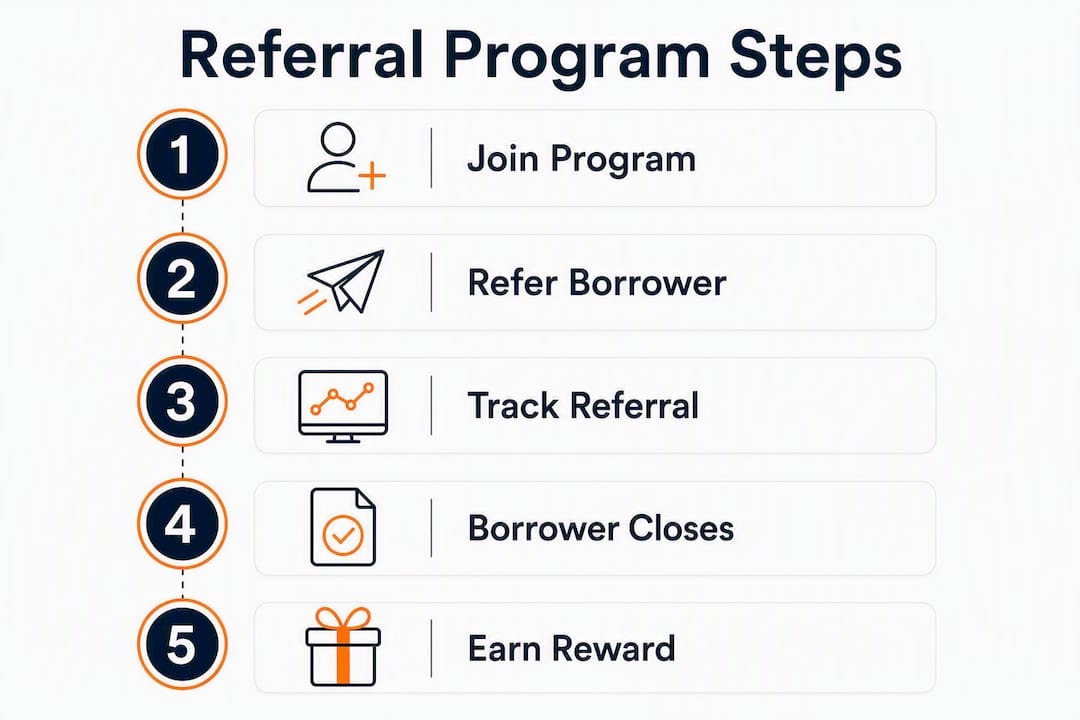
The typical workflow looks like this:
- Refer: You share a referral link, code, or contact with someone who needs a mortgage.
- Apply: The referred borrower submits a loan application with the lender.
- Close: The borrower completes the loan closing, this is the trigger for most rewards.
- Reward: A credit is applied at closing, or a defined benefit is issued after funding, per the published program terms.
Texasbankstatementloans offers a transparent, published referral path for self-employed borrowers in Texas that is structured to stay within RESPA and CFPB guidance. More on that program below.
Compliance note: RESPA and the CFPB govern all referral arrangements involving federally related mortgage loans. Any program offering cash payments to unlicensed referrers outside a documented, market-rate services agreement is operating in legally risky territory.
Table of Contents
- How does a mortgage referral program actually work?
- What do referral rewards actually look like?
- What eligibility rules and red flags should you know?
- What U.S. law says about mortgage referral programs
- How to make or use a referral safely
- Key questions to ask before you join or promote a program
- How Texasbankstatementloans structures referral benefits
- Key Takeaways
- Why compliance is the only referral strategy worth building
- A referral path built for self-employed borrowers in Texas
- Authoritative sources and primary references
How does a mortgage referral program actually work?
The mechanics vary by lender, but the core steps follow a consistent pattern across compliant programs.
- Get your referral credentials. The lender or program administrator gives you a unique referral link, code, or a specific email address to use. Save this, it is how the lender ties the referred borrower back to you.
- Share the referral. You send the link or code to someone actively looking for a mortgage. This can be via text, email, or a published post that includes the program’s required disclosures.
- Referee submits an application. The referred borrower uses your link or code when they start their loan application or prequalification. Some programs require the code at the prequalification stage; others accept it through closing.
- Underwriting and closing. The borrower goes through the standard underwriting process. The referral reward is not triggered until the loan actually closes, a prequalification alone rarely qualifies.
- Reward is issued. Depending on the program, the reward appears as a credit on the closing disclosure, a lender credit applied to fees, or a post-funding payment. The program’s published terms define the exact timing and form.
Who administers the payout matters. Lenders and credit unions typically apply credits directly to the closing disclosure. Third-party program administrators may issue separate payments, but those arrangements require careful compliance review under RESPA.
Pro Tip: Screenshot your referral confirmation email and note the referral ID and submission date. If a reward is ever disputed, that documentation is your only reliable evidence.
Programs also set time windows. A referred borrower usually must close within a defined period from the referral submission for the reward to count. Missing that window typically voids the credit, regardless of whether the loan closes later.
What do referral rewards actually look like?
Rewards in compliant programs are almost always consumer-facing benefits rather than cash paid directly to a referrer outside a licensed or documented arrangement. Here is what you will typically see:
- Closing-cost credit: A dollar amount applied to the borrower’s closing costs, reducing what they owe at the table.
- Lender credit: Applied against origination fees, appraisal costs, or other lender-controlled charges.
- Prepaid fee coverage: The lender covers a specific prepaid item (title insurance, homeowners insurance escrow) as the incentive.
- Referrer bonus: Some programs offer the referring party a separate credit or benefit, but this must be structured carefully to avoid RESPA issues. Consumer-facing credits to the borrower are the cleanest path.
- Dual-sided credits: A few programs split the benefit, giving both the referrer and the referee a defined credit, each published in the program terms.
Reward amounts vary widely and depend on loan size, program design, and lender policy. Consumer-facing programs that publish the reward, the conditions to receive it, and apply rewards as credits at closing are the safest design for both lenders and participants. Always check the program’s published terms for the exact figures, any program that cannot show you a written reward schedule is a red flag.
One practical note: a lender credit that reduces closing costs has real dollar value, but it may affect your interest rate depending on how it is structured. Ask your loan officer to show you the rate-versus-credit tradeoff on the loan estimate before you commit.
What eligibility rules and red flags should you know?
Common eligibility requirements
Most compliant programs require:
- The referred borrower must be a new customer of that lender (no existing loan relationship).
- The loan must close and fund, a prequalification or application alone does not trigger the reward.
- The referral must be submitted before the application or within a defined window.
- The borrower must meet the lender’s standard credit and income requirements independently, referral participation does not relax underwriting standards.
- Some programs restrict eligible loan types (purchase only, primary residence only, or specific loan products).
Red flags that signal a non-compliant program
- Rewards are paid in cash to a referrer with no documented services agreement and no licensing.
- The program has no published terms and conditions, you are told about the reward verbally or informally.
- Payments are tied to referral volume or conditioned on steering borrowers away from shopping around.
- The program asks you to sign a back-channel agreement separate from the published offer.
- Payments are not reasonably related to the market value of services actually provided, excessive payments or volume-based bonuses are a known CFPB enforcement trigger.
Pro Tip: Before you refer anyone, pull up the program’s published T&Cs and confirm the reward type, the cap, and the closing requirement are all in writing. If the lender cannot send you a link to the terms page, stop there.
| Feature to verify | What to look for | Timing | Cap | Required action |
|---|---|---|---|---|
| Reward type | Credit at closing or lender credit | At loan closing | Published in T&Cs | Borrower must close |
| Who receives it | Borrower, referrer, or both | Per program terms | Per referral or annual | Referral submitted before application |
| Documentation | Written T&Cs, closing disclosure | Before you refer | N/A | Save confirmation |
| Compliance signal | Published offer, no back-channel | Ongoing | N/A | Verify with loan officer |
What U.S. law says about mortgage referral programs
RESPA Section 8, codified at 12 U.S.C. § 2607, is the governing statute. Its language is broad: no person shall give or accept any fee, kickback, or thing of value pursuant to any agreement that business involving a federally related mortgage loan shall be referred to any person. The CFPB enforces this through 12 CFR § 1024.14, which adds that any referral of a settlement service is not a compensable service except in narrow circumstances.
“No person shall give and no person shall accept any fee, kickback, or thing of value pursuant to any agreement or understanding, oral or otherwise, that business incident to or a part of a real estate settlement service involving a federally related mortgage loan shall be referred to any person.”, 12 U.S.C. § 2607(a)
The CFPB has also addressed digital platforms directly. Its 2023 advisory opinion on online mortgage comparison-shopping tools clarifies that differential fees or enhanced placement tied to payment can constitute evidence of illegal referral activity. Platforms must present lenders neutrally; pay-to-play models that steer consumers toward lenders who pay for priority placement violate RESPA.
Marketing services agreements (MSAs) are another area of risk. CFPB Compliance Bulletin 2015-05 warns that many MSAs have been used to disguise referral kickbacks. An MSA is only lawful when actual, distinct services are performed and payments are reasonably related to market value, not tied to referral volume.
| Legal reference | What it covers | Practical takeaway |
|---|---|---|
| 12 U.S.C. § 2607 | Prohibits kickbacks and unearned fees | No cash-per-referral to unlicensed parties |
| 12 CFR § 1024.14 | CFPB regulation implementing RESPA §8 | Referral itself is not a compensable service |
| CFPB Advisory Opinion (2023) | Digital comparison platforms | Neutral presentation required; no pay-for-placement |
| CFPB Bulletin 2015-05 | Marketing services agreements | MSAs must reflect real services at market value |
The narrow exceptions under RESPA include bona fide salary payments to employees, affiliated business arrangements with proper disclosure, and real estate brokerage divisions. Consumer-facing credits documented in published program terms sit outside the prohibited zone because they are not payments for the referral act itself, they are published promotional incentives tied to a completed loan.
How to make or use a referral safely
- Read the published T&Cs first. Find the program’s written terms before you refer anyone. Confirm the reward type, the cap, the closing requirement, and the time window.
- Get your referral confirmation in writing. After submitting a referral, save the confirmation email or screenshot the confirmation screen. Note the referral ID and the date.
- Confirm timing with the loan officer. Ask directly: when does the reward apply, and will it appear on the closing disclosure? Get that answer in writing or in an email.
- Disclose prior relationships. If you have a personal or business relationship with the referrer, tell your loan officer. This protects you and keeps the transaction transparent.
- Confirm the referral does not affect your loan terms. Ask the loan officer explicitly: does participating in this referral program change my rate, my fees, or my approval criteria? The answer should be no.
- Track multiple referrals systematically. Use a simple spreadsheet or the lender’s program dashboard to log each referral: borrower name (with permission), referral ID, submission date, expected closing window, and reward status.
Practical guidance from mortgage industry sources recommends building referral relationships with real estate agents, builders, financial advisors, and accountants, and documenting genuine marketing activity rather than relying on informal arrangements. The same principle applies to consumers: keep records, stay transparent, and verify everything in writing.
Pro Tip: When sharing a referral link publicly (social media, a blog post, a group chat), include the program’s published terms link and a brief note that it is a referral offer. This protects you from inadvertently creating an undocumented agreement.

Use Texasbankstatementloans’s mortgage calculators and tools to help referred borrowers estimate their qualifying income and monthly payment before they apply, it makes the referral more useful and increases the likelihood the borrower actually closes.
Key questions to ask before you join or promote a program
Before you refer anyone or accept a referral credit, run through these:
- Is the offer published in writing? If you cannot find a terms page or a written offer document, the program is not structured for compliance.
- Who receives the reward, and when exactly? Confirm whether it goes to the borrower, the referrer, or both, and whether it is applied at closing or paid afterward.
- Does accepting the referral affect my loan terms or my right to shop? A compliant program never conditions your rate or approval on using the referral.
- Are payments tied to referral volume or any back-channel agreement? Volume-based payments to unlicensed referrers are a direct RESPA risk.
- Is there a cap or an expiration date? Most programs cap rewards per referral and per year; confirm both before you promote the offer.
- What documentation will I receive? You should get a referral confirmation, and the reward should appear on the closing disclosure or in a post-closing statement.
If a program representative cannot answer these questions clearly, ask for the written terms before proceeding. Evasive or vague answers are a signal to pause.
Pro Tip: Ask the lender to show you where the referral credit appears on a sample closing disclosure. A lender who has run this program before will have that document ready.
How Texasbankstatementloans structures referral benefits
Texasbankstatementloans offers a transparent referral path built around consumer-facing benefits for self-employed borrowers in Texas. The program is designed to align with RESPA and CFPB guidance: rewards are published, tied to a completed loan closing, and documented in the program terms rather than arranged informally.
Here is how it works in practice:
- Who it serves: Self-employed individuals, 1099 contractors, gig workers, and business owners seeking a mortgage using 12-24 months of bank statements instead of tax returns. Loan types covered include bank statement loans, DSCR investment property loans, ITIN loans, P&L loans, jumbo loans, and asset depletion loans.
- How to refer: Contact Texasbankstatementloans directly through the website, share the referral with the prospective borrower, and confirm the submission in writing. The referred borrower then starts their qualification check.
- Consumer-facing benefit: Credits and assistance are structured as published closing incentives or application support, not undisclosed cash payments. The exact benefit, cap, and timing are in the program terms.
- Redemption timing: The credit applies at loan closing. The borrower must close on a qualifying loan within the program’s defined window.
- What to expect in the T&Cs: A closing requirement, a defined cap, a time window from referral to closing, and documentation requirements. Read these before referring anyone.
The qualification check takes about 60 seconds and requires no obligation. Referred borrowers can use the bank statement loan calculator to estimate their qualifying income before they apply, which helps set realistic expectations early. Texasbankstatementloans serves borrowers across Texas, including Robertson County and Odessa, among other regions.
Pro Tip: Before referring a self-employed borrower, have them run a quick qualification check on the Texasbankstatementloans site. It takes 60 seconds and confirms whether they are likely to qualify, which makes your referral far more likely to result in a closed loan and a redeemed reward.
For current rate information, check the published rates page to understand how a lender credit compares to rate-versus-fee tradeoffs on a specific loan scenario.
Key Takeaways
Compliant mortgage referral programs deliver rewards as consumer-facing credits at closing, documented in published terms, not as undisclosed cash payments to unlicensed referrers under RESPA.
| Point | Details |
|---|---|
| RESPA sets the boundary | 12 U.S.C. § 2607 bars cash-per-referral kickbacks; consumer-facing credits in published terms are the compliant path. |
| Closing is the trigger | Rewards apply only when the referred borrower closes a qualifying loan within the program’s time window. |
| Published T&Cs are non-negotiable | Any program without written terms, a defined cap, and a documented redemption path carries legal and practical risk. |
| Document everything | Save referral confirmations, IDs, and dates; confirm the credit appears on the closing disclosure before closing day. |
| Texasbankstatementloans offers a compliant path | Self-employed Texas borrowers can access a published, RESPA-aligned referral credit program with a 60-second qualification check. |
Why compliance is the only referral strategy worth building
Most articles about referral programs focus on the reward amounts. The more useful question is whether the program will still be standing when your referred borrower closes six months from now.
The CFPB has shown consistent willingness to investigate arrangements where payments look like referral fees dressed up as marketing services. The tell is always the same: payments loosely tied to volume, no documentation of actual services, and terms that exist only in conversation. Programs built that way do not survive scrutiny, and the people who promoted them are left with nothing, and sometimes with liability.
Consumer-facing credits at closing are a different animal. They are published, they are tied to a completed transaction, and they show up on the closing disclosure where everyone can see them. That transparency is not just a compliance feature; it is what makes the program trustworthy enough for a borrower to act on.
For self-employed borrowers in Texas, the referral conversation is also a chance to connect someone with a lender who actually understands their income. A 1099 contractor or business owner who has been turned down by a conventional lender because their tax returns understate their income is not a marginal borrower, they are often a strong one. Matching them with a bank statement loan program that evaluates 12-24 months of actual deposits is the kind of referral that earns goodwill, not just a credit.
A referral path built for self-employed borrowers in Texas
Self-employed borrowers in Texas often qualify for more home than a conventional lender’s tax-return review suggests. Texasbankstatementloans evaluates 12-24 months of bank deposits instead, with down payment options starting at 10% and loan types that cover everything from primary purchases to DSCR investment properties.
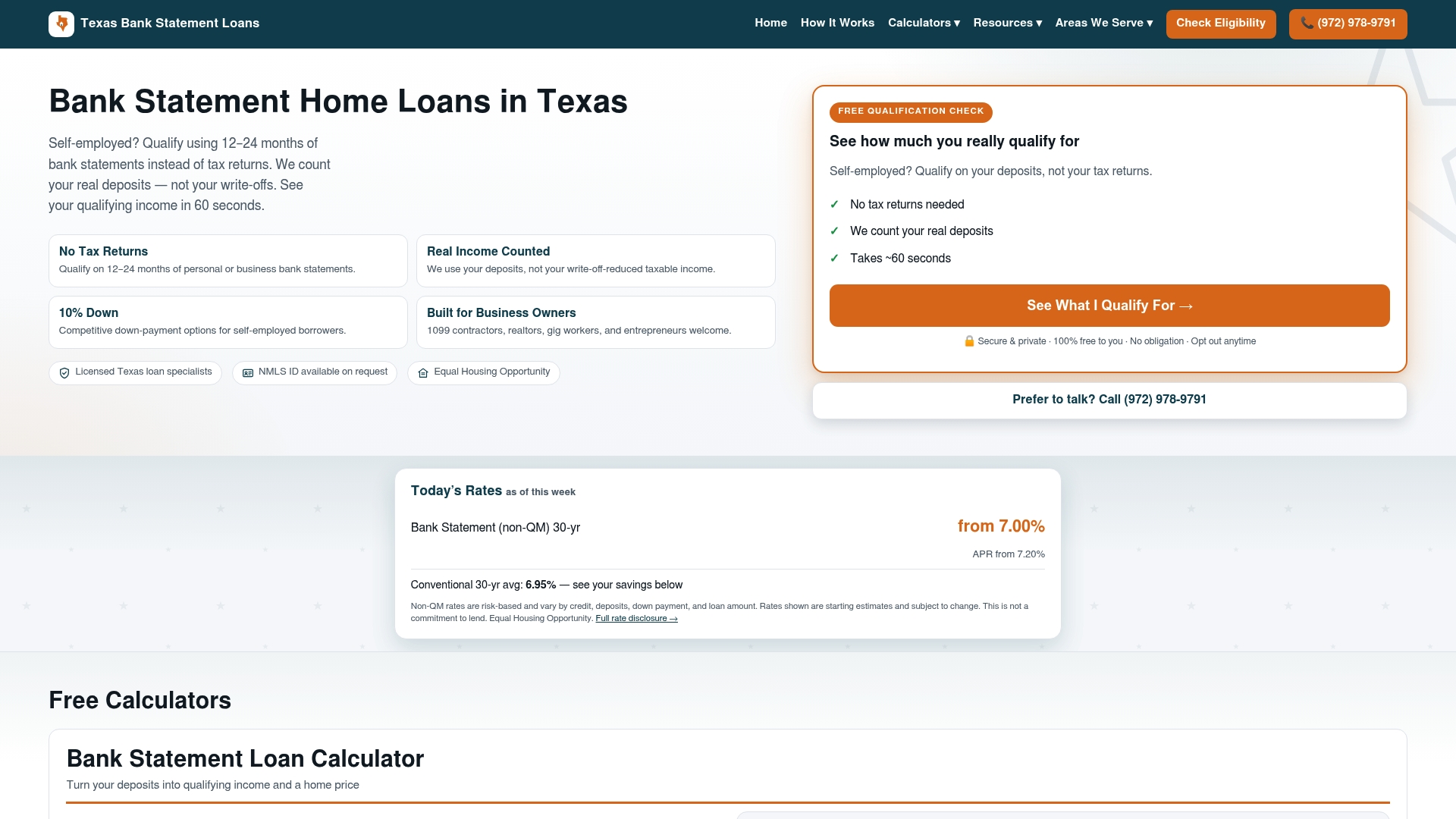
If you know a business owner, contractor, or gig worker who has been told they do not qualify for a traditional mortgage, the referral path at Texasbankstatementloans is worth a look. The program terms are published, the reward structure is transparent, and the qualification check takes 60 seconds with no obligation. Start at texasbankstatementloans.com to check qualification or submit a referral. For borrowers in the Houston area, the Houston loan page has region-specific details.
For context on how compliant referral incentives fit into the broader mortgage market, this overview of mortgage market alternatives covers how lenders and referral partners typically structure their relationships.
This article is general information, not legal or financial advice. Confirm current RESPA rules and program terms with the CFPB, a qualified attorney, or your loan officer before participating in any referral arrangement.
Authoritative sources and primary references
The primary legal and regulatory texts governing mortgage referral programs in the United States:
- 12 CFR § 1024.14, Prohibition against kickbacks and unearned fees (CFPB regulation)
- 12 U.S.C. § 2607, Prohibition against kickbacks and unearned fees (U.S. Code)
- CFPB advisory opinion on digital mortgage comparison-shopping tools (2023)
- CFPB Compliance Bulletin 2015-05, RESPA compliance and marketing services agreements
- CFPB guidance on pay-to-play digital comparison platforms
- Texasbankstatementloans, program terms and qualification check
For the authoritative legal text on what counts as a prohibited referral, start with 12 CFR § 1024.14 and the CFPB’s RESPA FAQs. These are the primary sources regulators and courts use, not third-party summaries.
Recommended
See what you qualify for in 60 seconds, free and no credit check. Use the eligibility check at the top of this page.