
1099 income mortgage qualification is defined as the process by which lenders assess whether a contractor or self-employed borrower earns enough stable, verifiable income to repay a home loan, using documentation other than a standard W-2. The industry term for this process is “self-employed mortgage underwriting,” and it follows a distinct set of rules from salaried borrower review. Fannie Mae and Freddie Mac guidelines require lenders to confirm that income is stable, supportable, and likely to continue. For 1099 contractors and freelancers, that proof rarely comes from a single pay stub. This guide walks through every stage of the qualification process, from baseline requirements to the best loan options available in 2026.
What are the standard mortgage qualification requirements for 1099 income borrowers?
The baseline requirement for a 1099 income home loan is a two-year self-employment history documented by federal tax returns. Lenders use IRS Form 1040 along with Schedule C for sole proprietors or Schedule K-1 for partnership and S-corp owners. One year of self-employment may sometimes qualify you if you have prior W-2 experience in the same field, but that exception is narrow and lender-specific.
The most misunderstood part of 1099 income mortgage qualification is how lenders calculate your income. They do not use your gross 1099 amount. Lenders focus on net qualifying income after deductions, which can be significantly lower than what you actually deposited. A contractor who earned $180,000 but wrote off $80,000 in business expenses qualifies on $100,000, not $180,000. That gap surprises many first-time self-employed applicants.
Credit score and debt-to-income ratio matter just as much for 1099 borrowers as for salaried ones. Most conventional loan programs require a minimum credit score of 620, and lenders cap the debt-to-income ratio at 43% or below. A strong credit profile can offset some of the income documentation complexity.
- Two years of tax returns (Schedule C or K-1 required)
- Net income after deductions used for qualifying, not gross 1099 amounts
- Credit score of 620 or higher for most conventional programs
- Debt-to-income ratio at or below 43%
- Stable income trend with no sharp year-over-year declines
Pro Tip: If your income grew between year one and year two, lenders typically average both years. If it dropped, many lenders use only the lower year. Plan your tax filings with that in mind.
How do lenders verify 1099 income differently from W-2 income?
The core difference between 1099 vs W-2 mortgage verification is the documentation trail. A W-2 borrower hands over two pay stubs and a single tax form. A 1099 borrower submits two years of full tax returns, profit and loss statements, a CPA letter confirming business operation, and sometimes a business license. The underwriting process takes longer and involves more judgment calls.

Tax returns often understate real earnings because business write-offs lower reported income on Schedule C. Depreciation, vehicle expenses, home office deductions, and equipment costs all reduce the number a lender sees. Underwriters can add back certain deductions, including depreciation and depletion, to raise qualifying income above the Schedule C bottom line. That add-back process requires a CPA letter or detailed documentation to justify each adjustment.
Stable income verification is not just about showing numbers. Lenders want evidence of business continuity, including clean bank records, consistent deposit patterns, and a realistic expectation that income will continue. A sudden 30% income drop in the most recent year will trigger underwriter scrutiny and may require a written explanation.
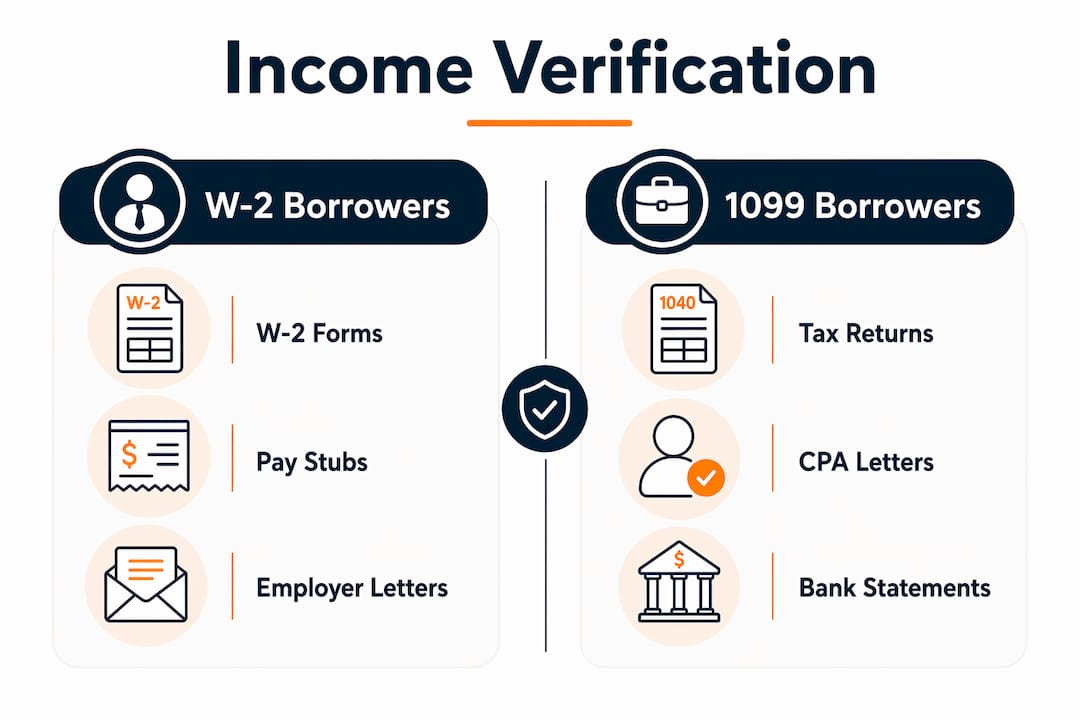
| Verification factor | W-2 borrower | 1099 borrower |
|---|---|---|
| Primary income document | W-2 form and pay stubs | Tax returns with Schedule C or K-1 |
| Income calculation | Gross salary | Net income after deductions plus add-backs |
| Additional docs required | Rarely | CPA letter, business license, bank statements |
| Underwriting complexity | Low | Moderate to high |
| Income fluctuation tolerance | High | Low without explanation |
Pro Tip: Ask your CPA to write a letter confirming two or more years of business operation and projecting income stability. That single document can resolve most underwriter questions before they are even asked.
What mortgage loan options are available for 1099 income earners?
1099 contractors have more loan options than most realize. The right choice depends on how your income looks on paper versus how it looks in your bank account.
Conventional loans
Conventional loans backed by Fannie Mae or Freddie Mac remain the cleanest path if your tax returns show sufficient net income. They offer the lowest interest rates and the widest range of loan limits. The trade-off is strict documentation. You need two full years of tax returns, and your qualifying income is limited to what those returns show after deductions.
Bank statement loans
Bank statement loans use 12-24 months of personal or business bank deposits to verify income without relying on tax returns or taxable net income. This is the most popular non-QM option for contractors whose write-offs make their tax returns look worse than their actual cash flow. Texasbankstatementloans specializes in exactly this program, evaluating real deposit history to give borrowers credit for what they actually earn.
1099 mortgage loans
1099 loans require one to two years of 1099 forms instead of tax returns, enabling contractors and gig workers to qualify based on actual reported contractor income. These non-QM products can finance primary residences, second homes, and investment properties, with loan amounts reaching up to $3.5 million. They fill a specific gap for borrowers whose 1099 income is consistent but whose tax returns are heavily reduced by deductions.
Profit and loss statement loans
Some non-QM lenders accept a CPA-prepared profit and loss statement covering 12-24 months as the primary income document. This works well for business owners with complex financials who cannot easily summarize income through bank statements alone.
- Conventional loans: Best rates, strictest documentation, net income only
- Bank statement loans: Uses deposit history, ideal for high write-off borrowers
- 1099 mortgage loans: Uses 1099 forms directly, no tax return required
- P&L statement loans: CPA-prepared summary, works for complex business structures
Non-QM loans typically carry a rate premium and may require larger down payments compared to conventional products. That premium is the cost of qualifying outside the standard underwriting box. Texasbankstatementloans offers down payments starting at 10%, which is notably lower than the 20-30% many non-QM lenders require.
What practical steps improve your 1099 mortgage qualification chances?
Preparation is the single biggest factor separating approved 1099 borrowers from denied ones. The 1099 mortgage prequalification workflow rewards borrowers who organize their documents before the first lender conversation.
- Gather two years of complete tax returns. Include all schedules, especially Schedule C or K-1. Missing pages are one of the most common causes of underwriting delays.
- Pull 12-24 months of bank statements. Both personal and business accounts may be needed. Consistent deposit patterns build lender confidence. Unexplained large deposits or irregular months will require written explanations.
- Request a CPA letter. Ask your accountant to confirm your business start date, current operation status, and income stability. This letter carries significant weight with underwriters.
- Calculate your debt-to-income ratio before applying. Add up all monthly debt payments and divide by your qualifying monthly income. If the ratio exceeds 43%, pay down debt or increase documented income before submitting an application.
- Use a self-employed affordability calculator. Tools like the affordability calculator at Texasbankstatementloans let you model different income scenarios and see realistic loan amounts before talking to a lender.
- Work with a mortgage specialist who knows self-employed borrowers. A generalist loan officer may not know how to structure your file for maximum qualifying income. A specialist in non-QM or bank statement loans will know which add-backs apply and which loan program fits your situation.
Pro Tip: If you are planning to transition from W-2 employment to 1099 contracting, timing that transition carefully can prevent a two-year wait before you qualify for a conventional mortgage. Buying before you make the switch is often the faster path.
Key Takeaways
1099 income mortgage qualification requires proving stable, verifiable income through tax returns, bank statements, or 1099 forms, with the right loan program determined by how your income appears on paper versus in your bank account.
| Point | Details |
|---|---|
| Net income drives qualification | Lenders use net income after deductions, not your gross 1099 amount, to calculate what you can borrow. |
| Two-year history is standard | Most lenders require two years of self-employment documented by federal tax returns with Schedule C or K-1. |
| Non-QM loans expand access | Bank statement and 1099 loan programs qualify borrowers based on deposit history or 1099 forms, bypassing tax return limitations. |
| Rate premium is real | Non-QM loans carry higher rates and sometimes larger down payments than conventional loans as a trade-off for flexible documentation. |
| Preparation determines approval | Organized tax returns, consistent bank statements, and a CPA letter resolve most underwriter concerns before they arise. |
What I have learned from watching 1099 borrowers get this wrong
The most common mistake I see is contractors assuming their gross 1099 income is what a lender will use. They earn $200,000, they feel financially strong, and then they are blindsided when the underwriter qualifies them on $95,000 after deductions. That gap is not a lender problem. It is a documentation strategy problem, and it is entirely fixable.
The second mistake is waiting too long to explore non-QM options. Many 1099 borrowers spend months trying to force their financials into a conventional loan box, only to discover that a bank statement loan would have approved them in the first conversation. The non-QM market has matured significantly. These are not fringe products. They are purpose-built for exactly the income profile that contractors carry.
What I have found works consistently is treating the mortgage application like a business presentation. You are making a case that your income is real, stable, and likely to continue. Every document you submit either strengthens or weakens that case. A clean two-year bank statement history with consistent deposits tells a better story than a tax return full of aggressive write-offs, even if the underlying income is identical.
The rate premium on non-QM loans is real, and I would not pretend otherwise. But for a borrower who cannot qualify conventionally, a slightly higher rate on an approved loan beats a lower rate on a denial. Refinancing into a conventional product later, once you have two years of strong documented income, is a straightforward exit strategy.
- Saad
How Texasbankstatementloans helps 1099 borrowers qualify
Self-employed contractors and freelancers in Texas have a direct path to homeownership through Texasbankstatementloans, which evaluates 12-24 months of bank deposits instead of tax returns.
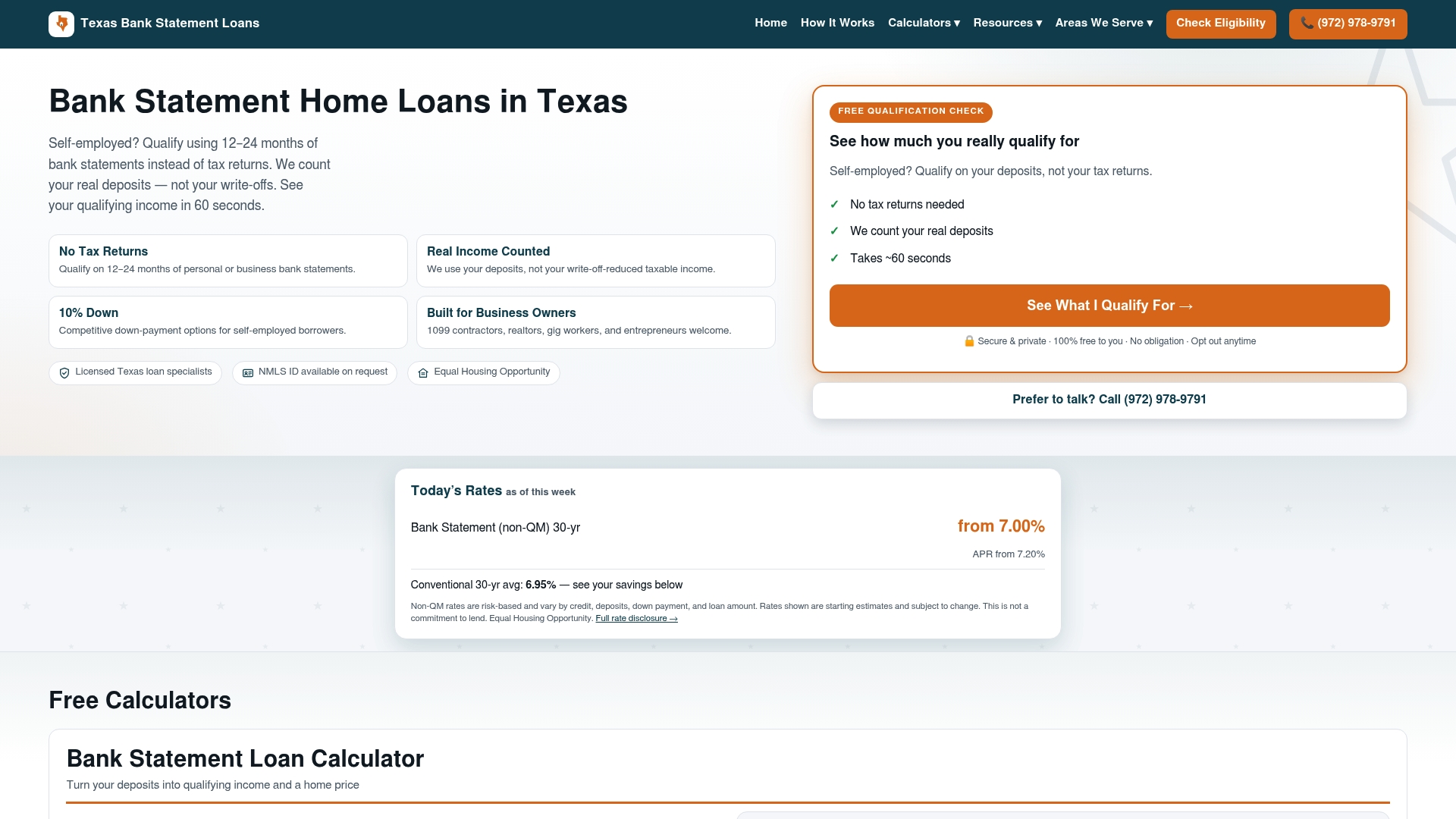
Texasbankstatementloans offers bank statement loan programs built specifically for 1099 income earners, with down payments starting at 10% and a 60-second qualification check that shows you a realistic loan amount with no obligation. Whether you are in Houston, Dallas, Plano, or anywhere else in Texas, the team specializes in non-QM underwriting for contractors, gig workers, and business owners. Check current loan rates and run your numbers through the bank statement loan calculator to see where you stand before your first lender call.
FAQ
What is a 1099 mortgage loan?
A 1099 mortgage loan is a non-QM product that uses one to two years of 1099 forms instead of tax returns to verify contractor income. It allows borrowers to qualify based on actual reported earnings rather than net income reduced by business deductions.
How do lenders verify 1099 income for a mortgage?
Lenders verify 1099 income through federal tax returns with Schedule C or K-1, CPA letters, business bank statements, and sometimes a business license confirming at least two years of operation.
Can I get a mortgage with only one year of 1099 income?
One year of self-employment may qualify you for a conventional mortgage if you have prior W-2 experience in the same industry. For non-QM programs like bank statement loans, some lenders accept 12 months of deposit history.
What credit score do I need for a 1099 home loan?
Most conventional loan programs require a minimum credit score of 620 for 1099 borrowers. Non-QM programs may have different thresholds depending on the lender and loan type.
Why does my qualifying income look lower than what I actually earn?
Lenders calculate qualifying income from net income after business deductions on your tax return, not your gross 1099 amount. Write-offs for equipment, vehicle use, and home office expenses all reduce the income figure a lender sees.
Recommended
See what you qualify for in 60 seconds, free and no credit check. Use the eligibility check at the top of this page.