
Platform income types mortgage lenders consider include self-employment earnings, 1099 contractor income, and bank statement deposits, each requiring distinct verification methods to qualify for a home loan. The industry term for loans that accept these non-traditional income sources is “non-QM” (non-qualified mortgage), and understanding how lenders treat each income type is the difference between approval and rejection. Most lenders require at least two years of self-employment or 1099 income history for conventional mortgage qualification. Non-QM bank statement loans offer a faster path, using 12-24 months of deposits instead of tax returns.
1. What platform income types do lenders evaluate for mortgage qualification?
Self-employment income, 1099 contractor earnings, and bank statement deposits are the three primary income types lenders assess for self-employed borrowers. Each type follows a different underwriting path, and knowing which category fits your situation determines which loan product you can access.
Self-employment income is reported on Schedule C (sole proprietors) or Schedule K-1 (partnership and S-corp owners). Lenders average the net profit from two years of federal tax returns to calculate qualifying income. The catch: every deduction you take reduces that net figure.

1099 contractor income covers gig workers, freelancers, and independent contractors paid via 1099-NEC or 1099-K forms. Fannie Mae guidelines allow a 90% gross-up to 1099-K income for conventional mortgages, which can significantly increase qualifying income compared to Schedule C net figures.
Bank statement deposits serve as the income basis for non-QM loans. Lenders review 12-24 months of business or personal bank statements and apply an expense ratio to estimate net income. This path bypasses tax returns entirely, which is why it works well for borrowers whose tax deductions have reduced their reported income to near zero.
| Income Type | Primary Document | Loan Type | Key Qualifier |
|---|---|---|---|
| Self-employment (Schedule C) | 2 years of tax returns | Conventional, FHA | Averaged net profit |
| 1099 contractor income | 1099-NEC or 1099-K forms | Conventional, non-QM | 90% gross-up or net income |
| Bank statement deposits | 12-24 months of statements | Non-QM only | Deposits minus expense ratio |
| K-1 partnership income | Schedule K-1, business returns | Conventional | Averaged distributable income |
Pro Tip: Know your income classification before you apply. A borrower who receives both W-2 wages and 1099 income may qualify using the combined figure, which can push debt-to-income ratios into an approvable range.
2. How lenders calculate qualifying income from self-employed and platform earnings
Lenders do not use your gross revenue or your take-home pay. They calculate a “qualifying income” figure based on what underwriting guidelines define as stable and sustainable earnings.
Step-by-step: how underwriters verify and calculate income
- Collect tax returns. Underwriters pull two years of federal returns and average the Schedule C net profit or K-1 distributions.
- Add back allowable deductions. Depreciation and depletion are added back to net income because they are non-cash expenses. Most operating expenses are not added back.
- Apply the 90% gross-up for 1099-K income. Under current Fannie Mae guidelines, lenders multiply gross 1099-K income by 90% to estimate qualifying income for conventional loans.
- Apply expense ratios to bank deposits. For non-QM bank statement loans, underwriters apply expense ratios to deposits: typically 50% for service businesses and 60% for product-based businesses. A $10,000 monthly deposit may qualify as only $4,000-$5,000 of income.
- Average the result over 12-24 months. Lenders smooth out seasonal swings by averaging income across the statement period.
- Divide by 12. The final figure becomes your monthly qualifying income, which feeds directly into your debt-to-income ratio calculation.
The “deduction trap” is the most common problem self-employed borrowers face. Aggressive tax deductions reduce qualifying income for conventional loans, even though some non-cash deductions like depreciation are added back by underwriters. Borrowers who heavily deduct expenses may lose borrowing capacity despite strong actual cash flow.
Pro Tip: Run your numbers through a bank statement loan calculator before you apply. Seeing your estimated qualifying income in advance helps you choose the right loan type and avoid surprises during underwriting.
3. What documentation must self-employed and 1099 contractors provide?
Lenders require specific documentation that varies by loan type and borrower circumstances. Preparing this paperwork before you apply cuts weeks off the process.
For conventional and FHA loans:
- Two years of federal tax returns (personal and business), including all schedules. This is the baseline for calculating averaged net income.
- 1099-NEC or 1099-K forms for the past two years. These confirm the source and consistency of contractor income.
- Year-to-date profit and loss statement (P&L), prepared by a licensed CPA. Lenders use this to confirm income has not dropped significantly since the last tax return.
- Business license or proof of business existence. This verifies that the self-employment is ongoing and legitimate.
- CPA letter. Some lenders request a letter from your accountant confirming the nature of your business and that you have been self-employed for at least two years.
For non-QM bank statement loans:
- 12-24 months of business or personal bank statements. Business statements are preferred because they separate business income from personal transfers.
- A CPA-prepared expense ratio letter. If your actual business expenses differ significantly from the standard ratio the lender applies, a CPA letter documenting real expenses can increase your qualifying income.
- Proof of business ownership. Articles of incorporation, a business license, or a DBA filing all work.
Manual underwriting for gig workers often involves extensive documentation review and requests for updated bank statements or CPA letters mid-process. Having everything organized in a single folder before you submit saves significant back-and-forth time.
4. What factors affect approval chances and mortgage terms for platform income borrowers?
Income type alone does not determine approval. Credit score, down payment, and debt-to-income ratio all interact with your income documentation to shape the final outcome.
Credit score minimums
A strong credit score significantly improves mortgage options. The minimum for conventional loans is 620, while many non-QM programs require at least 660. Borrowers with scores above 720 access the best rates and lowest down payment requirements regardless of income type.
Down payment requirements
Conventional loans allow down payments as low as 3% for qualifying borrowers. Bank statement loans typically require 10%-20% down and carry interest rates that run 0.5%-1.5% higher than conventional rates. That premium reflects the additional risk lenders take when bypassing tax return verification.
Debt-to-income ratio
Lenders target a total debt-to-income ratio below 43% of qualifying income. For self-employed borrowers, this means the ratio is calculated using the underwriter’s income figure, not your actual take-home pay. A borrower earning $120,000 in gross deposits but qualifying at $60,000 after expense ratios faces a very different DTI ceiling than their bank account suggests.
Income stability and trend
Lenders look for an upward or stable income trend across the two-year review period. A borrower whose income dropped 30% in year two compared to year one will face questions, and some lenders will use only the lower year’s figure. Consistent or growing income across 12-24 months is the single strongest signal of creditworthiness for non-traditional earners.
“The biggest mistake self-employed borrowers make is assuming lenders see the same income they do. Lenders see what the documentation proves, not what the bank account shows. Preparing your documentation strategy before you apply, ideally with a CPA who understands mortgage underwriting, is the most effective way to close the gap between actual earnings and qualifying income.”
Key takeaways
Self-employed borrowers qualify for mortgages by matching their income type to the right loan product and documentation strategy, not by earning more money.
| Point | Details |
|---|---|
| Three core income types | Lenders assess self-employment, 1099 contractor, and bank statement deposit income differently. |
| Expense ratios reduce qualifying income | Bank statement lenders apply 50%-60% expense ratios, so $10,000 in deposits may qualify as $4,000-$5,000. |
| 90% gross-up for 1099-K | Fannie Mae allows conventional lenders to use 90% of gross 1099-K income as qualifying income. |
| Credit score drives loan access | A minimum of 620 qualifies for conventional loans; 660 is the floor for most non-QM programs. |
| Documentation preparation is critical | Having two years of tax returns, 12-24 months of bank statements, and a CPA letter ready shortens underwriting time. |
What I’ve learned about platform income and mortgage approval
The underreporting paradox is real, and it catches self-employed borrowers off guard every time. You spend years writing off every legitimate expense to reduce your tax bill, then walk into a mortgage application and discover that the same strategy has cut your qualifying income in half. I’ve seen borrowers with $200,000 in annual deposits qualify for less than someone earning $80,000 as a W-2 employee, simply because their Schedule C showed $30,000 in net profit after deductions.
The fix is not to stop taking deductions. The fix is to plan your loan strategy at least 12 months before you apply. Talk to a CPA who understands mortgage underwriting, not just tax strategy. Some deductions are worth keeping; others cost you more in borrowing capacity than they save in taxes. That calculation is different for every borrower.
Bank statement loans are not a last resort. For borrowers with strong deposit history and a credit score above 680, a non-QM bank statement loan often produces a higher qualifying income than a conventional loan based on a heavily deducted Schedule C. The rate premium is real, but so is the ability to actually buy the house.
67% of lenders agree that accepting digital gig income would improve credit access, but 83% say it is difficult to document. That gap is your opportunity. Borrowers who document their income clearly and consistently close loans that others cannot. Patience and preparation are the two most underrated tools in a self-employed borrower’s toolkit.
- Saad
How Texasbankstatementloans helps self-employed borrowers qualify
Self-employed buyers and 1099 contractors in Texas have a direct path to mortgage approval through Texasbankstatementloans, which evaluates 12-24 months of bank deposits instead of tax returns.
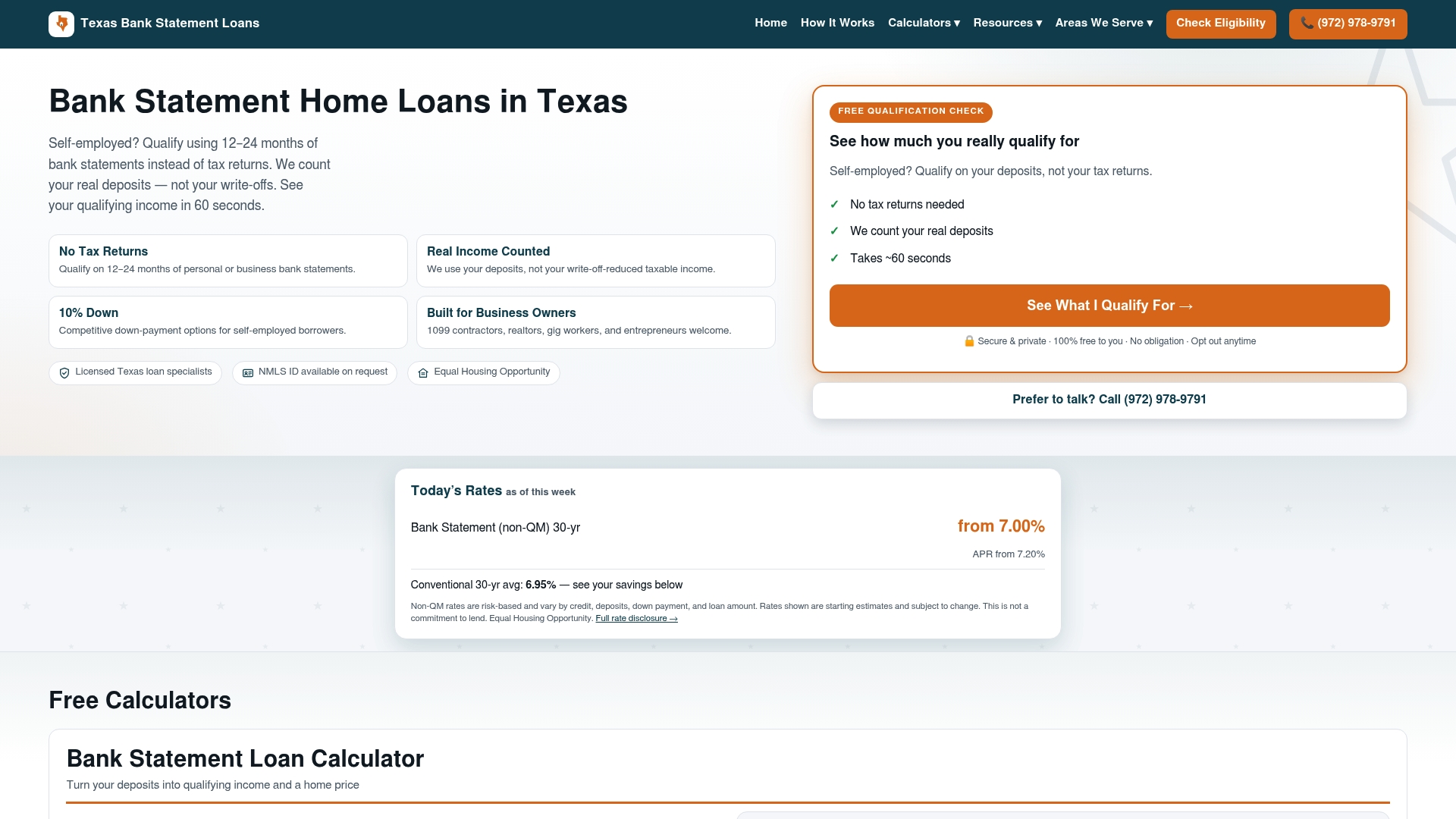
Texasbankstatementloans accepts bank statement income from business owners, freelancers, and gig workers who cannot qualify through conventional tax return review. Down payments start at 10%, and a no-obligation qualification check takes 60 seconds. You can also use the self-employed affordability calculator to estimate how much home your deposit history supports before you speak with a loan officer. For borrowers in specific Texas markets, location-specific programs are available in cities including Houston and Plano.
FAQ
What income types do mortgage lenders accept from self-employed borrowers?
Lenders accept self-employment income from Schedule C or K-1, 1099 contractor income, and bank statement deposits for non-QM loans. Each type requires different documentation and follows a separate underwriting calculation method.
Can gig platform income qualify for a conventional mortgage?
Yes. Fannie Mae guidelines allow lenders to apply a 90% gross-up to 1099-K income from gig platforms, which can increase qualifying income compared to Schedule C net figures. Two years of consistent income history is required.
How many months of bank statements do lenders require?
Non-QM bank statement loans require 12-24 months of statements. Conventional loans do not use bank statements as the primary income source; they rely on two years of tax returns instead.
Does a high credit score offset irregular income for self-employed borrowers?
A credit score above 720 improves rate and term options, but it does not replace income documentation requirements. Lenders still calculate qualifying income from tax returns or bank statements regardless of credit score.
What is the debt-to-income ratio limit for non-traditional income borrowers?
Most lenders target a total debt-to-income ratio below 43% of qualifying income. For self-employed borrowers, that qualifying income is the underwriter’s calculated figure, which may be lower than actual cash flow due to expense ratios or deductions.
See what you qualify for in 60 seconds, free and no credit check. Use the eligibility check at the top of this page.