
Yes, lenders treat a declining income trend as a risk and will generally use a conservative, recent income figure unless you can document stabilization. Underwriters weigh your most recent year or year-to-date numbers more heavily than older, stronger years, so the fix is providing clear evidence that the dip has stopped and your earnings are holding steady or recovering.
TL;DR:
- Underwriters may use the latest 12 months of income, annualized year to date earnings, or the lower of two years when income keeps falling.
- Gather a current year profit and loss statement, recent bank statements, signed contracts, and a dated explanation linked to the decline.
- Reserves covering two to six months of payments can strengthen the file, but lenders still assess whether documented income supports ongoing mortgage payments.
- Bank statement underwriting can help borrowers with heavy business deductions or an unusual tax year, but lenders verify recurring revenue and exclude transfers and loans.
- Fannie Mae’s calculator may permit averaging declining self employment income over 12 months only after the lender documents that it has stabilized.
Table of Contents
- How underwriters evaluate declining income
- Documentation lenders typically request when income has declined
- Policy signals lenders follow and when declines trigger manual review
- Practical steps to strengthen your application when income is declining
- How bank-statement underwriting works for borrowers with declining income
- Common mistakes I see and three quick fixes
- How we help borrowers with declining or nontraditional income
- FAQ
- Sources
How underwriters evaluate declining income
Two questions sit at the center of every income review: is this money stable, and is it likely to continue? A downward trend raises doubt on both counts, so underwriters respond by discounting the number they use to qualify you rather than taking an average that flatters the file.
Lenders typically handle a declining pattern one of a few ways. Some use only the most recent 12 months of income instead of a two-year average. Others pull your year-to-date figures and annualize them. When the trend is steep, many default to the lower of the two years rather than blending them, which keeps the qualifying income conservative.
Automated underwriting systems add another layer of scrutiny. Tools like Fannie Mae’s Income Calculator analyze self-employment income trends and flag files where earnings are falling, often requiring the lender to document that income has stabilized before using a 12-month average. When that happens, your loan can move from automated approval to manual underwriting, where a human reviewer looks at business viability directly.
- A single soft quarter rarely triggers a downgrade on its own.
- A consistent two-year decline almost always prompts deeper documentation requests.
- Manual underwriting shifts the focus from algorithmic averaging to a reviewer’s judgment about whether your income will hold.
Documentation lenders typically request when income has declined
When your file shows a downward trend, lenders ask for a specific stack of paperwork to decide whether your current income is reliable enough to qualify you. Assembling it before you apply saves weeks of back-and-forth.
- Year-to-date profit and loss statement, ideally prepared or reviewed by an accountant.
- Twelve to twenty-four months of business bank statements showing deposit activity.
- Two years of personal and business tax returns, when available, to establish the baseline trend.
- A signed letter of explanation describing why income dropped and why it will not continue falling.
- Verification of employment, signed client contracts, or evidence of recurring deposits that show ongoing cash flow.
- Proof of reserves, such as checking, savings, or investment statements, that demonstrate payment capacity beyond income alone.
Pro Tip: Date your letter of explanation and tie it directly to a specific event, a lost contract, a seasonal slowdown, a temporary closure, rather than a vague statement about “a slow year.”
Policy signals lenders follow and when declines trigger manual review
Agency guidance shapes how far a lender can go in excusing a temporary dip. FHA’s Mortgagee Letter on calculating effective income lets mortgagees exclude months affected by certain documented COVID-19 related economic events, but only with supporting paperwork such as a year-to-date profit and loss statement or audited financials. The same guidance notes that when effective income declines beyond a threshold, the file may be downgraded and routed to manual underwriting.
The FHA Single Family Housing Policy Handbook spells out when that downgrade happens and what a manual reviewer checks once it does, including income continuance and overall file risk.
On the conventional side, Fannie Mae’s Income Calculator behaves similarly: when two years of tax returns show declining self-employment income, the tool can average the figures over 12 months, but it adds a message requiring the lender to document that income has stabilized before relying on that average.
- Declines beyond agency thresholds commonly trigger manual underwriting.
- Manual review focuses on business stability, not just the numbers on a return.
- Documentation requirements grow heavier the steeper the decline.
Practical steps to strengthen your application when income is declining
A thin file invites a conservative number. A thorough one gives the underwriter a reason to look past the dip.
- Write a short, dated letter of explanation that names the cause of the decline and states clearly why it has ended.
- Compile a year-to-date profit and loss statement alongside 12 to 24 months of business bank statements that back it up.
- Collect proof that income has stabilized: signed contracts, new client engagements, retained accounts, or recurring monthly deposits.
- Build reserves, two to six months of payments is a common benchmark lenders look for, to show you can absorb a slow stretch.
- Ask your loan officer early which income figure they plan to use, and request that in writing before you commit to a purchase contract.
Pro Tip: Run your numbers through a self-employed affordability calculator before you apply, so you know roughly where you stand before an underwriter tells you.
How bank-statement underwriting works for borrowers with declining income
Bank-statement underwriting looks at 12 to 24 months of deposits to measure actual cash flow instead of relying on the net income reported on a tax return. For a self-employed borrower whose write-offs, depreciation, or a single rough tax year make income look weaker than it really is, that distinction matters directly: deposits can tell a steadier story than a Schedule C.
This approach tends to help three kinds of borrowers most: those with heavy business deductions that shrink taxable income, those with irregular 1099 work that varies month to month, and those whose most recent tax year included a one-time anomaly that does not reflect ongoing earnings.
A typical bank-statement review asks for:
- 12 to 24 months of personal or business bank statements, depending on the program.
- A reconciliation between deposits and a profit and loss statement to confirm which deposits count as income.
- Documentation ruling out transfers, loans, or one-off deposits that do not represent recurring revenue.
Lenders still expect deposits to map to a real, ongoing revenue stream, so consistency across those months carries more weight than the total on any single statement.
Common mistakes I see and three quick fixes
The biggest mistake applicants make is assuming automated systems will quietly average away a bad year. They will not. The second is showing up without a dated letter of explanation that matches the deposit activity in their bank statements, which leaves the underwriter guessing instead of confirming.
Three things fix most of this: call your lender before you apply and ask what income figure they will use, build your documentation around a clear, consistent story, and look into DSCR loans if a standard file is going to penalize you for a tax year that no longer reflects your business.
- Saad
How we help borrowers with declining or nontraditional income
We evaluate 12 to 24 months of bank deposits instead of tax returns, which can mean a declining net-income figure on your return does not have to define what you qualify for. For self-employed borrowers, 1099 contractors, and business owners whose actual cash flow looks stronger than their tax paperwork suggests, that is often the difference between a denial and an approval.
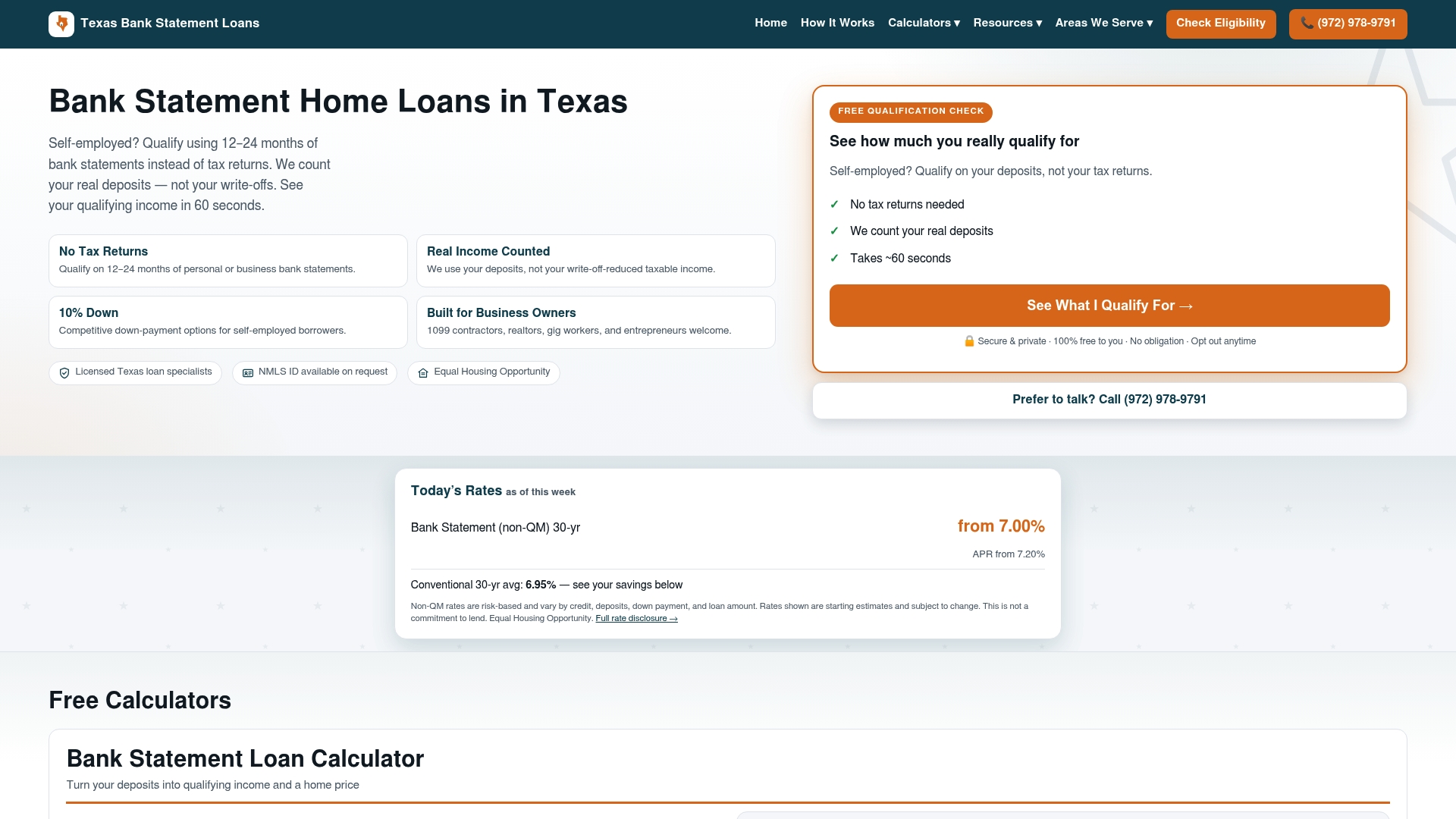
Run the numbers with our mortgage calculators, then see your options on our Bank Statement (non-QM) 30-yr page or start a quote at Texas Bank Statement Home Loans.
This article is general information, not a substitute for advice from a qualified financial advisor. Consult a qualified financial professional about your own circumstances before acting on anything here.

FAQ
What does FHA consider declining income?
FHA guidance allows mortgagees to exclude months affected by certain documented economic events, such as COVID-19 related impacts, when calculating effective income, provided the borrower supplies supporting documentation like a year-to-date profit and loss statement. When the decline exceeds set thresholds, the file may be downgraded to manual underwriting for closer review.
How much of a mortgage can I afford if I make $70,000 a year?
Affordability depends on your debt-to-income ratio, down payment, interest rate, and the loan program you use, not income alone, so there is no single fixed answer. A self-employed affordability calculator or a quick pre-qualification check gives a realistic range based on your actual numbers rather than a generic assumption.
Is it okay if half of my income goes to mortgage payments?
Most conventional and government-backed programs cap total debt payments, including the mortgage, well below half of gross income, so a 50% housing payment would exceed typical underwriting limits. Non-QM and bank-statement programs sometimes allow more flexibility, but a lender still needs to confirm the payment is sustainable against your documented cash flow.
Can I afford a $300,000 house on a $50,000 salary?
It depends heavily on your down payment, interest rate, existing debt, and the loan program, since a large purchase amount on modest income would likely push standard debt-to-income limits for most conventional loans. A larger down payment, a bank-statement program that credits actual cash flow, or paying down other debt can shift that math meaningfully.
Sources
- Subject Calculating Effective Income After a Reduction or Loss of Income for Borrowers Affected by Presidentially-Declared COVID-19 National Emergency
- Income Calculator Frequently Asked Questions | Fannie Mae
- Underwriting factors and documentation for a self-employed borrower | Fannie Mae
- FHA Single Family Housing Policy Handbook
See what you qualify for in 60 seconds, free and no credit check. Use the eligibility check at the top of this page.