
Yes, your 1099 income can qualify you for a mortgage. The key question is which documentation path gives you the highest qualifying income: a 1099-only Non-QM program, a bank statement loan, or a conventional tax-return route. For most Texas contractors with significant deductions, 1099 income-only mortgages allow lenders to evaluate gross earnings instead of taxable net income, often producing a meaningfully higher qualifying figure.
Here is what you need to decide your path:
- Do most of your deposits come from 1099 payers? If yes, a 1099-only Non-QM program may work well.
- Do your tax returns show low net income after deductions? Bank statement loans capture gross deposits before deductions, which often yields a better number.
- Can you pull 12-24 months of bank statements? That is the core document for both paths.
- Do you have 1099-NEC or 1099-MISC forms for the same period? Gather them now, lenders want both.
The fastest next step: collect 12-24 months of statements and your 1099s, then run a no-obligation prequal to see what you actually qualify for.
Table of Contents
- How do conventional, 1099-only, and bank statement loans treat your income differently?
- Which 1099 contractors typically qualify for these programs?
- How do lenders actually calculate your qualifying income?
- What underwriting red flags should you watch for?
- What documents do you need to assemble?
- What should you expect for timing, costs, and down payment?
- How Texasbankstatementloans helps 1099 contractors qualify
- How do self-employment taxes and deductions affect your qualifying income?
- Regulatory and compliance considerations for 1099 borrowers
- Key Takeaways
- What most borrowers get wrong about 1099 mortgage qualification
- Your next step with Texasbankstatementloans
- Useful sources
How do conventional, 1099-only, and bank statement loans treat your income differently?
The role of 1099 income in real estate financing depends entirely on which loan type you pursue. Conventional and agency loans (Fannie Mae, Freddie Mac) derive qualifying income from two years of tax returns and Schedule C. If you deduct aggressively, that net figure can be far below your actual cash flow.

1099 loans are Non-QM products that skip tax-return reconciliation entirely. Lenders sum your gross 1099 amounts, apply an expense factor (commonly around 10% for low-overhead service work), and divide by months. Bank statement loans average gross deposits over 12-24 months, which captures all income channels and tends to work best when income flows from multiple sources.
| Dimension | Conventional | 1099-Only Non-QM | Bank Statement |
|---|---|---|---|
| Documentation window | 2 years tax returns | 12-24 months 1099s | 12-24 months statements |
| Income basis | Net Schedule C | Gross 1099 minus expense factor | Gross deposits minus expense factor |
| Down payment minimum | Typically 3-5% | Often 10%+; strong-credit 1099 files can reach 90% LTV in select lender programs | Often 10%+ |
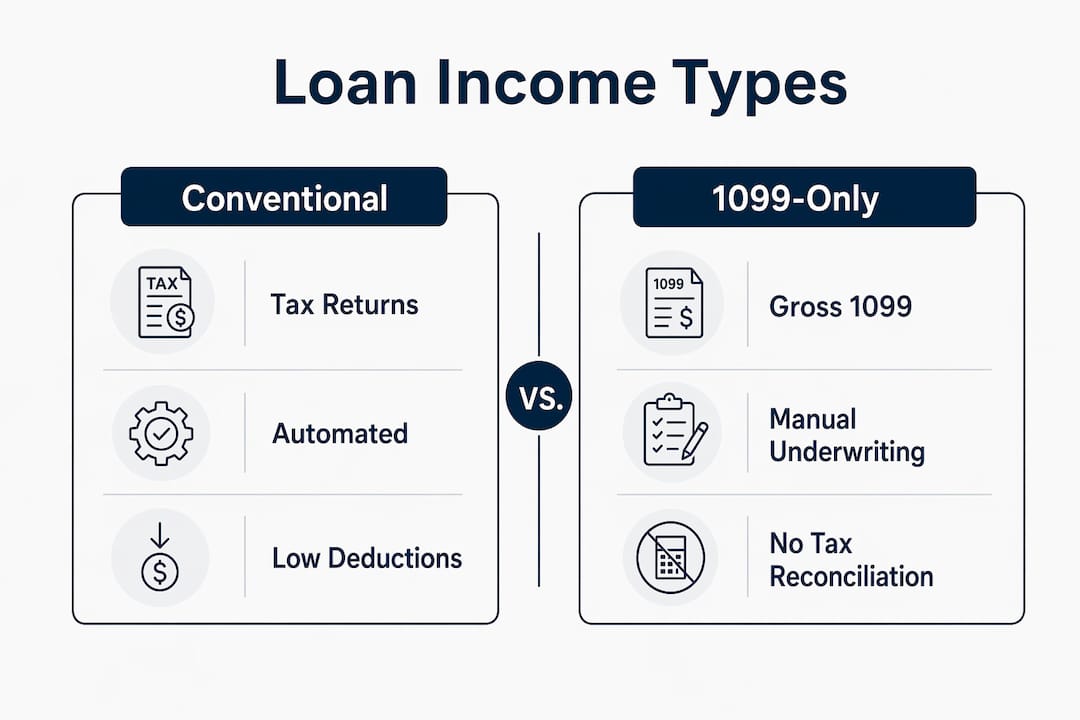
| Underwriting | Automated (DU/LP) | Manual or hybrid | Manual or hybrid | | Best for | Low-deduction filers | Single-payer 1099 earners | Mixed-channel income |
The practical difference: a contractor earning $180,000 gross but showing $60,000 net after deductions qualifies on $60,000 with a conventional loan. The same contractor using a 1099 or bank statement path may qualify on $160,000+.
Which 1099 contractors typically qualify for these programs?
Strong candidates are high-gross 1099 earners: real estate agents, independent consultants, mortgage brokers, and skilled-trade contractors with consistent deposit histories. Gig workers qualify too, provided deposits are steady over the full 12-24 month window.
Typical program minimums to screen yourself against:
- Credit score: Many non-QM programs start at 620-680 FICO; best pricing kicks in at 720+.
- Down payment: Bank statement programs often start at 10% for clean files; strong-credit 1099 files can reach 90% LTV in select programs.
- Reserves: Typically 3-6 months PITI after closing.
- History: Most programs want 12-24 months of self-employment; some non-QM investors accept one year with strong compensating factors.
Quick self-screen checklist:
- Do you have 12-24 months of personal or business bank statements available?
- Is your dominant income from a small number of repeat payers?
- What is your average monthly deposit over the last 12 months?
- Do you have 3-6 months of PITI in reserves after your down payment?
Pro Tip: Lenders favor stable payer relationships, a few repeat clients paying consistently beats dozens of small, fragmented payments. If your income comes from many sources, expect a more detailed underwriting review.
How do lenders actually calculate your qualifying income?
Two methods dominate. Here is the arithmetic for each.
Method A: 1099-Only
- Collect all 1099-NEC/MISC forms for the past 12-24 months.
- Sum gross 1099 amounts for the period.
- Apply expense factor (commonly 10% for service-based work; varies by lender and profession).
- Divide by number of months.
Example: $240,000 gross 1099 over 24 months × 90% = $216,000 ÷ 24 = $9,000/month qualifying income.
Method B: Bank Statement
- Pull 12-24 months of personal or business bank statements.
- Total qualifying deposits (exclude transfers between your own accounts, loan proceeds, and one-time windfalls).
- Apply expense factor (lender-specific; often 10-50% depending on business type).
- Divide by months.
Example: $280,000 in qualifying deposits over 24 months × 90% = $252,000 ÷ 24 = $10,500/month qualifying income.
| Step | 1099-Only | Bank Statement |
|---|---|---|
| Source documents | 1099-NEC/MISC forms | Personal or business statements |
| Gross figure | Sum of all 1099s | Sum of qualifying deposits |
| Expense factor | ~10% (service work) | Varies by lender/business type |
| Divide by | Months in period | Months in period |
| Result | Monthly qualifying income | Monthly qualifying income |
Note: large transfers between a business and personal account count once, not twice. One-time deposits (a property sale, an inheritance) get excluded or require a written explanation.
What underwriting red flags should you watch for?
Lenders prioritize stability even in Non-QM programs. The following patterns trigger manual underwriting or outright denials:
- Sudden deposit drops: A month where deposits fall 30%+ with no explanation raises questions about income continuity.
- Recent industry change: Switching from W-2 employment to 1099 work within the past 12 months weakens the history argument.
- Fragmented payer list: Income from dozens of small, unrelated payers complicates underwriting and may force a combined 1099 plus bank statement review.
- Large unexplained deposits: Any deposit that does not match a 1099 or invoice needs a paper trail.
- Related-entity 1099s: Payments from a company you own or control get scrutinized for circular income.
Mitigation steps:
- Provide payer letters or active contracts for your top 3-5 clients.
- Annotate your statements: highlight recurring deposits, note transfer sources.
- Write a short explanation letter for any one-off deposits, attaching the invoice or receipt.
- If possible, stabilize deposits for 3-6 months before applying.
Pro Tip: Underwriters often adjust qualifying income downward for borrowers with many small payers. Documenting recurring contracts reduces those manual adjustments and speeds up approval.
What documents do you need to assemble?
Start building this file now, before you apply. For guidance on documenting variable income for mortgage applications, the underwriting standards for variable income are worth reviewing.
Core documents:
- 12-24 months of personal and/or business bank statements (all pages, no gaps).
- All 1099-NEC and 1099-MISC forms for the same period.
- Government-issued photo ID.
- Proof of reserves (most recent 2-3 months of asset statements).
- Business formation documents (LLC operating agreement, DBA filing, etc.) if applicable.
Supporting proofs:
- CPA or accountant letter confirming self-employment status and business type.
- Active client contracts or recurring engagement letters.
- Invoices matching large deposits.
- Written explanations for any atypical deposits.
How to prepare your statements:
- Download complete statements, every page, every month, no gaps.
- Highlight recurring deposit lines from your main payers.
- Annotate transfers between accounts so underwriters do not double-count.
- Attach a one-page narrative for any deposit over $5,000 that does not match a 1099.
What should you expect for timing, costs, and down payment?
A realistic timeline for a bank statement or 1099 loan:
- Prequal: Same day in most cases.
- Application to conditional approval: 7-21 days, depending on document completeness.
- Underwriting to clear-to-close: 2-6 weeks; manual underwriting adds time when red flags exist.
On costs: Non-QM programs typically carry higher rates and lender fees than conventional loans. The tradeoff is real but often worth it, a borrower qualifying on $10,500/month instead of $5,000/month can afford a substantially larger loan, and the higher rate is the price of that access. Check current bank statement loan rates to see where pricing sits today.
Down payment and reserve expectations:
- Bank statement programs often start near 10% down for clean files.
- Reserve requirements typically include several months of Principal, Interest, Taxes, and Insurance (PITI) payments after closing.
- Debt-to-income ratios up to roughly 50% are possible with strong compensating factors.
How Texasbankstatementloans helps 1099 contractors qualify
Texasbankstatementloans specializes in exactly this borrower profile. The programs use 12-24 months of deposit analysis instead of tax returns, covering a full range of loan types:
- Primary residence and second home loans.
- DSCR and investment property loans.
- ITIN loans for borrowers without a Social Security number.
- P&L loans, jumbo loans, and asset-depletion loans.
Down payments start at 10% for eligible borrowers, with 90% LTV available in select lender programs for strong-credit 1099 files. The 60-second online prequalification tool at texasbankstatementloans.com lets you see a realistic qualifying range before you commit to a full application. Service covers major Texas markets including Houston, Austin, Plano, and beyond.
To start a prequal, have ready: 12-24 months of bank statements, your 1099s, a rough reserve figure, and your target purchase price.
How do self-employment taxes and deductions affect your qualifying income?
This is where 1099 vs W-2 for real estate financing diverges most sharply. W-2 employees have taxes withheld automatically; 1099 contractors pay self-employment tax (covering both the employer and employee portions of Social Security and Medicare) on top of income tax. That tax burden encourages aggressive deduction strategies, which is rational for tax purposes but damaging for conventional mortgage qualification.
When you deduct home office expenses, vehicle use, equipment, and business travel, your Schedule C net income shrinks. A conventional lender sees that reduced net figure and qualifies you on it. A bank statement or 1099-only lender sees your gross deposits or gross 1099 earnings, which is a fundamentally different number.
The practical implication: if you have been filing aggressively to minimize taxes, a bank statement or 1099-only program will almost always produce a higher qualifying income than a conventional loan. The tradeoff is a slightly higher rate. For most heavy-deduction filers, that tradeoff favors the Non-QM path.
Regulatory and compliance considerations for 1099 borrowers
Non-QM loans, including bank statement and 1099-only programs, are not backed by Fannie Mae or Freddie Mac. They are held by private investors or securitized outside agency guidelines. That means program rules vary by lender and can change without the regulatory consistency of agency products.
A few compliance points worth knowing:
- TRID disclosures still apply. The Loan Estimate and Closing Disclosure requirements under TRID (RESPA/TILA) govern all residential mortgage transactions, including Non-QM loans.
- ATR rule. Lenders must still demonstrate a reasonable, good-faith determination of your ability to repay, even for Non-QM products. Bank statement and 1099 income documentation is the lender’s method of satisfying that requirement.
- IRS reporting. Your 1099 income is taxable regardless of how a lender treats it for qualification. Real estate income reporting obligations do not change because you used a Non-QM loan. Consult a tax professional for your specific situation.
- State licensing. Texas mortgage lenders must be licensed under the Texas Department of Savings and Mortgage Lending. Confirm your lender holds an active Texas license before proceeding.
For guidance on documenting income across different mortgage scenarios, the income documentation guide from Platinum Capital Advisors covers the documentation standards lenders expect.
This article is general information, not legal, tax, or financial advice. Confirm current program rules and regulatory requirements with a licensed mortgage professional and a qualified tax advisor for your specific situation.
Key Takeaways
1099 income qualifies for a mortgage most effectively through a bank statement or 1099-only Non-QM program when tax deductions reduce conventional qualifying income below actual cash flow.
| Point | Details |
|---|---|
| Two documentation paths | 1099-only programs use gross 1099 earnings; bank statement loans use gross deposits over 12-24 months. |
| Credit and reserves | Most non-QM programs start at 620-680 FICO; best pricing at 720+; reserves of 3-6 months PITI typically required. |
| Down payment floor | Bank statement programs often start at 10% down; strong-credit 1099 files can reach 90% LTV in select lender programs. |
| Deductions cut both ways | Aggressive tax deductions lower conventional qualifying income but do not reduce bank statement or 1099-only qualifying figures. |
| Texasbankstatementloans | Offers 12-24 month deposit analysis, down payments starting at 10%, and a 60-second no-obligation prequal for Texas 1099 contractors. |
What most borrowers get wrong about 1099 mortgage qualification
The biggest mistake I see is timing. Borrowers spend months researching loan types and then apply with statements that show two or three irregular months right at the front of the window. Underwriters read those months as a trend, not an anomaly, and the file goes manual or gets repriced.
The second mistake is underestimating how much annotation underwriters actually want. A clean bank statement is not enough. Underwriters want to know why a $22,000 deposit landed in March, why deposits dropped in August, and who the three payers sending recurring ACH transfers are. Borrowers who prepare a one-page narrative for each unusual item move through underwriting in days. Those who do not can spend weeks answering back-and-forth requests.
The third thing people miss: waiting 3-6 months to clean up deposit patterns before applying is not a delay. It is a pricing strategy. A file with 12 months of consistent, annotated deposits from stable payers gets better rates than an identical income profile with erratic history. That rate difference compounds over a 30-year loan.
Your next step with Texasbankstatementloans
Self-employed borrowers in Texas have a real path to homeownership that does not require explaining away three years of aggressive deductions to a conventional underwriter. Texasbankstatementloans works specifically with 1099 contractors, gig workers, and business owners whose actual cash flow is strong but whose tax returns do not show it.
The 60-second prequalification check at texasbankstatementloans.com gives you a realistic qualifying range with no obligation. Down payments start at 10%, with 90% LTV possible for strong-credit 1099 borrowers in select programs. The programs cover primary residences, investment properties, jumbo loans, and ITIN loans across Texas. Have your 12-24 months of bank statements and 1099s ready, and a loan officer will walk you through which program fits your deposit pattern and credit profile. Start your qualification check today.
Useful sources
| Source | What it covers |
|---|---|
| Bankrate: Self-Employed Mortgage Guide | Lender behavior, stability requirements, and manual underwriting triggers for self-employed borrowers |
| Gustan Cho Associates: 1099 Income-Only Mortgages | How 1099-only programs calculate qualifying income and the benefit over tax-return-based qualification |
| Q Mortgage: Texas 1099 Income Loans | 1099 and bank statement calculation methodology, payer continuity standards, and LTV possibilities |
| Austin Capital Mortgage: 1099 Loan Requirements | Credit score thresholds, reserve expectations, and statement window requirements |
| Andes Mortgage: Buy with 1099 Income | Rate and fee tradeoffs for Non-QM programs versus conventional loans |
| Rocket Mortgage: Self-Employed Mortgage | Document checklist and how bank statement loans treat gross income for qualification |
| Fannie Mae Selling Guide | Agency underwriting standards and income stability analysis requirements for self-employed borrowers |
| Texasbankstatementloans.com | Texas-specific bank statement and 1099 loan programs, prequalification tool, and regional coverage |
Recommended
- Bank Statement Loans in Austin County, TX | Self-Employed
- Bank Statement Loans in Glasscock County, TX | Self-Employed
See what you qualify for in 60 seconds, free and no credit check. Use the eligibility check at the top of this page.