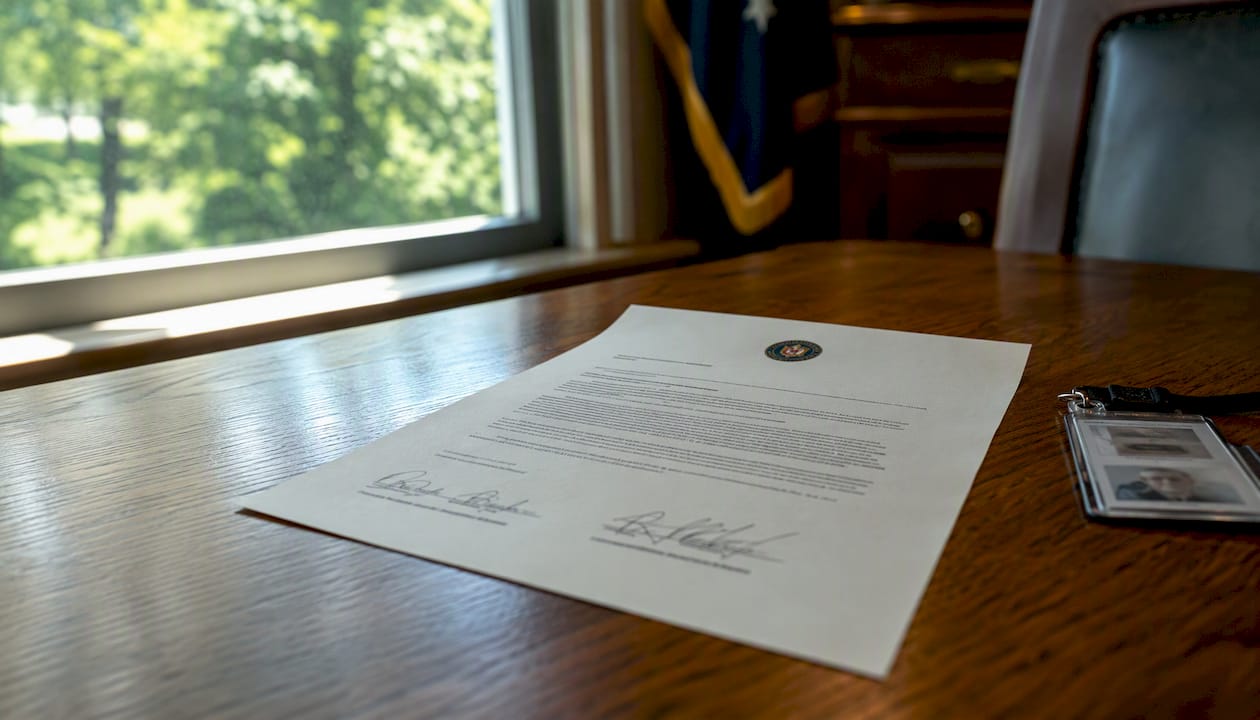
A VA statement of service is the signed military memorandum lenders require to verify a currently serving member’s eligibility for a VA home loan. If you’re on active duty, activated Reserve, or National Guard status, you have no DD-214 yet, so this document is what stands in its place. Your first move: walk into your S1 or personnel office, hand them the field checklist from this article, and ask for a signed copy on official letterhead.
Key Takeaways
A valid, signed VA statement of service with every required field is the single document that keeps an active-duty VA home loan file moving without delays.
| Point | Details |
|---|---|
| Request SOS from S1 immediately | Contact your personnel office early and provide the exact field checklist. |
| Include every required field | Name, SSN, DOB, entry date, lost time, command name, and ETS date must all appear. |
| Get multiple signed copies | Request at least two originals or a CAC-signed PDF in case closing is delayed. |
| Give SOS to lender at COE request | Submitting early prevents manual review delays and supports Web LGY processing. |
| Plan for reissuance if closing slips | Most lenders require the SOS dated within 90-120 days of closing. |
Table of Contents
- What a VA statement of service is and why lenders require it
- Who needs to provide a statement of service?
- What must appear on a valid statement of service?
- How to request your statement of service
- How the statement of service connects to your COE
- How the SOS compares to DD-214, LES, and NGB forms
- Common errors that delay your COE or loan closing
- Why Web LGY is fast but a signed SOS still matters
- The part most service members find out too late
- Sources
What a VA statement of service is and why lenders require it
The Statement of Service (SOS) is an official military memorandum that confirms you are currently serving. It is not a Certificate of Eligibility (COE), not a Leave and Earnings Statement (LES), and not a DD-214. Each of those documents serves a different purpose in the loan file.
Here is why lenders specifically need it:
- No DD-214 exists for active-duty members. The DD-214 is issued at separation. Until then, the SOS is the only official document that verifies your service status, entry date, and projected separation.
- The COE verifies entitlement; the SOS verifies current status. According to VA home loan COE guidance, the COE confirms you are entitled to VA loan benefits, but lenders also need a snapshot of your active service to underwrite the file correctly.
- The LES shows pay, not service status. A lender can see your base pay on an LES, but it does not show your entry date, lost time, or expected separation date. Those fields are what underwriters need.
- The SOS is a point-in-time document. It must be current, signed, and dated within a window your lender specifies, typically 90-120 days of closing.
Who needs to provide a statement of service?
Your category determines exactly what you must supply. Get this wrong and your file stalls.
- Active-duty service members always need an SOS. No exceptions. You have no discharge paperwork, so the signed memorandum is the only way to verify current service for a VA benefits eligibility determination.
- Guard and Reserve members who have been federally activated need an SOS plus a copy of their activation orders. The orders confirm the nature and duration of the activation, which affects eligibility calculations.
- Guard and Reserve members who have never been federally activated need an SOS that includes total creditable years of service. VA guidance is explicit on this: the creditable-years field is required for this group specifically.
- Recently separated veterans typically use their DD-214. In some cases, a lender may request a supplemental SOS if separation occurred within the last few months and the DD-214 has not yet been processed or received.
Pro Tip: If you are a Guard or Reserve member with both activated and non-activated periods, ask your personnel officer to address both in the same memorandum. Combining them in one document prevents a second round of requests from the lender.
What must appear on a valid statement of service?
Getting every field right the first time saves you a week of back-and-forth. VA guidance specifies the following required fields:
- Full legal name (exactly as it appears on your military ID)
- Social Security number
- Date of birth
- Date you entered active duty
- Duration of any lost time (even if zero, state it explicitly)
- Name of the command providing the information
- Total creditable years of service (required for never-activated Guard/Reserve members)
- Expected separation date (ETS/EAOS) when applicable
Beyond the content, the format and authentication matter just as much:
| Element | Requirement |
|---|---|
| Letterhead | Official unit or installation letterhead |
| Signature authority | Commander, adjutant, or personnel officer |
| Signature block | Printed name, rank, and title beneath the signature |
| Signature type | Original ink signature or verified CAC digital signature |
| Date | Date the letter is signed, not backdated |
| Addressee | Lender name or “To Whom It May Concern” |
A letter typed on plain paper with no letterhead and no printed rank beneath the signature will be kicked back. Lenders are not being difficult; they are following VA underwriting guidelines that require authenticated documentation.
You can review a federal agency example SOS PDF to see how the layout and fields are typically arranged before you hand your S1 the request.
How to request your statement of service
Follow these steps in order. The goal is to hand your lender a correctly formatted, signed document without a second trip to the personnel office.
- Identify your point of contact. Go to your unit’s S1 shop, personnel office, or directly to your adjutant. In smaller commands, the commanding officer signs directly.
- Submit your request in writing. Email is fine, but handle PII carefully. Use your official military email and do not send your SSN in an unencrypted message. Ask your S1 how they prefer to receive the request.
- Provide the exact field list. Give them this article’s checklist or your lender’s SOS checklist if one was provided. Do not assume they know what the lender needs.
- Include your loan timeline. Tell them when you need the letter and give them your lender’s contact information in case questions arise.
- Use this template as a starting point:
[Unit Letterhead]
[Date]
To Whom It May Concern:
This memorandum certifies that [Full Legal Name], SSN: [XXX-XX-XXXX], DOB: [MM/DD/YYYY], entered active duty on [MM/DD/YYYY] and is currently serving with [Command Name]. Lost time: [none / specify duration]. Expected date of separation: [MM/DD/YYYY].
[For Guard/Reserve never-activated: Total creditable years of service: [X years].]
[Printed Name] [Rank] [Title / Commanding Officer / Adjutant]
- Request multiple copies. Ask for at least two originals. If your closing gets delayed, you may need a reissued letter.
Pro Tip: Ask your personnel office whether a CAC-signed PDF is available. A verified digital signature on official letterhead is accepted by most lenders and eliminates the risk of the ink copy being damaged in transit.
How the statement of service connects to your COE
The SOS is not the finish line. It is the document that gets you across it. The Certificate of Eligibility is what your lender actually needs to approve a VA-backed loan, and the SOS is the primary evidence that supports COE issuance for active-duty files.
According to VA COE guidance, you have three ways to apply for a COE:
- Web LGY through your lender. Most lenders have access to Web LGY, an internet-based system that can issue a COE instantly when VA records are sufficient. This is the fastest path. Ask your lender on day one whether your case qualifies.
- Through your lender manually. If Web LGY cannot pull enough data, your lender submits the SOS and supporting documents directly to VA for manual review.
- By mail using VA Form 26-1880. You complete the form and mail it to your regional loan center. Mail requests take longer than online or lender-submitted routes. Attach your signed SOS to the envelope.
You can also check your COE status through eBenefits, which gives you an online self-service option outside of the lender channel.
Give your lender the SOS at the same time you start the COE process. Handing it over early often prevents the manual research that otherwise triggers a mail-in Form 26-1880 review.
How the SOS compares to DD-214, LES, and NGB forms
Different service situations call for different documents. Here is how they line up:
| Document | Who uses it | What it proves | SOS substitute? |
|---|---|---|---|
| Statement of Service | Active duty, activated Guard/Reserve | Current service status, entry date, ETS | N/A (this is the primary doc) |
| DD Form 214 | Separated veterans | Dates of service, character of discharge | Yes, for separated veterans |
| NGB Form 22 | Discharged Guard members | State-level Guard service summary | Partial; may need NGB Form 23 too |
| NGB Form 23 | Guard members | Retirement points, creditable service | Supplements NGB Form 22 |
| LES | All currently serving | Pay, deductions, leave balance | No |
Separated veterans who need a DD-214 can request copies through the National Archives military records portal. The LES is not a substitute for an SOS under any circumstances. It shows what you earn; it does not show when you entered service, whether you have lost time, or when you are expected to separate.
Guard members who have been discharged at the state level should provide both NGB Form 22 and NGB Form 23. Activated Guard members should include their activation orders alongside the SOS.
Common errors that delay your COE or loan closing
Most underwriting holds on VA active-duty files trace back to a handful of avoidable mistakes:
- Missing signature or missing printed rank/name/title. A signature alone is not enough. The signer’s printed name, rank, and title must appear beneath it.
- Incorrect or missing SSN. A transposed digit or a missing SSN sends the file to manual review immediately.
- No ETS/EAOS date. Omitting the expected separation date is one of the most frequent content errors. Lenders cannot verify continued eligibility without it.
- Plain paper instead of official letterhead. The letterhead is part of the authentication. No letterhead means the document cannot be verified as official.
- Stale date. Many lenders require the SOS to be dated within 120 days of closing; some use a 90-day window. If your closing slips by two months, you may need a reissued letter.
- Wrong signer. Only a commander, adjutant, or personnel officer can sign. A first sergeant or NCO signing “by direction” without proper authority creates a problem.
Pro Tip: Before submitting, run through the field checklist one more time with the signed letter in hand. Confirm the SSN matches your ID, the ETS date is present, and the letterhead is visible. Thirty seconds of review prevents a two-week delay.
Why Web LGY is fast but a signed SOS still matters
Web LGY can issue a COE in seconds when VA’s records are complete. The system pulls DoD data directly and, for many active-duty members, that is enough to generate an instant COE without any additional documentation.

The problem is that VA’s records are not always current. A recent PCS, a unit transfer, or a data lag in the Defense Enrollment Eligibility Reporting System (DEERS) can leave gaps that Web LGY cannot bridge automatically. When that happens, the lender must submit the file for manual review, which adds days or weeks to the timeline.
A signed, correctly formatted SOS in the lender’s hands from the start gives the underwriter what they need to resolve those gaps without waiting for a mail-in Form 26-1880 response. Think of it as insurance: if Web LGY works, the SOS sits in the file unused. If Web LGY hits a gap, the SOS is already there.
Pro Tip: Ask your lender on the first call whether your case is likely to be Web LGY-eligible. If they are not sure, hand them the SOS anyway. There is no downside to having it ready.
The part most service members find out too late
The administrative side of a VA home loan is not complicated, but it is unforgiving about timing. The SOS is a simple letter. Getting it wrong, or getting it late, is what turns a 30-day closing into a 60-day headache.
My honest advice: treat the SOS request the same way you treat a mission brief. Know who is responsible for signing it, give them exactly what they need, and confirm the output before it leaves the building. A letter with a transposed SSN or a missing ETS date does not fail because the system is broken. It fails because no one checked.
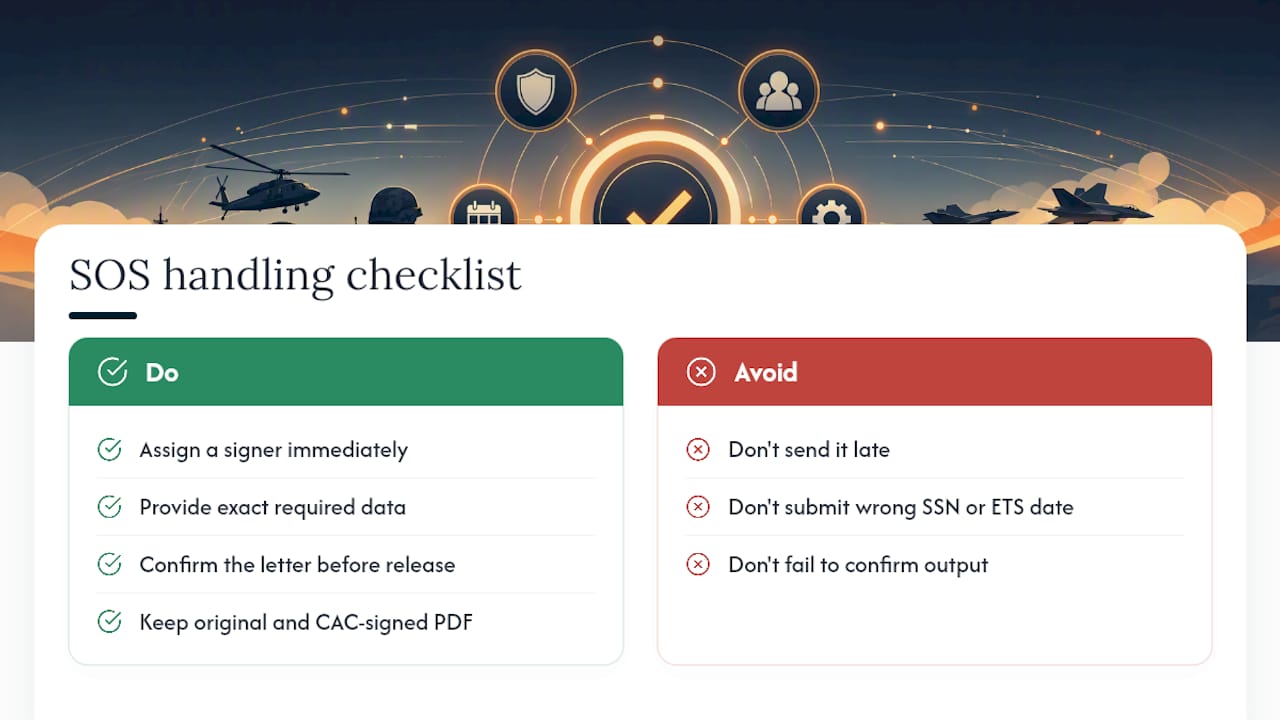
Keep the original. Keep a CAC-signed PDF backup. And give your lender a copy before they ask for it. That one move, handing it over early, is what separates the files that close on time from the ones that sit in underwriting waiting for a document that should have been there on day one.
Sources
- How To Request A VA Home Loan Certificate Of Eligibility (COE) | Veterans Affairs
- Certificate of Eligibility - VA Home Loans
- Military service records | National Archives
- Cbp
Recommended
See what you qualify for in 60 seconds, free and no credit check. Use the eligibility check at the top of this page.