
Traditional lenders want a few months of bank statements to verify reserves and confirm your deposits match your income. Bank-statement (non-QM) programs, built for self-employed borrowers, want a year or two, because deposits become the actual income calculation rather than a side check. Underwriters on either path are hunting for the same three things: are deposits consistent, is there a large unexplained deposit sitting on the page, and does the account show overdrafts or NSF fees.
- Consistency of deposits month to month
- Large, unexplained deposits that could be undisclosed debt or gifts
- Overdrafts and NSF fees that suggest cash flow stress
If your tax returns underreport what your business actually generates, a bank-statement program is usually the better route. If your tax returns already reflect strong, provable income, a conventional loan will almost always be cheaper.
Key Takeaways
Bank-statement mortgage approval hinges on clean, consistent deposits, documented large transactions, and choosing the statement window that matches your loan program.
| Point | Details |
|---|---|
| Match the window to the program | Conventional loans need 2-3 months of statements; bank-statement programs need 12-24 months. |
| Fix red flags early | Resolve NSF patterns and document large deposits before your quiet period starts. |
| Understand the expense factor | A CPA letter can lower your assumed expense factor from the default 50% and raise qualifying income. |
| Separate accounts | Comingled business and personal funds are a leading cause of underwriter follow-up requests. |
| Check qualification early | Texasbankstatementloans offers a 60-second, no-obligation check without specifying down payment amounts. |
Where to Read More
- CFPB: Prepare to Buy a Home covers non-QM risk and general homebuying guidance.
- NMLS Consumer Access lets you verify a lender’s licensing before sharing statements.
Table of Contents
- How Many Months of Bank Statements Do Lenders Need?
- What Do Underwriters Actually Look for on Bank Statements?
- How Do Bank-Statement Mortgage Programs Underwrite Self-Employed Income?
- How Do You Prepare and Clean Up Bank Statements Before Applying?
- What Other Documents Do Lenders Request, and When Do They Recheck Statements?
- Worked Example: How Lenders Calculate Qualifying Income From Deposits
- How Texasbankstatementloans Helps You Turn Deposits Into an Approval
- Frequently Asked Questions
- Sources
How Many Months of Bank Statements Do Lenders Need?
The gap between the two paths is wide. Conventional and most government-backed loans ask for a few months of statements, used mainly to confirm reserves and spot-check that your paycheck deposits match your W-2. Bank-statement mortgage programs ask for a year or two, because that stretch of deposits is the income documentation, standing in for a tax return.
- 2-3 months: standard verification for W-2 or salaried borrowers
- 12 months: common for stable, established businesses with steady deposit patterns
- 24 months: often required for newer businesses, seasonal income, or when a lender wants a longer trend line before pricing the loan
Twelve months usually gets you priced closer to a 12-month average; 24 months can smooth out a slow quarter but also means twice as many pages to explain. Experian notes that bank statement loans typically pull from that 12 to 24 month window, and missing pages or unexplained gaps in the sequence are one of the fastest ways to stall a file in underwriting.
What Do Underwriters Actually Look for on Bank Statements?
Underwriters read statements the way an auditor reads a ledger, line by line, looking for anything that breaks the pattern. Here’s the order they typically check things in:
- Deposit consistency. Do monthly totals track close enough to trust an average, or does the pattern zigzag without explanation?
- Large unexplained deposits. Anything unusually large relative to your typical deposit gets flagged, even if it’s your own money moved between accounts.
- Overdrafts and NSF fees. Repeated overdrafts signal cash flow stress that raises default risk in the underwriter’s mind.
- Internal transfers. Money moved from a business account to a personal account is the single most common trigger for manual review, since underwriters have to trace it to make sure it isn’t being counted as income twice.
- Reserves. Statements also double as proof you have cushion left over after the down payment and closing costs.
On the flip side, steady recurring deposits, clearly labeled business payouts (think Stripe, Square, or client ACH deposits), and healthy end-of-month balances all work in your favor. The Mortgage Reports flags overdrafts, unexplained deposits, and inconsistent patterns as the three things underwriters most often push back on.
Pro Tip: Keep a running log of anything unusual the moment it happens, a client’s late invoice payment, a tax refund, a gift from a relative. A one-page letter of explanation written the same week is far more convincing than one written three months later trying to reconstruct memory.
How Do Bank-Statement Mortgage Programs Underwrite Self-Employed Income?
Bank-statement underwriting replaces your tax return with a formula. Lenders total your qualifying deposits over the statement period, strip out transfers between your own accounts and one-time windfalls, divide by the number of months, then apply an expense factor to estimate what actually counts as usable income.
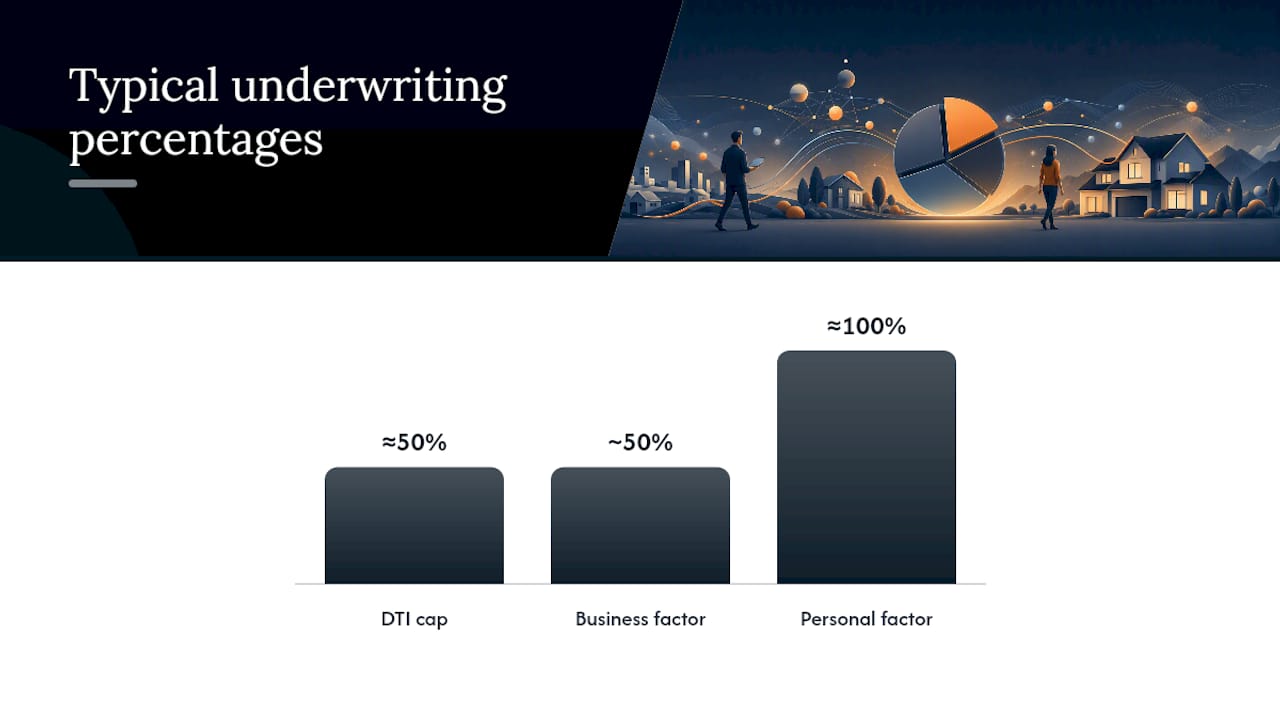
That expense factor matters more than most borrowers realize. Lenders commonly apply a default of roughly around half for business accounts, assuming half of gross deposits cover overhead, and something closer to 100% for personal accounts where the deposits are clearly owner compensation rather than business revenue. A CPA letter documenting your real expense ratio can move that factor in your favor, sometimes significantly, since the lender no longer has to assume the worst case.
| Program Detail | Typical Range |
|---|---|
| Credit score | generally moderate to high credit scores, varies by lender |
| Down payment | starting from a noticeable down payment for qualified borrowers |
| Debt-to-income ratio | Often capped near 50% |
| Statement window | 12-24 months |
| Business account expense factor | ~50% default, lower with documentation |
Bank-statement loans fall outside Qualified Mortgage rules, which means lenders set their own underwriting criteria rather than following a uniform federal standard. The CFPB advises borrowers to read the fine print on non-QM loans carefully, since features like prepayment penalties or higher rates can show up more often in this category than in conventional lending.
Pro Tip: Ask your CPA to write a one-page letter breaking down your actual business expense ratio before you apply. It’s a small ask that can directly raise your qualifying income.
How Do You Prepare and Clean Up Bank Statements Before Applying?
Cleaning up your statements is less about hiding anything and more about making the story obvious at a glance. Underwriters approve fast when the paper trail requires zero guesswork.
- Pull complete monthly statements, every page, including the ones that just say “continued,” since gaps read as red flags even when nothing’s wrong.
- Start a 60-day quiet period. Stop moving large sums between accounts, stop taking out cash advances, and let your deposit pattern settle into something readable.
- Separate business and personal accounts if you haven’t already. Comingled funds are one of the most common reasons files get kicked back for clarification.
- Document every large deposit the moment it lands, with an invoice, a signed gift letter, or a sale receipt attached.
- Resolve any NSF pattern before you apply. A single overdraft from two years ago rarely matters; three in the last four months will draw questions.
Build a simple deposit ledger alongside your statements, and if your accountant can provide a P&L or expense letter, request it early. That paperwork often takes longer to produce than borrowers expect.
Pro Tip: Give your 60-day quiet period real teeth. If you transfer a large sum on day 58, you’ve effectively reset the clock, and the underwriter will ask why.
What Other Documents Do Lenders Request, and When Do They Recheck Statements?
Beyond bank statements, expect requests for a profit-and-loss statement, a CPA letter, and sometimes a formal Verification of Deposit (VOD) sent directly to your bank. Lenders often use preapproval as a snapshot, then recheck accounts closer to closing to confirm funds are still there and no new problems have surfaced since your file was first reviewed. Submit statements unredacted and in full when asked; a cropped screenshot is one of the fastest ways to trigger a follow-up request.
Worked Example: How Lenders Calculate Qualifying Income From Deposits
Say your business deposits total $180,000 over 12 months, after removing a $15,000 owner transfer and a one-time $8,000 insurance payout. That leaves $157,000 in qualifying deposits, divided by 12 months, for a gross monthly average of about $13,083. Apply a 50% business expense factor and qualifying income lands near $6,542 a month.
- Total qualifying deposits, excluding transfers and one-time items
- Divide by the number of statement months
- Apply the expense factor for your account type
- Compare the result against a sample mortgage payment to check your DTI
Attach an invoice or contract to any deposit over your typical average, it saves a follow-up email later.
A quick note on what actually derails these files
I’ve seen the same mistake sink otherwise strong applications: borrowers wait until underwriting flags a deposit to explain it, instead of documenting it the week it happened. Start your paper trail now, and run a no-obligation qualification check before you commit to a specific lender or rate.

How Texasbankstatementloans Helps You Turn Deposits Into an Approval
If you’re self-employed, Texasbankstatementloans built its entire process around the math above, evaluating a year or two of your actual deposits instead of tax returns that underreport what your business really brings in. That means the income your accountant works hard to minimize on paper doesn’t have to work against you when you’re trying to buy a house.
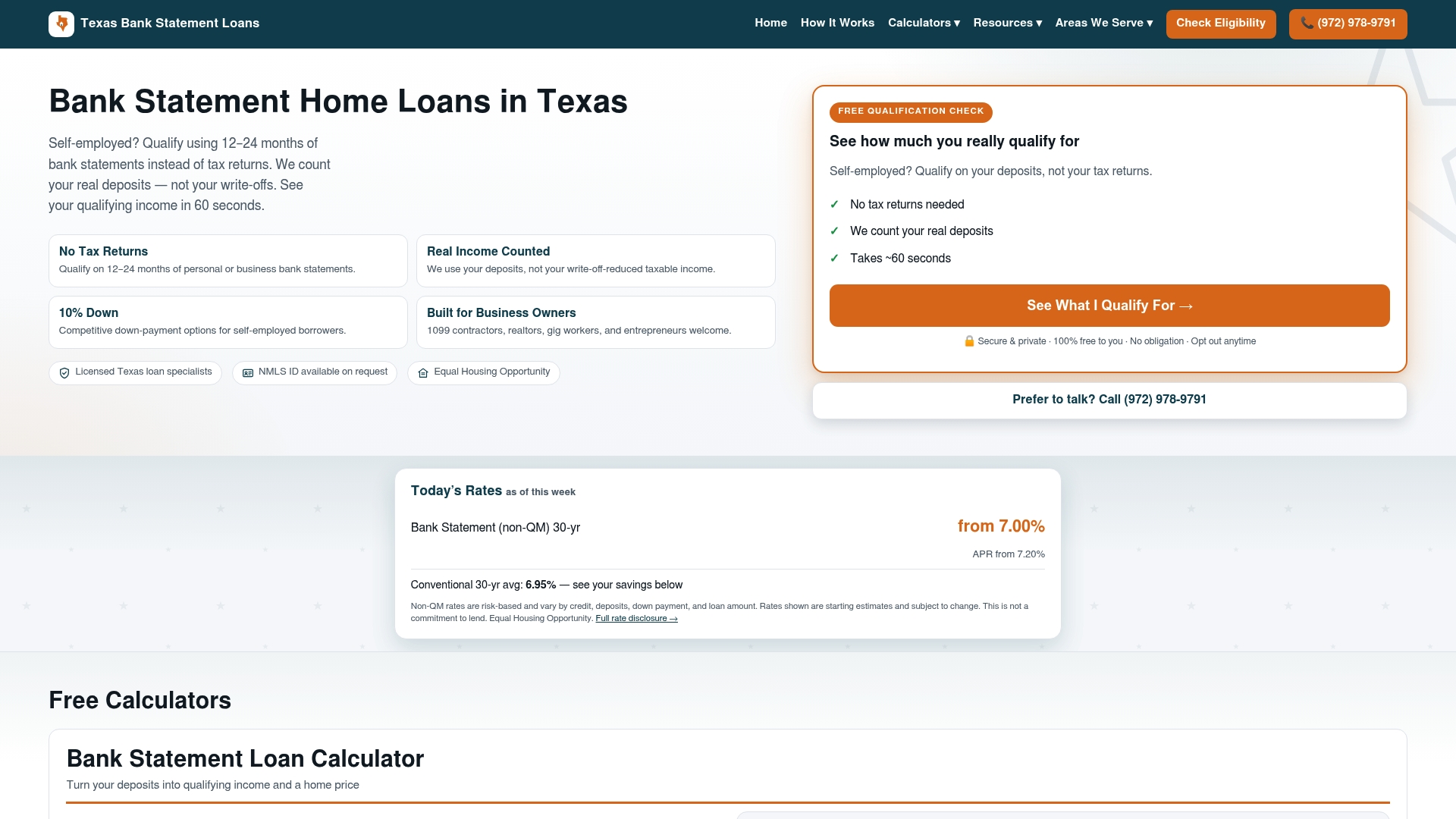
A qualification check takes about 60 seconds and gives you a realistic read on what you can afford before you gather a single page of statements, no hard credit pull, no obligation. If you want to see actual numbers first, run your deposits through the bank statement loan calculator or check current rates before you talk to a loan officer.
Frequently Asked Questions
How many bank statements do I need for a mortgage? Conventional lenders typically want a few months. Bank-statement (non-QM) programs for self-employed borrowers usually require a year or two, since deposits replace tax returns as proof of income.
Do lenders count gross deposits or net income from bank statements? Neither exactly. Lenders total qualifying deposits, remove transfers and one-time items, then apply an expense factor, often around half for business accounts, to estimate usable income.
What counts as a red flag on bank statements for a mortgage? Repeated overdrafts, unexplained large deposits, and transfers between your own accounts top the list, since each one raises questions an underwriter has to resolve before closing.
Can I use personal bank statements instead of business statements? Yes, many programs accept either, though personal accounts often get a higher expense factor since income there is treated as direct compensation rather than business revenue.
Will my bank statement loan have a higher rate than a conventional mortgage? Often, yes. Because these loans fall outside Qualified Mortgage rules, pricing and terms vary by lender, and rates tend to run higher to offset the added underwriting flexibility.
This article is general information, not a substitute for advice from a qualified financial advisor. Consult a qualified financial professional about your own circumstances before acting on anything here.
Sources
- Prepare to buy a home | Consumer Financial Protection Bureau
- What Is a Bank Statement Loan? | Experian
- Bank Statements for Self-Employed: 12-24 Months + What Lenders Check (2026)
- Bank statements: 3 things mortgage lenders don’t want to see | The Mortgage Reports
Recommended
See what you qualify for in 60 seconds, free and no credit check. Use the eligibility check at the top of this page.