
Yes, some U.S. lenders underwrite mortgages for ITIN holders who lack a traditional credit score. Your fastest path is to document steady income and alternative payment history, then compare Loan Estimates from multiple lenders. Start by gathering bank statements plus rent and utility proof, and consider HUD-approved housing counseling before you sign anything.
TL;DR:
- Lenders may require multiple rent, utility, phone, or insurance histories, plus written verification, and manual underwriting when no borrower has a credit score.
- Many programs limit financing to primary residences, while investment properties may need a different product; expect higher down payments, reserves, or rates.
- Self-employed borrowers whose tax returns understate earnings can consider bank statement loans, which assess personal or business deposits instead of reported taxable income.
- Apply early for an ITIN: processing usually takes about seven weeks, rising to nine to eleven weeks during peak tax season.
- Compare Loan Estimates from several lenders side by side, checking interest rates, fees, and prepayment penalties because nontraditional terms can vary widely.
Table of Contents
- What lenders typically check for ITIN mortgages
- Mortgage programs that can work with an ITIN and no credit
- How to build a nontraditional credit history lenders will accept
- How to apply for or renew an ITIN before you apply for a mortgage
- Lender-ready checklist and the right questions to ask
- How bank-statement underwriting helps ITIN borrowers
- Check your options with a quick qualification check
- FAQ
- Sources
What lenders typically check for ITIN mortgages
An Individual Taxpayer Identification Number is a tax processing number the IRS issues to people who need to file U.S. taxes but don’t qualify for a Social Security Number. It doesn’t grant work authorization or immigration status, and it isn’t a substitute identifier for federal loan programs that require an SSN. For mortgage purposes, it’s simply the number a lender uses to verify your tax identity and pull your file together.
Lenders reviewing an ITIN application generally look at a consistent set of items:
- Valid government ID along with your ITIN documentation or your IRS receipt confirming an application is pending
- Proof of steady income, either through tax returns or bank statements showing regular deposits
- Occupancy and property type, since many programs limit financing to a primary residence rather than an investment property
- Down payment ranges that typically run higher than conventional loans, reflecting the added risk lenders take on without a credit score
When you have no FICO score at all, lenders usually ask for documented nontraditional credit references, such as rent and utility payment records, or they shift to bank-statement underwriting that evaluates your actual cash flow instead of a score. Reserve requirements (extra savings left after closing), debt-to-income ratios, and down payment minimums tend to run a bit higher on these programs than on a standard conventional loan, since the lender is replacing one risk signal (credit score) with others.
Pro Tip: Pull your own rent and utility payment history together before you apply. A clean record of on-time payments does more for your file than almost anything else.
Mortgage programs that can work with an ITIN and no credit
Several loan categories are built around exactly this situation, and each fits a slightly different borrower profile.
- Specialized ITIN mortgage programs accept your ITIN in place of an SSN, generally expect a higher down payment than conventional financing, and often focus on primary residences.
- Bank-statement (non-QM) loans use personal or business deposits to establish income, which helps self-employed borrowers whose tax returns show heavy write-offs rather than their true cash flow.
- Nontraditional-credit and manual underwriting programs accept rent, utility, phone, and insurance payment histories as a substitute for a credit score, usually requiring several references rather than just one or two.
Each path has tradeoffs worth knowing upfront. Property eligibility can be narrower than with a conventional loan, interest rates or reserve requirements may run higher to offset the lack of a credit score, and many of these files require manual underwriting rather than an automated approval, which adds a bit more time and documentation to the process. None of that rules you out. It just means the paperwork does more of the work a credit score would otherwise do.
How to build a nontraditional credit history lenders will accept
Nontraditional credit generally includes rent, utilities, phone bills, and insurance payments, anything that shows a pattern of on-time financial obligations outside the traditional credit bureau system. The CFPB and FHFA have both pointed to this kind of alternative data as a legitimate way to expand mortgage access for borrowers who don’t have a conventional credit file.
- Collect bank statements that clearly show recurring rent or mortgage-style payments going out each month.
- Gather utility, phone, and insurance statements covering the same period.
- Ask landlords or service providers for written verification letters confirming your payment history.
- Keep a simple rent ledger if your landlord doesn’t provide one, dated and consistent with your bank records.
Fannie Mae’s automated underwriting system, Desktop Underwriter, can factor in rental payment history for qualifying borrowers, but when no borrower on the loan has a credit score, the file typically needs manual underwriting with multiple nontraditional references and sometimes additional reserves. Lenders may ask for multiple payment histories before treating your file as fully documented.
Pro Tip: Ask your landlord in writing, not just verbally, for a rental payment letter as soon as you start house hunting. It’s one document that’s easy to forget until a lender asks for it on a deadline.
How to apply for or renew an ITIN before you apply for a mortgage
If you don’t yet have an ITIN, you’ll file Form W-7 through one of several routes:
- By mail directly to the IRS
- In person at an IRS Taxpayer Assistance Center
- Through a Certifying Acceptance Agent, who can authenticate your documents for you
- At select Volunteer Income Tax Assistance (VITA) sites
Processing typically takes about 7 weeks, stretching to 9 to 11 weeks during peak tax season, so starting early matters if you’re also trying to close on a home. Most first-time applicants must attach a federal tax return to their W-7, but Exception 3 covers mortgage interest third-party reporting and can let you apply without attaching a return in certain cases. Tell your lender about your ITIN status as soon as you start the process so they can tell you exactly which documentation and timing will work for your file, including any needed TIN matching & verification.
Lender-ready checklist and the right questions to ask
Before you submit anything, put together:
- Personal or business bank statements
- Proof of payment history: rent receipts, utility bills, insurance statements
- Government-issued ID and your ITIN card or IRS receipt notice
- Business records or proof of self-employment, if that applies to you
Then ask every lender you’re considering the same set of questions: Do you accept ITIN borrowers? Do you offer bank-statement or nontraditional-credit underwriting? What down payment and reserves do you require? Which credit scoring model, Classic FICO or VantageScore 4.0, will you use if the loan is sold to Fannie Mae or Freddie Mac?
Once you have a few offers in hand, compare the Loan Estimates side by side. The CFPB recommends looking closely at interest rates, fees, and prepayment penalties, since nontraditional loan terms can vary more widely than on a standard conventional mortgage. A pre-qualification gives you a rough sense of what you can afford, while a pre-approval, often involving manual underwriting for ITIN files, carries more weight when you’re ready to make an offer.
Pro Tip: Request Loan Estimates from multiple lenders before committing. Even a half-point difference in rate adds up to thousands of dollars over a 30-year term.
How bank-statement underwriting helps ITIN borrowers
Our bank-statement approach at Texasbankstatementloans looks at deposits instead of tax returns, which helps self-employed borrowers, 1099 contractors, and gig workers whose tax filings don’t reflect their actual earning power. That matters for ITIN holders in particular, since many run small businesses or freelance work where write-offs shrink the income a traditional lender would see on paper.

We offer down payment options along with free calculators to estimate purchasing power before you apply. A quick, no-obligation qualification check can give you a preliminary picture of what you could afford, which is a useful first step before you start gathering the full document package.
Check your options with a quick qualification check
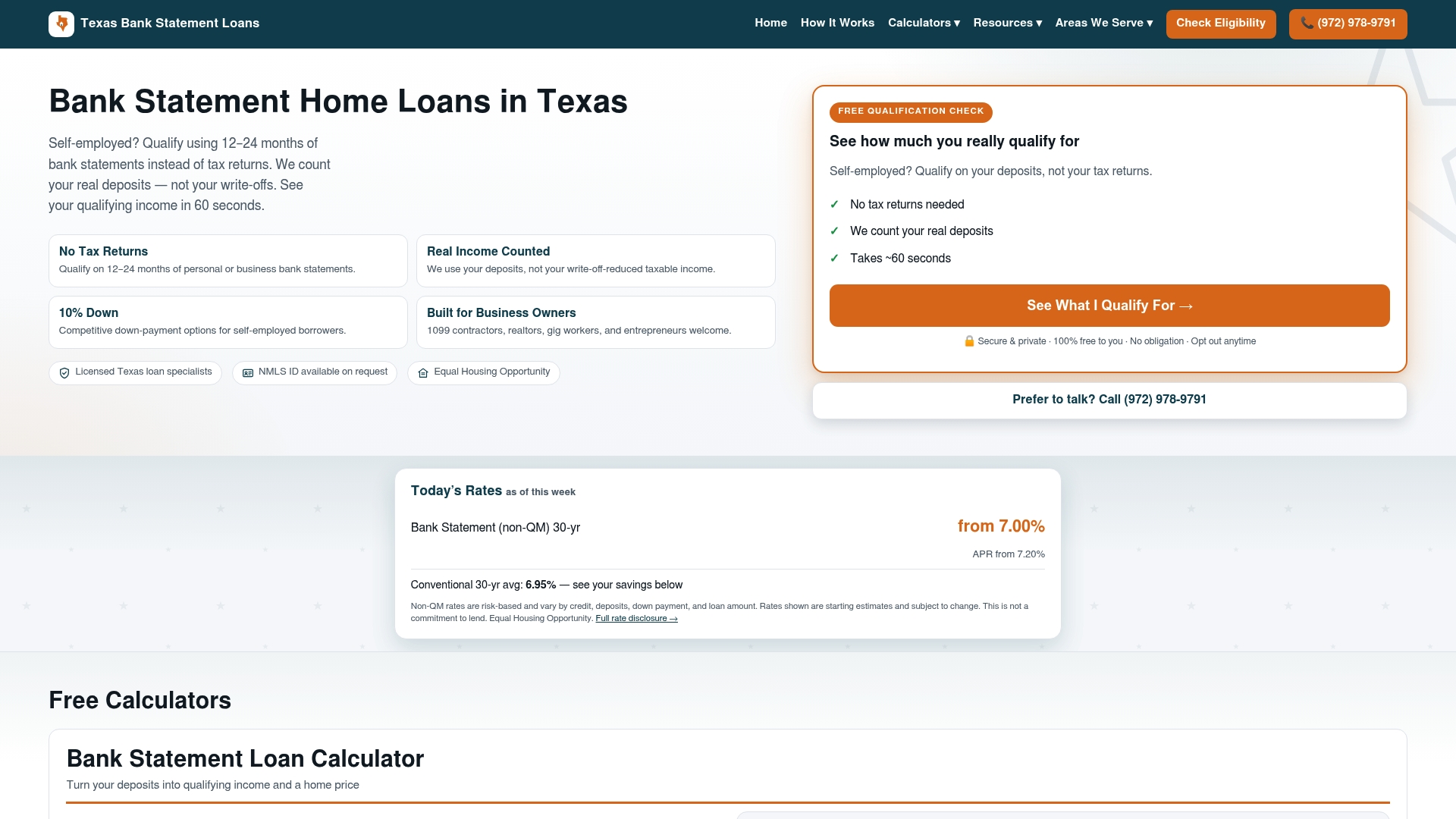
If you’re an ITIN holder trying to figure out whether bank-statement underwriting fits your situation, the fastest way to find out is to run the numbers yourself. Our free mortgage calculators give you a quick affordability estimate, and our Bank Statement Home Loans page walks through how the deposit review works in practice. If you’re weighing an investment property instead of a primary residence, our DSCR loan calculator looks at property cash flow rather than personal income.
After you start a qualification check, expect a short form, a request for your bank statements and ID documentation, and a follow-up call from a loan officer to walk through your specific file. Check current Bank Statement (non-QM) 30-yr rates to see where today’s pricing stands before you apply.
This article is general information, not a substitute for advice from a qualified financial advisor. Consult a qualified financial professional about your own circumstances before acting on anything here.

FAQ
Can I get a mortgage loan with an ITIN number?
Yes, some lenders accept ITIN applicants through specialized ITIN mortgage programs or bank-statement underwriting that doesn’t require a traditional credit score. Expect a higher down payment than a conventional loan and plan to document your income and payment history thoroughly.
Do you have to be a U.S. citizen to get a mortgage loan?
No, U.S. citizenship isn’t required to get a mortgage. Lenders that work with ITIN holders underwrite based on documented income, identification, and payment history rather than citizenship status.
What will disqualify you from getting a mortgage?
Common disqualifiers include unverifiable income, insufficient down payment or reserves, and an inability to document a payment history when you have no credit score. Lenders also decline files where property type or occupancy doesn’t fit the program’s rules, such as using an owner-occupant program for an investment property.
What credit score is needed for a $10,000 loan?
Credit score requirements vary by lender and loan type rather than following one fixed number, especially for smaller personal loans outside the mortgage space. For ITIN mortgage borrowers with no score at all, lenders typically substitute documented nontraditional credit references instead of a minimum score requirement.
Sources
- Irs
- How to deal with “bad credit”-or no credit-when you want to buy a home | Consumer Financial Protection Bureau
- FHFA Announces Inclusion of Rental Payment History in Fannie Mae’s Underwriting Process | FHFA
Recommended
See what you qualify for in 60 seconds, free and no credit check. Use the eligibility check at the top of this page.