
Most lenders require a substantial history of self-employment, typically around two years or an equivalent period including related prior employment, before they count your income toward a mortgage. If you fall short of that window, alternative paths exist, including programs that evaluate bank deposits instead of tax returns, which can open the door sooner.
TL;DR:
- Most lenders require two years of self employment, but documented work in the same or a related occupation can help meet that threshold.
- Lenders usually average the two latest tax years and may use the lower figure, so legitimate deductions can reduce qualifying income despite healthy cash flow.
- Conventional loans rely on tax returns; bank statement programs assess 12 to 24 months of deposits but may require different reserves and carry higher rates.
- If current income exceeds tax returns, lenders generally require an audited profit and loss statement or signed quarterly filings before counting the increase.
- Prepare signed returns, a current profit and loss statement, reconciled bank accounts, and client deposit records; avoid unexplained transfers and build cash reserves before applying.
Table of Contents
- Quick Facts: The Essentials at a Glance
- Underwriting Criteria: Time in Business, Income Stability, and Continuity
- Documents Underwriters Use and What Each Proves
- How Lenders Turn Tax and Bookkeeping Records into Qualifying Income
- Which Loan Paths Help Self-Employed Borrowers
- Actionable Preparation Checklist Before You Apply
- How Bank Statement Underwriting Fits Typical Self-Employed Cases
- Start a Quick Qualification Check
- FAQ
- Sources
- Primary Sources and Further Reading
Quick Facts: The Essentials at a Glance
Before you dig into underwriting detail, here’s what matters most for a self-employed borrower.
- Two-year rule: lenders generally want two years of self-employment, and anyone with 25% or greater ownership in a business is treated as self-employed for underwriting purposes.
- Core documents: signed federal tax returns, a profit and loss statement, bank statements, and IRS transcripts form the backbone of most income verification.
- Income averaging: lenders typically average your income over two years and may use the lower of the two figures, which means heavy write-offs can shrink your qualifying income even if cash flow looks strong.
- Preparation steps: reconcile your bookkeeping, produce a year-to-date profit and loss statement, and build up reserves before you apply.
These basics apply whether you’re using a conventional loan, an FHA loan, or an alternative program built around bank statements.
Underwriting Criteria: Time in Business, Income Stability, and Continuity
Underwriters care about one thing above all else: whether your income is likely to continue. That’s why time in business matters so much. Fannie Mae’s selling guide generally calls for a two-year history of self-employment earnings, documented through signed individual federal tax returns, and lenders must prepare a written analysis of that business income before counting it. FHA and HUD guidance follows a similar structure: self-employment income becomes effective once a borrower has two or more years in the business, with documentation requirements that scale depending on how the business is organized.
Ownership thresholds matter. Lenders look at each business separately, and if business funds are being used for a down payment, closing costs, or reserves, they may request a business credit report and a cash-flow analysis on top of the personal file.
What if you’ve been self-employed for less than two years? This is where the related-occupation exception comes into play. If your self-employment history is shorter, HUD guidance allows lenders to count prior employment in the same or a related field toward that two-year window, provided it’s documented with prior W-2s, employment letters, or evidence of relevant training. A graphic designer who freelanced for a year after five years as a salaried designer at an agency, for example, may still clear the bar because the occupation didn’t change, only the employment structure did.

Seasonality and disruption get special treatment as well. A landscaping business with predictable winter slowdowns isn’t penalized the same way an unexplained income gap would be, because underwriters are trained to read a trend line rather than a single low month. For borrowers whose income dipped during COVID-era shutdowns, HUD guidance allows excluding closed months from the income calculation when the disruption and recovery are documented, and permits aggregating pre- and post-event history to reach the required time-in-business threshold. The common thread across all these rules is continuity: lenders want to see that whatever dip or gap occurred, your underlying business kept functioning and your income trend points forward, not down.
Documents Underwriters Use and What Each Proves
Every document in a self-employed mortgage file answers a specific underwriting question. Knowing what each one proves makes the process far less confusing when your loan officer requests it.
- Signed individual federal tax returns (Form 1040 with schedules): the baseline requirement is two years, and this is the primary evidence Fannie Mae relies on to establish an earnings history and trend.
- Business tax returns: required when the business is structured as a partnership, S corporation, or corporation, since personal returns alone won’t capture the full financial picture.
- Year-to-date profit and loss statement and balance sheet: these show how the business is performing in the current year, which matters if your most recent numbers diverge from prior tax returns.
- Bank statements (business and personal): used to confirm deposit patterns and, in alternative programs, to calculate qualifying income directly.
- IRS transcripts: lenders order these to confirm that the tax returns you submitted match what was actually filed with the IRS.
- Business registration and ownership documentation: articles of incorporation, partnership agreements, or a business license establish how long the business has existed and who owns what share.
The IRS maintains forms and schedules self-employed filers use, including Schedule C and related business returns, and lenders lean on these same documents because they’re the most reliable third-party record of reported income. That reliance creates a well-known tension: if you’ve legitimately minimized taxable income through deductions, your tax returns may understate the cash flow your business actually generates.
One documentation wrinkle catches many business owners off guard. If your year-to-date profit and loss statement shows materially higher income than what your tax returns reflect, a lender generally won’t just take your word for it. Expect a request for an audited P&L or signed quarterly tax filings to support that higher figure. Without that extra support, the income calculation typically defaults back to whatever your tax returns show, no matter how strong this year has been.
For corporations and partnerships, expect additional layers: K-1s, a corporate resolution authorizing the loan if business assets are pledged, and sometimes a letter from your accountant confirming your ownership percentage and the business’s continued operation. Organizing these in advance, ideally in a single folder by tax year, saves real time once underwriting begins.
How Lenders Turn Tax and Bookkeeping Records into Qualifying Income
The math behind self-employed mortgage qualification isn’t mysterious, but it does catch people off guard. The standard approach averages your gross self-employment income over the two most recent tax years. When your most recent year is lower than the prior one, many lenders will use the lesser of the two figures, or the straight average, depending on the specific trend and agency guidelines. That means a strong current year doesn’t always offset a weaker previous one in the way borrowers expect.
Depreciation and other non-cash expenses complicate the picture further. Some deductions, like depreciation, can be added back to your taxable income because they don’t represent actual cash leaving the business. Other write-offs, like vehicle expenses or home office deductions taken as a flat percentage, may or may not be added back depending on how they were reported and whether they reflect a genuine ongoing cash expense. This is exactly why two business owners with identical bank account balances can qualify for very different loan amounts: one simply reported more taxable income than the other.
HUD and FHA guidance carves out specific exceptions for borrowers whose income was disrupted by events like COVID-19 closures. HUD’s guidance permits aggregating income from before and after a documented disruption, rather than forcing a straight two-year average that unfairly penalizes a temporary closure. This lesser-of and aggregation framework reflects a broader underwriting philosophy: lenders want the most defensible, conservative estimate of what you’ll actually earn going forward, not the most optimistic one.
All of this calculation work happens inside the framework of the ability-to-repay rule, which requires lenders to verify your current or reasonably expected income using reasonably reliable third-party records before extending a qualified mortgage. That’s the regulatory reason tax returns and transcripts carry so much weight: they’re documents the IRS itself can confirm, which makes them the most defensible evidence a lender can point to later if a loan is ever questioned.

Which Loan Paths Help Self-Employed Borrowers
Self-employed borrowers generally choose between two broad paths, and the right one depends on how your tax returns compare to your actual cash flow.
- Conventional and government-backed loans rely on the tax-return-based calculation described above, typically require two years of self-employment documentation, and come with down payment and reserve expectations that vary by loan program and credit profile.
- Bank-statement (non-QM) programs use 12 to 24 months of personal or business bank deposits to estimate income instead of tax returns, which helps borrowers whose write-offs make their taxable income look smaller than their actual cash flow.
The tradeoff is real: bank-statement programs are built for documentation flexibility, not for matching the lowest possible rate on a conventional loan, and they may carry different reserve or down payment profiles depending on the lender and loan amount. For a borrower whose tax returns reflect aggressive, legitimate deductions, that tradeoff is often worth it, because the alternative is qualifying for far less home than the business can genuinely support.
Pro Tip: Before ruling out a tax-return-based loan, ask your accountant whether a one-year adjustment to how you report certain deductions could meaningfully change your qualifying income on next year’s return.
A bank-statement path makes the most sense when your deposits consistently exceed your reported taxable income by a wide enough margin that a conventional lender’s calculation would underqualify you. If your tax returns already reflect your real earning power, a standard loan program usually remains the more straightforward route, and we outline how bank statement loans for self-employed buyers work when that gap becomes the deciding factor.
Actionable Preparation Checklist Before You Apply
A little organization months before you apply can be the difference between a smooth underwriting process and a stressful one.
- Gather two full years of signed federal tax returns, every schedule, and your business returns if your entity structure requires them.
- Produce an updated year-to-date profit and loss statement and balance sheet that matches your bookkeeping records exactly.
- Reconcile your business and personal bank accounts so deposits and expenses are clearly categorized and explainable.
- Avoid large, unexplained transfers between accounts in the months leading up to your application, since underwriters flag anything that looks inconsistent with your documented income.
- Document recurring deposits from clients or platforms with invoices or contracts so a reviewer can see the income pattern, not just the balance.
- Build up reserves beyond what you expect to need for a down payment and closing costs, since self-employed files often draw extra scrutiny on cash flow.
- Talk with a mortgage professional early about how your specific deductions affect your qualifying income, and ask directly whether a bank-statement path fits your situation better than a conventional one.
Doing this work before you start shopping for a rate, rather than after a lender has already flagged a gap, keeps you in control of the timeline instead of scrambling to produce documents on short notice.
How Bank Statement Underwriting Fits Typical Self-Employed Cases
The most common frustration I hear from self-employed borrowers isn’t that they don’t earn enough. It’s that their tax strategy, built sensibly to minimize what they owe the IRS, ends up working against them when a lender calculates qualifying income from those same returns. That conflict is predictable, and planning for it a year or two before you want to buy is far more effective than trying to fix it during underwriting.
This is where bank-statement underwriting earns its place as a realistic option rather than a last resort. For a contractor or gig worker whose deposits tell a stronger story than their Schedule C, that’s a meaningful difference in what they can qualify to buy.
If your tax returns and your bank balance tell noticeably different stories, that’s the signal to reach out to a bank-statement lender before you assume your options are limited.
- Saad
Start a Quick Qualification Check
If your tax returns understate what your business actually brings in, a bank-statement review may show you qualify for more than a standard calculation suggests. A quick qualification check can take about 60 seconds and give you a realistic read on affordability before you commit to a full application.
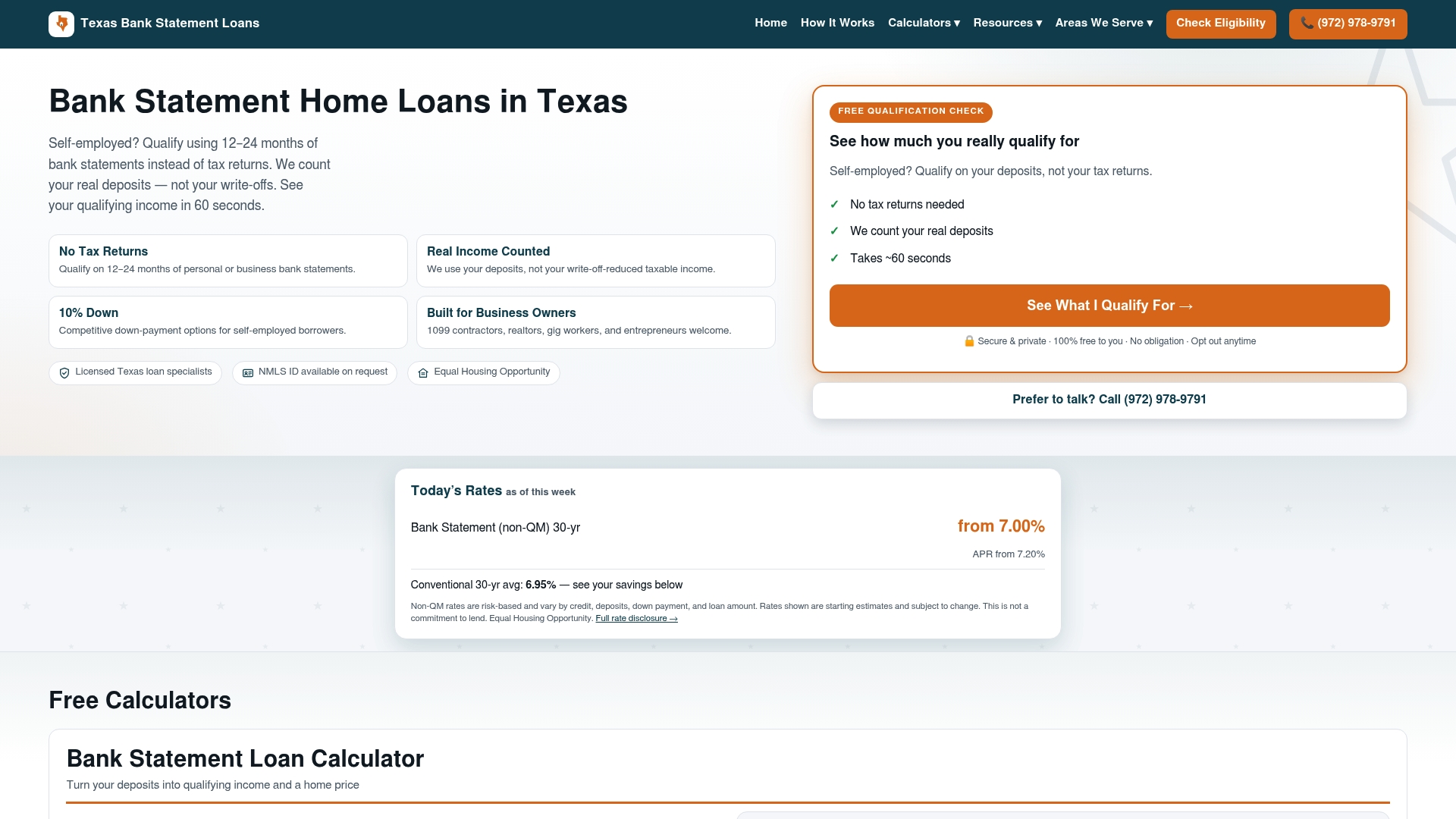
Have your last 12 to 24 months of bank statements, a rough estimate of your credit profile, and your target purchase price on hand before you start. From there, you can explore current bank statement loan rates for our 30-year non-QM program, or check out options if you’re investing rather than buying a primary residence through our DSCR loan calculator. We also serve self-employed buyers directly in Houston, Plano, Midland, and Tyler.
This article is general information, not a substitute for advice from a qualified financial advisor. Consult a qualified financial professional about your own circumstances before acting on anything here.
FAQ
How many years do I have to be self-employed to get a mortgage?
Most lenders want two years of self-employment history, documented through signed federal tax returns, before counting that income fully. If you have less than two years, lenders can often count prior employment in the same or a related occupation toward that two-year window.
Do most people have their house paid off when they retire?
This depends heavily on individual circumstances like when someone bought their home, their mortgage term, and their broader financial planning, so there’s no single figure that applies to every self-employed homeowner. A mortgage professional can help you model a payoff timeline based on your specific loan terms and retirement goals.
What is the 3-7-3 rule for a mortgage?
This isn’t a standardized underwriting term used by Fannie Mae, HUD, or the CFPB, and definitions vary widely depending on the source. If you’ve encountered this phrase, it’s worth asking your loan officer directly what rule or disclosure timeline they’re referencing, since TILA-RESPA rules around Loan Estimate and Closing Disclosure timing are the closest regulated timelines that affect your application.
What salary do you need for a $400,000 mortgage?
The income needed depends on your interest rate, down payment, existing debt, property taxes, and insurance costs, so there’s no single salary figure that applies universally. A loan officer can run your specific numbers, including how your self-employment income is calculated under the ability-to-repay rule, to give you an accurate qualifying range.
Sources
- Underwriting Factors and Documentation for a Self-Employed Borrower | Fannie Mae
- Section D. Borrower Employment and Employment Related Income (HUD Guidance)
- CFPB guide: Ability-to-Repay / QM small-entity compliance guidance
- IRS: Self-Employed Individuals Tax Center
Primary Sources and Further Reading
For readers who want the underwriting rules firsthand, review HUD’s self-employment guidance, Fannie Mae’s selling guide, the CFPB’s ability-to-repay guide, and the IRS Self-Employed Individuals Tax Center. For a third-party look at alternative underwriting, see this explainer on no tax return business loans. When you’re ready, start with our bank statement loan programs.
See what you qualify for in 60 seconds, free and no credit check. Use the eligibility check at the top of this page.