
A 12 month bank statement review is defined as an income verification method where lenders average your total qualifying deposits over the prior 12 months to determine your mortgage eligibility. For self-employed borrowers and 1099 contractors, this method replaces tax returns as the primary income proof. Tax returns often understate real earnings due to legitimate business deductions, which means traditional mortgage underwriting routinely disqualifies borrowers who are genuinely creditworthy. The 12 month review solves that problem by measuring actual cash flow instead of taxable income, giving you a direct path to mortgage qualification based on what you actually earn.
How does a 12 month bank statement review calculate qualifying income?
Lenders calculate qualifying income by summing all deposits across your 12 monthly statements, applying an expense factor, then dividing by 12 to get your average monthly income. Each step in that process directly affects how much home you can afford.

The expense factor is the most misunderstood part of the calculation. Lenders apply it to account for business operating costs, since your gross deposits include money you spend to run your business. Business account expense factors range from 30-60%, while personal accounts often use 50% or more. A lower expense factor means more of your deposits count as qualifying income.
Here is a concrete example of how the math works:
- Total deposits over 12 months: $456,000
- Expense factor applied (50%): $228,000 qualifying income
- Average monthly qualifying income: $19,000
- Estimated qualifying loan amount: Based on your debt-to-income ratio and current rates
The type of account you use matters significantly. Business checking accounts typically produce a higher qualifying income than personal accounts because lenders assign them lower expense factors. If you deposit business revenue into a personal account, the lender assumes a larger portion covers personal expenses, which reduces your qualifying income.
Pro Tip: Keep all business revenue flowing into a dedicated business checking account for at least 12 months before applying. This single habit can meaningfully increase your qualifying income calculation.
Lenders also exclude non-income deposits from the calculation. Transfers between your own accounts, loan proceeds, and one-time asset sales do not count as qualifying income. Documenting the source of any large or irregular deposit protects you from having those funds excluded or flagged.
12 vs 24 month bank statement comparison: which period works better for you?
The choice between a 12 and 24 month review depends on the direction your income has moved over the past two years. Loan officers often calculate qualifying income from both periods simultaneously and select the higher figure to maximize your purchasing power. That means you do not always have to choose.
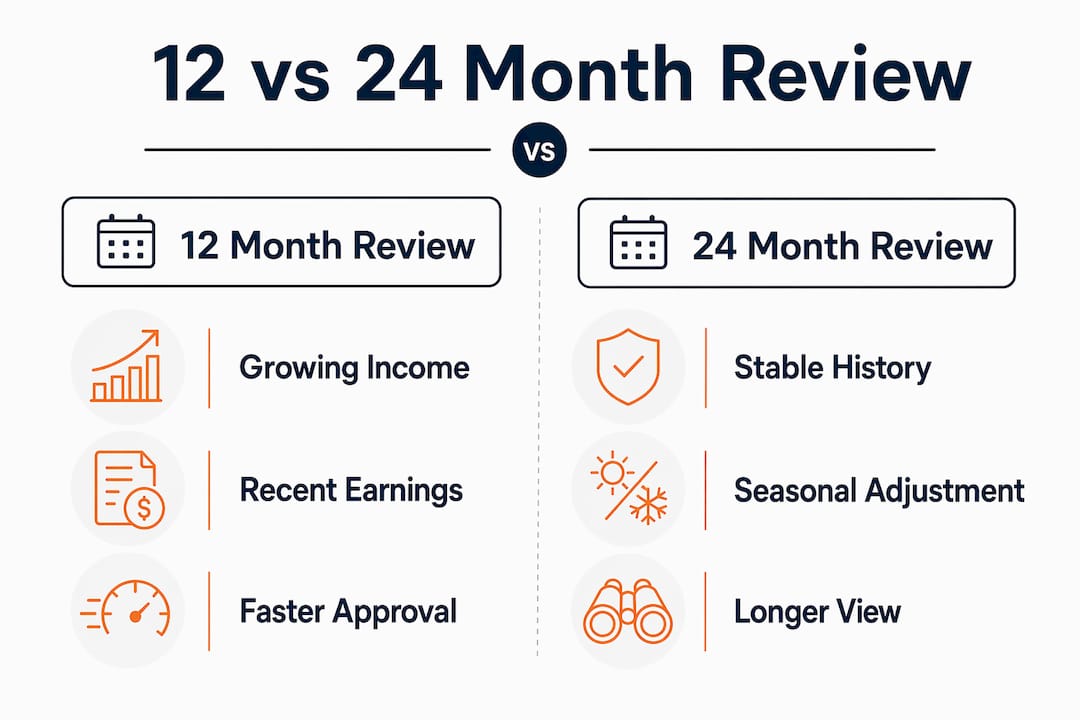
A 24 month review smooths out seasonal swings and gives lenders a longer view of your income stability. If your business had a slow year two years ago followed by a strong year, the 24 month average may actually hurt you by pulling your qualifying income down. The 12 month review captures only your most recent performance.
| Factor | 12 month review | 24 month review |
|---|---|---|
| Best for | Growing or recently improved income | Stable or seasonal businesses |
| Income averaging | Recent 12 months only | Full 2-year average |
| Seasonal impact | Higher if recent months are strong | Smoothed across 2 years |
| Lender preference | Common for newer businesses | Preferred for established income |
| Rate impact | Slightly higher in some programs | Often lower rates with 24 months |
12 month reviews benefit growing businesses by capturing recent higher income, while 24 month reviews may dilute that growth by averaging in lower earlier periods. If your revenue has climbed steadily over the past year, the 12 month period almost always produces a stronger qualifying income number.
Pro Tip: Ask your loan officer to run both calculations before committing to a program. The higher qualifying income figure is the one that should drive your loan structure.
Rate and down payment terms can differ between 12 and 24 month programs. Some lenders price 12 month programs at a slightly higher rate because the shorter window carries more risk in their view. That trade-off is often worth it when the income difference is substantial.
What documentation do lenders require for a bank statement mortgage?
Lenders require a specific set of documents to process a bank statement mortgage, and missing any one of them delays approval. Standard bank statement loan requirements include credit scores from 620-660, down payments of 10-20%, and reserves of 3-12 months. Reserves refer to the liquid assets you hold after closing, measured in months of mortgage payments.
The core documentation checklist looks like this:
- 12 consecutive months of bank statements from the same account, with no gaps. Missing a single month forces the lender to restart the review period.
- Business license or CPA letter confirming you are self-employed and have been operating for at least one to two years.
- Profit and loss statement prepared by a CPA, covering the same 12 month period as your statements.
- Government-issued ID and Social Security number for identity verification.
- Proof of reserves showing liquid assets equal to 3-12 months of your projected mortgage payment.
Consistency across all 12 statements is non-negotiable. Lenders look for a stable or growing deposit pattern. A sudden spike in deposits in the final month before application raises questions about whether that income is sustainable. Lenders commonly require 12 to 24 consecutive months of statements depending on the program, with 12 months favored for newer or growing businesses.
Your credit score directly affects your interest rate, not just your approval odds. Borrowers at 660 and above typically access better pricing than those near the 620 floor. Strengthening your credit before applying is one of the highest-return preparation steps you can take.
What are the common red flags in a bank statement review?
Red flags in your bank statements trigger additional lender scrutiny and can reduce your qualifying income or stall your approval entirely. Common red flags include NSF fees, large round-number deposits, sudden deposit spikes, frequent personal transfers mixed into business accounts, and declining deposit trends.
Each red flag tells a different story to an underwriter:
- NSF fees signal cash flow problems and suggest you are spending more than you earn.
- Large round-number deposits look like transfers or loans rather than earned income, and lenders may exclude them.
- Sudden deposit spikes in the months before application suggest income manipulation rather than organic growth.
- Commingled funds occur when personal and business transactions share the same account, making it impossible to isolate business income cleanly.
- Declining deposit trends suggest your business is contracting, which raises questions about future income sustainability.
Preparing clients for a bank statement review means addressing these issues months before the application. Long-term clean banking habits strengthen loan approval odds far more than any last-minute fix. If you have an irregular deposit you cannot avoid, document its source with a letter of explanation and supporting records before the lender asks.
Running a monthly bank statement analysis on your own accounts gives you a borrower’s-eye view of what the underwriter will see. Catching a problem in month three of your 12 month window gives you time to correct it before it becomes part of your qualifying period.
How can self-employed borrowers maximize qualifying income?
The most direct way to increase your qualifying income is to reduce the expense factor the lender applies to your deposits. A CPA letter certifying actual business expenses can raise the expense factor applied, improving qualifying income. For example, if your actual business expenses are 20%, a CPA letter validating that figure may push your expense factor to 80%, meaning 80% of your deposits count as qualifying income instead of 50%.
Business structure also affects your outcome. Sole proprietors using personal accounts face the most conservative expense factors. S-corps and LLCs with dedicated business accounts typically receive more favorable treatment because the income separation is cleaner and easier for underwriters to verify.
Steady, consistent deposits matter more than large occasional ones. A borrower depositing $15,000 every month for 12 months qualifies more easily than one depositing $90,000 in two months and nothing in others, even if the totals are similar. Lenders want to see that your income is repeatable.
Pro Tip: If you are a 1099 contractor with consistent, documented income from a single client, ask your loan officer whether a 1099 income program qualifies you faster than a full bank statement review. These programs can require less documentation for borrowers with straightforward income sources.
The 12 month review window is also a strategic choice. If your income grew significantly in the past year, locking in a 12 month calculation before that growth fades from your recent history is a real advantage. Use a bank statement loan calculator to model different scenarios before you apply.
Key Takeaways
A 12 month bank statement review gives self-employed borrowers and 1099 contractors the strongest path to mortgage qualification when recent income growth outpaces what tax returns show.
| Point | Details |
|---|---|
| Income calculation method | Lenders sum 12 months of deposits, apply an expense factor, then divide by 12 for monthly qualifying income. |
| Account type matters | Business checking accounts produce higher qualifying income due to lower expense factors than personal accounts. |
| 12 vs 24 month choice | Use 12 months when recent income is higher; loan officers can calculate both and select the better figure. |
| Red flags to eliminate | Remove NSF fees, commingled funds, and unexplained deposit spikes at least 12 months before applying. |
| CPA letters add value | A CPA letter documenting actual expenses can raise your expense factor and increase qualifying income significantly. |
Why the 12 month review changed how I think about self-employed lending
Most mortgage advice treats the 24 month review as the default and the 12 month option as a workaround. I disagree with that framing. For a business owner whose revenue climbed 40% last year, the 24 month average actively punishes their success by dragging in lower numbers from a period that no longer reflects their reality.
What I have seen repeatedly is that borrowers who understand the expense factor calculation walk into the process with far more control than those who do not. Choosing a business account over a personal account, getting a CPA letter, and keeping deposits consistent are not minor details. They are the levers that determine how much home you can buy.
The 2026 lending environment has also made lender flexibility more important. Programs that accept 12 months of self-employment history are more accessible than they were three years ago, which opens the door for borrowers who recently went independent. If you have been self-employed for just over a year and your income is strong, waiting for a two-year history is often unnecessary.
My honest advice: run the numbers on both periods before you assume one is better. The math tells you the answer, and a good loan officer will show you both calculations without you having to ask.
- Saad
How Texasbankstatementloans makes the bank statement mortgage process work for you
Self-employed borrowers and 1099 contractors in Texas have a direct resource in Texasbankstatementloans, which specializes in qualifying borrowers through deposit-based income verification rather than tax returns. The team processes bank statement loans for self-employed buyers with down payment options starting at 10%, making homeownership accessible without requiring years of traditional employment documentation.
Texasbankstatementloans works with borrowers across the state, from Houston to Midland, and offers a 60-second qualification check so you can see your realistic buying power before committing to a full application. If you are ready to put your deposit history to work, Texasbankstatementloans gives you the tools and expertise to do it.
FAQ
What is a 12 month bank statement review for a mortgage?
A 12 month bank statement review is an income verification method where lenders average your total qualifying deposits over the past 12 months to calculate your monthly income for mortgage qualification. It replaces tax returns as the primary income proof for self-employed borrowers and 1099 contractors.
What credit score do I need for a bank statement loan?
Standard bank statement loan requirements include credit scores from 620-660, with higher scores typically resulting in better interest rates and terms.
How does the expense factor affect my qualifying income?
The expense factor reduces your gross deposits to account for business costs. A 50% expense factor on $456,000 in annual deposits produces $228,000 in qualifying income. A CPA letter documenting lower actual expenses can raise that factor and increase your qualifying income.
Is a 12 month or 24 month bank statement review better?
The better option depends on your income trend. Loan officers can calculate qualifying income from both periods and select the higher figure, so borrowers with growing income often benefit most from the 12 month calculation.
What are the biggest red flags lenders look for in bank statements?
Common red flags include NSF fees, large unexplained deposits, commingled personal and business funds, and declining deposit trends. Addressing these issues at least 12 months before applying gives you the cleanest possible statement history.
Recommended
See what you qualify for in 60 seconds, free and no credit check. Use the eligibility check at the top of this page.