
Most conventional loans do not require a CPA letter. Lenders ask for one only in specific situations: confirming your business still exists, verifying you used business funds properly for a down payment, or certifying an expense ratio on a bank-statement loan. If your loan officer has not mentioned one, you probably do not need it yet.
The single best move you can make right now is to ask your loan officer exactly what wording or verification they need, and whether a CPA letter is required or just one option among several. That five-minute question saves days of back-and-forth later.
Three situations trigger the request most often:
- Your business needs to show it existed within roughly 120 days of the loan’s note date.
- You are using business account funds for your down payment or closing costs.
- You are on a bank-statement loan and the lender wants a CPA-certified expense ratio.
Pro Tip: Get the lender’s exact requested wording in an email before you call your CPA. Handing your accountant a vague request like “something for the mortgage” almost always produces a letter the underwriter kicks back, and every revision costs you time and, often, money.
Key Takeaways
A CPA letter works only when it stays factual and non-attest, and most self-employed borrowers can avoid needing one entirely by choosing a bank-statement loan instead.
| Point | Details |
|---|---|
| Ask before you assume | Confirm with your loan officer whether a CPA letter is required or optional before requesting one. |
| Get wording in writing | Forward your CPA the lender’s exact template so revisions happen once, not three times. |
| Stay factual, not promotional | Acceptable letters confirm ownership, existence, and records reviewed, never future solvency. |
| Budget realistically | Expect a few hundred dollars up to $1,000+, faster if your CPA already prepared your returns. |
| Consider the alternative | Texasbankstatementloans qualifies borrowers on 12-24 months of bank deposits, sidestepping the CPA letter question altogether. |
Table of Contents
- What Is a CPA Letter for a Mortgage, Exactly?
- When Do Lenders Actually Request a CPA Letter?
- What Should Be in an Acceptable CPA Mortgage Letter?
- What CPAs Can and Cannot Say in These Letters
- How to Get a CPA Mortgage Letter Without Delaying Closing
- Safe Sample Wording Your CPA Will Actually Accept
- How Much Does a CPA Letter Cost and How Long Does It Take?
- What If a CPA Letter Isn’t Available?
- When a Bank-Statement Loan Makes More Sense Than a CPA Letter
- Frequently Asked Questions
- Sources
What Is a CPA Letter for a Mortgage, Exactly?
A CPA letter for a mortgage is a non-attest, descriptive document your accountant writes at your request. It states facts, like whether your business exists, who owns it, and what income it generates. It does not audit your finances, verify your solvency, or predict your future profitability.
That distinction sounds technical, but it matters enormously to how the letter gets written. A CPA letter is separate from an audit, a review, or an attestation engagement, each of which carries its own professional standards and liability exposure. Your CPA is not signing off on your financial future. They are confirming what they know from preparing your returns and reviewing your records.
Lenders sometimes call this an “accountant letter for mortgage,” a “comfort letter,” or a “third-party verification letter.” The name shifts depending on the lender and loan type, but the professional limits stay the same regardless of what the form calls itself.
A few entities shape how these letters get written and accepted:
- The AICPA sets the professional standards CPAs follow when drafting non-attest letters.
- Fannie Mae and Freddie Mac set the underwriting rules that dictate when business-existence verification is required and how long a CPA letter satisfies that requirement.
- IRS Form 8879 authorizes electronic filing of your return and often gets referenced when a CPA needs written proof they are permitted to discuss your return with a third party.
A CPA letter for a home loan supplements your tax returns. It never replaces them.
When Do Lenders Actually Request a CPA Letter?
Underwriters request CPA letters when something in your file needs independent confirmation that your tax returns or bank statements alone do not provide. Three triggers cover most cases.
The first is business-existence verification. Fannie Mae guidance generally requires lenders to confirm a self-employed borrower’s business existed within 120 calendar days of the note date, and a CPA letter is one accepted method, though not the only one. The second is proof that funds pulled from a business account for a down payment will not compromise the business itself. The third shows up specifically on bank-statement and other non-QM programs, where a CPA-certified expense ratio can adjust your qualifying income upward from what your tax returns show.
Different loan types treat this differently:
- Conventional/agency loans rarely need a CPA letter unless your business-existence documentation is thin or your file raises a specific underwriting question.
- FHA loans may ask for a year-to-date profit and loss statement instead, particularly if it has been a while since your last tax year ended.
- Bank-statement and non-QM loans are where CPA letters show up most consistently, mainly for expense-ratio certification.
Underwriters aren’t being difficult when they ask. They need confirmation of facts, like business ownership or continued operation, that a tax return from eighteen months ago cannot prove on its own. Ask your loan officer directly: “Is this letter required by the investor guidelines, or is it something you’re requesting as extra comfort?” The answer changes how much negotiating room you have.
What Should Be in an Acceptable CPA Mortgage Letter?
An acceptable letter reads like a factual report, not a sales pitch for your creditworthiness. Underwriters want specific, verifiable items, not a general endorsement of your business.
The core facts almost every accepted letter includes:
- CPA’s name, firm, and license status
- A statement confirming the CPA prepared the referenced tax returns
- The specific tax years or period reviewed
- Business legal name and EIN, where applicable
- Your ownership percentage and role in the business
- Years the business has been active
- Documents the CPA reviewed (returns, profit and loss statements, bank statements)
| Element | Why underwriters want it |
|---|---|
| CPA identification and license | Confirms a licensed professional, not a bookkeeper or family friend, prepared the letter |
| Period reviewed | Ties the letter to a specific, verifiable timeframe rather than a vague “ongoing” claim |
| Ownership percentage | Determines how the lender calculates qualifying income from that business |
| Documents reviewed | Shows the factual basis behind each statement in the letter |
| Negative-assurance language | Lets the CPA flag “nothing came to my attention” without overstepping into a guarantee |
Lenders often request negative-assurance phrasing, something like “nothing came to my attention that would indicate the business has ceased operating.” That phrasing gives underwriters what they need without asking your CPA to make promises about the future.
Every compliant letter also carries disclaimers: no audit was performed, no assurance is being provided, and the CPA relied entirely on records you supplied. Delivery matters too. Reference client authorization tied to your signed IRS Form 8879, decide whether the letter stands alone or rides along as a transmittal page with copies of your returns, and name the specific lender and loan purpose. A generic “to whom it may concern” letter gets rejected more often than one addressed to a named lender for a named loan file.
What CPAs Can and Cannot Say in These Letters
CPAs operate under real professional boundaries, and those boundaries are exactly why some lender-drafted letters get rejected outright. Understanding this upfront saves you a frustrating conversation with your accountant later.
AICPA attestation standards prohibit CPAs from providing assurance that a business is or will remain solvent, or that it can meet future debt obligations. A CPA confirming your business existed last year is a factual statement. A CPA promising your business will still be profitable next year, or that a $40,000 withdrawal “will not adversely affect operations,” crosses into an assurance no non-attest engagement supports.
That gap trips up a lot of borrowers, because it’s the exact language many lenders default to in their template letters. When a lender’s requested wording asks for guarantees about future performance or the impact of a withdrawal, most CPAs will decline, and rightfully so. Third-party verification requests carry real liability for the CPA since a lender who later relies on that letter can come back and claim damages if the business fails.
What usually happens instead is a revision. Your CPA replaces the risky assurance language with a factual, defensible substitute: confirming what records were reviewed, stating the business appeared active as of a certain date, and disclaiming any opinion about future solvency. This is normal, not a red flag on your file.
Pro Tip: Never hand your CPA a verbal summary of what the lender wants. Get the lender’s actual letter template or exhibit language in writing and forward it directly. Your CPA needs to see the exact wording to know what to accept, reject, or revise.
How to Get a CPA Mortgage Letter Without Delaying Closing
Getting a compliant letter fast comes down to preparation, not luck. Here is the sequence that works.
- Get the lender’s exact wording in writing. Email or ask your loan officer to send the specific letter template, exhibit, or list of required statements.
- Assemble your documentation packet. Gather your last two years of tax returns, IRS transcripts if requested, recent bank statements, a year-to-date profit and loss statement if applicable, and proof of business registration or licensing.
- Sign a client authorization. Your CPA needs written consent, tied to your Form 8879 or a separate authorization letter, before discussing your return details or issuing a transmittal with a third party. The AICPA’s Section 7216 guidance is explicit that this consent has to happen before any disclosure.
- Confirm scope and fee upfront. Ask your CPA for an estimated flat fee and a specific turnaround date, not a vague “I’ll get to it.”
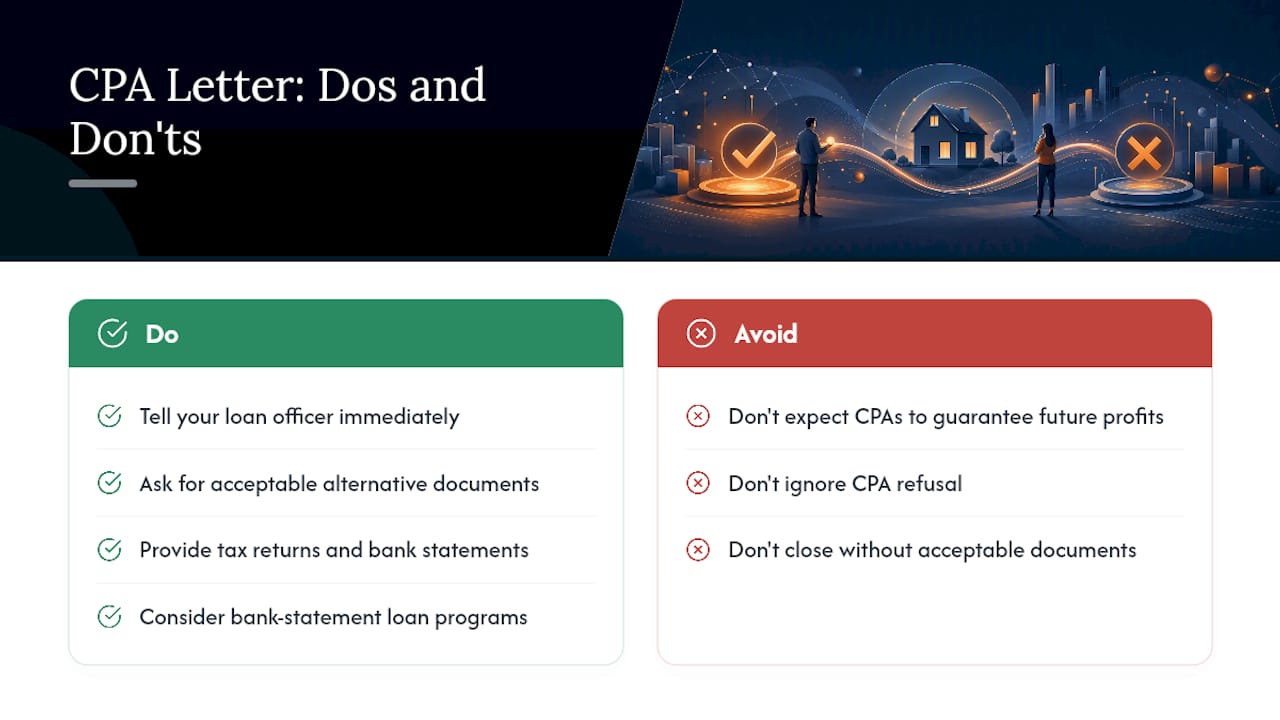
- Have an escalation plan ready. If your CPA declines the requested wording, ask your loan officer immediately what alternative documentation they will accept.
A few things worth keeping in your back pocket:
- Loop your CPA and loan officer into a short phone call if the requested wording is ambiguous. It resolves more disputes than a week of forwarded emails.
- If your usual CPA declines, some accounting firms specialize in mortgage verification letters and can turn requests around faster because they already know what underwriters accept.
- Keep a copy of everything you send and receive. If the underwriter asks a follow-up question, you want the paper trail ready.
Safe Sample Wording Your CPA Will Actually Accept
Handing your CPA a template modeled on accepted industry language, rather than the lender’s raw request, often gets you a signed letter on the first try. This is close to what’s known in the profession as Exhibit 2 language, and practitioner guidance from the Journal of Accountancy treats it as the standard safe format.
A workable one-page structure looks like this:
“This letter confirms that [CPA Name], CPA, prepared the federal income tax returns for [Borrower/Business Name] for tax years [XXXX-XXXX] based on information provided by the client. We have not audited, reviewed, or compiled these financial statements and express no opinion or assurance regarding them. Based solely on information provided, [Borrower Name] holds a [XX]% ownership interest in [Business Name], which has operated continuously since [Year]. This letter is provided solely for [Lender Name] in connection with a mortgage loan application and should not be relied upon for any other purpose.”
Do this when handing it off:
- Keep every sentence factual and tied to a specific document your CPA actually reviewed.
- Name the lender and the loan purpose directly in the letter.
- State the period reviewed and the records relied on.
- Confirm your written authorization is attached or referenced.
Do not ask for:
- Any statement implying the business will remain solvent or profitable.
- Any language guaranteeing the mortgage will be repaid.
- An underwriting conclusion about whether you should qualify for the loan.
| What to hand your CPA | What it accomplishes |
|---|---|
| Lender’s requested wording | Lets your CPA see exactly what’s being asked before drafting anything |
| Safe sample template | Gives your CPA a defensible starting point instead of a blank page |
| Signed client authorization | Satisfies the consent requirement before any disclosure happens |
| Documentation packet | Cuts back-and-forth by answering likely questions upfront |
How Much Does a CPA Letter Cost and How Long Does It Take?
Fees typically run from a few hundred dollars up to $1,000 or more, and the range depends heavily on complexity, whether your CPA already prepared the returns being referenced, and how much back-and-forth is needed to satisfy the lender’s wording.
Turnaround is usually fast when your CPA already has your file on hand. Same-day to two or three business days is realistic if no new records need review. It stretches longer, sometimes a week or more, if your CPA has to dig through records they haven’t seen before or negotiate revised language with your lender.
A few ways to keep both cost and time down:
- Get the lender’s wording upfront so your CPA drafts once instead of three times.
- Hand over a complete document packet at the first meeting, not piecemeal over several emails.
- Ask about a flat fee instead of hourly billing when the scope is well defined.
CPAs who already prepared your returns and have your file on hand issue letters faster and for less than a new accountant starting from scratch. If your closing date is tight, that familiarity is often worth more than any discount a stranger might offer.
What If a CPA Letter Isn’t Available?
A CPA letter is not the only path to closing. Several alternatives satisfy most underwriting requirements when your accountant declines to write one, or when the timeline simply does not allow it.
| Alternative | Best used when |
|---|---|
| Year-to-date profit and loss statement | More than a quarter has passed since your last tax year, a common FHA requirement |
| Bank-statement (non-QM) loan program | Your tax returns understate actual cash flow due to legitimate business deductions |
| Business license or regulatory registration lookup | You need business-existence verification without a CPA letter |
| Business phone and address verification | Underwriter needs quick confirmation the business is operational |
The most practical alternative for many self-employed borrowers is a bank-statement loan. Instead of leaning on tax returns, these programs calculate your qualifying income from 12 to 24 months of actual deposits, which often paints a far more accurate income picture than a return full of legitimate write-offs. Some bank-statement programs still ask for a CPA-certified expense ratio to fine-tune your qualifying income, but it’s a narrower, more mechanical request than a full comfort letter.

If a quarter or more has passed since your last filed tax year, FHA guidelines commonly call for a year-to-date profit and loss statement instead of a CPA letter altogether. And for straightforward business-existence checks, a state licensing lookup or verified business phone listing frequently satisfies the requirement without involving a CPA at all.
The key move is transparency. Tell your loan officer immediately if your CPA won’t provide the requested wording, and propose the alternative documentation yourself rather than waiting for the underwriter to ask. Loan officers who see you get ahead of a problem tend to work harder to keep your file moving.
A Lender-Side View on What Actually Causes Delays
The single biggest cause of delay I see is not a CPA refusing to help. It’s borrowers passing along vague, secondhand lender wording and hoping their accountant fills in the gaps correctly. That guesswork produces a letter the underwriter kicks back, and the whole cycle starts over.
Conservative, factual CPA language actually keeps files moving faster than aggressive assurance language does. Underwriters trust a letter that says “based on records reviewed” far more than one that promises future outcomes, because the factual version holds up to scrutiny.
If your CPA seems uncertain about scope or wording, do not let emails bounce back and forth for a week. A ten-minute call between your loan officer and your CPA resolves more of these standoffs than any amount of written correspondence, and it usually happens faster than either side expects.
When a Bank-Statement Loan Makes More Sense Than a CPA Letter
Sometimes the cleanest solution isn’t a CPA letter at all. It’s skipping the tax-return-based underwriting process entirely. That’s exactly what Texasbankstatementloans built its programs around.
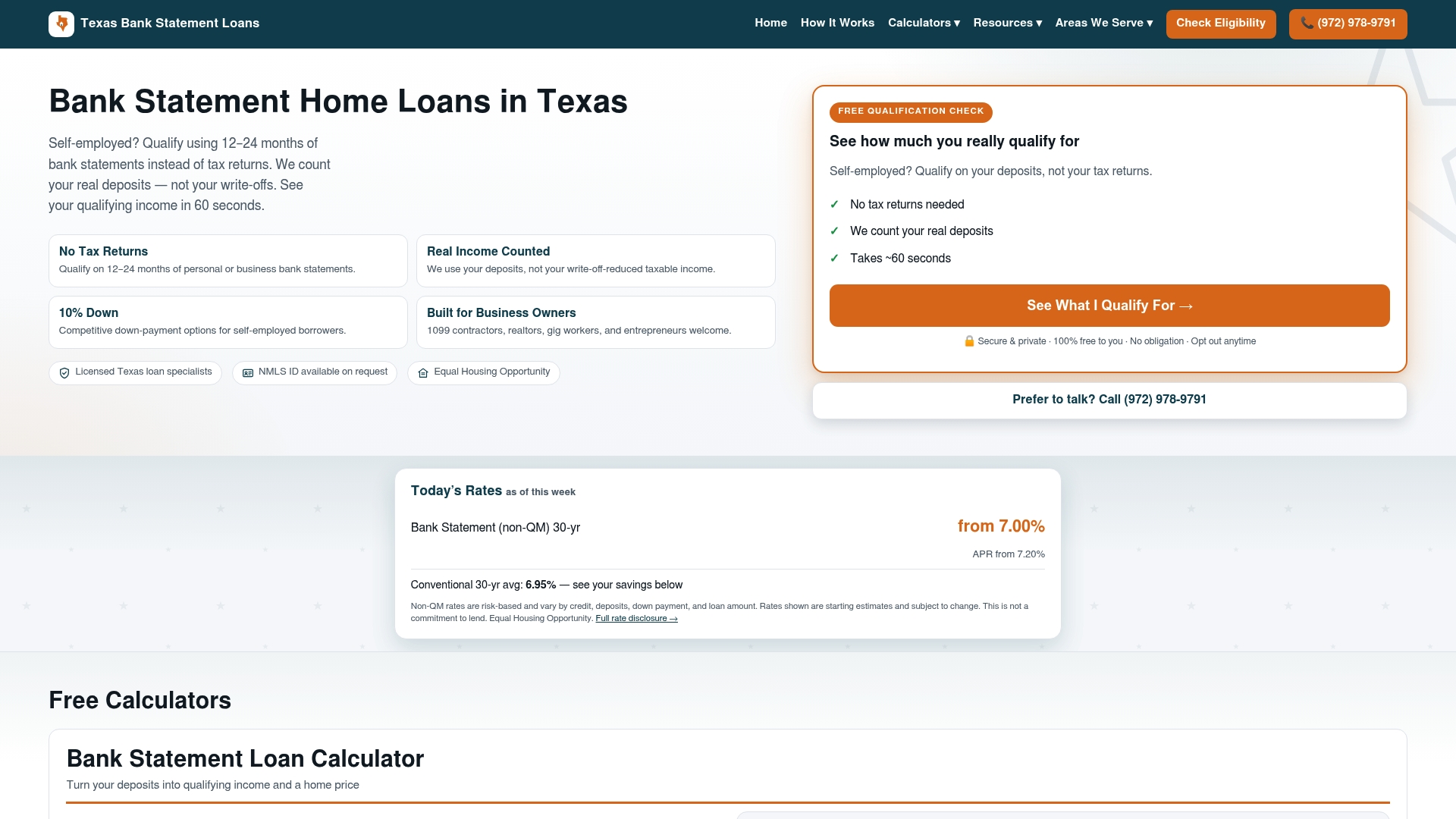
Instead of asking your accountant to explain why your returns show less income than your bank account does, a bank-statement loan works from your actual deposits. Twelve to twenty-four months of personal or business bank statements replace the tax-return requirement, which means the legitimate write-offs that make your taxable income look thin never become an underwriting obstacle. This path tends to fit best if your tax returns are lean from deductions, your business changed structure recently, or your CPA won’t sign off on the wording your lender wants. The tradeoff is usually a somewhat higher rate and different down payment requirements than a conventional loan, so it is not automatically the cheaper option, just often the faster and more realistic one for income that does not show up cleanly on paper.
If you want to see where you stand before committing to either path, run your numbers through the bank statement loan calculator to estimate your qualifying income, or check our current rates to compare the cost tradeoff against a conventional loan. Start your bank-statement loan application today and get a real answer on affordability in about 60 seconds, no CPA letter required.
Frequently Asked Questions
Does every self-employed borrower need a CPA letter mortgage document? No. Most conventional loans close on tax returns and bank statements alone. A CPA letter comes into play only for specific triggers like business-existence verification or bank-statement expense ratios.
Can my CPA guarantee my business will stay profitable in a mortgage letter? No. AICPA attestation standards prohibit CPAs from offering assurance about future solvency or profitability in a non-attest letter, regardless of what a lender’s template requests.
What happens if my CPA refuses the lender’s requested wording? Tell your loan officer immediately and ask what alternative documentation they’ll accept, such as a year-to-date profit and loss statement or a bank-statement loan program that doesn’t require the letter at all.
How is a CPA mortgage verification letter different from a comfort letter? They’re generally the same type of document under different names. Both are non-attest, descriptive letters that confirm factual items without providing audit-level assurance.
Is a CPA letter for refinancing handled differently than for a purchase loan? The requirements for a CPA letter for refinancing mirror purchase-loan requirements: it depends on the loan type and whether the underwriter needs business-existence or income verification beyond your returns.
What if I can’t get a CPA letter before closing? Bank-statement loan programs, which qualify you using 12 to 24 months of deposits, sidestep the need for a CPA letter in most cases and can keep your closing timeline intact.
This article is general information, not a substitute for advice from a qualified financial advisor. Consult a qualified financial professional about your own circumstances before acting on anything here.
Sources
- What Is a CPA Letter for Mortgage? Income Verification, LegalClarity
- Third‑Party Verification Letters, Journal of Accountancy
Recommended
- Bank Statement Loan Calculator | Texas Bank Statement Loans
- Bank Statement Loans in Mason County, TX | Self-Employed
See what you qualify for in 60 seconds, free and no credit check. Use the eligibility check at the top of this page.