
“Stated income” once meant a lender took your word for your earnings, no proof required. That practice is largely gone. A bank-statement loan replaces it with something a lender can actually verify: a year or more of real deposits into your account, averaged into a qualifying income figure. For most self-employed borrowers today, the bank-statement route is the workable path, since unverified stated-income lending mostly disappeared after the 2008 mortgage crisis.
TL;DR:
- Bank-statement loans require 12 to 24 months of deposit histories and detailed documentation like profit and loss statements, unlike the unverified stated-income approach of the past.
- They are best suited for borrowers with steady, legitimate deposits that reflect actual cash flow, especially self-employed or gig workers with significant write-offs.
- Rates on bank-statement loans tend to be higher than conventional loans, and approval depends heavily on consistent deposit patterns and proper documentation to avoid delays or denials.
- The process demands thorough pre-application preparation, including separate business accounts, clear explanations of large deposits, and accurate expense factor negotiations.
- Regulatory standards mean bank-statement loans cannot carry the same low rates as agency-backed mortgages, as lenders must verify deposit sources and demonstrate income sustainability.
Table of Contents
- Stated Income vs Bank Statement Loans: The Core Difference
- What Documents Do Lenders Actually Request?
- Is a Bank-Statement Loan Worth the Trade-Offs?
- Which Path Fits Your Situation?
- Why Regulation Shapes What’s Available
- How to Prepare Your Application Without Losing Weeks to Rework
- Bank Statements Aren’t a Workaround. They’re the Verification.
- Get a Bank-Statement Mortgage Quote Without Touching Your Tax Returns
- Sources
- FAQ
Stated Income vs Bank Statement Loans: The Core Difference
The two terms describe opposite philosophies of proving income to a lender. “Stated income” refers to a pre-2008 underwriting style where the borrower simply declared an income figure and the lender took it at face value, with little to no documentation behind it. A bank-statement loan flips that entirely. The lender pulls your actual deposit history and calculates income from money that genuinely moved through your accounts.
Here’s how the mechanics differ in practice:
- Verification method: Stated income relied on borrower self-reporting; bank-statement loans require about one to two years of statements from personal or business accounts, or both.
- Income calculation: Lenders total eligible deposits over the review period and divide by the number of months, then apply an expense factor (often a flat percentage) to estimate net qualifying income.
- Product fit: Bank-statement underwriting shows up most in non-QM lending, while W-2 employees and salaried borrowers still typically go through standard tax-return underwriting.
- Pricing: Rates on bank-statement products generally run higher than agency-backed conventional loans, and lenders often expect larger cash reserves and a bigger down payment as an offset for the added underwriting risk.
The averaging window matters more than most applicants expect. A contractor who had one enormous month and eleven slow ones will qualify very differently than someone with steady, predictable deposits, even if their annual totals match. Lenders read consistency as a sign of the borrower’s ability to sustain the payment, not just hit an income target on paper. This is one reason Fannie Mae’s underwriting guidance calls for a written analysis of self-employed income rather than a single-number shortcut.
Where standard tax-return underwriting still wins is cost. If your tax returns show enough net income after deductions to qualify, a conventional or agency-backed loan will almost always price better than a bank-statement product. Bank-statement loans exist for the gap: borrowers whose real cash flow looks nothing like their adjusted gross income.
What Documents Do Lenders Actually Request?
Getting approved on bank statements doesn’t mean handing over three months of checking account PDFs and waiting for a decision. It’s a documentation-heavy process, just built around different paperwork than a W-2 file.
Expect a lender to ask for most of the following:
- 12 to 24 months of bank statements, personal or business, depending on how you deposit income.
- A profit and loss statement, often prepared by a bookkeeper or CPA, covering the same period as the statements.
- A year-to-date P&L if you’re applying mid-year, to reconcile recent activity against your annual pattern.
- 1099s for contractors and gig workers, supporting the deposit trail.
- Business license or formation documents, proving the business is legitimate and has operated long enough to show a track record.
- Invoices or contracts for larger, irregular deposits that need a paper trail.
- Proof of down payment source, usually a separate statement showing the funds seasoned for at least two months.
Underwriters don’t just add up every deposit and call it income. They exclude transfers between your own accounts, loan proceeds, tax refunds, and one-time gifts, since none of that reflects recurring earning power. A Freddie Mac review of business financials and bank statements works the same way: normalize the deposits, strip out anything that isn’t operating income, and check that owner withdrawals aren’t quietly draining the business below sustainable levels.
Commingled accounts cause the most friction. If your personal grocery runs and your client payments hit the same checking account, expect the underwriter to ask for a clearer separation, or to discount deposits they can’t confidently tie to your business. Large, unexplained deposits get flagged too. A one-time $15,000 transfer with no invoice or contract behind it can get excluded from your income calculation entirely, or worse, trigger a request for your full tax returns.
Pro Tip: Open a dedicated business checking account at least a year before you apply. It won’t just make underwriting faster; it will likely bump your qualifying income higher because every deposit in that account clearly counts.
Is a Bank-Statement Loan Worth the Trade-Offs?
Bank-statement underwriting solves a real problem: it captures what you actually earn instead of what your accountant managed to shrink on paper. If you write off vehicles, home office expenses, equipment depreciation, and a dozen other legitimate deductions, your Schedule C might show a fraction of your real cash flow. Deposits don’t lie the same way.
The benefits are concrete:
- Qualifying income reflects real cash flow, not taxable income after write-offs.
- Contractors and gig workers with irregular, but substantial deposits get a fairer shot at approval.
- Seasonal businesses can average across a full 12 to 24 months instead of being judged on a single slow quarter.
The costs are just as real:
- Interest rates tend to run higher than conventional, tax-return-verified loans.
- Reserve requirements are often steeper, sometimes six months of payments or more.
- Underwriters scrutinize deposits closely, and unexplained activity can slow or sink an approval.
- A high expense-factor deduction (the lender’s assumed cost of doing business) can shrink your qualifying income more than you’d expect.
There’s a historical reason for the extra scrutiny. Research from FHFA on stated-doc loan performance found that stated-income and other low-documentation loans defaulted at materially higher rates than fully documented loans. That gap is why the unverified version of “stated income” mostly vanished from the market, and why every modern alternative, bank-statement loans included, leans on verifiable paper trails instead of a borrower’s word.
Income variability cuts both ways here. A business with a bad six months buried inside a strong 24-month window will still average out reasonably well. A business with a bad six months inside a 12-month window looks a lot riskier to an underwriter, which is one reason some borrowers deliberately choose the longer look-back period even though it means gathering more paperwork.

Which Path Fits Your Situation?
Not every self-employed borrower needs a bank-statement loan, and not every bank-statement applicant will get approved on deposits alone. A few questions cut through the noise fast.
Ask yourself these before choosing a path:
- Do your tax returns already show enough net income to qualify? If yes, standard underwriting will almost always be cheaper.
- Is your deposit history stable across 12 to 24 months, or wildly inconsistent? Stability strengthens a bank-statement application; volatility weakens it.
- What’s your credit score and current debt-to-income ratio? Bank-statement lenders often want stronger credit to offset the documentation flexibility.
- Can you cover a larger down payment and reserve requirement? Many bank-statement programs start around 10% down, but expect reserves on top of that.
Quick decision rules help narrow the field. If your write-offs are modest and your tax returns tell an accurate income story, standard underwriting is faster and cheaper. If your write-offs are heavy but your deposits are steady, bank-statement underwriting is likely your strongest option. If you’re mid-year and need current numbers, a P&L-only loan (qualifying primarily off a CPA-prepared profit and loss statement rather than raw deposits) can bridge the gap. Real estate investors buying rental property, meanwhile, often skip personal income documentation entirely and qualify through DSCR loans, which weigh the property’s rental income against its debt obligations instead of the borrower’s personal cash flow.
Borrowers without a Social Security number but with steady income and a valid ITIN have their own dedicated path, generally following similar deposit-based logic to standard bank-statement underwriting. None of these are better or worse in the abstract. They’re built for different income shapes.
Why Regulation Shapes What’s Available
The Ability-to-Repay rule under Truth in Lending Act Regulation Z is the reason unverified stated income can’t simply make a comeback. The rule requires creditors to verify a borrower’s income and assets using reasonably reliable records, and any deposit relied on for qualifying has to be explained if its source isn’t obvious. That single requirement is what killed the old “just tell us your income” model industry-wide.
The CFPB’s compliance guide spells out which documents count as reliable: tax return transcripts, W-2s, payroll records, and financial institution statements among them. Bank statements qualify, but only when the lender can trace deposits back to a genuine income source. A lender that can’t do that tracing is taking on liability it likely can’t defend if the loan later defaults.
Agency guidance builds on that same foundation. Fannie Mae’s selling guide requires a written analysis of self-employed income before it’s used to qualify a borrower, and permits bank-statement analysis when a lender can document that the income is both stable and available for personal use, not locked up in the business. Freddie Mac’s guidance follows a parallel path, instructing lenders to review recent statements and P&Ls to confirm income is likely to continue, not just that it existed once.
That regulatory backdrop explains why bank-statement loans sit in the non-QM (non-Qualified Mortgage) category rather than the conventional agency market. Loans that meet Fannie Mae or Freddie Mac’s full documentation standards can be sold to those agencies, which spreads risk and generally keeps rates lower. Bank-statement loans, built around alternative documentation, usually can’t be sold that way. That’s the direct reason they carry higher rates: the lender holds more of the risk, for longer, without an agency backstop.
How to Prepare Your Application Without Losing Weeks to Rework
Most of the friction in bank-statement underwriting comes from borrowers submitting paperwork that doesn’t match what the underwriter needs, then scrambling to fix it mid-process. A little prep work up front saves real time.
Work through these steps before you apply:
- Pull 12 to 24 months of statements from every account you plan to use, personal and business.
- Separate personal and business spending into distinct accounts if you haven’t already; commingled accounts slow underwriting down significantly.
- Get a P&L prepared, ideally by a bookkeeper or CPA, covering the same window as your statements.
- Flag and document large deposits in advance, gathering invoices or contracts that explain anything unusual before an underwriter asks.
- Confirm your down payment source is seasoned in an account for at least two months prior to applying.
- Run your numbers through a bank-statement loan calculator to get a realistic sense of qualifying income before you submit anything.
Timelines vary, but expect underwriting on a bank-statement file to take longer than a straightforward W-2 approval, largely because of the back-and-forth over deposit documentation. The most common friction point isn’t the income calculation itself; it’s chasing down explanations for deposits the borrower forgot were unusual.
Pro Tip: Before you sign with any lender, ask exactly how they calculate your expense factor and whether it’s negotiable with additional documentation. A lender who can’t explain that number clearly, or who quotes a rate that seems too good given your deposit volatility, is worth a second opinion. Running your debt load through a debt-to-income calculator alongside your income estimate gives you a fuller picture before you commit to an application.
Bank Statements Aren’t a Workaround. They’re the Verification.
A lot of borrowers still talk about bank-statement loans like they’re a loophole, a modern wink-and-nod version of old stated-income lending. They’re not. They’re closer to the opposite: a documented, agency-recognized method for proving income that doesn’t fit neatly into a tax return.
What gets underestimated is how much rigor sits behind the process. Lenders aren’t skimming your statements for a big number to write down. They’re tracing deposits, excluding anything that doesn’t look like recurring income, and building a written case that your business can sustain the payment for years, not just the month you applied. That’s a meaningfully higher bar than what stated income ever required, and it’s exactly why the product survived while stated income didn’t.
The borrowers who struggle most with this process aren’t dishonest; they’re disorganized. Commingled accounts, undocumented deposits, and inconsistent bookkeeping create more denials than actual income shortfalls do. Fix the paperwork, and the underwriting tends to take care of itself.
- Saad
Get a Bank-Statement Mortgage Quote Without Touching Your Tax Returns
Texas Bank Statement Home Loans built its entire process around the reality this article just walked through: your tax returns don’t reflect your real income, so why should they decide your mortgage? We evaluate 12 to 24 months of your actual deposits, personal or business, and turn that into a qualifying income figure a lender can stand behind.
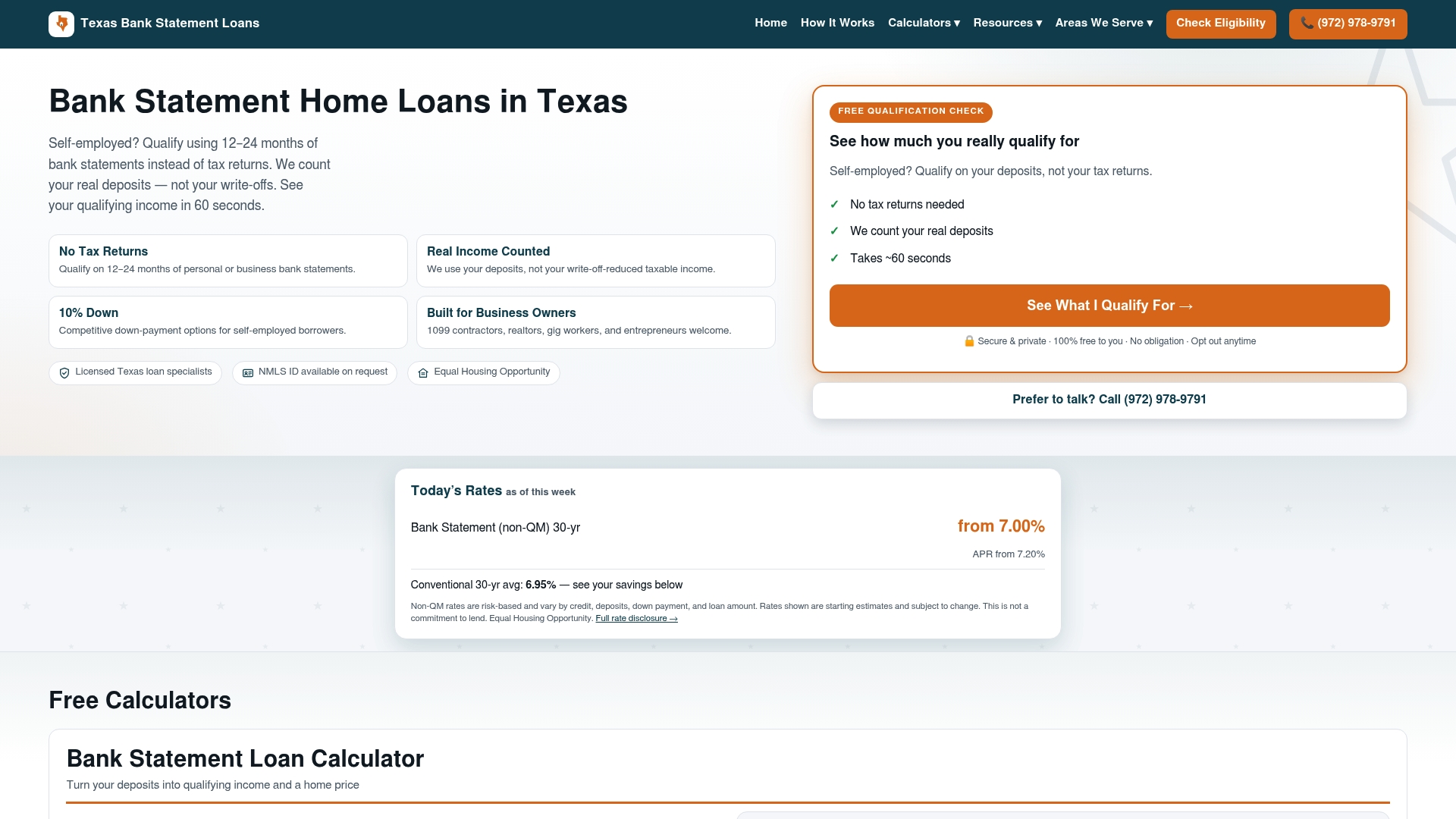
You can run your own numbers through the bank-statement loan calculator before you talk to anyone. If you’re an investor rather than an owner-occupant, the DSCR loan option qualifies you off the property’s rental income instead of your personal cash flow. Whichever path fits, the free qualification check takes about 60 seconds and puts a real number in front of you. Start there, then look at current bank-statement rates to see what a 30-year non-QM bank-statement loan would actually cost you.
Sources
For the regulatory detail behind this article, see the CFPB’s ATR/QM compliance guide, Fannie Mae’s self-employed underwriting guidance, and Freddie Mac’s guidance on income stability.
This article is general information, not a substitute for advice from a qualified financial advisor. Consult a qualified financial professional about your own circumstances before acting on anything here.
- Underwriting factors and documentation for a self-employed borrower | Fannie Mae
- Ability-to-Repay and Qualified Mortgage Rule: Small entity compliance guide | CFPB
- Research on stated-doc loans and default performance | FHFA
FAQ
What Is Another Name for a Bank Statement?
A bank statement is sometimes called an account statement or a transaction history, and lenders may refer to the underwriting method as “bank-statement analysis” or “alternative documentation” underwriting. All describe the same thing: a periodic record of deposits and withdrawals in an account.
What Are the Different Types of Bank Statements Lenders Accept?
Lenders typically accept personal bank statements, business bank statements, or a combination of both, depending on how you receive income. Some also accept statements from money market or business savings accounts if regular deposits flow through them.
What Can I Use Instead of a Bank Statement for a Mortgage?
Alternatives include a CPA-prepared profit and loss statement, 1099 forms, asset-depletion documentation, or standard tax returns for borrowers who qualify that way. Which option works best depends on whether your income is steady, seasonal, or tied up in business assets rather than direct personal deposits.
What Is Considered a Bank Statement for Loan Purposes?
A qualifying bank statement shows the account holder’s name, the institution, the statement period, and a full transaction history, typically covering one month at a time. Lenders generally require 12 to 24 consecutive months, according to Fannie Mae’s underwriting guidance, with no gaps in the sequence.
Is Stated Income Still Available Anywhere?
Fully unverified stated-income loans are largely gone from the mortgage market because Ability-to-Repay rules require lenders to verify income with reliable documentation. What’s marketed as “stated income” today is almost always a bank-statement or P&L-based product that still requires real financial records.
See what you qualify for in 60 seconds, free and no credit check. Use the eligibility check at the top of this page.