
Yes, interest-only DSCR loans are offered to Texas rental investors and they can meaningfully improve near-term cash flow on a lease-up property or a portfolio you’re scaling fast. They work best when you have a concrete plan for the higher payment that arrives once the interest-only window closes. Skip one if you don’t have reserves or an exit strategy lined up for that day.
TL;DR:
- Interest-only DSCR loans in Texas are most advantageous when you have a clear plan for higher payments after the interest-only period ends, such as refinancing, sale, or stabilization.
- Lenders often underwrite to the fully amortizing payment for stress testing, so the interest-only DSCR is used mainly as a cash flow tool during the term, not a qualification loophole.
- Texas property taxes are due annually, so you should split the bill into monthly reserves and account for caps on appraised value increases to avoid surprises.
- Stress testing your deal with both interest-only and amortizing payments is essential, as rent and expenses can easily cause your DSCR to fall below the required threshold once market conditions shift.
- Using bank-statement qualification and maintaining sufficient reserves can improve approval chances for self-employed investors pursuing interest-only loans with cash flow constraints.
Table of Contents
- What Is a DSCR Interest-Only Loan in Texas?
- How Interest-Only Payments Change Your DSCR Math
- Texas Property Taxes and Appraisal Rules That Affect DSCR
- How to Calculate DSCR With an Interest-Only Loan: A Worked Example
- When an Interest-Only DSCR Loan Actually Makes Sense
- Documents, Reserves, and Red Flags Lenders Check
- Managing Payment Shock When the Interest-Only Period Ends
- An Editorial Take: Use Interest-Only as a Tool, Not a Crutch
- Get Approved Using Your Real Cash Flow, Not Your Tax Return
- Sources
- FAQ
What Is a DSCR Interest-Only Loan in Texas?
A DSCR interest-only loan qualifies you on the property’s rental income rather than your personal tax returns, and structures your payments so you owe interest only for a set stretch of the loan term. No principal gets paid down during that window. Your balance on day 900 of the loan looks exactly like it did on day one, only your equity comes from appreciation and whatever amortization happens later, not from the payments you’ve made.
Interest-only periods on these loans commonly run 3 to 10 years, based on the lender and the loan program. After that period ends, one of three things typically happens:
- The loan converts to a fully amortizing payment for the remaining term, and your monthly payment jumps because it now has to cover both interest and enough principal to zero out the loan by maturity.
- The loan matures as a balloon, and you owe the full remaining balance in one payment, usually satisfied through a sale or refinance.
- You refinance into a new loan, ideally before the IO period runs out, resetting the clock.
DSCR underwriting cares about one number above almost everything else: the property’s net operating income relative to its debt service. That’s why lenders can approve you without W-2s or a stack of tax returns. But it also means the IO structure changes the denominator in that equation, sometimes in ways that flatter you now and squeeze you later.
How Interest-Only Payments Change Your DSCR Math
The debt service coverage ratio is straightforward: divide net operating income by total debt service, expressed as NOI over annual debt service. An interest-only payment lowers the denominator because you’re not paying principal, which mechanically raises your DSCR compared to an amortizing loan on the same balance and rate.

Here’s a quick example. Say a rental property generates $36,000 in annual NOI. An amortizing loan at a given rate and 30-year term might carry annual debt service of $34,000, producing a DSCR of about 1.06. Strip the principal portion out and pay interest only, and annual debt service might drop to $27,000, pushing DSCR to roughly 1.33. Same property, same income, a much healthier-looking ratio.
Lenders know this, which is why most won’t take the IO-period DSCR at face value:
- Many underwrite to the fully amortizing payment even when they’re offering an IO schedule, specifically to confirm you can survive the payment once principal kicks in.
- Some run a stress test using a higher assumed rate or vacancy factor on top of the amortizing calculation.
- Reserve requirements often increase for IO loans, frequently six to twelve months of payments held in liquid reserves.
Underwriting reality check: guidance on commercial real estate lending treats nonamortizing loans conservatively and expects lenders to size loans using amortizing debt-service calculations for stress testing, not the discounted IO number. That single practice explains why an IO loan doesn’t automatically let you borrow more. It’s a cash flow tool during the term, not a qualification loophole. If your deal only works on the IO payment and falls apart on the amortizing one, most lenders will flag it before you do.
Texas Property Taxes and Appraisal Rules That Affect DSCR
Texas has no state income tax, but property taxes run high relative to much of the country, and how the bill lands matters for cash flow planning. Property tax bills are generally due by January 31 of the following year, with penalties and interest starting February 1 if unpaid. That’s one lump obligation, not twelve smooth monthly ones, unless your servicer escrows it for you.
A few Texas-specific items belong in every DSCR worksheet:
- Build your monthly operating expense line as if the annual tax bill were spread evenly across twelve months, even if you’re not escrowing, so a January surprise doesn’t wreck your reserves.
- For eligible non-homestead investment properties, Texas Tax Code Section 23.231 caps annual appraised value increases at 20% for properties valued up to $5,320,000, which limits but doesn’t eliminate the risk of a tax jump after a reappraisal.
- Roll special assessments, local fees, and any municipal utility district charges into your NOI expense schedule; these are common in newer Texas subdivisions and get missed in DSCR math borrowed from other states.
Skipping this step is one of the more common ways an out-of-state DSCR worksheet underestimates true carrying costs on a Texas property.
How to Calculate DSCR With an Interest-Only Loan: A Worked Example
Start with the inputs every lender will ask for: gross scheduled rent, a vacancy allowance, and operating expenses (taxes, insurance, management, maintenance, and reserves). Subtract vacancy and operating expenses from gross rent to get NOI.

Take a single-family rental renting for $2,400 a month, or $28,800 a year. Apply a 7% vacancy allowance and operating expenses of $7,200 a year (taxes, insurance, and maintenance combined), and NOI lands at roughly $19,584.
Now compare debt service on a $280,000 loan under two structures:
| Scenario | Annual Debt Service | DSCR |
|---|---|---|
| Interest-only (7.00% rate) | $19,584 | 1.00 |
| Fully amortizing (7.00%, 30-year) | $22,368 | 0.88 |
That IO structure is the difference between a deal that clears a 1.00 DSCR threshold and one that doesn’t clear it amortized. It’s exactly the gap that makes lenders underwrite conservatively rather than take the IO number as gospel.
Run the sensitivity check before you commit to a deal, because rent and expenses rarely stay flat:
| Stress Scenario | NOI | DSCR (IO) |
|---|---|---|
| Base case | $19,584 | 1.00 |
| Vacancy rises to 12% | $17,856 | 0.91 |
| Operating expenses increase significantly | $18,504 | 0.94 |
| Both stresses combined | $16,776 | 0.86 |
A deal that barely clears 1.00 on paper can drop below break-even fast once vacancy or expenses move against you. Run your own numbers with the DSCR calculator before you sign a term sheet, and stress-test the amortizing payment too, not just the IO one.
When an Interest-Only DSCR Loan Actually Makes Sense
IO structures earn their place in specific situations, not as a default financing choice. They fit best when you’re mid rehab or lease-up on a property that isn’t generating full rent yet, when you need to preserve liquidity to close on a second or third property in the same quarter, or when you’re bridging to a sale or refinance you can document with real timelines, not wishful thinking.
They fit poorly for a buy-and-hold investor with no stabilization event on the horizon, thin reserves, or a market where rent growth has stalled. If nothing changes about the property’s income between now and the end of the IO period, you’re just deferring a bigger payment for no strategic reason.
Before signing, run through this checklist:
- Do you have a documented exit (refinance, sale, or stabilized rent increase) before the IO period ends?
- Can you cover 6 to 12 months of the fully amortizing payment in reserves if the exit slips?
- Does the local rental market support the rent growth your plan assumes?
- What’s your contingency if refinancing terms are worse than they are today?
Pro Tip: Calculate the amortizing payment on day one and keep it in a spreadsheet next to your current IO payment. If you’d struggle to make that higher number today, build reserves toward it now instead of hoping the market solves it for you later.
Documents, Reserves, and Red Flags Lenders Check
DSCR lenders typically want the property’s paperwork more than yours, but a few personal financial documents still matter. Expect to submit:
- A signed lease or rent roll for occupied units, and market rent comps for vacant ones.
- Bank statements, usually 12 to 24 months, if you’re using bank-statement qualification instead of tax returns for any personal income component.
- A year-to-date profit and loss statement if you own the property through an entity.
- Insurance declarations pages showing current coverage and premiums.
- A property management agreement, if a third party runs the property.
Reserve requirements on IO DSCR loans commonly run higher than on standard amortizing loans, often 6 to 12 months of principal, interest, taxes, and insurance held in a liquid account. Lenders want to see that money allocated with purpose, not just sitting there. Split it mentally, if not literally, between tax reserves, insurance reserves, capital expenditure reserves, and vacancy reserves.
Common red flags include a DSCR that only clears 1.00 on the interest-only calculation, gaps in the rent roll history, undocumented cash income, and insurance coverage that lapsed or changed insurers recently. Fix what you can before applying. A six-month track record of consistent bank deposits often does more for your file than any explanation letter.
Managing Payment Shock When the Interest-Only Period Ends
Payment shock is the term regulators use for the jump in your monthly obligation once amortization begins or a balloon comes due, and it’s the single biggest risk in this loan structure. The CFPB’s booklet on adjustable-rate mortgages documents this pattern directly: payments increase after the IO period even if the interest rate itself doesn’t move, purely because principal repayment starts.
The CFPB also cautions borrowers directly not to assume refinancing or a sale will be available when the IO period ends. Markets shift. Rates move. Lending standards tighten. Plan as if none of those levers are guaranteed to work in your favor.
Practical mitigation steps that actually hold up:
- Stress-test your deal against the fully amortizing payment before you close, not two years into the loan.
- Build reserves in stages throughout the IO period rather than trying to save it all in the final year.
- Choose a shorter IO term if your business plan for the property resolves faster than 10 years; there’s no reason to carry more IO risk than your plan requires.
- Line up a backup exit, whether that’s a second lender relationship or a documented sale strategy, in case your first plan stalls.
An Editorial Take: Use Interest-Only as a Tool, Not a Crutch
Interest-only DSCR loans are one of the more misunderstood products in Texas real estate financing. Investors either avoid them out of vague fear or lean on them as a default without a stabilization plan, and both mistakes come from treating the IO period as the whole strategy rather than a bridge to one.
The real skill is matching the IO term to something that actually resolves. A rehab that finishes in 18 months. A lease-up that stabilizes in year two. Reserves that grow every quarter, not just at closing.
For self-employed Texas investors, bank-statement qualification solves a separate but related problem: proving the income is real when tax returns understate it through legitimate write-offs. That combination, verified cash flow plus a disciplined IO exit plan, is what actually works.
- Saad
Get Approved Using Your Real Cash Flow, Not Your Tax Return
Texas Bank Statement Home Loans is the alternative to the tax-return grind for self-employed investors and 1099 earners whose write-offs make a strong year look weak on paper. Instead of parsing Schedule C deductions, the process reviews 12 to 24 months of your actual bank deposits, then pairs that with DSCR loan options that qualify the property on its own rental income.
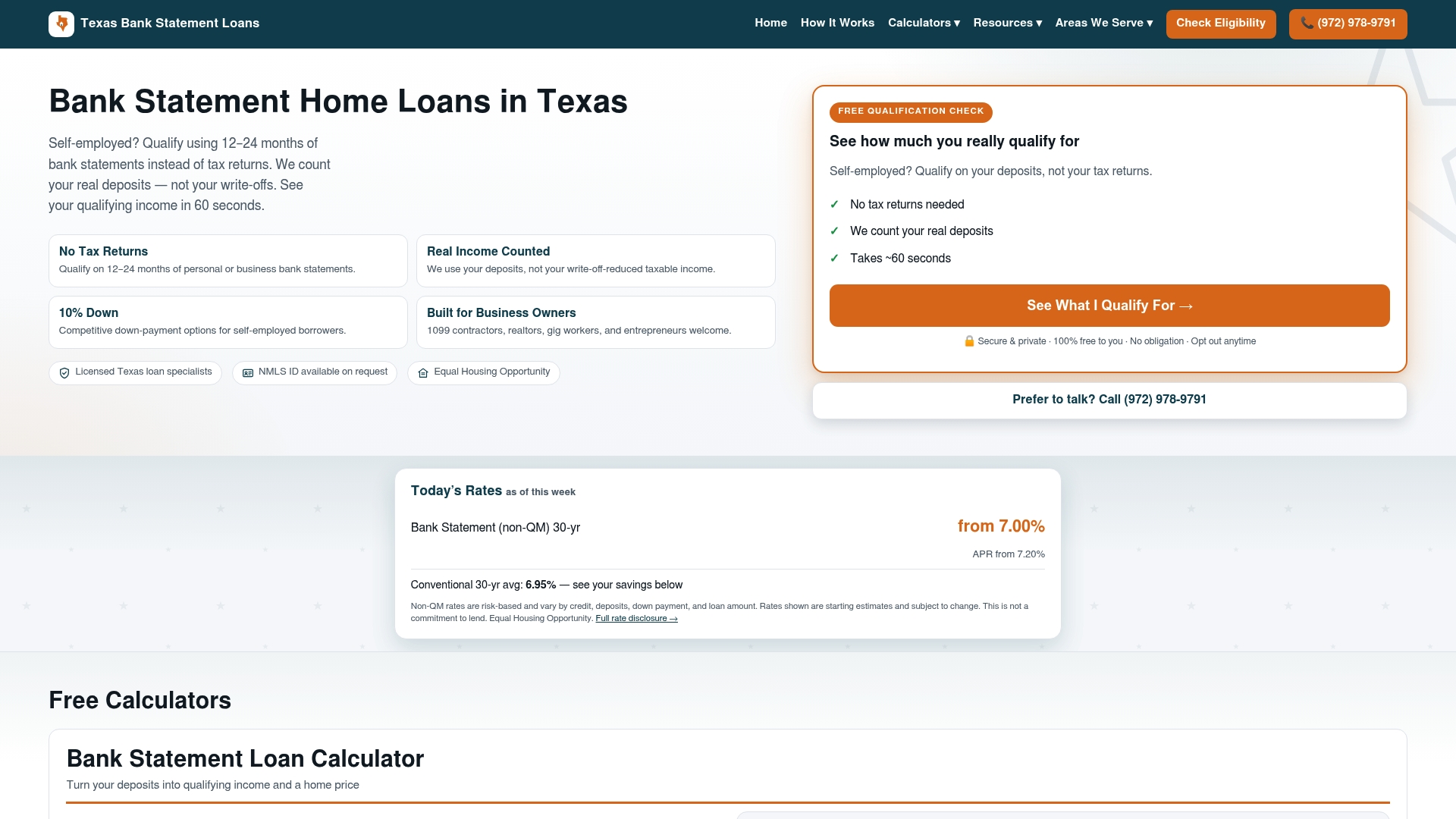
If you’re weighing an interest-only structure on a rental purchase, plug your numbers into the DSCR calculator first, then check current terms on the rates page for the Bank Statement (non-QM) 30-year program, which starts at 7.00% per year. Investors in the Austin-Round Rock area can also see local bank-statement loan details specific to that market. Start with the calculator, confirm the rate, and get your qualification check done today.
Sources
These are the primary references behind the mechanics and warnings covered above:
- What is an “interest-only” loan? | Consumer Financial Protection Bureau
- Consumer handbook on adjustable-rate mortgages (CFPB)
- Valuing property | Texas Comptroller of Public Accounts
This article is general information, not a substitute for advice from a qualified financial advisor. Consult a qualified financial professional about your own circumstances before acting on anything here.
FAQ
Can a DSCR Loan Be Interest-Only?
Yes, many DSCR lenders offer interest-only structures, typically for 3 to 10 years before the loan converts to fully amortizing payments or matures as a balloon. Not every DSCR lender offers this, so confirm availability and terms with your specific loan program before assuming it’s included.
What Is the $100,000 Loophole for Family Loans?
This refers to a personal-lending tax rule about low-interest loans among family members, not a DSCR underwriting feature, and it does not apply to institutional rental property financing.
What Are Current DSCR Loan Rates in Texas?
DSCR loan rates vary by lender, credit profile, loan-to-value ratio, and whether the payment structure is interest-only or amortizing. Texas Bank Statement Home Loans lists its Bank Statement (non-QM) 30-year program starting at 7.00% per year on its rates page, and DSCR-specific pricing is available through its DSCR calculator.
Which Lender in Texas Is Best for DSCR Loans?
The right lender depends on your income documentation, credit, and the property’s cash flow, but self-employed investors whose tax returns understate real income often do better with a lender that reviews bank statements directly. Texas Bank Statement Home Loans evaluates 12 to 24 months of bank deposits alongside DSCR options built for this exact situation.
Recommended
- Bank Statement Loans in Central Texas
- Bank Statement Loans in Dallas-Fort Worth
- Bank Statement Loans in Travis County, TX
See what you qualify for in 60 seconds, free and no credit check. Use the eligibility check at the top of this page.