
For mortgage qualification, lenders count adjusted net business income, not gross revenue. That single fact trips up more self-employed borrowers than any other part of the process. Your business might deposit $400,000 a year, but if your Schedule C shows $60,000 in net profit after deductions, most conventional lenders start from $60,000.
Three levers actually move the needle on your qualifying income:
- Two-year tax history: Lenders average net income across your two most recent federal returns. One strong year rarely saves you if the prior year was weak.
- Add-backs: Non-cash deductions like depreciation and amortization get added back to net profit, sometimes increasing monthly qualifying income by hundreds or thousands of dollars.
- Program choice: Bank-statement loans bypass tax returns entirely, using recent months of deposits instead. For owners with heavy write-offs, this can produce a significantly higher qualifying figure.
Quick-start checklist:
- Gather two years of signed personal tax returns (1040s with all schedules)
- Pull 12-24 months of business and personal bank statements
- Prepare a year-to-date profit and loss statement
- Note all large non-cash deductions (depreciation, amortization, depletion)
- Consider a bank-statement loan if your tax returns underreport what you actually earn
Table of Contents
- How lenders convert your business income into a qualifying number
- What documents lenders typically require from business owners
- Which loan program fits your income documentation?
- What underwriters look at beyond your revenue numbers
- Concrete steps to take now to improve your approval odds
- How bank-statement loans work and when they outperform tax-return programs
- What the self-employed mortgage process actually looks like, start to finish
- Key Takeaways
- What self-employed borrowers consistently get wrong
- Qualify faster with Texasbankstatementloans’s bank-statement program
- Authoritative sources for verifying official rules
How lenders convert your business income into a qualifying number
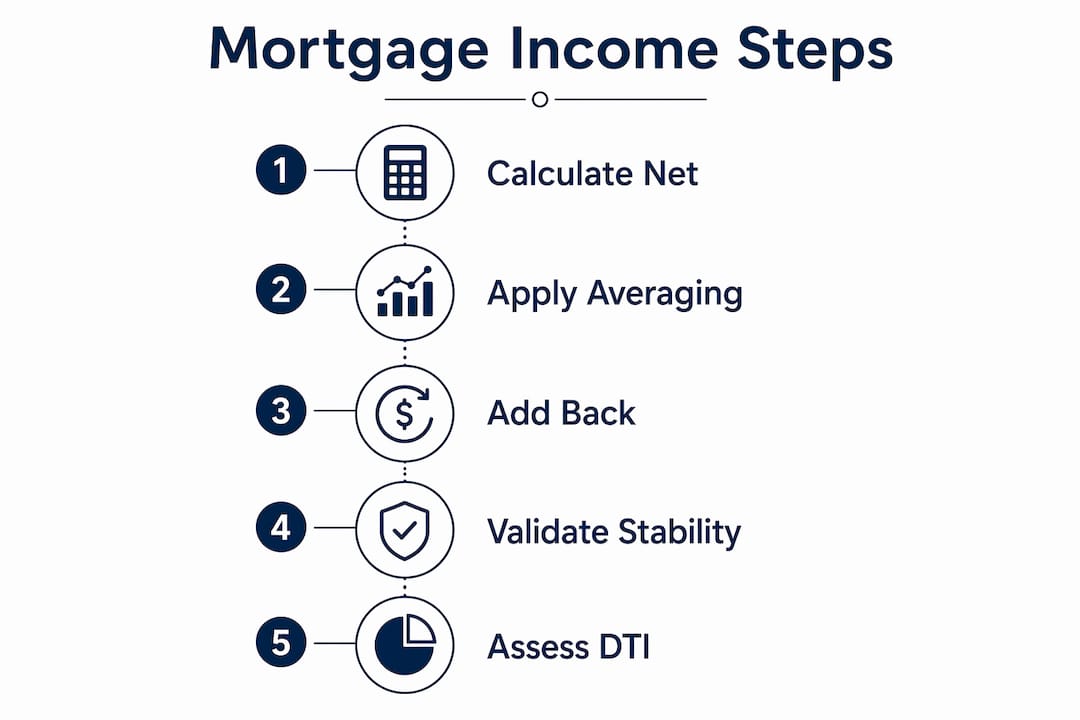
The starting point is almost never your top-line revenue. Underwriters work from net profit on your personal tax return, then make specific adjustments before arriving at a monthly qualifying income figure.
Schedule C vs. S-corp and partnership income
Sole proprietors file Schedule C, and the net profit line is the baseline. For S-corp owners and partners, it is more layered: lenders combine your W-2 wages from the business with your distributive share from the K-1. If the business shows a loss on the K-1, that loss typically reduces your qualifying income, even if the business is otherwise healthy.
A detail many owners miss: retained earnings that stay inside the business usually do not count as personal qualifying income. Underwriters want to see that income was actually distributed to you, or that the business has enough distributable cash flow to support a distribution. Fannie Mae’s selling guide is explicit on this point.
The two-year averaging rule
Lenders generally require a minimum two-year history of self-employment and average the net income across both years. If Year 1 shows $80,000 and Year 2 shows $100,000, the qualifying income is $90,000 annually, or $7,500 per month before add-backs.

One exception worth knowing: established businesses with five or more years of consistent ownership may qualify with only one year of returns under specific Fannie Mae guideline conditions. This is not automatic, but it is a real option for long-tenured owners.
Add-backs that raise your qualifying income
Underwriters add back non-cash deductions to net profit because those deductions did not actually leave your bank account. Common add-backs include:
- Depreciation and amortization
- Depletion (for natural resource businesses)
- Certain one-time, non-recurring losses documented as such
- Business use of home deduction (in some programs)
What lenders do not add back: ordinary cash expenses like payroll, rent, utilities, and supplies. Those are real costs that reduce real cash flow.
Worked example:
| Item | Year 1 | Year 2 |
|---|---|---|
| Schedule C net profit | $80,000 | $100,000 |
| Add: depreciation | $10,000 | $15,000 |
| Add: amortization | $0 | $5,000 |
| Adjusted annual income | $90,000 | $120,000 |
| Two-year average | $105,000 | |
| Monthly qualifying income | $8,750 |
That $8,750 per month is what the underwriter plugs into the debt-to-income calculation, not the $7,500 the raw average would have produced.
What documents lenders typically require from business owners
Documentation is where self-employed applications stall. Gathering the right paperwork before you apply cuts weeks off underwriting and prevents last-minute scrambles.
Standard required documents
- Two years of signed personal tax returns (Form 1040) with all schedules attached
- Business returns where applicable: Form 1120S for S-corps, Form 1065 for partnerships, Form 1120 for C-corps
- Schedule C (sole proprietors), Schedule E (rental/partnership income), K-1s from any pass-through entity
- W-2s from your own business if you pay yourself a salary
- 1099s for contract income
Supplemental documents most lenders request
Acceptable supplemental documents include a year-to-date profit and loss statement, a current balance sheet, several months of business bank statements, and several months of personal bank statements. If you plan to use business assets for your down payment or reserves, expect the lender to request a business cash-flow analysis and several months of business account statements to confirm that withdrawing those funds will not impair operations. Fannie Mae’s underwriting guidance is explicit that lenders must evaluate whether a withdrawal would harm the business.
Non-standard evidence for ongoing revenue
If your tax returns understate current income, you can supplement with:
- Signed client contracts showing recurring revenue
- Invoices and purchase orders from established clients
- Retainer agreements or subscription-based service contracts
- Evidence of contract renewals or multi-year service agreements
Annotation tips that reduce underwriting friction
Do not hand over a stack of raw returns and hope for the best. Mark add-back line items on the returns with a sticky note or a cover memo. Highlight any one-time losses or unusual distributions and explain them in a short letter. If there is a timing difference between when income was earned and when it was deposited, explain that too. A two-paragraph cover memo from your CPA can prevent a week of back-and-forth with the underwriter.

Which loan program fits your income documentation?
Not every program treats business income the same way. Matching your documentation to the right program is often the difference between approval and denial.
| Program | How income is calculated | Documentation required | Typical down payment / credit | Best use case |
|---|---|---|---|---|
| Conventional (Fannie/Freddie) | Two-year average of net taxable income plus add-backs | 2 years personal and business returns, K-1s, P&L | 5-20%, 620+ credit score | Stable income, moderate write-offs |
| FHA | Two-year average of net taxable income | 2 years returns, business docs, P&L | 3.5%, credit scores vary | Lower credit scores, first-time buyers |
| VA | Two-year average, flexible on business structure | 2 years returns, business verification | 0%, credit score minimum varies | Eligible veterans with self-employment income |
| Non-QM | Varies by lender; may use one year or asset-based | Flexible; lender-specific | 10-20%, 620+ typical | Complex income, recent business changes |
| Bank-statement loans | 12-24 months of deposits minus expense ratio | Bank statements, P&L, no tax returns required | 10%+, 620+ typical | High gross revenue, heavy write-offs |
Program highlights and trade-offs
Conventional loans (Fannie Mae / Freddie Mac): The most widely available option. Fannie Mae requires a written analysis of the borrower’s income, business stability, and the business’s ability to continue generating income. Tools like Comparative Income Analysis or Form 1088 may be used. The upside is competitive rates; the downside is that aggressive tax deductions can severely reduce qualifying income.
FHA and VA loans: Both programs follow the two-year average rule but offer more flexibility on credit scores and down payments. VA loans require no down payment for eligible veterans, which is a meaningful advantage. Neither program sidesteps the tax-return income calculation, so heavy write-offs still hurt.
Non-QM loans: These sit outside the qualified mortgage framework and let lenders set their own underwriting criteria. Some use one year of returns; others use asset depletion or a hybrid approach. Rates are typically higher than conventional, and terms vary widely by lender.
Bank-statement loans: The clearest alternative for owners whose tax returns underreport actual cash flow. Bank-statement programs use 12-24 months of deposits and apply an expense ratio to derive qualifying income. For a sole proprietor with $20,000 per month in deposits and a 50% expense ratio, qualifying income is $10,000 per month, regardless of what the Schedule C shows. That can be a much stronger number than the tax-return route for owners with large write-offs.
What underwriters look at beyond your revenue numbers
Revenue is the starting point, not the whole picture. Underwriters weigh several other factors that can push an application toward approval or denial.
Income stability and trend
Lenders prioritize stability over absolute dollars. A borrower with $90,000 in steady, growing income is a stronger file than one with $150,000 one year and $70,000 the next. When income declines significantly between years, lenders may use only the lower year’s figure or ask for a written explanation. A large, unexplained spike is also a flag, because underwriters want to see that income is repeatable.
Debt-to-income ratio
DTI is the ratio of your monthly debt payments to your monthly qualifying income. Most conventional programs cap DTI at 43-45%, though some allow higher with compensating factors. Use a DTI calculator to run your numbers before you apply, because a qualifying income figure that looks strong can still fail DTI if you carry significant business or personal debt.
Credit score and history
A score below 620 closes most conventional and government-backed programs. Above 740, you typically access the best rate tiers. Business credit does not directly appear on your personal report, but personal guarantees on business loans do.
Cash reserves
Lenders want to see that you can cover several months of mortgage payments after closing. For self-employed borrowers, reserve requirements are often higher than for W-2 employees because income is perceived as less predictable.
Red flags underwriters flag
- Revenue or profit declining year over year without a documented explanation
- Large, irregular owner distributions that do not match reported income
- Inconsistent deposit patterns across bank statements
- Significant business debt that appears on personal guarantees
- Missing schedules or unsigned returns
Compensating factors that help
A larger down payment, a low DTI, a credit score well above the minimum, and documented cash reserves can offset concerns about income variability. Signed recurring contracts or a client pipeline letter from your accountant can also neutralize a single weak year.
Concrete steps to take now to improve your approval odds
Getting organized before you apply is worth more than any single compensating factor. Here is a practical sequence:
- Separate your accounts. Keep business and personal finances in distinct accounts with clean, documented transfers. Commingled funds are a red flag and create documentation headaches.
- Establish consistent owner distributions. Pay yourself a regular, documented salary or distribution rather than pulling irregular amounts. Consistency signals stability to underwriters.
- Avoid heavy write-offs in the year before you apply. Aggressive tax planning reduces taxable income and, by extension, your qualifying income. Discuss the timing of large deductions with your CPA before filing.
- Gather your priority document pack. Signed tax returns for the past two years, 12-24 months of bank statements, a year-to-date P&L, signed client contracts, and copies of any business licenses or insurance certificates.
- Order your credit report and run your DTI. Know your numbers before a lender does. Use the self-employed affordability calculator to model different qualifying income scenarios.
- Prepare an add-back memo with your CPA. A one-page letter identifying each non-cash deduction, its dollar amount, and its line on the return gives the underwriter exactly what they need without a back-and-forth.
Suggested four-week packaging timeline:
- Week 1: Collect two years of signed returns and 12-24 months of bank statements
- Week 2: Prepare an annotated P&L and add-back memo with your CPA
- Week 3: Pull your credit report and run DTI calculations
- Week 4: Submit to an advisor or run a pre-qualification
Pro Tip: Ask your CPA to produce a concise letter that explains each non-cash deduction and flags any one-time items. Underwriters see hundreds of files; a clear, organized memo moves your file to the front.
How bank-statement loans work and when they outperform tax-return programs
Bank-statement underwriting flips the conventional model. Instead of starting with taxable net income, the lender averages your monthly deposits over 12-24 months and applies an expense ratio to estimate your actual income.
The mechanics
- The lender collects 12-24 months of business or personal bank statements.
- Total deposits are summed and divided by the number of months to get average monthly gross deposits.
- An expense ratio is applied. For sole proprietors, this is commonly around 50%, though it varies by lender and business type. Some lenders use a lower ratio for businesses with documented lower overhead.
- The result is monthly qualifying income, which feeds into the DTI calculation.
Who benefits most
- Business owners with high gross revenue but large tax deductions (depreciation-heavy industries, real estate, equipment-intensive trades)
- 1099 contractors whose expenses are real but whose net income on returns looks thin
- Gig workers and freelancers with multiple income streams
- Owners who have recently grown revenue but whose most recent tax return has not yet captured that growth
Side-by-side example
The math is stark. Bank-statement qualification can yield significantly higher qualifying income for borrowers with large write-offs, which is exactly the profile of many Texas business owners. Use the bank-statement loan calculator to run your own numbers with your actual deposit history.
Texasbankstatementloans accepts multiple months of deposits, offers down payment options starting at a low percentage, and provides a quick pre-qualification check so you can see a realistic number before committing to a full application.
What the self-employed mortgage process actually looks like, start to finish
Expect the process to take longer than a W-2 borrower’s application. The extra time is almost entirely in documentation gathering and underwriting review.
Document gathering: 1-3 weeks
- Collecting two years of signed returns, business returns, and all schedules
- Pulling 12-24 months of bank statements (business and personal)
- Preparing or updating the year-to-date P&L
- Obtaining the CPA add-back memo
Lender review and underwriting: 2-6 weeks
- Initial file review and income calculation
- Possible requests for additional documentation (conditions)
- Business viability analysis if business assets are used for the down payment
- Written income analysis per Fannie Mae or program guidelines
Appraisal and closing: several weeks
- Property appraisal ordered after underwriting approval
- Title and escrow work
- Final loan approval and closing disclosure
Typical costs to budget for:
- Appraisal: varies by property type and location
- Credit report pull: typically a small flat fee
- Origination fees: vary by lender and loan size
- Title and escrow fees: vary by state and transaction size
- CPA fees for P&L preparation or add-back letter: varies by accountant
- Reserve requirements: typically 2-6 months of mortgage payments held in liquid accounts after closing
The total timeline from document gathering to closing commonly runs over a month for self-employed borrowers, compared to a shorter time for W-2 applicants. Planning for the longer window prevents surprises.
Key Takeaways
Qualifying income for self-employed borrowers is adjusted net income from tax returns, not gross revenue, but bank-statement programs offer a deposit-based alternative that can produce a higher qualifying figure for owners with heavy write-offs.
| Point | Details |
|---|---|
| Net income, not gross revenue | Lenders start with net profit on tax returns and apply add-backs, not top-line revenue. |
| Two-year average is standard | Most programs average the past two years of net income; declining income may trigger use of the lower year only. |
| Add-backs raise your number | Depreciation, amortization, and certain one-time losses are added back, increasing monthly qualifying income. |
| Bank-statement loans are a real alternative | For owners with large write-offs, deposit-based qualification can produce significantly higher qualifying income than tax returns. |
| Texasbankstatementloans pre-qualification | Texasbankstatementloans accepts 12-24 months of deposits, starts at 10% down, and offers a quick pre-qualification check online. |
What self-employed borrowers consistently get wrong
The most common mistake I see in self-employed mortgage files is treating gross revenue as the number that matters. Business owners spend years building revenue, and that number feels like the proof of their financial strength. But the underwriter never sees it that way. They see the net profit after every deduction, averaged across two years, and that figure can be a fraction of what the business actually generates.
The second mistake is submitting a file cold, without any annotation or explanation. A return with $30,000 in depreciation looks like a struggling business to someone who does not know the context. A one-page memo from your CPA that says “this is non-cash depreciation on equipment purchased in 2023, and it will be added back per lender guidelines” changes the entire read of that file.
The corrective is straightforward: separate your accounts now, document your distributions consistently, and get your CPA involved before you apply, not after the lender asks questions. The borrowers who move through underwriting fastest are the ones who show up with a clean, annotated file and a short explanation for anything unusual. That preparation signals to the underwriter that you understand your own finances, which is exactly the confidence they want to see before approving a six-figure loan.
Qualify faster with Texasbankstatementloans’s bank-statement program
Self-employed borrowers who earn strong income but show modest net profit on their returns have a concrete alternative: Texasbankstatementloans evaluates 12-24 months of bank deposits instead of tax returns, so your actual cash flow drives the qualification, not your write-offs.
Down payment options start at 10%, which keeps the program accessible for business owners who want to preserve working capital. The pre-qualification process takes about 60 seconds and carries no obligation, so you can see a realistic loan amount before you commit to a full application. Whether you are in Houston, San Antonio, or anywhere else in Texas, the program is built for the way business owners actually earn income.
Run your numbers now at Texasbankstatementloans and see what your deposit history qualifies you for.
This article is general information, not professional financial or legal advice. Confirm current program guidelines and qualification requirements with a licensed mortgage professional for your specific situation.
Authoritative sources for verifying official rules
- Fannie Mae Selling Guide, Self-Employed Borrower Documentation: The primary source governing how conventional lenders must calculate and document qualifying income for self-employed borrowers, including the written analysis requirement and business viability evaluation.
- IRS Self-Employed Individuals Tax Center: Official IRS guidance on how business income is reported, which schedules apply, and how deductions are documented. Useful for understanding which deductions appear on your return and how they affect net income.
- CFPB, What Is a Qualified Mortgage?: Explains the qualified mortgage framework, DTI limits, and how lenders must verify income under federal ability-to-repay rules.
- CFPB, Mortgage Application Denial: Covers borrower rights after a denial and what documentation lenders must provide, useful if your first application does not succeed.
- Texas Department of Savings and Mortgage Lending (SML): The state regulator for mortgage lenders operating in Texas. Verify that any lender you work with holds a current Texas license.
- Texasbankstatementloans, Bank-Statement Loan Pre-Qualification: For self-employed borrowers in Texas who want to test their qualifying income using deposit history rather than tax returns, the pre-qualification tool provides a fast, no-obligation starting point.
See what you qualify for in 60 seconds, free and no credit check. Use the eligibility check at the top of this page.