
Yes, self-employed Texas veterans can qualify for a VA home loan. The two realistic paths are: standard VA underwriting using two years of tax returns plus a Certificate of Eligibility (COE), or a bank-statement program when your tax returns show low net income due to write-offs.
- Route 1: Traditional VA loan. Requires a COE from VA.gov, two years of federal tax returns, and enough net profit to satisfy the VA’s residual income test.
- Route 2: Bank-statement alternative. Uses 12-24 months of deposits to calculate qualifying income, bypassing the tax-return problem entirely. Texasbankstatementloans offers this for Texas self-employed borrowers with a minimum down payment of 10%.
The catch most borrowers miss: VA underwriting counts net taxable income, not gross revenue. Heavy write-offs that reduce your tax bill also reduce the income a VA lender will count toward your loan.
Table of Contents
- Who qualifies for a VA home loan?
- What VA lenders look for during underwriting
- How self-employed borrowers document income for a VA loan
- What are your options if tax returns show low income?
- Bank-statement loans vs. VA loans: what actually changes
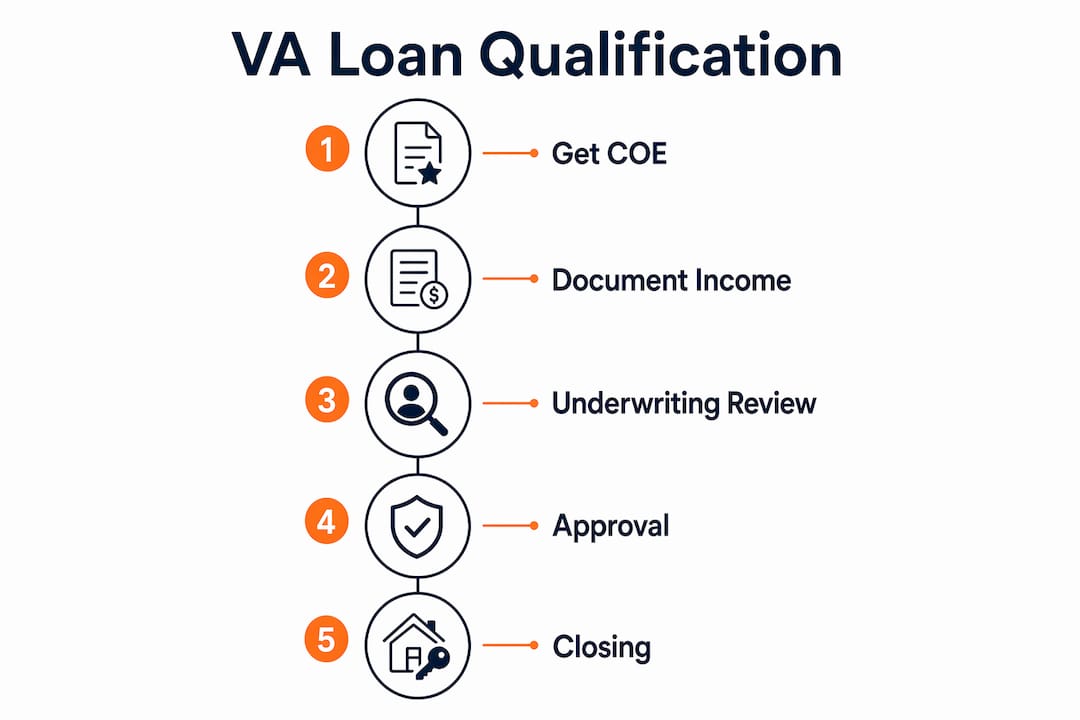
- Step-by-step: how to pursue a VA loan when you’re self-employed
- What timeline and costs should you expect?
- Key Takeaways
- Why you should talk to a VA-specialist lender before you do anything else
- When VA qualification isn’t possible, there’s a direct alternative
- Primary sources and further reading
Who qualifies for a VA home loan?
VA eligibility is based on service history, not credit score. You must meet minimum active-duty service requirements and obtain a COE before any lender can underwrite your loan.
Qualifying categories:
- Active-duty servicemembers who meet minimum continuous service requirements
- Veterans who served continuous active duty for at least two years (or the full ordered period), discharged other than dishonorably
- National Guard and Reserve members who meet creditable service requirements including active Title 10 service
- Surviving spouses eligible for or receiving Dependency and Indemnity Compensation (DIC)
Getting your COE: Your lender can pull it in seconds through VA’s WebLGY system. You can also apply directly at VA.gov or mail VA Form 26-1880. Most purchase transactions go through the lender route because it’s fastest.
One planning note: VA loans require primary occupancy. You must intend to live in the home you’re buying, which rules out pure investment purchases under the VA program.
What VA lenders look for during underwriting
VA underwriting has two primary tests: debt-to-income ratio (DTI) and residual income. Per 38 CFR § 36.4340, failing one test doesn’t automatically disqualify you, but both must be addressed.

Residual income is the amount left after paying all monthly obligations, including the proposed mortgage. The VA sets minimum residual income thresholds by family size and region. For Texas borrowers, this is the Southwest region table. A lender can approve a loan with a DTI above 41% if residual income is strong enough, and a VA residual income calculator can help you estimate where you stand before applying.
Credit score: The VA sets no minimum, but most lenders require at least a 620-640 mid-score. Self-employed borrowers with thin credit files or recent business debt should expect more scrutiny. Higher scores also mean better pricing.
Income stability: VA guidance requires income to be stable and reliable. For self-employed borrowers, lenders typically average two years of net profit and look for an upward or flat trend. A sharp income decline in year two raises flags.
VA funding fee: Most borrowers pay a funding fee at closing, ranging by down payment and whether it’s a first or subsequent use. Veterans with a service-connected disability rating are exempt.
How self-employed borrowers document income for a VA loan
Lenders treat self-employment as higher risk because income can fluctuate. Expect to provide more paperwork than a W-2 employee.
| Document | What the lender looks for |
|---|---|
| Two years of personal federal tax returns (all schedules) | Net profit, Schedule C/K-1 income, consistency |
| Business tax returns or K-1s | Business profitability, ownership percentage |
| 1099s | Proof of 1099 income sources and consistency |
| Year-to-date P&L statement | Current income trend vs. prior year |
| Business balance sheet | Business financial health and liabilities |
| 12 months of business bank statements | Cash flow, deposit patterns, business debt payments |
| Business license | Confirms active, legitimate business |
| CPA letter | Verifies business existence and income method |
Underwriters use net profit, not gross revenue. However, certain non-cash expenses like depreciation can be added back to increase qualifying income. A CPA who understands mortgage qualification can prepare a P&L that clearly shows these add-backs.
Pro Tip: Keep business and personal bank accounts completely separate. Commingled accounts slow underwriting and can cause a lender to exclude deposits they can’t clearly attribute to business income. Label every unusual deposit with a brief memo at the time it hits your account.
What are your options if tax returns show low income?
This is the most common problem for self-employed Texas veterans. High write-offs lower your tax bill but also lower the income a VA lender will count. Here are your ranked options:
- Talk to your CPA before filing. If you plan to buy within 24 months, reducing certain deductions strategically can raise net qualifying income. This is the highest-leverage move, but it requires planning ahead.
- Add a co-borrower. A spouse or partner with W-2 income can significantly increase qualifying income and residual income. The VA allows co-borrower income when the co-borrower is on the application.
- Build cash reserves. Strong reserves (3-6 months of mortgage payments) act as a compensating factor. They don’t replace income, but they give underwriters confidence.
- Find a lender with VA self-employment experience. An experienced VA loan officer knows which add-backs the VA allows and how to apply the residual income test correctly. The wrong lender may deny a loan that a specialist would approve.
- Use a bank-statement loan. When VA qualification isn’t possible, a bank-statement program uses 12-24 months of deposits instead of net taxable income. You preserve buying power based on actual cash flow.
Pro Tip: If you go the bank-statement route, prepare a one-page narrative cover letter for your underwriter. Explain your business model, note any large non-recurring deposits, and flag consistent monthly revenue sources. It cuts back-and-forth by days.
Bank-statement loans vs. VA loans: what actually changes
Understanding the tradeoffs helps you choose the right path rather than defaulting to whichever lender calls you back first.
- Documentation: VA loans use net taxable income from two years of returns. Bank-statement programs use 12-24 months of deposits to calculate qualifying cash flow.
- Impact of write-offs: Heavy deductions hurt VA qualification. They’re irrelevant in a bank-statement program.
- Down payment: VA loans can require zero down. Bank-statement programs require a minimum down payment of 10%.
- Rates: Bank-statement loans usually carry higher interest rates than VA-guaranteed loans, which benefit from the VA’s partial guarantee.
- VA entitlement: A bank-statement loan is a separate product. It doesn’t use or affect your VA entitlement, so you can still use a VA loan later.
The VA program’s strongest advantages are the no-down-payment option, the residual income protection (which is genuinely borrower-friendly), and the funding fee exemption for disabled veterans. Bank-statement programs trade some of those benefits for documentation flexibility. Neither is universally better; the right choice depends on what your tax returns actually show.
Step-by-step: how to pursue a VA loan when you’re self-employed
- Request your COE. Ask your lender to pull it through WebLGY, or apply at VA.gov. Confirm your entitlement amount.
- Assemble two years of tax returns. Include all schedules, K-1s, and business returns. Organize by year and label clearly.
- Prepare a current YTD P&L and balance sheet. Have your CPA sign and date both. Make sure the P&L is consistent with your bank deposits.
- Gather 12-24 months of business and personal bank statements. Highlight regular income deposits. Annotate large or irregular ones.
- Request prequalification from a VA lender with self-employment experience. Ask directly: “How do you handle Schedule C income and add-backs?” Their answer tells you everything about their experience level.
- Address credit and reserve gaps before applying. Pay down revolving balances, avoid new credit inquiries, and move reserves into a single verifiable account.
- Submit to underwriting and respond fast. Delays in document requests are the single biggest cause of extended timelines. Keep a digital folder ready with every document organized.
Pro Tip: Before you commit to a lender, ask whether they have overlay policies on self-employment income. Some lenders add requirements beyond VA minimums. A lender who regularly handles variable self-employed income will have a cleaner, faster process.
What timeline and costs should you expect?
- Prequalification: 1-7 days, depending on how quickly you provide documents
- Underwriting: 2-4 weeks for a complete file; longer if documents are missing
- Appraisal and closing: 2-6 weeks after underwriting approval
- Total offer to close: 30-60 days is typical for a well-prepared file
Common costs to budget:
- VA appraisal fee (varies by state; Texas typically runs $500-$800)
- Title and escrow fees
- VA funding fee (if applicable, varies by loan amount and usage)
- Down payment: $0 for VA loans; minimum 10% for bank-statement programs
- Reserves: plan for 3-6 months of mortgage payments in a verifiable account
A stronger reserve position and a complete document package at submission are the two factors most within your control. Both shorten underwriting and can improve your rate offer.
Key Takeaways
Self-employed Texas veterans can qualify for a VA home loan through standard tax-return underwriting or a bank-statement alternative when write-offs reduce net qualifying income below VA thresholds.
| Point | Details |
|---|---|
| COE is the first step | Obtain your Certificate of Eligibility through VA.gov or your lender before any underwriting begins. |
| Net income, not gross revenue | VA lenders count net profit from tax returns; heavy write-offs directly reduce your qualifying amount. |
| Residual income matters most | The VA’s residual income test can override a high DTI, making it the most borrower-friendly part of VA underwriting. |
| Bank-statement loans fill the gap | When tax returns show low net income, 12-24 months of deposits can qualify you based on actual cash flow. |
| Texasbankstatementloans | Offers bank-statement qualification with a minimum down payment of 10% for self-employed Texas borrowers. |
Why you should talk to a VA-specialist lender before you do anything else
Most self-employed veterans who get denied for a VA loan weren’t actually ineligible. They worked with a lender who didn’t know how to apply the residual income test correctly, missed legitimate add-backs, or asked for documents in the wrong order. The VA’s underwriting rules have more flexibility than most people realize, but only a loan officer who works with Schedule C and 1099 borrowers regularly knows how to use that flexibility.
Early consultation also gives you time to adjust. If your last two tax returns show declining income, you may need to wait a filing cycle or shift your documentation strategy. Finding that out six months before you want to close is manageable. Finding it out during underwriting is not.
When VA qualification isn’t possible, there’s a direct alternative
If your tax returns show low net income because you run a profitable business with significant deductions, Texasbankstatementloans was built for exactly that situation. Instead of relying on what you reported to the IRS, the program qualifies you on 12-24 months of actual bank deposits, which reflects what your business actually generates.
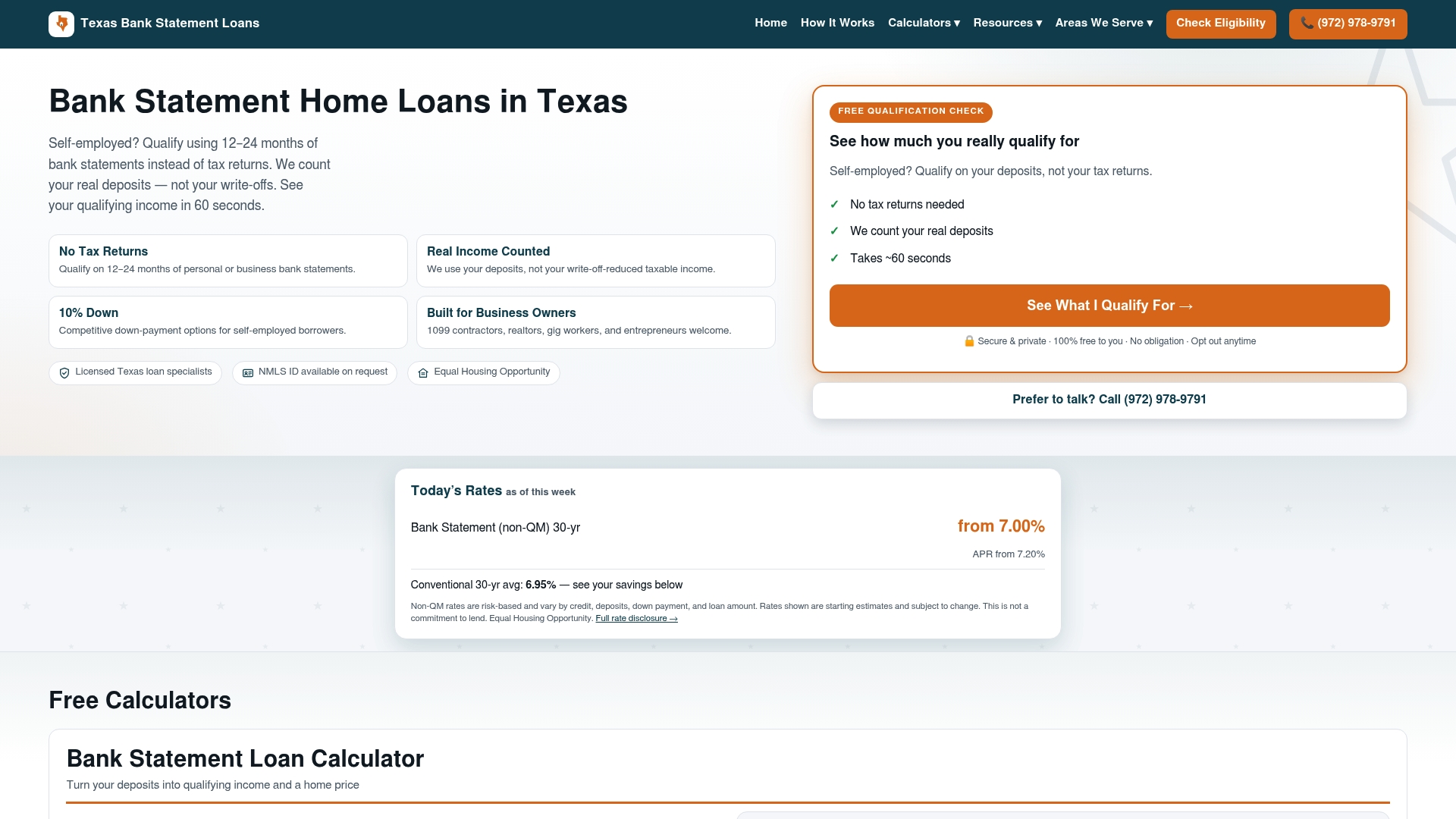
The minimum down payment is 10%, and you can run a quick qualification estimate in about 60 seconds to see what you’d realistically qualify for. The program works across Texas, including Houston, San Antonio, and the surrounding regions. It’s the right fit when you have strong gross revenue, consistent deposits, and tax returns that don’t tell the full story. Check your qualifying income now with no obligation.
Primary sources and further reading
- VA Home Loan Eligibility and COE, VA.gov official eligibility requirements and COE application
- VA Underwriting Standards (38 CFR § 36.4340), Federal regulation governing DTI, residual income, and lender certification
- VA Income Verification Circular, VA guidance on income stability and lender documentation requirements
- VA Home Loan Guaranty Buyer’s Guide, Plain-language overview of VA loan requirements and process
- Self-Employed Income for VA Loans, Practical guidance on 1099 and Schedule C income qualification
- Texasbankstatementloans, Bank-statement loan products for self-employed Texas borrowers
This article is general information, not financial or legal advice. Confirm current VA rules and your specific qualification with VA.gov and a licensed mortgage professional before making any borrowing decisions.
See what you qualify for in 60 seconds, free and no credit check. Use the eligibility check at the top of this page.