
Preapproval is the stronger, more credible signal of the two. It comes from a lender that has already pulled your credit and checked your income and assets, while prequalification is mostly a self-reported estimate. Neither one, though, is a guaranteed loan. Both are preliminary steps a lender revisits during full underwriting, and one uses a soft credit check while the other typically runs a hard inquiry.
- Preapproval: verified, document-backed, carries more weight with sellers
- Prequalification: fast, self-reported, best for early budgeting
- Neither is a final loan commitment. Underwriting and appraisal still have to happen.
Key Takeaways
Preapproval outweighs prequalification in negotiating power because it verifies income, assets, and credit rather than relying on self-reported numbers.
| Point | Details |
|---|---|
| Preapproval carries more weight | Sellers and agents generally treat a verified preapproval letter as proof you can close, not just a rough estimate. |
| Neither letter is final | Full underwriting and appraisal still follow, no matter how strong your preapproval looks. |
| Watch the expiration window | Preapproval letters often expire in 30 to 60 days, so refresh yours if your search runs long. |
| Prepare documents early | Two years of tax returns, bank statements, and a P&L (for the self-employed) speed up verification. |
| Bank-statement loans fit complex income | Texas Bank Statement Home Loans qualifies self-employed buyers using 12 to 24 months of deposits instead of tax returns. |
This article is general information, not a substitute for advice from a qualified financial advisor. Consult a qualified financial professional about your own circumstances before acting on anything here.
Table of Contents
- Prequalification vs Preapproval: Understanding the First Step
- What Mortgage Preapproval Actually Verifies
- Preapproval vs Prequalification Mortgage: Side-by-Side Contrasts
- When to Get Prequalification vs Preapproval
- Getting Preapproval-Ready: Documents and Self-Employed Pitfalls
- Why the CFPB and Regulation C Definitions Matter
- A Quick Note From the Editor
- Getting Credit-Ready When Your Income Doesn’t Fit a W-2 Box
- Sources
Prequalification vs Preapproval: Understanding the First Step
Prequalification is usually the first real conversation you have with a lender about what you might be able to afford. You tell them your income, debts, and assets. They plug the numbers into a formula and hand you a rough estimate of what you could borrow.
Most lenders run this check using only a soft credit pull, though it’s worth confirming that directly with whoever you’re talking to since practices vary. Here’s what typically happens during the process:
- You share income, debt, and asset figures verbally or through an online form.
- The lender runs a soft credit check that doesn’t affect your score.
- You receive a letter estimating your likely borrowing range.
This step works well for early house hunting, before you’ve picked a neighborhood or started attending open houses. It tells you roughly what price range makes sense so you’re not wasting weekends touring homes you can’t actually afford.
What Mortgage Preapproval Actually Verifies
Preapproval goes several steps further. Instead of taking your word for your income and assets, the lender verifies them. That usually means a hard credit inquiry alongside a documented review of what you earn, what you owe, and what you have in the bank.
Expect to hand over recent pay stubs, two years of tax returns, and bank statements covering the last several months. The lender checks all of it against what you reported, then issues a conditional commitment for a specific loan amount.
- Hard credit pull that can cause a small, temporary dip in your score
- Documented verification of income, assets, and debts
- A letter that’s typically valid for 30 to 90 days depending on the lender
Preapproval letters commonly expire in 30 to 60 days, according to the Consumer Financial Protection Bureau, though some lenders extend that window closer to 90 days. That expiration matters more than most buyers realize, because a preapproval that lapses mid-search forces you back through the verification process right when you’re trying to move fast on an offer.
Even with all that documentation behind it, a preapproval is still conditional. The lender still has to order an appraisal, confirm the property itself qualifies, and complete full underwriting before funding.

Preapproval vs Prequalification Mortgage: Side-by-Side Contrasts
The practical differences come down to four things: how deep the credit check goes, how much documentation gets verified, how it affects your timeline, and how sellers read the letter.
- Credit check type: Prequalification typically relies on a soft pull; preapproval usually triggers a hard inquiry that can briefly affect your score.
- Verification depth: Prequalification is an estimate based on self-reported numbers; preapproval is a documented, conditional offer backed by pay stubs, tax returns, and bank statements.
- Who benefits: Prequalification suits someone still deciding if now’s the right time to buy; preapproval suits someone ready to write offers.
- Seller perception: Agents and sellers in competitive markets often treat a prequalification letter as a formality and a preapproval letter as proof you can actually close.
None of this means prequalification is pointless. It’s the right tool at the right stage. The mistake buyers make is treating either letter as a done deal instead of what it actually is: a lender’s estimate, not a closing.
When to Get Prequalification vs Preapproval
Sequencing matters more than most buyers expect. Get prequalified as soon as you’re seriously considering a purchase, even months before you start touring homes. It costs you nothing in credit score and gives you a realistic number to plan around.
- Get prequalified early to set a realistic budget and narrow your search area.
- Get preapproved once you’re actively touring homes and ready to compete for one.
- If your preapproval expires before you find the right house, ask your lender to refresh it rather than letting it lapse mid-negotiation.
- Avoid triggering multiple hard inquiries by shopping lenders within a short window, since credit scoring models generally treat mortgage inquiries made in a tight rate-shopping period as a single event.
Pro Tip: Talk to your real estate agent before you start applying anywhere. In some markets sellers won’t even entertain an offer without a preapproval letter attached, and your agent knows exactly how strict the local sellers tend to be.
Getting Preapproval-Ready: Documents and Self-Employed Pitfalls
Lenders want to see two years of tax returns, recent bank statements, a current profit-and-loss statement if you’re self-employed, and documentation for any large or irregular deposits. Each document exists to answer one question: does your actual cash flow support this loan?
- Two years of tax returns to establish an income trend
- Bank statements covering several recent months
- A current-year profit and loss statement
- Written explanations for large or unusual deposits
Self-employed borrowers run into predictable snags here. Mixing personal and business accounts, or depositing large sums without a paper trail, tends to slow underwriting down. Organizing bank statements, a CPA-prepared P&L, and deposit explanations ahead of time shortens that review considerably.
When tax returns understate what a business actually brings in, a program built around 12 to 24 months of bank deposits instead of tax filings can present a more accurate picture of true earning power.
That’s exactly the gap alternative bank-statement programs and non-QM loans exist to fill, though they typically carry their own rate and down payment trade-offs worth weighing against a conventional path.
Why the CFPB and Regulation C Definitions Matter
The CFPB is direct about this: both letters estimate what you might borrow, and neither is a guaranteed loan offer. Terminology also isn’t standardized across lenders.
- Regulation C defines a true preapproval program as one built on a comprehensive creditworthiness review that issues a written commitment for a set period, subject only to limited conditions.
- Some lenders label a quick estimate “preapproval” even when it doesn’t meet that formal standard.
- Ask any lender directly what they verified: credit, income, assets, or just your word.
A Quick Note From the Editor
Mortgage lending moves in details, not headlines. Ask a lender exactly what they checked before you trust either letter in a negotiation.
- Saad
Getting Credit-Ready When Your Income Doesn’t Fit a W-2 Box
If you’re self-employed, a 1099 contractor, or running a small business, the standard preapproval path built around tax returns can undersell what you actually earn. Texas Bank Statement Home Loans looks at 12 to 24 months of personal or business bank deposits instead, so your real cash flow, not a tax return shaped by deductions, drives your loan amount.
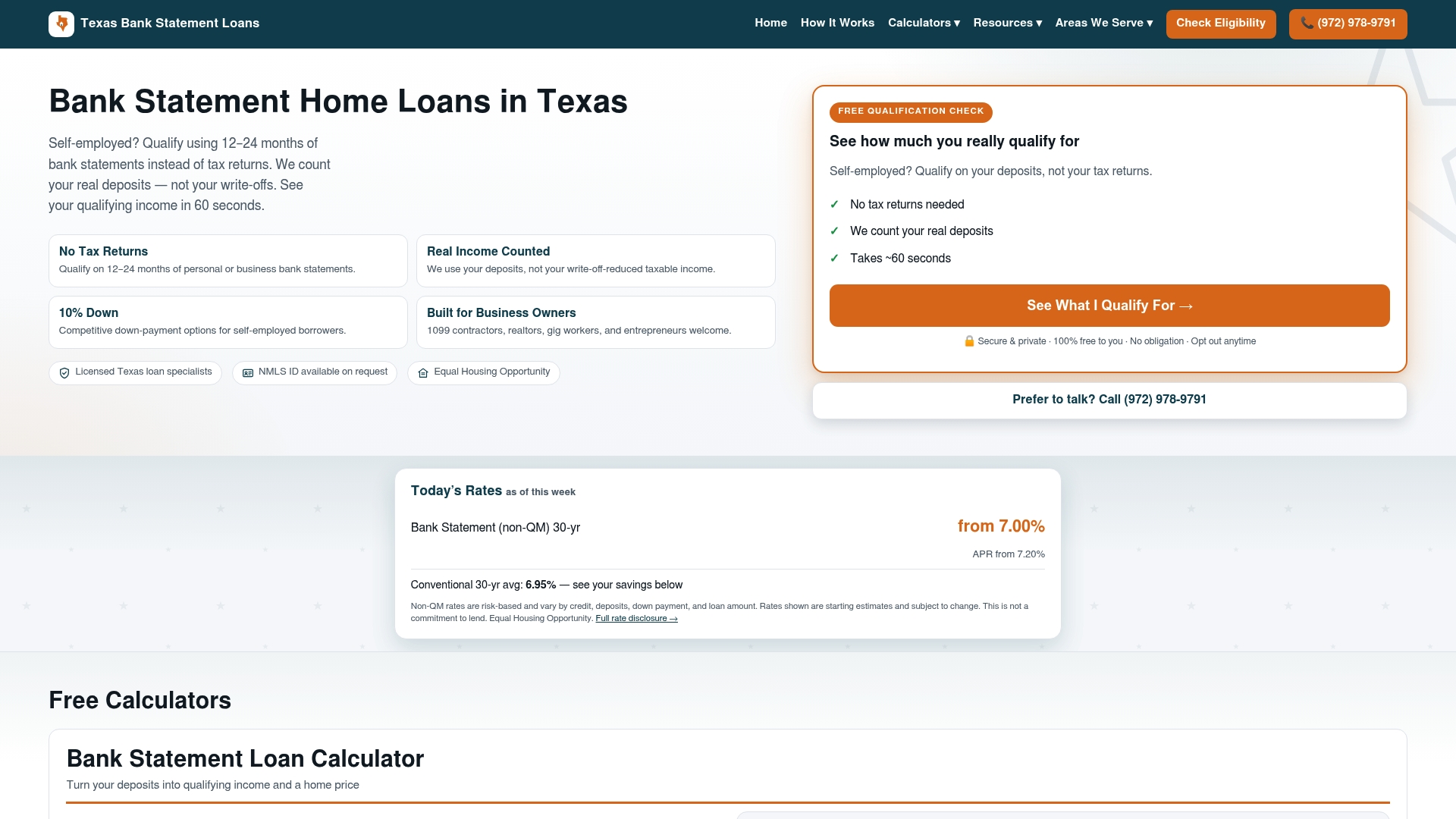
This approach was built for gig workers, business owners, and realtors across Texas who’ve been turned down or lowballed by conventional underwriting despite solid income. The free qualification check takes about 60 seconds and comes with no obligation, and down payments start at 10 percent rather than the higher thresholds many non-QM programs require. Before you apply, run your numbers through the self-employed affordability calculator to see a realistic price range based on your actual deposits, then start your qualification check to find out what a document-based preapproval could look like for you.
Sources
- Get a preapproval letter | Consumer Financial Protection Bureau
- § 1003.2 Definitions. | Consumer Financial Protection Bureau
- Prequalified vs. Preapproved: What’s the Difference? | Investopedia
See what you qualify for in 60 seconds, free and no credit check. Use the eligibility check at the top of this page.