
A non-permanent resident alien is a foreign national living legally in the United States without a green card, and that single distinction shapes almost everything about your tax filing and your ability to get a mortgage. You are not a U.S. citizen and you are not a lawful permanent resident, but you can still hold work authorization, a Social Security Number or an ITIN, and enough legal standing to file taxes and buy a home.
Two things matter immediately. First, your tax obligation depends on whether you pass the Green Card Test or Substantial Presence Test, if you fail both, you’re a nonresident alien who files Form 1040-NR and pays U.S. tax only on U.S.-source income. Second, on the mortgage side, Fannie Mae allows non-permanent resident borrowers to qualify under the same terms as U.S. citizens, provided you’re legally present and can document it.
Before you do anything else, check these three sources:
- IRS Topic 851 and Publication 519 to confirm your tax residency status and filing requirements
- USCIS documentation (Form I-551 for green card holders, or your visa/EAD) to establish your immigration status
- Fannie Mae’s Selling Guide to understand what a lender will actually ask you to prove
Key Takeaways
Non-permanent resident aliens can file taxes correctly and qualify for a mortgage once they separate immigration status, tax residency, and lender legal-presence standards into three distinct questions.
| Point | Details |
|---|---|
| Definition matters | A non-permanent resident alien lacks a green card but may hold work authorization, an SSN, or an ITIN. |
| Two tax tests decide filing | The Green Card Test and Substantial Presence Test determine whether you file Form 1040 or Form 1040-NR. |
| Immigration status isn’t tax status | A visa holder can become a tax resident through Substantial Presence despite non-permanent immigration standing. |
| Lenders use legal presence, not tax tests | Fannie Mae allows qualification with SSN/ITIN, visa, EAD, or I-551 documentation, separate from IRS residency rules. |
| Bank-statement loans fit self-employed borrowers | Texasbankstatementloans qualifies applicants using 12-24 months of deposits instead of tax returns, with down payments starting at 10%. |
Table of Contents
- How Do You Determine Your Tax Residency Status?
- What Does Being a Nonresident Alien Mean for Your Taxes?
- Immigration Status and Tax Residency Are Not the Same Thing
- How Do Lenders Evaluate Non-Permanent Resident Alien Borrowers?
- Your Document Checklist for Tax Filing and Mortgage Applications
- Bank-Statement Loans for Self-Employed Non-Permanent Residents
- When Should You Call a Tax Pro, Immigration Attorney, or Mortgage Broker?
- How Underwriters Actually Look at Non-Permanent Resident Applications
- A Faster Path to Mortgage Approval for Self-Employed Borrowers
- Where to Verify These Rules Yourself
- Frequently Asked Questions
- Sources
How Do You Determine Your Tax Residency Status?
You’re a resident alien for tax purposes if you pass either of two IRS tests. Fail both, and you default to nonresident alien status. This single determination decides which form you file and how much of your income the IRS can touch.
The Green Card Test
If USCIS has issued you a Form I-551 (the actual green card), you’re a lawful permanent resident and, for tax purposes, a resident alien. It doesn’t matter if you spent eight months out of the country last year visiting family. Green card status alone triggers resident tax treatment, full stop, unless you formally abandon it or a tax treaty tiebreaker applies.
The Substantial Presence Test
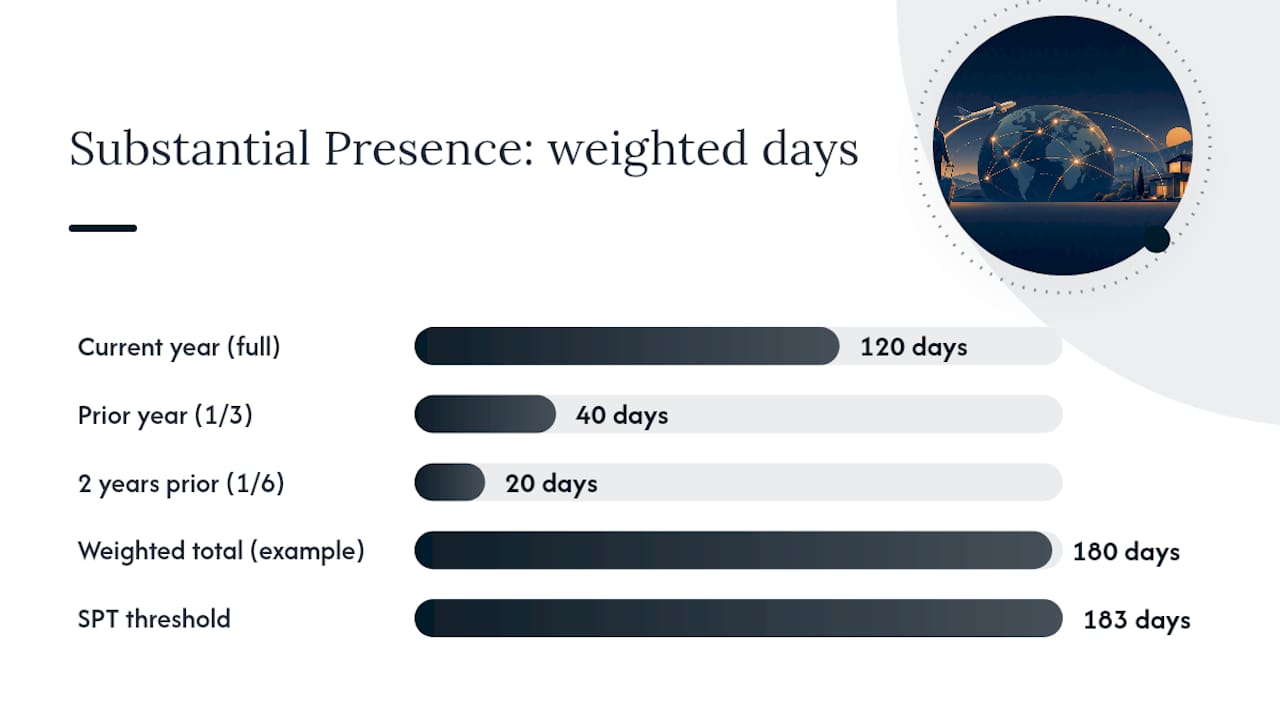
This one trips up more people because it’s math, not paperwork. The Substantial Presence Test counts:
- All the days you were physically present in the U.S. during the current year
- One-third of the days you were present in the prior year
- One-sixth of the days you were present in the year before that
You need at least 31 days in the current year, and the three-year weighted total has to hit 183 days or more. Here’s a worked example: say you spent 120 days in the U.S. in 2026, 120 days in 2025, and 120 days in 2024. That’s 120 + (120 ÷ 3 = 40) + (120 ÷ 6 = 20) = 180 days. You’d miss the test by three days and stay a nonresident alien for 2026.
Change one variable, say 130 days in the current year instead of 120, and the math flips: 130 + 40 + 20 = 190. Now you’re a resident alien, taxed on worldwide income starting that year.
| Test | Which applies | Filing form required | Tax scope | Treaty impact |
|---|---|---|---|---|
| Green Card Test | Lawful permanent residents (I-551 holders) | Form 1040 | Worldwide income | Limited; treaty tiebreaker rarely overrides green card status |
| Substantial Presence Test | Visa holders meeting the 183-day weighted threshold | Form 1040 | Worldwide income | Closer-connection exception or treaty tiebreaker may apply |
If you meet Substantial Presence but maintain a closer connection to another country, Form 8840 can let you claim nonresident treatment anyway. Arriving mid-year? The First-Year Choice election under Publication 519 lets some new arrivals split the year into dual-status treatment rather than defaulting to full-year resident or nonresident status.
Pro Tip: Days don’t count the same for everyone. Certain visa categories (students on F visas, teachers on J visas, some diplomats) are “exempt individuals” whose days don’t count toward Substantial Presence at all. Keep a personal travel log with entry and exit stamps. Immigration records and your own memory rarely agree, and a miscounted week can flip your entire tax status.
What Does Being a Nonresident Alien Mean for Your Taxes?
If you fail both tests, you file Form 1040-NR and the IRS only taxes your U.S.-source income and income “effectively connected” to a U.S. trade or business. That’s a real advantage over resident alien status, which pulls in worldwide income no matter where you earned it.
The IRS splits nonresident income into two buckets. FDAP income (fixed, determinable, annual, or periodic, think dividends, interest, royalties) usually gets a flat withholding rate, often 30%, unless a tax treaty lowers it. Effectively connected income, your wages from a U.S. job or profits from a U.S. business, gets taxed at the same graduated rates U.S. citizens pay.
A few practical points that trip up filers every year:
- Wage withholding for nonresident aliens often differs from what a citizen employee sees on the same paycheck, so check your W-4 setup with your employer.
- Tax treaties between the U.S. and dozens of countries can reduce or eliminate withholding on specific income types, but you generally have to claim the position on Form 8833.
- Dual-status years, arriving or departing mid-year, split your return into a resident period and a nonresident period, each taxed under different rules.
- The First-Year Choice election under Publication 519 can retroactively treat part of your arrival year as resident status if you meet specific day thresholds later in the year.
The 183-day threshold is the number that decides everything. Miss it and you’re taxed narrowly on U.S.-source income only. Cross it, even by a few weighted days from three years of travel, and the IRS expects a return covering your entire worldwide income, foreign bank accounts and all.
Immigration Status and Tax Residency Are Not the Same Thing
This is where most confusion starts, and it costs people money. Immigration status is a legal classification issued by USCIS. Tax residency is a math problem the IRS runs independently. They frequently point in different directions.
A visa holder on an H-1B, still years from green card eligibility and fully “non-permanent” in the eyes of immigration law, can easily meet the Substantial Presence Test after a full year of physical presence. The IRS then treats that person as a resident alien for tax purposes, worldwide income and all, even though USCIS still classifies them as temporary. Run it the other direction: a green card holder who spends eleven months abroad caring for a parent is still a resident alien for tax purposes. Lawful permanent residency doesn’t pause just because you’re not physically in the country.
Pro Tip: Don’t assume your visa category tells you your tax bracket scope. A non-permanent visa holder who has been in the U.S. for two consecutive years is very likely a tax resident already, taxed on worldwide income, regardless of what their immigration paperwork says. Check the day count every single tax year, not just once.
Lenders operate on a third standard entirely, separate from both of these frameworks: legal presence. That’s the piece that matters most if you’re shopping for a mortgage, and it’s not the same test the IRS or USCIS uses.
How Do Lenders Evaluate Non-Permanent Resident Alien Borrowers?
Fannie Mae’s Selling Guide states plainly that non-U.S. citizen borrowers, whether lawful permanent residents or non-permanent residents, can qualify for a mortgage under the same terms as U.S. citizens. The determining factor isn’t your visa category or your tax residency test result. It’s whether you’re legally present in the country and can document it.
Lenders accept a range of documents to establish that legal presence, and they have real discretion in how they verify it. Commonly accepted proof includes a Social Security Number or ITIN, an Employment Authorization Document, Form I-551 for green card holders, Form I-94 arrival/departure records, and current, unexpired visa stamps. Fannie Mae doesn’t mandate one fixed checklist; underwriters look at the totality of your documentation.
| Mortgage dimension | What lenders look for |
|---|---|
| Eligible borrower types | Lawful permanent residents, legally present non-permanent visa holders, ITIN borrowers |
| Required ID | SSN preferred; ITIN accepted for many programs |
| Documentation | Visa/EAD/I-551, I-94, proof of income, bank statements |
| Down payment expectations | Often higher than conventional minimums; bank-statement and ITIN programs frequently start near 10% |
| Program availability | Conventional loans (Fannie Mae eligible), ITIN loan programs, bank-statement loans for self-employed borrowers |
Underwriters weigh a few things beyond the paperwork checklist:
- Income continuity matters more than any single document. Underwriters want to see a pattern, not a snapshot.
- Employment authorization timing gets scrutinized. If your EAD expires in four months, expect questions about renewal plans.
- Visa stamp history helps establish how long you’ve maintained lawful status, which feeds into the lender’s overall risk assessment.
- Status changes after closing are rarely a problem for an existing loan. Lenders qualify you at origination; they don’t re-underwrite you every renewal cycle.
A typical timeline runs four to eight weeks: gathering documentation takes one to two weeks if you’re organized, preapproval takes a few days once documents are in, underwriting runs two to four weeks depending on complexity, and closing typically follows within a week of clear-to-close.
Your Document Checklist for Tax Filing and Mortgage Applications
Two parallel checklists, one for the IRS and one for your lender, cover almost everything you’ll need to gather.
For tax filing:
- Passport and visa documentation showing entry and exit dates
- A personal travel log or calendar for calculating Substantial Presence days
- Prior-year tax returns if you filed in the U.S. before
- Form 1040-NR (or Form 1040 if you’re a resident alien) and Form 8840 if claiming closer-connection
- ITIN application (Form W-7) if you don’t have an SSN and need one to file
For a mortgage application:
- SSN or ITIN
- Visa, EAD, or Form I-551 showing current legal status
- Two most recent pay stubs, or 12 to 24 months of bank statements if you’re self-employed
- Proof of funds for down payment and closing costs
- Two years of employment history, even if some of it was abroad
Pro Tip: Build your travel calendar before you need it, not during tax season. A simple spreadsheet logging every entry and exit date, cross-checked against your passport stamps, saves hours when you’re calculating Substantial Presence days under pressure.
On costs: preparing Form 1040-NR through a tax professional typically runs a few hundred dollars depending on complexity, ITIN processing through Form W-7 has no IRS filing fee but often involves a certified acceptance agent fee, and mortgage preapproval itself is usually free, though you’ll eventually cover appraisal and underwriting fees at closing.
Bank-Statement Loans for Self-Employed Non-Permanent Residents
Self-employment complicates mortgage qualification for anyone, and it compounds fast when you’re also a non-permanent resident alien navigating unfamiliar paperwork. Traditional underwriting leans hard on tax returns, and self-employed borrowers routinely write off enough expenses that their reported taxable income looks nothing like their actual cash flow.
Bank-statement loans sidestep that problem entirely. Instead of tax returns, a lender reviews 12 to 24 months of personal or business bank deposits to establish real income. If you’re a 1099 contractor, a gig worker, or a small business owner who writes off aggressively for tax purposes but still deposits solid income every month, this approach lets your actual cash flow speak for you instead of a tax return that undersells what you make.

The process typically requires your bank statements for the full lookback period, a profit and loss statement if your lender requests one, your visa/EAD/I-551 documentation to establish legal presence, and your SSN or ITIN. Underwriting timelines run similar to conventional loans, usually two to four weeks once your documents are complete, since the lender is analyzing deposit patterns rather than waiting on tax transcript verification.
Pro Tip: If your deposits are irregular month to month, gig income, seasonal contracts, project-based work, keep a simple ledger explaining large or unusual deposits before you apply. A lender reviewing 18 months of statements wants to see a pattern they can trust, and a one-line explanation for an outlier deposit can prevent a delay in underwriting.
Bank statement programs built for this exact situation are available through the Coastal Bend and South Texas market, where self-employed and gig-economy borrowers use deposit history instead of tax returns to qualify. Down payment options start at a higher threshold to widen access for borrowers who’d otherwise get filtered out by conventional debt-to-income math built around underreported taxable income.
When Should You Call a Tax Pro, Immigration Attorney, or Mortgage Broker?
Some situations are simple enough to handle yourself with a good checklist. Others aren’t, and guessing wrong gets expensive fast.
- Dual-status years with mixed income sources almost always benefit from a tax professional who’s handled cross-border filings before.
- Treaty positions claimed on Form 8833 deserve a second set of eyes; misapplying a treaty article is a common, costly error.
- Large asset sales involving property or investments in another country can trigger reporting obligations most general tax preparers haven’t dealt with.
- A change in immigration status while you already have an active mortgage rarely threatens the loan itself, but it’s worth a quick call to your loan servicer to confirm nothing changes on your end.
- Disputes over how self-employed income should be documented for underwriting purposes are exactly what a mortgage broker experienced in bank-statement programs exists to solve.
Start with a tax professional for anything involving Form 1040-NR complexity, treaty claims, or dual-status calculations. Go to an immigration attorney when the question is about your visa category, status changes, or path to permanent residency, not your tax return. Bring a mortgage broker in once you’re ready to discuss actual loan programs, and bring your documentation checklist to that first conversation so you’re not wasting a consultation figuring out what you don’t have yet.
How Underwriters Actually Look at Non-Permanent Resident Applications
Underwriters aren’t looking for a perfect immigration file. They’re looking for three things in order: proof you’re legally present right now, proof your income holds up over time, and a valid SSN or ITIN tied to your application.
The paperwork that speeds this along is almost always the same across files: a current I-94 record, a valid EAD if you’re working under one, and, for self-employed applicants, 12 to 24 months of bank statements that tell a consistent income story. Borrowers who show up with all three organized on day one move through underwriting noticeably faster than those who submit documents piecemeal over several weeks.
Income continuity carries more weight than most applicants expect. A single strong month doesn’t move the needle if the eleven months before it look inconsistent. What underwriters actually want is a pattern they can extrapolate forward, which is exactly why bank-statement review works so well for gig workers and contractors whose tax returns understate what they really bring in.
A Faster Path to Mortgage Approval for Self-Employed Borrowers
If you’ve read this far, you already know the two frameworks that decide your situation: the IRS tests for tax residency and Fannie Mae’s legal-presence standard for mortgage eligibility. What you may not have is a lender built around the reality that self-employed income rarely matches a tax return.
Texasbankstatementloans evaluates 12 to 24 months of bank deposits instead of tax filings, which means your actual cash flow, not your write-offs, decides what you qualify for.
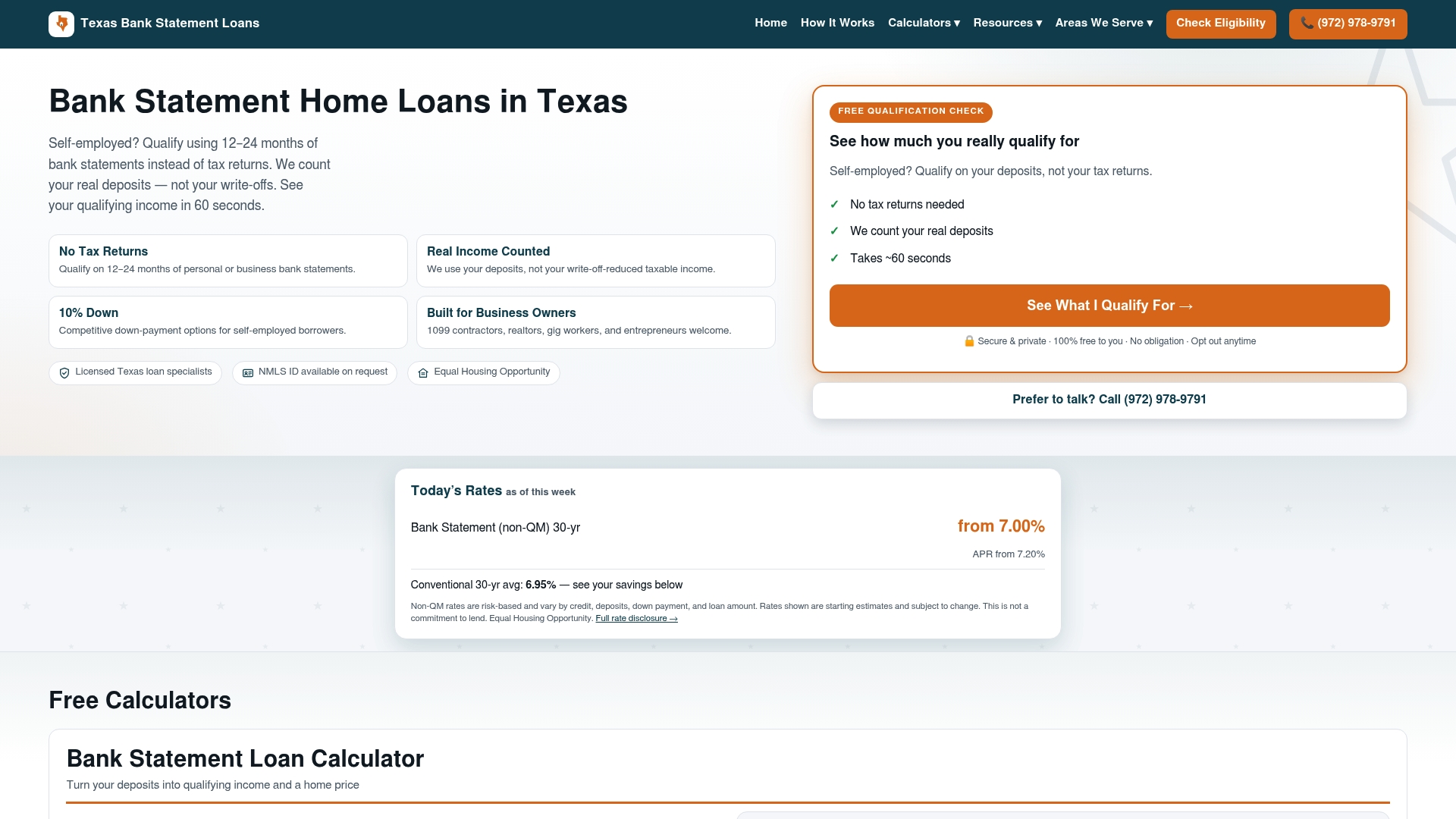
That single shift matters most for the exact borrowers this article covers: 1099 contractors, gig workers, and business owners whose taxable income on paper looks nothing like their bank balance. Down payment options start at 10%, and ITIN borrowers without an SSN have a path to qualification most conventional lenders won’t offer. The qualification check takes about 60 seconds and comes with no obligation, so you can see a realistic number before you commit time to a full application. If you’re weighing whether your income and documentation will clear underwriting, running the bank statement loan calculator first gives you a concrete estimate to work from, and current rate information is available if pricing is your next question. Start with the free qualification check and see where you actually stand.
Where to Verify These Rules Yourself
Every claim in this guide traces back to a primary source you can check directly before you file or apply.
- IRS Topic No. 851 covers the basic resident versus nonresident alien classification and which tests apply.
- Publication 519 is the full U.S. Tax Guide for Aliens, covering dual-status years, First-Year Choice, and closer-connection exceptions in detail.
- The Substantial Presence Test page walks through the exact day-counting formula with IRS examples.
- Alien taxation essential concepts explains FDAP versus effectively connected income and Form 1040-NR filing triggers.
- Fannie Mae’s Non-U.S. Citizen Borrower Eligibility Requirements lays out exactly what lenders check before approving a non-permanent resident’s mortgage application.
This article provides general information on tax filing and mortgage eligibility for non-permanent resident aliens and is not a substitute for advice from a licensed tax professional, immigration attorney, or mortgage broker familiar with your specific situation.
Frequently Asked Questions
Is a non-permanent resident alien the same as a nonresident alien for tax purposes? No. “Non-permanent resident alien” describes your immigration status, lacking a green card. “Nonresident alien” is a tax classification based on the Green Card Test and Substantial Presence Test. You can be non-permanent for immigration purposes while still being a resident alien for tax purposes if you meet Substantial Presence.
Can a non-permanent resident alien get a mortgage in the U.S.? Yes. Fannie Mae guidance allows non-permanent residents who are legally present to qualify under the same terms as U.S. citizens, provided they document their status with an SSN or ITIN along with visa, EAD, or similar proof.
Do I need an SSN or can I use an ITIN for a mortgage? Both work depending on the program. Conventional Fannie Mae loans generally expect an SSN, while ITIN-specific loan programs exist for borrowers without Social Security eligibility, often paired with a larger down payment.
What happens if I meet the Substantial Presence Test but hold a temporary visa? You become a resident alien for tax purposes and are taxed on worldwide income, filing Form 1040 instead of Form 1040-NR, even though your immigration status remains non-permanent.
How long does mortgage underwriting take for a non-permanent resident alien? Typically four to eight weeks from document collection through closing, similar to a conventional loan timeline, though bank-statement programs for self-employed borrowers can move faster once 12 to 24 months of deposits are submitted.
Sources
- Topic No. 851, Resident and nonresident aliens
- Publication 519 (2025), U.S. Tax Guide for Aliens
- Substantial presence test
- Non-U.S. Citizen Borrower Eligibility Requirements
- Alien taxation, Certain essential concepts
Recommended
See what you qualify for in 60 seconds, free and no credit check. Use the eligibility check at the top of this page.