
A large deposit won’t automatically sink your mortgage. Underwriters will flag it and ask you to prove where the money came from, and if you can’t, they’ll usually just strip the unsourced amount out of your usable assets rather than deny the loan outright. Most lenders start asking questions once a single deposit tops about half of your monthly qualifying income, though some loan officers get curious at lower proportions. Call your loan officer today, pull your last two to three months of statements, and start drafting a letter of explanation before anyone asks for one.
TL;DR:
- Deposits exceeding 50% of your monthly income are flagged, but documented paychecks or transfers reduce the unsourced amount needing explanation.
- Providing clear, linear proof for each deposit type and labeling documents properly can prevent delays and streamline approval.
- Large deposits from irregular income sources like self-employment are evaluated based on 12 to 24 months of consistent bank statements, not just a single transaction.
- Timing deposits at least 60 to 90 days before applying helps them seasoned and reduces the risk of needing extra documentation or facing delays.
- Failing to source or disclose borrowed funds or cash deposits can lower your assets, impact your debt-to-income ratio, and risk loan denial or fraud suspicion.
Table of Contents
- What Counts as a “Large Deposit” in a Mortgage Review
- Why Underwriters Flag Deposits: Risk, Rules, and DU Messages
- The Exact Documents Lenders Want for Each Deposit Type
- Writing a Letter of Explanation That Actually Works
- How Conventional, FHA, and VA Loans Handle Large Deposits Differently
- Bank-Statement Underwriting Offers a Different Path for Irregular Income
- How a Large Deposit Can Shift Your Approval Odds
- Debt-to-Income Ratio: Where Large Deposits Quietly Cause Trouble
- When Large Deposits Signal Borrowed Money or Something Worse
- Timing Your Deposits Before You Apply for a Mortgage
- What Loan Officers Wish Every Borrower Understood About Deposits
- How Texas Bank Statement Home Loans Handles Deposit-Heavy Income
- Sources
What Counts as a “Large Deposit” in a Mortgage Review
Lenders don’t flag every windfall. They compare a single deposit against your total monthly qualifying income, and if it clears a set threshold, it gets a second look. Fannie Mae’s Selling Guide defines a large deposit as one that exceeds 50% of your total monthly qualifying income, and when part of that deposit is already explained by, say, a visible payroll credit, only the leftover unsourced portion counts toward that 50% test.
Here’s how the math actually plays out. Say your qualifying income is around several thousand dollars a month. About half of that amount is the threshold, so any single deposit above that gets flagged. If a deposit shows up but a portion is a documented paycheck, only the remaining unsourced portion is considered for the threshold, which may clear without further explanation.
Underwriters typically pull 60 to 90 days of bank statements to check for these patterns, a practice sometimes called “seasoning.” Funds sitting in an account for at least two months with a clear paper trail are generally treated as stable. A few things to keep in mind while you self-audit your statements:
- Deposits into accounts opened within the last 90 days draw extra scrutiny since there’s no track record.
- Multiple smaller deposits that add up to a large sum can trigger the same review as one lump sum.
- The threshold applies per deposit, not to your account balance as a whole.
Why Underwriters Flag Deposits: Risk, Rules, and DU Messages
Underwriters aren’t just being nosy. Federal anti-money-laundering rules require financial institutions to trace where large sums of money originate, and mortgage underwriting follows similar principles. The Consumer Financial Protection Bureau’s ability-to-repay standards also push lenders to verify that the funds behind a loan are real, stable, and belong to the borrower, not a loan in disguise.
When a deposit can’t be explained, the consequence isn’t automatically denial. It’s usually one of three outcomes:
- The unsourced amount gets subtracted from your usable assets, which can shrink your down payment or reserve cushion.
- The underwriter requests more documentation, which delays closing.
- In rare cases involving unresolved or suspicious funds, the loan gets denied.
Fannie Mae’s Desktop Underwriter automates a lot of this. DU generates specific validation messages telling the lender exactly which deposits need paperwork, and satisfying those messages usually closes the loop without a manual underwriter escalation. Purchase transactions get more scrutiny than refinances here, since the lender needs to confirm the actual cash you’re bringing to the table is legitimate. On a refinance, there’s often no new money changing hands, so the large-deposit rule frequently doesn’t even apply.
The Exact Documents Lenders Want for Each Deposit Type
Different sources of money require different proof, and matching the right document to the right deposit saves you from a back-and-forth that can stretch your closing timeline by weeks. Here’s the breakdown by scenario:
- Transfers between your own accounts. Submit full statements from both the origin and receiving accounts, showing the withdrawal and the matching deposit. Experian notes that underwriters want a linear trail, not a scattered series of transfers that loop through multiple accounts.
- Payroll or bonus deposits. A recent paystub covering the deposit period, paired with an employer letter stating the amount, pay period, and payroll timing, usually satisfies the underwriter.
- Tax refunds. A copy of the tax return plus an IRS transcript confirming the refund amount and date.
- Gift funds. A signed gift letter stating the money doesn’t need to be repaid, along with the donor’s bank statement showing they had the funds and the withdrawal that matches your deposit.
- Proceeds from selling an asset (car, stock, property). A bill of sale for personal property, or brokerage and escrow statements for securities and real estate.
- Cash deposits. Deposit slips, receipts, or any contemporaneous record you have. Cash is genuinely the hardest source to document, and if you can’t produce a paper trail, the underwriter will likely exclude it from your usable assets.
- Verification of Deposit (VOD). Some lenders will ask your bank to complete a VOD form directly rather than relying solely on statements, especially for larger or unusual balances.
File everything together as one package rather than trickling documents in one at a time. Underwriters process a complete file far faster than a partial one that keeps growing.
Pro Tip: Label each document with the deposit date and amount it corresponds to before you submit it. Underwriters review dozens of files a week, and a clearly labeled package gets processed faster than one they have to decode themselves.
Writing a Letter of Explanation That Actually Works
A letter of explanation doesn’t need to be long. It needs three things: a plain statement of what the deposit was, the evidence that backs it up, and a list of attachments. Something like: “The $8,200 deposit on March 3 was the proceeds from selling my 2019 truck to a private buyer. Attached: bill of sale, buyer’s contact information, and the bank statement showing the corresponding deposit.” One paragraph, no hedging, no extra narrative.

Where borrowers get tripped up most is with transfers between their own accounts. Moving money from savings to checking and back again to make a balance look more “seasoned” creates a circular trail, and underwriters specifically watch for this pattern. Keep transfers linear: money should move in one direction, from a documented source to the account it needs to land in, with statements from both sides showing the same date and amount.
Common mistakes worth fixing before an underwriter ever sees your file:
- Depositing cash without keeping any receipt or record of where it came from.
- Combining two unrelated deposits into one bank entry, which makes the math impossible to untangle later.
- Waiting until the underwriter asks instead of proactively including the LOE with your initial documents.
If a gift donor can’t produce a bank statement, ask whether their bank can issue a printed transaction history or a signed letter from a bank officer confirming the withdrawal. Some credit unions will provide this on request even when standard statements aren’t available online.
Pro Tip: Keep your LOE under one page. A long, defensive explanation reads as evasive even when it’s honest. Short and factual moves faster through review.
How Conventional, FHA, and VA Loans Handle Large Deposits Differently
The core concept, unusual money in needs an explanation, holds across every loan type. The trigger points and paperwork expectations shift depending on the program.
- Conventional loans follow Fannie Mae’s 50% rule, and Desktop Underwriter often generates specific validation messages telling the lender exactly what to collect. Only the unsourced portion of a mixed deposit counts against that threshold.
- FHA loans apply a similar standard: HUD Handbook 4000.1 requires documentation for any deposit exceeding 50% of your total monthly effective income, and the source needs to line up reasonably with your income and savings history.
- VA loans expect comparable documentation from veteran and active-duty borrowers, and the VA’s home loan guidance points to the same types of evidence, paystubs, transfer records, and gift letters, to clear a flagged deposit.
- Purchase versus refinance matters a lot here. Purchases require sourcing because new cash is entering the transaction. Refinances often skip this scrutiny entirely since no new funds typically change hands.
Bank-Statement Underwriting Offers a Different Path for Irregular Income
If your income comes from 1099 work, gig platforms, or running your own business, the large-deposit conversation looks different because your deposits often are your income. Bank-statement loan underwriting reviews 12 to 24 months of personal or business deposits instead of tax returns, which tend to understate what self-employed borrowers actually earn after deductions.
Recurring, seasoned deposits across nearly two years give underwriters a pattern to evaluate, rather than a single suspicious lump sum sitting in isolation. A contractor who gets paid in irregular chunks throughout the month doesn’t need each payment individually sourced the way a W2 borrower’s one-time transfer might. Texasbankstatementloans built a 60-second qualification check specifically so business owners can see roughly what they’d qualify for before assembling a full document package.
How a Large Deposit Can Shift Your Approval Odds
A flagged deposit doesn’t touch your credit score directly. Credit scoring models look at payment history, utilization, and account age, not your bank balance. But a large deposit can still affect your qualification indirectly, and that distinction trips up a lot of first-time buyers.
If an underwriter can’t verify a deposit’s source, the unsourced amount gets removed from your usable assets before the lender calculates your reserves or down payment. That can shrink the cash you appear to have available, even though the money is sitting right there in your account. A borrower who thought they had $40,000 for a down payment might suddenly show up with $34,000 on paper if $6,000 can’t be traced, and that gap can be the difference between qualifying for a specific loan program and falling short of its minimum requirements.
Timing compounds the problem. A deposit that lands in the middle of underwriting, after you’ve submitted your application but before closing, gets far more scrutiny than one that’s been sitting in your account for three months with a documented history. Lenders assume older, seasoned funds are legitimately yours; brand new money invites questions about where it came from and whether it’s actually a loan you’ll need to repay later, which would change your real financial picture.
The safest approach is treating any deposit above the relevant threshold as something you’ll need to explain, regardless of whether you think it looks suspicious. Waiting for the underwriter to ask costs you days. Getting ahead of it costs you nothing.
Debt-to-Income Ratio: Where Large Deposits Quietly Cause Trouble
Your debt-to-income ratio compares your monthly debt payments to your gross monthly income, and it’s one of the biggest levers in whether you qualify for a given loan amount. Large deposits don’t change your DTI directly, since DTI is calculated from income and existing debt, not asset balances. Where things get complicated is when a large deposit turns out to be borrowed money.
If a $15,000 deposit is actually a personal loan or a cash advance you didn’t disclose, that debt should be showing up in your monthly obligations, and if it isn’t, your DTI calculation is wrong from the start. Underwriters ask for source documentation partly to catch exactly this scenario. A gift that’s really a loan in disguise, one that a friend or relative expects repaid, distorts your real ability to cover a mortgage payment on top of whatever you owe them.
This is also where self-employed and irregular-income borrowers hit a specific snag. If a large deposit gets excluded from usable assets because it can’t be sourced, it doesn’t just shrink your reserves, it can also make your file look thinner relative to the loan amount you’re requesting, pushing your effective DTI calculation into less favorable territory even though your actual monthly obligations haven’t changed. Sourcing the deposit properly keeps your DTI calculation accurate and keeps your file moving instead of stalling for clarification.
When Large Deposits Signal Borrowed Money or Something Worse
Not every large deposit is a gift, a bonus, or an asset sale. Some are loans, and a small number involve funds an underwriter has real reason to question. Both scenarios matter because the consequences differ sharply.
Borrowed funds used for a down payment are a real problem if they’re not disclosed. Lenders qualify you based on your ability to repay your mortgage plus your existing obligations. A $20,000 “gift” that’s secretly a loan from a relative, with a quiet expectation of repayment, hides a debt that should factor into your DTI. If this surfaces later, whether through a slip in conversation or a mismatched paper trail, it can trigger a denial or, worse, a fraud referral if it looks like it was deliberately concealed.
Then there’s the harder case: deposits an underwriter can’t tie to any legitimate source at all. This isn’t about ordinary borrowers with messy paperwork. It’s about funds that don’t have a plausible origin, cash deposits with no receipts, transfers from unfamiliar third parties, or amounts that don’t match any documented income or asset sale. In these situations, lenders are required to dig deeper, and unresolved cases can end in a declined application.
The fix for both scenarios is the same: full disclosure, upfront. If a family member is genuinely loaning you money, tell your loan officer and structure it correctly, sometimes that means it needs to be documented as a subordinate loan rather than a gift. If you can’t explain where cash came from, don’t deposit it right before applying for a mortgage. Sourcing problems are almost always easier to solve before the money hits your account than after.

Timing Your Deposits Before You Apply for a Mortgage
The best strategy for large deposits is planning them months, not days, before you apply. Funds that have sat in your account for at least 60 to 90 days generally clear the seasoning window without extra paperwork, so if you know a bonus, an asset sale, or a gift is coming, timing it early removes most of the friction later.
If you’re expecting a gift for your down payment, ask the donor to transfer the funds as soon as you start house hunting rather than waiting until you’re under contract. That gives the money time to season and gives you time to collect the donor’s statement and a signed gift letter while it’s still fresh and easy to request.
Selling an asset, a car, stock, a second property, works the same way. Complete the sale and deposit the proceeds well before you submit a mortgage application, and keep every piece of paperwork: the bill of sale, the brokerage statement, the closing disclosure from a property sale. Bundling these documents into a folder as they happen, rather than scrambling to find them during underwriting, saves real time, see this home closing checklist for first timers for practical guidance on closing documentation and funds needed.
Once you’ve submitted your application, treat your accounts as if they’re under observation, because they are. Avoid moving money between accounts unless necessary, skip cash deposits entirely if you can help it, and loop in your loan officer before any unusual deposit lands rather than after. A quick heads-up call costs you two minutes. A surprise deposit discovered mid-underwriting can cost you weeks.
What Loan Officers Wish Every Borrower Understood About Deposits
The first thing a loan officer checks isn’t the deposit amount. It’s whether the pattern looks consistent with how you normally handle money. A sudden $12,000 deposit from someone with steady, predictable statements gets flagged faster than the same amount from someone whose income has always been irregular.
Early disclosure is the single biggest lever borrowers control. Telling your loan officer about an incoming deposit before it lands lets them tell you exactly what documentation to gather in advance, instead of scrambling once an underwriter’s questions arrive.
A quick checklist worth sending your loan officer the moment a large deposit is on the horizon: the source, the expected date, and whatever proof you already have on hand. That one email can shave days off your closing timeline.
- Saad
How Texas Bank Statement Home Loans Handles Deposit-Heavy Income
For self-employed borrowers, gig workers, and 1099 contractors, deposits aren’t a red flag to explain away, they’re the income itself. Texasbankstatementloans is built around that reality: instead of forcing your irregular deposits through a lens designed for W2 paychecks, it evaluates 12 to 24 months of personal or business bank statements to establish your real qualifying income, tax returns and their deductions never enter the picture.
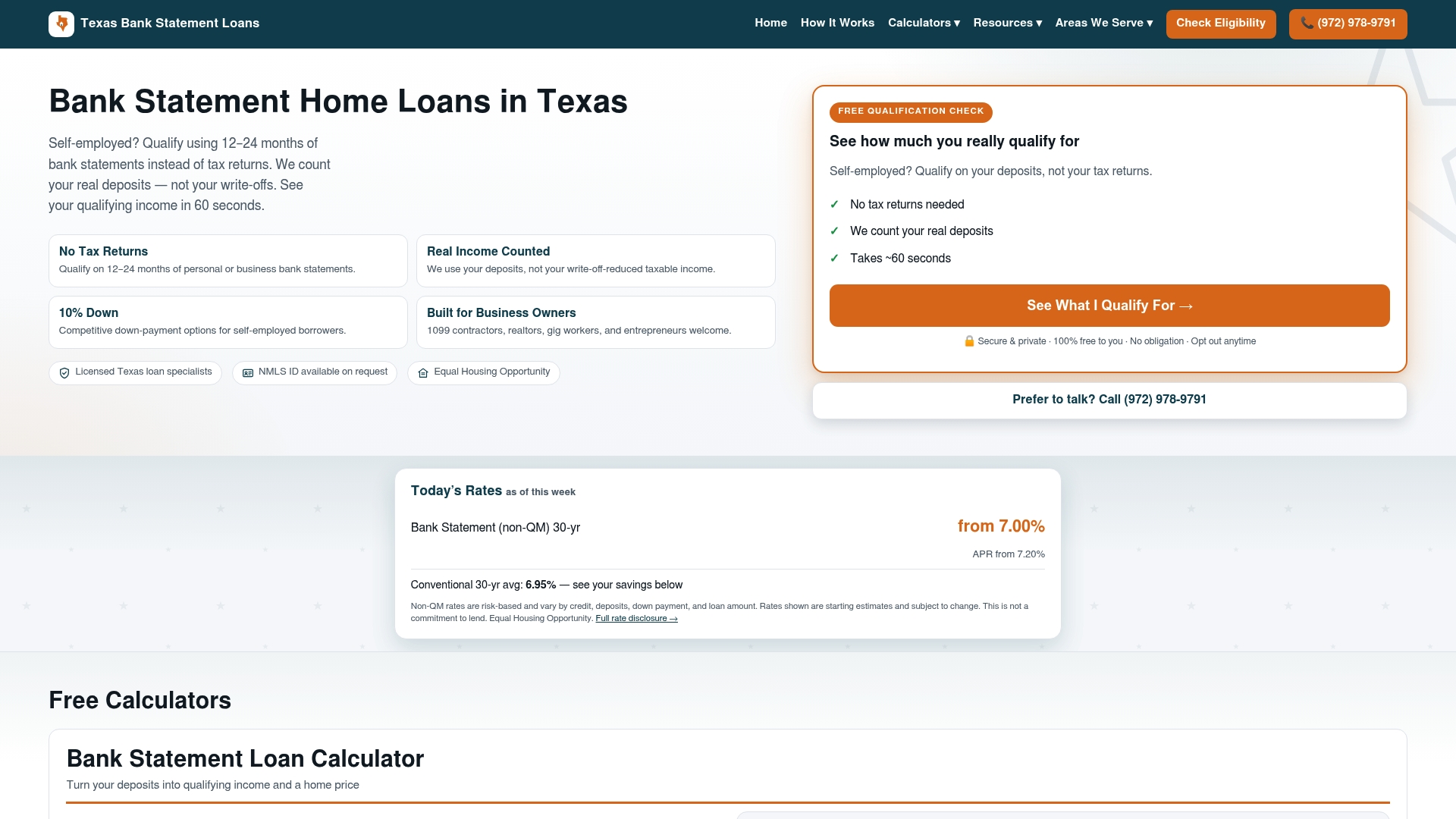
Down payments start at 10%, and the 60 second qualification check gives you a realistic read on what you can afford before you gather a single document. If you want to see how a specific deposit pattern would translate into a loan amount, the bank statement loan calculator walks through the math directly, and current rate and program details are available for a closer look at what qualifying actually involves. Business owners in Midland and across the Texas market can start that 60 second check now and find out where they stand before committing to a full application.
This article is general information, not a substitute for advice from a qualified financial advisor. Consult a qualified financial professional about your own circumstances before acting on anything here.
Sources
- HUD / FHA Handbook 4000.1
- Fannie Mae Selling Guide: Depository accounts (B3-4.2-02)
- Experian: What is seasoned money for down payment?
Recommended
See what you qualify for in 60 seconds, free and no credit check. Use the eligibility check at the top of this page.