
Documenting gig income for a home loan requires two years of consistent earnings history, verified through tax returns, 1099 forms, or bank statements, before most lenders will approve a mortgage. The industry term for this process is “self-employed income documentation,” and it applies to rideshare drivers, freelancers, 1099 contractors, and anyone whose income does not come from a traditional W-2 employer. Conventional and FHA lenders calculate qualifying income by averaging net profit from Schedule C over two years. Lenders do not simply take your word for what you earn. They cross-verify every figure against IRS transcripts and bank deposits to confirm the numbers match.
What documents do gig workers need to prove income for a home loan?

The core documentation package for gig workers covers several categories, and missing even one item can stall your application. Standard documentation includes two years of personal federal tax returns with all schedules attached, especially Schedule C, which reports business profit and loss. Lenders read Schedule C the way an accountant reads a financial statement. Every line matters.
Here is the full list of documents most lenders require:
- Two years of personal federal tax returns, including all schedules. Schedule C is non-negotiable for sole proprietors and 1099 workers.
- Business tax returns if your gig work operates under an LLC or S-corp structure.
- Year-to-date profit and loss statement prepared by a CPA or signed by you, showing current income trajectory.
- 12-24 months of bank statements, both business and personal, to verify actual deposit activity.
- 1099 forms from every gig platform or client you worked with during the qualifying period.
- CPA letter confirming business ownership, income sustainability, and self-employment status.
- Business license or client contracts if the lender needs additional proof of ongoing work.
The reason lenders ask for so many documents is that discrepancies between 1099s, Schedule C, and bank statements can stall or derail mortgage approvals entirely. Every document must tell the same story.
Pro Tip: Gather your last two years of tax returns before you speak to a single lender. Knowing your net profit figures upfront lets you estimate your qualifying income before the underwriter does it for you.
How do lenders calculate qualifying gig income for mortgage applications?
Lenders use a specific formula to turn your gig earnings into a qualifying income figure. The method depends on the loan type and the documents you provide.
- Average Schedule C net profit. For conventional loans, lenders add your net profit from the two most recent tax years and divide by 24 months. That monthly figure is your qualifying income.
- Apply a 90% gross-up for 1099-K income. Some 2026 programs allow a 90% gross-up on 1099-K income to better approximate actual earning power when deductions are high.
- Combine multiple income streams. Multiple gig income streams must be aggregated into a single combined profit and loss statement. You cannot present each platform separately and expect the lender to add them up.
- Factor in the year-to-date profit and loss statement. If your current year income is significantly higher than prior years, a strong year-to-date statement can support a higher qualifying figure. If income is declining, lenders may use the lower number.
- Check debt-to-income ratio. Monthly debts including the mortgage must stay under roughly 43% of qualifying income for most programs.
One detail that catches many gig workers off guard: heavy tax write-offs reduce your net income on paper. Business deductions like depreciation reduce the amount lenders count toward qualifying income, which directly shrinks the loan size you can access. Some deductions, such as depreciation and business use of home, can be added back by the lender. Others cannot.
| Income scenario | Lender calculation method |
|---|---|
| Sole proprietor, two full tax years | Average Schedule C net profit over 24 months |
| 1099-K income with high deductions | 90% gross-up applied to gross receipts |
| Multiple gig platforms | Combined profit and loss statement required |
| Rising income trend | Year-to-date statement may support higher figure |
| Declining income trend | Lender typically uses the lower year’s average |
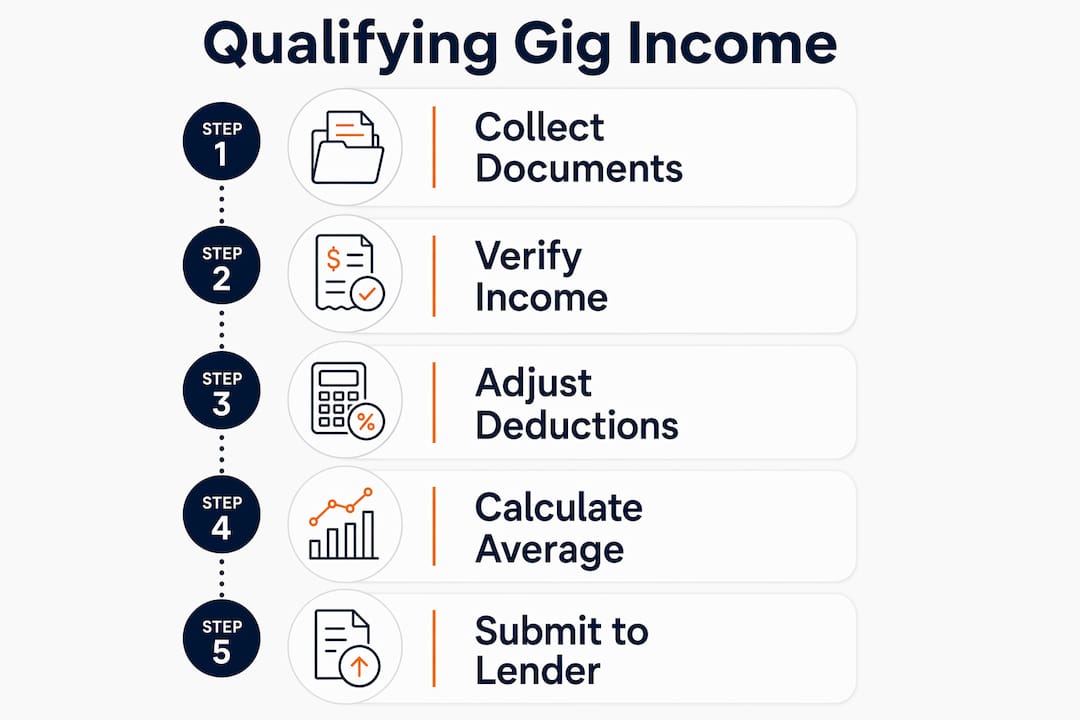
Pro Tip: Ask your CPA to add back depreciation and home office deductions on your profit and loss statement. Those add-backs can meaningfully increase your qualifying income without changing your tax liability.
What alternative documentation options exist for gig workers?
Not every gig worker has two clean years of tax returns. Heavy write-offs, recent career transitions, or a short self-employment history can all block access to conventional loans. Non-qualified mortgage programs, commonly called non-QM loans, exist specifically for this situation.
Non-QM bank statement loans let you qualify using 12-24 months of bank statements instead of tax returns. These programs bypass many traditional tax return requirements and instead evaluate your gross deposits to determine income. Texasbankstatementloans offers exactly this type of program for gig workers and self-employed borrowers across Texas, with down payment options starting at 10%.
The trade-offs are real and worth understanding:
- Higher interest rates. Non-QM loans carry rates above conventional loan rates because the lender accepts more documentation risk.
- Larger down payments. Most programs require 10%-20% down, though some bank statement loans accept gift funds for the full down payment amount.
- Business versus personal statements. Lenders prefer business bank statements because they isolate income from personal spending. If you only have personal statements, an expense ratio (typically 50%) is applied to estimate net income.
- CPA letter requirement. Many non-QM lenders require a CPA letter confirming self-employment and income sustainability before they will issue approval.
- Lower minimum credit scores. Some bank statement programs accept scores around 660, which widens access for gig workers who have not yet built a long credit history.
The right program depends on how long you have been earning gig income, how much you have saved for a down payment, and how aggressively you have written off expenses. Use the self-employed affordability calculator at Texasbankstatementloans to model different scenarios before you apply.
How to prepare your income documents to avoid underwriting delays
Clean, complete files move through underwriting faster. Disorganized or incomplete files generate conditions, and every condition adds days or weeks to your closing timeline.
Follow these steps to build a file that lenders can verify without friction:
- Separate your accounts. Keeping personal and business bank accounts separate removes ambiguity about which deposits are income and which are transfers. Commingled accounts force underwriters to make judgment calls, and those calls rarely favor the borrower.
- Write explanations for unusual deposits. Underwriters cross-verify earnings against IRS transcripts and require written explanations for any deposit that does not match a known income source. Prepare those letters before the lender asks.
- Submit fully signed tax returns with all schedules. An unsigned return or a missing schedule creates an immediate condition. Check every page before you submit.
- Have a CPA prepare or review your profit and loss statement. A CPA-prepared profit and loss statement carries more weight with underwriters than a self-prepared spreadsheet. The cost is worth it.
- Archive all 1099s and client contracts. Keep digital copies organized by year and platform. Lenders may request them at any point during underwriting.
- Respond to lender requests within 24 hours. Conditional approval phases require prompt documentation to reach clear-to-close status. Slow responses push your closing date back.
Pro Tip: Treat your tax return as a mortgage application, not just a tax minimization tool. Every dollar you write off reduces your qualifying income. Talk to your CPA about the trade-off before filing.
Key Takeaways
Gig workers can qualify for a home loan, but the documentation process requires consistency, preparation, and the right loan program for your income structure.
| Point | Details |
|---|---|
| Two-year income history | Most lenders require two years of consistent gig income verified through tax returns or bank statements. |
| Schedule C averaging | Qualifying income is calculated by averaging net profit from Schedule C over the most recent two tax years. |
| Non-QM bank statement loans | Gig workers with heavy deductions can qualify using 12-24 months of bank deposits instead of tax returns. |
| Document consistency | All 1099s, Schedule C figures, and bank deposits must align or underwriting will stall. |
| CPA involvement | A CPA letter and reviewed profit and loss statement accelerate approval and reduce underwriting conditions. |
What I have learned from helping gig workers get approved
The biggest mistake I see gig workers make is treating their tax return as a tax document rather than a financial profile. Every deduction that saves you money at tax time costs you qualifying income at the mortgage desk. That trade-off is real, and most people do not realize it until they are sitting in front of a lender wondering why their loan amount is so much lower than expected.
The second mistake is fragmented income reporting. If you drive for three platforms and do freelance design work on the side, each income stream needs to feed into one clean, combined profit and loss statement. Lenders do not piece together scattered documents. They need a single, coherent income picture.
The gig workers I have seen get approved fastest are the ones who prepared 12 months before they applied. They opened a dedicated business checking account, kept their deposits clean, and worked with a CPA who understood mortgage qualification, not just tax minimization. That combination makes underwriting straightforward.
Bank statement loan programs have genuinely changed what is possible for gig workers. The ability to qualify on gross deposits rather than net profit after deductions means your actual earning power finally counts. That is a meaningful shift, and it is worth understanding before you assume a conventional loan is your only path.
- Saad
Gig workers in Texas have a direct path to homeownership
Texas gig workers who struggle with conventional loan requirements have a real alternative. Texasbankstatementloans evaluates 12-24 months of bank deposits instead of tax returns, which means your actual income, not your taxable income, drives the approval decision.
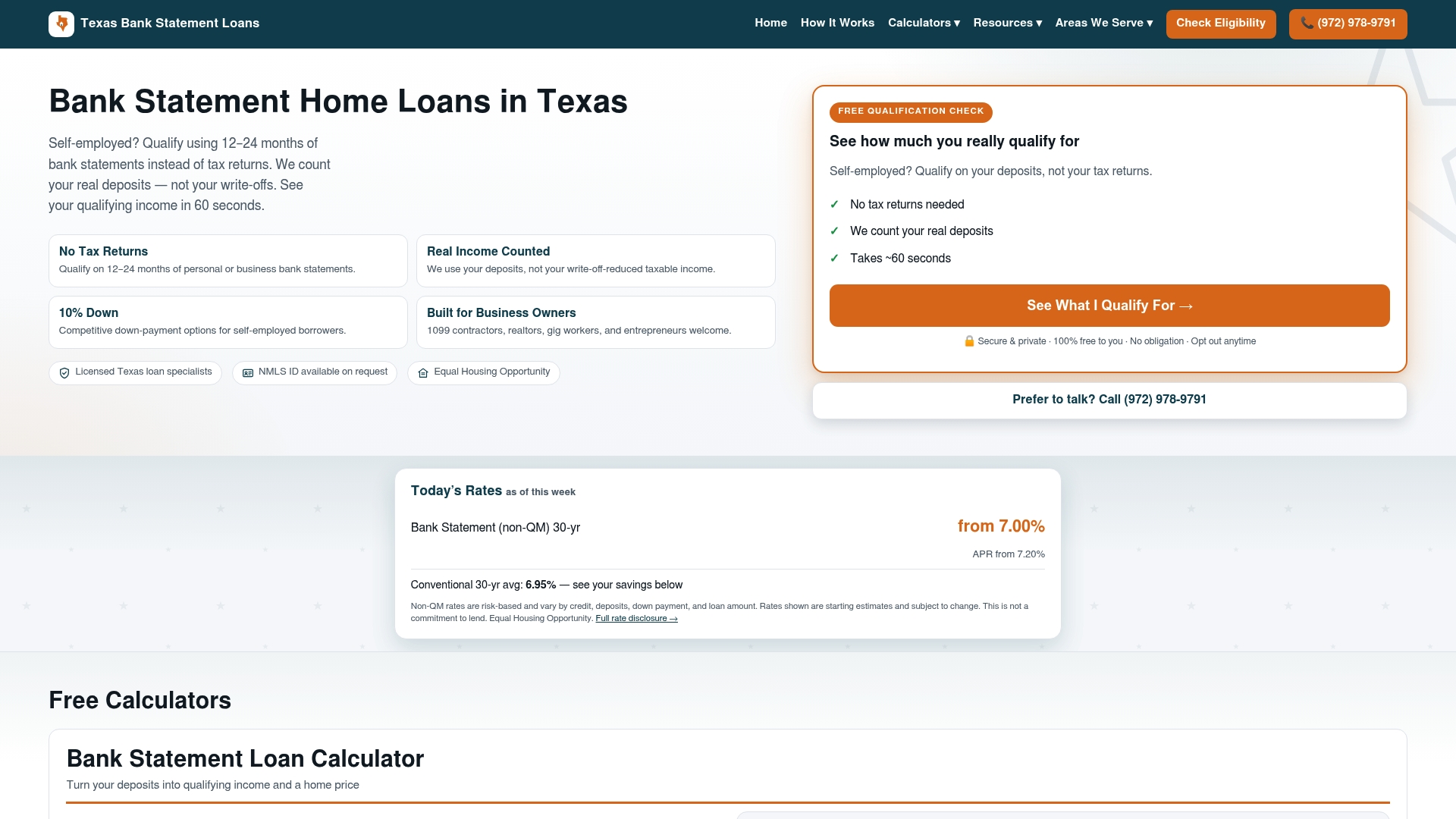
Down payment options start at 10%, and the qualification check takes 60 seconds with no obligation. Whether you are based in Houston, Austin, San Antonio, or anywhere else in Texas, Texasbankstatementloans offers bank statement loan programs built specifically for 1099 contractors, freelancers, and gig economy borrowers. Check today’s rates and see what you qualify for at Texasbankstatementloans.
FAQ
What income documents do gig workers need for a mortgage?
Gig workers typically need two years of personal tax returns with Schedule C, year-to-date profit and loss statements, 12-24 months of bank statements, and all 1099 forms from clients or platforms. A CPA letter confirming self-employment status is also commonly required.
How do lenders calculate gig income for mortgage qualification?
Lenders average the net profit from Schedule C across the two most recent tax years and divide by 24 to get a monthly qualifying income figure. Some programs apply a 90% gross-up to 1099-K income when deductions significantly reduce net profit.
Can I get a home loan with only one year of gig income?
Conventional and FHA loans generally require two years of self-employment history. Non-QM bank statement loan programs may accept 12 months of bank statements, though they typically require a higher down payment and carry higher interest rates.
Do tax write-offs hurt my chances of getting a mortgage?
Yes. Every deduction that reduces your taxable income also reduces the net profit lenders use to calculate your qualifying income. Some deductions like depreciation can be added back, but most reduce the loan amount you can access.
What is a bank statement loan and who qualifies?
A bank statement loan is a non-QM mortgage that uses 12-24 months of bank deposits to verify income instead of tax returns. It suits gig workers, freelancers, and self-employed borrowers with strong deposit history but limited qualifying income on paper due to deductions.
Recommended
See what you qualify for in 60 seconds, free and no credit check. Use the eligibility check at the top of this page.