
In this article, “second chance mortgages” means one specific thing: bank-statement mortgages that qualify you using 12-24 months of personal or business bank deposits instead of tax returns. These are Non-QM loans built for self-employed borrowers, 1099 contractors, gig workers, and business owners whose taxable income on paper understates what they actually earn. If that’s your situation, the fastest first move is a no-obligation 60-second qualification check to see what you can realistically borrow. Most programs require 12-24 months of consecutive bank statements and allow down payments starting at 10% for primary residence purchases.
Key Takeaways
Bank-statement mortgages are the most direct qualification route for self-employed Texans whose deposits outpace their taxable income.
| Point | Details |
|---|---|
| Core qualification method | Lenders average 12-24 months of bank deposits instead of reviewing tax returns. |
| Down payment floor | Primary residence programs can start at 10% down for borrowers with strong credit; borrowers with lower credit scores typically face a higher minimum down payment. |
| Income boost available | A CPA letter can reduce the default 50% expense factor to roughly 30-40%, raising qualifying income. |
| Texas cost factor | Property taxes averaging 1.6-1.8% annually add significantly to escrow and DTI calculations. |
| Recommended next step | Texasbankstatementloans offers a free 60-second qualification check and mortgage calculators to start the process. |
Table of Contents
- Who should consider a second chance mortgage?
- How lenders calculate your income from bank deposits
- What documents do you need to qualify?
- What loan types and down payment options are available?
- What does the process look like from start to closing?
- What will a bank-statement loan actually cost you?
- Pros and cons of choosing a bank-statement mortgage
- How to prepare your bank statements before applying
- Texas-specific details that affect your loan
- Why bank-statement loans matter more than most borrowers realize
- Get started with Texasbankstatementloans
- Sources
Who should consider a second chance mortgage?
Bank-statement loans aren’t for everyone. They’re purpose-built for borrowers whose cash flow is real but whose tax returns don’t show it.
Core borrower profiles:
- Self-employed small business owners who write off significant expenses
- Freelancers and gig workers with 1099 income and no W-2
- Commission-based salespeople and realtors with irregular deposit patterns
- ITIN holders without a Social Security Number
- Investors purchasing rental properties who prefer DSCR qualification
When this route makes sense over a conventional loan:
- Your net income on tax returns is substantially lower than actual deposits
- You’ve been self-employed for at least one to two years (some programs allow exceptions with relevant industry experience)
- Your credit score is at or above 620, the common floor for competitive programs
- You have reserves and can cover a down payment of 10% or more
When to pause: A very short business history with no prior industry experience, or a recent bankruptcy or foreclosure within the lender’s required waiting window, can complicate approval. If your tax returns actually show strong qualifying income, a conventional loan will likely give you a better rate.
How lenders calculate your income from bank deposits
The short answer: lenders average your deposits over 12-24 months, then apply an expense factor to business accounts to arrive at a qualifying monthly income figure.
Here’s how the calculation typically works:
- Add up all deposits across the statement period, excluding transfers between your own accounts, loan proceeds, and one-time non-business windfalls.
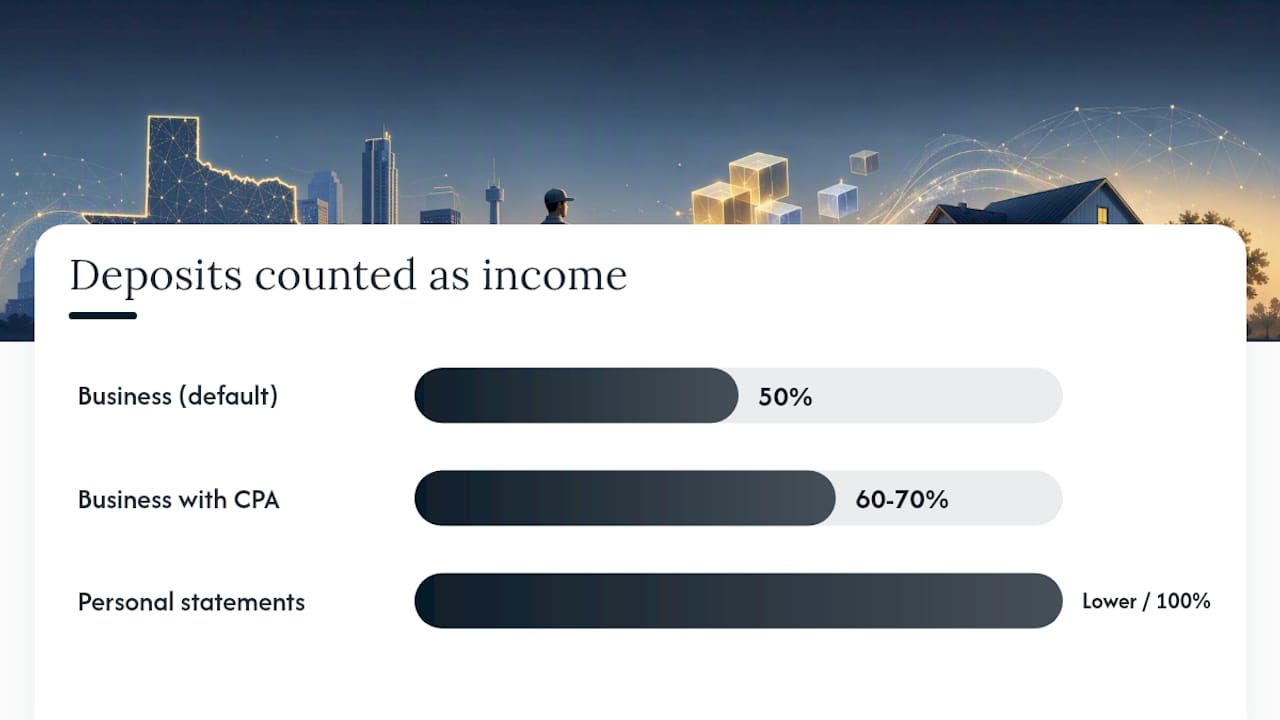
- Apply the expense factor. For business bank statements, underwriters commonly apply a default 50% expense factor, meaning half of gross deposits are treated as business expenses. The remaining 50% becomes your qualifying gross income.
- Divide by the number of months to get a monthly qualifying income figure.
- Compare to personal statements. Personal bank statements often carry a lower or no expense factor, so running both scenarios can reveal which account type yields better qualifying income.
A CPA letter or year-to-date profit and loss statement can change that math significantly. Providing a CPA letter may reduce the default 50% expense factor to roughly 30-40%, which directly increases your qualifying income and, in turn, your maximum loan amount.
Other adjustments worth knowing: a co-borrower’s income can be stacked onto yours, and documented rental income from investment properties can supplement the calculation in some programs.
What documents do you need to qualify?
Getting your file complete before you submit is the single biggest factor in how fast underwriting moves. Bank-statement programs typically require the following:
Core documents:
- 12-24 months of consecutive personal or business bank statements (PDFs, no missing months)
- Government-issued photo ID
- Proof of business ownership or operation: business license, invoices, or a CPA letter confirming self-employment
- Documentation of down payment source (60-day account history for those funds)
Supporting items lenders commonly request:
- CPA letter or year-to-date profit and loss statement
- Asset statements showing reserves (typically two to six months of mortgage payments)
- Signed occupancy intent letter for primary residence purchases
- Business license or DBA registration
Eligibility thresholds to know before you apply:
- Credit score: most programs start at 620; better pricing typically begins at 680 and above.
- DTI: many programs allow debt-to-income ratios up to about 50%.
- Self-employment history: commonly one to two years, though industry experience can substitute for business age in some programs.
- Loan amounts: some programs allow loans in the millions, making jumbo purchases possible.
What loan types and down payment options are available?
Bank-statement programs cover more ground than most borrowers expect.
Available program types:
- Primary residence purchase and rate-and-term refinance
- Cash-out refinance (useful for business owners pulling equity)
- DSCR loans for investment properties (qualified on rental income, not personal income)
- ITIN loans for borrowers without a Social Security Number
- Jumbo bank-statement loans for higher-priced Texas properties
Down payment structure by scenario:
| Scenario | Typical Minimum Down Payment |
|---|---|
| Primary residence, strong credit (680+) | 10% |
| Primary residence, lower credit (620+) | 15% |
| Investment property / DSCR | 20% |
| Jumbo loan | 20% depending on LTV |
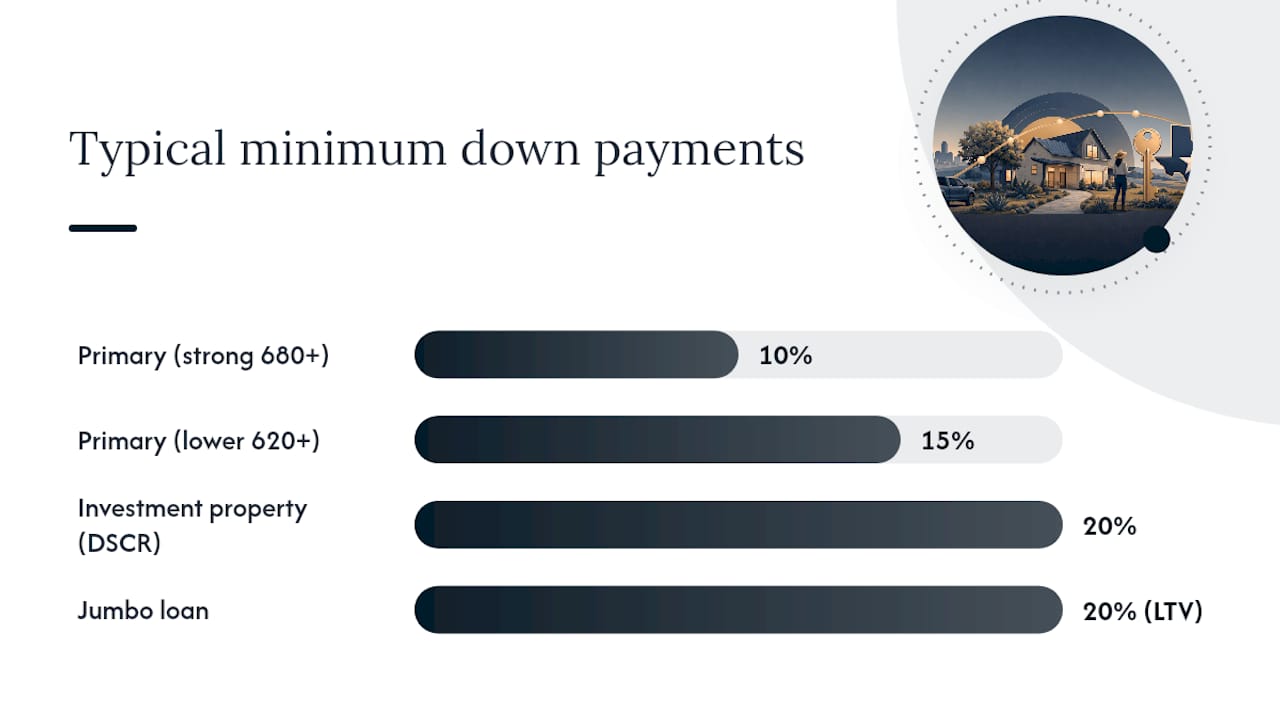
Minimum down payments for primary residence purchases depend on credit profile; strong credit allows for 10% down, while lower credit scores typically require at least 15%.
A higher down payment does more than reduce your monthly payment. It improves your loan-to-value ratio, which directly affects your interest rate and whether mortgage insurance applies. Most bank-statement programs cap loan-to-value ratio at 90% for purchases, meaning a 10% down payment is the floor, not the norm for every credit profile.
What does the process look like from start to closing?
- Pre-qualification (minutes to one business day): Run the 60-second check or speak with a loan officer. You’ll get a realistic borrowing range before gathering a single document.
- Document assembly (two to five days): Pull consecutive bank statements, ID, business proof, and down payment documentation.
- Loan submission (one to two days): Your loan officer packages and submits the file to underwriting.
- Underwriting review (one to three weeks): The underwriter calculates qualifying income, reviews deposit patterns, and may issue conditions (requests for additional documentation).
- Clear to close (one to two days after conditions are satisfied): Final approval issued; closing disclosure sent.
- Closing (one to three weeks after clear to close): Title, escrow, and county recording in Texas. Closing timelines for well-prepared files can run 7-15 business days; more complex files typically take 30-45 days.
Common delay triggers: missing statement months, commingled personal and business deposits, large unexplained transfers, no CPA letter when the default expense factor hurts qualifying income, and appraisal or title backlogs in high-demand Texas metros.
What will a bank-statement loan actually cost you?
Bank-statement loans carry a rate premium over conventional loans. That’s the honest starting point. The premium exists because these are Non-QM products that don’t conform to Fannie Mae or Freddie Mac guidelines, so lenders price in additional risk.
Typical cost components:
- Interest rate: Generally 0.5-2 percentage points above comparable conventional rates, depending on credit score, LTV, and loan amount. Check current bank-statement rates before assuming a number.
- Origination fees: Typically 1-2% of the loan amount, similar to conventional loans.
- Appraisal: $500-$800 for standard Texas properties; more for jumbo or rural.
- Title and closing fees: Vary by county; budget $2,000-$4,000 for most Texas transactions.
- Reserves: Lenders often require two to six months of mortgage payments in liquid assets post-closing.
Three things narrow the rate gap with conventional loans: a credit score above 700, a CPA letter that reduces your expense factor, and a down payment above the program minimum. None of them eliminate the premium, but together they can meaningfully reduce it.
Pros and cons of choosing a bank-statement mortgage
Advantages:
- Qualifies on actual cash flow, not taxable net income
- Works for borrowers with heavy legitimate deductions who would otherwise be denied
- Covers purchases, refinances, cash-out, and investment properties
- Faster path to homeownership than waiting to rebuild tax return income
Tradeoffs:
- Higher interest rate than conventional loans
- Tighter documentation requirements around deposit sources
- Higher reserves and down payments for lower credit profiles
- Refinancing to a conventional loan later (once tax returns improve) is the smart long-term play for many borrowers
The practical decision framework: if you need to buy now and your deposits support the payment, a bank-statement loan gets you there. If you can wait two years and restructure your tax returns to show more income, a conventional loan will cost less. Most self-employed borrowers can’t or don’t want to wait.
How to prepare your bank statements before applying
Pro Tip: Start separating business and personal accounts at least 60 days before applying. Commingled accounts are the single most common reason underwriting stalls.
Preparation checklist:
- Run all business revenue through one dedicated business account
- Avoid large non-business transfers into that account in the 60 days before application
- Download consecutive monthly PDFs directly from your bank (no screenshots)
- Highlight recurring client payments to make deposit patterns obvious to the underwriter
- Get a CPA letter early, it can reduce your expense factor and increase qualifying income
- Run both your business and personal statement scenarios to see which yields a higher qualifying income figure
- Gather invoices or contracts that corroborate large or irregular deposits
Underwriters look for account continuity, clear deposit descriptions, and evidence that deposits come from legitimate business activity. A clean, well-organized file moves faster and generates fewer conditions.
Texas-specific details that affect your loan
Texas has no state income tax, which removes one layer of documentation complexity. But the state’s property taxes average roughly 1.6-1.8% annually, among the highest in the country. On a $400,000 home, that’s $6,400-$7,200 per year added to your escrow, which directly affects your DTI calculation.
What Texas borrowers should factor in:
- Estimate property tax escrow before you run affordability numbers, it moves the DTI more than most borrowers expect
- HOA fees in Houston, Dallas, Austin, and San Antonio subdivisions add another monthly obligation that counts against DTI
- County-level recording and title fees vary; confirm with your loan officer before finalizing closing cost estimates
- Appraisal timelines in Austin and Dallas can run longer during high-demand periods, build that into your closing timeline
Texasbankstatementloans covers major Texas metros including Houston, Dallas, Austin, San Antonio, Plano, and Midland. If you’re in a specific county, regional program pages can confirm local availability and connect you with a loan officer who knows your market’s appraisal and title timelines.
Why bank-statement loans matter more than most borrowers realize
The conventional mortgage system was designed around W-2 employees. It assumes that taxable income equals real income, which is almost never true for a self-employed business owner who runs legitimate expenses through the business. A contractor earning $180,000 in deposits but showing $60,000 in net income after deductions isn’t a risky borrower. They’re a borrower the standard system was never built to evaluate correctly.
Bank-statement loans fix that mismatch. They’re not a workaround or a last resort. For a well-documented self-employed borrower, they’re often the most accurate way to qualify. The rate premium is real, but so is the alternative: waiting years to restructure tax returns while the Texas housing market moves without you.
The borrowers who get the best outcomes are the ones who treat documentation as seriously as the loan itself. A clean account, a CPA letter, and a realistic deposit history aren’t just paperwork, they’re the argument you’re making to the underwriter.
Get started with Texasbankstatementloans
Texasbankstatementloans gives self-employed Texans a direct path from bank deposits to a pre-qualification letter, without the tax return requirement that blocks most conventional applications.
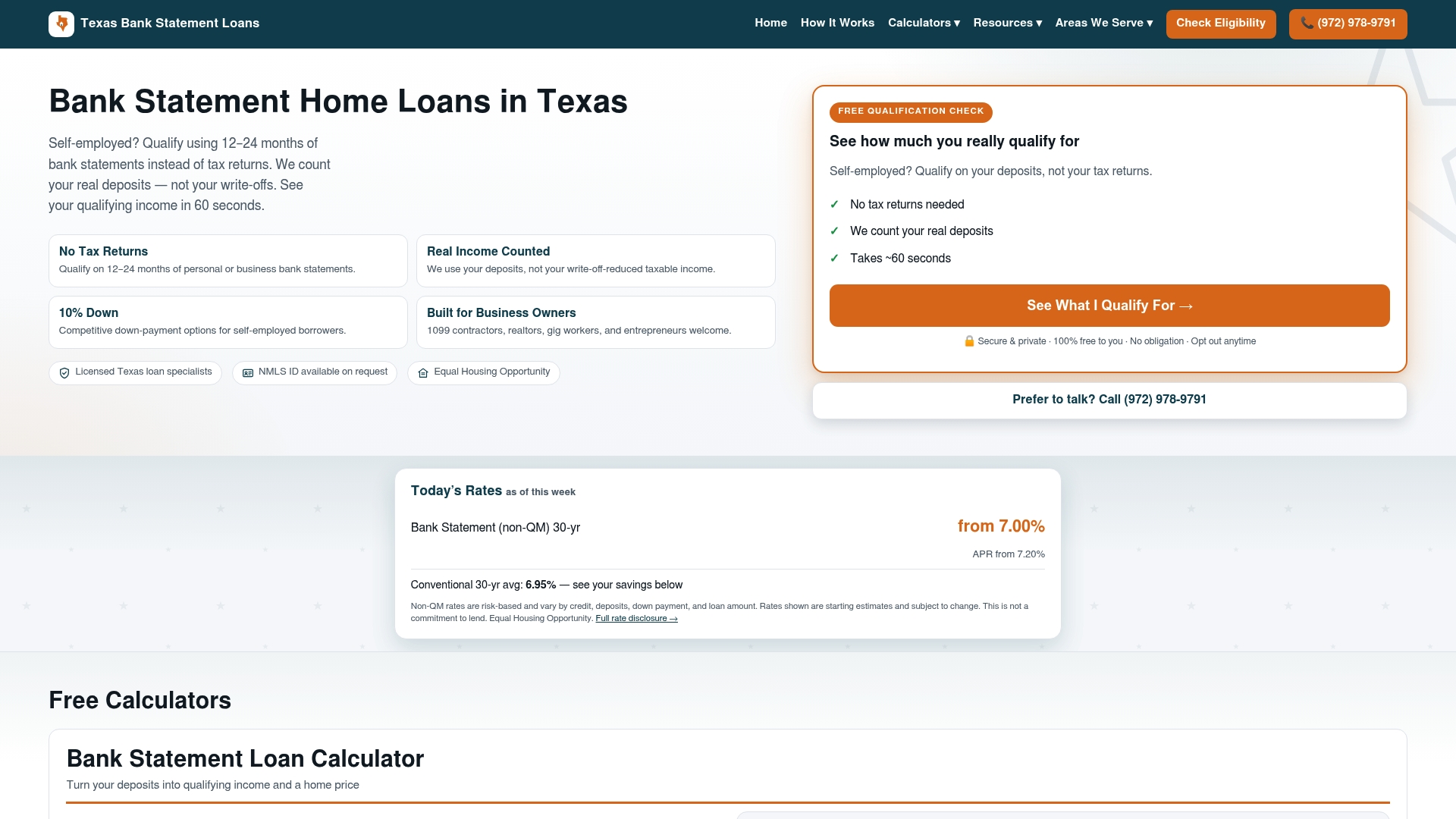
Run the 60-second no-obligation qualification check right now to see your realistic borrowing range before you gather a single document. From there, use the self-employed affordability calculator to model different deposit scenarios and down payment amounts, and check today’s bank-statement rates to understand current pricing. If you’re in Houston, Plano, or Midland, city-specific pages connect you with loan officers who know your local market. After the 60-second check, expect a document request, a loan officer call, and a pre-qualification letter, typically within one to two business days for a complete file.
Sources
External resources:
- Self-Employed & Non-QM Loans in Texas | TMP - Texas Mortgage Plan
- Bank Statement Mortgage Loans in Texas | Loankea
Texasbankstatementloans tools:
This article is general information, not a substitute for advice from a qualified financial advisor. Consult a qualified financial professional about your own circumstances before acting on anything here.
Recommended
See what you qualify for in 60 seconds, free and no credit check. Use the eligibility check at the top of this page.