
Mortgage points are prepaid interest you buy at closing to lower your mortgage rate permanently. One point costs 1% of your loan amount. The core decision rule: buy points only if you expect to keep the loan past the break-even point and you have the cash available at closing without shortchanging your down payment.
Here’s what shapes that decision:
- Cost per point: 1% of the loan amount ($4,000 on a $400,000 loan)
- Typical rate reduction: roughly 0.20-0.25 percentage points per discount point, though lenders vary widely
- Monthly payment impact: lower rate means lower payment, which accumulates into real savings over time
- Tax note: points on a primary residence may be deductible under IRS Topic 504 rules, but only if specific tests are met
Table of Contents
- How mortgage points actually work
- How to calculate your break-even on mortgage points
- When buying points makes sense (and when it doesn’t)
- Alternatives to buying points worth knowing about
- U.S. tax treatment of mortgage points: what the IRS actually says
- Key Takeaways
- The part most borrowers skip until it’s too late
- Self-employed in Texas? Here’s how Texasbankstatementloans handles the points decision
- Authoritative sources and calculators to use
How mortgage points actually work
Not all points are the same, and mixing them up on your Loan Estimate is an expensive mistake.
Discount points vs. origination points
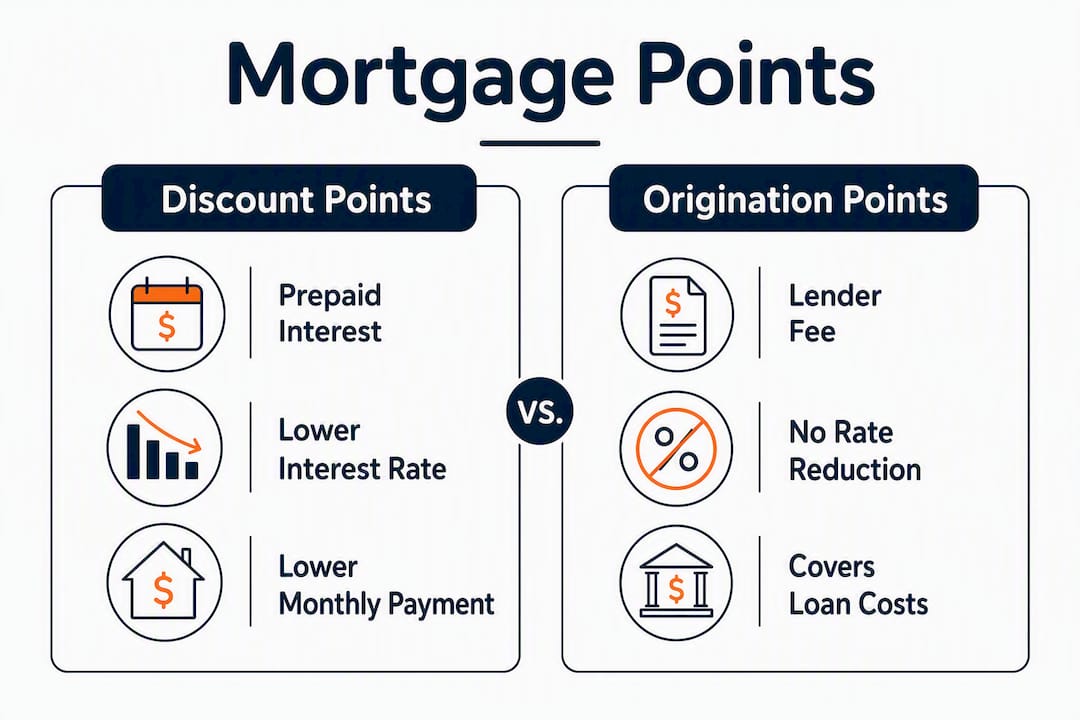
Discount points are prepaid interest. You pay them at closing to permanently reduce your interest rate. Origination points are lender fees for processing the loan. They do not lower your rate. Both appear on your Loan Estimate and Closing Disclosure, which is exactly why borrowers confuse them. One saves you money over time; the other is just a cost of doing business.
How the cost is calculated
One point equals 1% of the loan amount, paid at closing. On a loan, one point costs 1% of the loan amount. For example, two points cost twice that percentage. These charges appear on your Loan Estimate under “Origination Charges” and again on the Closing Disclosure. Under TRID rules, lenders must disclose rate and fee tradeoffs, so you can request side-by-side Loan Estimates comparing a points scenario against a lender-credit scenario.
How points change your rate, APR, and payment

The CFPB notes that discount points have no fixed value in terms of rate reduction. One point might buy you 0.25% off the rate at one lender and only 0.20% at another. The reduction depends on loan type, your credit profile, and current market conditions. That variability matters because it changes your break-even calculation entirely.
Buying points lowers your interest rate and therefore your monthly payment. It also lowers your APR slightly. Over the full loan term, the total interest paid drops meaningfully. But you pay that savings upfront, which is the whole trade-off.
Worked example: $400,000 loan, one point
Without points: a certain rate and monthly payment. With one point: a slightly lower rate and lower monthly payment, resulting in monthly savings. Dividing the cost of points by monthly savings gives a break-even period in months.
Pro Tip: Ask your lender to show you the exact rate reduction per point on your specific loan, in writing, on the Loan Estimate. Never assume the 0.25% rule of thumb applies to your deal. Also ask: “Is this a discount point or an origination fee?” Those are different things with different financial implications.
How to calculate your break-even on mortgage points
The math is straightforward. The interpretation is where most borrowers go wrong.
Simple break-even formula
Break-even months = Cost of points ÷ Monthly payment savings
Using the example above: Cost of points divided by monthly savings gives the break-even period in months. If you keep the loan past 5 years, you come out ahead. Sell or refinance before that, and you’ve paid $4,000 for nothing.
The adjusted break-even
The simple method ignores one important factor: when you buy points, you pay more cash at closing. That cash could have been invested or applied to your principal. The adjusted break-even accounts for the difference in remaining loan balances at your planned exit date and the opportunity cost of the cash you spent. In most scenarios, the adjusted break-even runs a few months longer than the simple one. For most borrowers, the simple method is close enough to make the decision. The adjusted method matters most on large loans where the cash outlay is significant.
Using an online calculator
The mortgage payment calculator at Texasbankstatementloans lets you test different rate and payment scenarios. When you use any break-even calculator, confirm the point-to-rate schedule with your lender first. Calculators that assume 0.25% per point will give you the wrong answer if your lender’s actual schedule is different.
Break-even summary table
| Scenario | Value |
|---|---|
| Loan amount | $400,000 |
| Cost of 1 point | $4,000 |
| Simple break-even | ~60 months (5 years) |
Typical break-even ranges run 5 years, though some scenarios range from 4 to 7 years depending on loan size and the rate reduction your lender offers.
When buying points makes sense (and when it doesn’t)
The decision comes down to time horizon, cash reserves, and loan type. Get these three right and the answer usually becomes obvious.
Scenarios where buying points pays off
- You plan to stay in the home well past the break-even period, traditionally considered several years.
- Your loan amount is large, so the monthly savings are meaningful in dollar terms
- You have enough cash at closing to cover points without reducing your down payment below your target
- You itemize deductions on your federal return and the points qualify under IRS rules for a primary residence
- You’re on a 30-year fixed loan where the savings compound over a long term
Scenarios where buying points is usually a bad idea
- You expect to sell or refinance within 3-4 years (buying points is a bet on your own timeline, and a short one loses)
- Your cash reserves are tight and buying points would reduce your down payment, potentially triggering PMI
- You’re in a falling-rate environment where refinancing in 2-3 years is likely
- The loan is for a second home or investment property where the tax treatment is less favorable
- You’re financing a refinance where the new break-even stacks on top of the old one
How loan type changes the calculation
On a purchase loan for a primary residence, points have the best tax treatment and the longest potential hold period. On a refinance, you’re starting the break-even clock over. On an investment property, points are still deductible but as a business expense amortized over the loan term, not as home mortgage interest. The math still works if the hold period is long enough, but the tax benefit is different.

Pro Tip: Before your closing appointment, write down your realistic expected keep time for this loan. Not how long you plan to own the home. How long before you might refinance. If rates drop 1.5% in two years, will you refi? If yes, factor that into your break-even, not just your moving plans.
Alternatives to buying points worth knowing about
Points aren’t the only lever. Three alternatives are worth understanding before you commit.
Lender credits
Lender credits are the mirror image of discount points. You accept a slightly higher interest rate, and the lender covers some or all of your closing costs. The CFPB describes this as a tradeoff between upfront cash and long-term interest costs. Lender credits make sense when you’re short on cash at closing or you don’t expect to keep the loan long enough to justify paying points. You pay more over time, but you preserve liquidity now.
Buying points vs. increasing your down payment
Adding cash to your down payment lowers your loan balance, which reduces your monthly payment through a smaller principal rather than a lower rate. It also reduces or eliminates PMI if you’re below 20% equity. In many cases, especially on loans near the PMI threshold, adding to the down payment beats buying points on a pure dollar-for-dollar comparison. Run both scenarios before deciding.
Temporary buydowns (2-1 buydowns)
A 2-1 buydown reduces your rate by 2% in year one and 1% in year two, then returns to the note rate in year three. Unlike discount points, the savings are front-loaded and temporary. Sellers sometimes offer these as concessions in slow markets. They’re useful if you expect your income to grow or if you want lower payments early in the loan. They don’t reduce your long-term interest cost the way permanent discount points do.
Financing points by rolling them into your loan balance is the worst of both worlds. You pay interest on the points for the life of the loan, which worsens your break-even significantly and often makes the buy-points option financially unattractive compared to simply taking the higher rate. If you can’t pay points in cash at closing, lender credits are usually the better path.
Red flags to watch for
- Origination fees labeled as “points” on a Loan Estimate (they don’t reduce your rate)
- Sellers or brokers describing temporary buydowns as permanent rate reductions
- Lenders who won’t show you the explicit rate reduction per point in writing
U.S. tax treatment of mortgage points: what the IRS actually says
The tax rules for mortgage points are more nuanced than most borrowers realize, and getting them wrong costs money.
The basic IRS rule
Under IRS Topic 504, points paid on a mortgage for your principal residence may be deductible as home mortgage interest in the year paid, provided specific tests are met. If those tests aren’t met, the points are deducted ratably over the loan term. IRS Publication 936 covers the full deduction rules for home mortgage interest including points.
Tests for full deduction in the year paid
- The loan must be secured by your main home
- Paying points must be an established business practice in your area
- The points must not exceed the amount generally charged in your area
- You must use the cash method of accounting
- The points must be computed as a percentage of the principal amount
- The points must be clearly shown on the settlement statement
- The funds you used at closing (including any seller-paid amounts) must not have been borrowed from the lender
Seller-paid points
If the seller pays points on your behalf, IRS rules treat those points as paid by you for deductibility purposes. The catch: you must reduce your cost basis in the home by the amount of seller-paid points. That affects your capital gains calculation when you eventually sell.
Amortizing points over the loan term
When points don’t qualify for full upfront deduction (common on refinances), you deduct them ratably. The IRS specifies dividing the total points by the number of scheduled payments, not by years. On a 30-year loan, that’s 360 payments. If you make 12 payments in a tax year, you deduct 12/360 of the total points that year.
If you sell or refinance with a different lender before the loan ends, you can deduct any remaining unamortized points in the year of payoff. That rule generally does not apply if you refinance with the same lender.
Documentation checklist
- Loan Estimate and Closing Disclosure showing points paid
- Settlement statement (HUD-1 or ALTA)
- Form 1098 from your lender (shows mortgage interest and points paid)
- Proof that points were paid from unborrowed funds if claiming the upfront deduction
- Records of seller-paid points and the basis adjustment made
This is general information, not tax advice. Consult a qualified tax professional to confirm how IRS rules apply to your specific situation.
Key Takeaways
Buying mortgage points pays off only when you keep the loan past the break-even point and pay for the points in cash at closing, not by financing them into the loan.
| Point | Details |
|---|---|
| Break-even is the core test | Divide points cost by monthly savings; if you keep the loan past that month count, points pay off. |
| Cash matters as much as math | Financing points into the loan worsens break-even; always pay points from unborrowed funds. |
| Tax deduction has conditions | IRS Topic 504 tests must be met for a primary-residence upfront deduction; refinance points amortize over 360 payments. |
| Short timelines favor lender credits | If you expect to sell or refinance within 4 years, lender credits preserve cash better than discount points. |
| Texasbankstatementloans offers tools | Self-employed borrowers can model points vs. no-points scenarios using the bank statement loan calculator and rate pages. |
The part most borrowers skip until it’s too late
Most people treat the points decision as a math problem. It is, but the math only works if the inputs are honest. The number borrowers consistently get wrong is their expected keep time. They plan for how long they’ll own the home, not how long they’ll keep this specific loan. Those are different numbers, and in a rate-volatile market, they can be very different.
The second mistake is treating points as a sunk cost the moment they’re paid. If you’re 18 months into a 60-month break-even and rates drop 1.5%, the right question isn’t “should I refinance?” It’s “what does refinancing cost me in unrecovered points, and does the new rate still justify it?” Use a cash-out refinance calculator to model the full cost of refinancing before you assume it’s the obvious move.
The third mistake is comparing points against nothing. The real comparison is always: points vs. lender credits vs. adding that cash to your down payment. On loans near the PMI threshold, the down payment option often wins by a wider margin than borrowers expect.
One thing that rarely gets said plainly: the Loan Estimate is a negotiating document. You can ask your lender for multiple scenarios in writing before you commit. A side-by-side showing a lender-credit option, a no-points option, and a one-point option takes your lender about 10 minutes to produce and gives you the actual numbers for your specific loan. Most borrowers never ask. Ask.
Self-employed in Texas? Here’s how Texasbankstatementloans handles the points decision
For self-employed borrowers, the points calculation starts with qualifying income, and that’s where traditional lenders often get it wrong. Texasbankstatementloans qualifies borrowers using 12-24 months of bank statements instead of tax returns, which means your actual deposits determine your loan amount, not a tax return that understates your income.
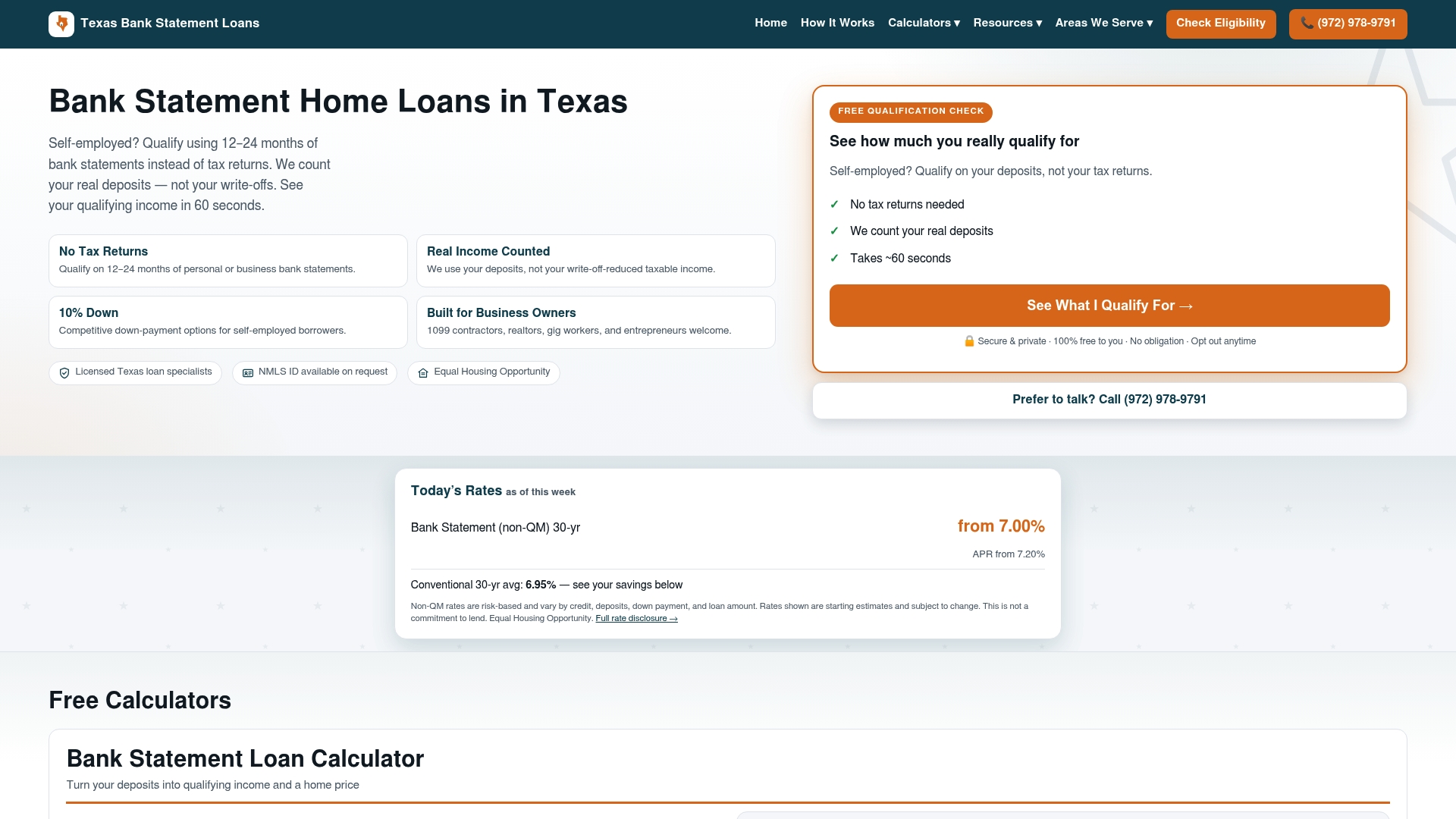
Once your qualifying income is established, the points decision works the same way it does for any borrower: compare the upfront cost against the monthly savings and your expected keep time. The bank statement loan calculator at Texasbankstatementloans lets you model different rate scenarios, and the current rate pages show live pricing so you can see exactly what buying down the rate would cost on a bank-statement product. Down payment options start at 10%, which means the cash-at-closing question matters even more. Run the numbers before you commit to points. Start with a no-obligation qualification check at Texasbankstatementloans to see your actual loan pricing and whether buying points fits your profile.
Authoritative sources and calculators to use
These are the primary sources worth bookmarking when you’re verifying rules or running your own numbers.
- IRS Topic 504: Home Mortgage Points, the governing IRS page for deductibility tests, seller-paid points rules, and the ratable amortization requirement. Start here before talking to your tax preparer.
- IRS Publication 936: Home Mortgage Interest Deduction, the full IRS publication covering all home mortgage interest rules, including points, limits, and special situations. More detailed than Topic 504.
- CFPB: Discount Points and Lender Credits, the CFPB’s explanation of the points-vs-lender-credits tradeoff, written for consumers. Useful for understanding what should appear on your Loan Estimate.
- CFPB Data Spotlight: Trends in Discount Points, research on how discount point usage shifts with interest rate environments, useful context for timing decisions.
- Texasbankstatementloans Mortgage Calculators, tools hub for self-employed borrowers to run payment, affordability, and rate-scenario comparisons.
Save your Closing Disclosure and settlement statement permanently. If you amortize points over the loan term, you’ll need those documents every tax year until the loan is paid off or refinanced.
Recommended
- Mortgage Payment Calculator (Texas) | Texas Bank Statement Loans
- Bank Statement Loan Rates Today | Texas Bank Statement Loans
See what you qualify for in 60 seconds, free and no credit check. Use the eligibility check at the top of this page.