
Whether your spouse’s income counts toward your mortgage comes down to one question: are they signing the loan? If yes, lenders add their income and their debts into your qualifying numbers. If no, their income is normally left out, though in community property states with FHA or VA loans, their debts can still count against you. The immediate move is to ask your lender to run both a joint and a solo scenario before you commit to either path.
TL;DR:
- A spouse’s income counts toward your mortgage only if they sign the loan as a co-borrower; otherwise, their income is usually excluded from qualifying calculations.
- In community property states, debts incurred during marriage may be counted against the borrowing spouse even if their income is not included, especially on FHA and VA loans.
- Accepted forms of spousal income include W-2 wages, verified self-employment income, court-ordered support, Social Security benefits, and rental income, all requiring proper documentation.
- Running both joint and solo mortgage scenarios ensures you understand how adding or removing a spouse from the loan impacts your approval chances and interest rate.
- Bank-statement underwriting can help self-employed spouses qualify by focusing on 12 to 24 months of deposit history instead of tax return income, especially when it underreports earnings.
Table of Contents
- How Lenders Count Spousal Income: Co-Borrower vs Non-Borrower
- Which Types of Spousal Income Qualify
- Joint Application vs Solo Borrowing: Which Wins?
- What Documents Do You Need for Spousal Income?
- Strategies When a Spouse Has Low Credit or Irregular Income
- How Texas Bank Statement Loans Helps Couples Qualify
- What I’d Tell a Couple Before They Apply
- Use Bank-Statement Tools When Spousal Income Is Irregular
- Sources
- FAQ
How Lenders Count Spousal Income: Co-Borrower vs Non-Borrower
The distinction that decides everything else is whether your spouse is a co-borrower or a non-borrowing spouse. A co-borrower signs the promissory note and takes on legal responsibility for repaying the loan. A non-borrowing spouse might still sign the mortgage or deed of trust and might even be listed on the title without ever taking on personal liability for the debt itself.
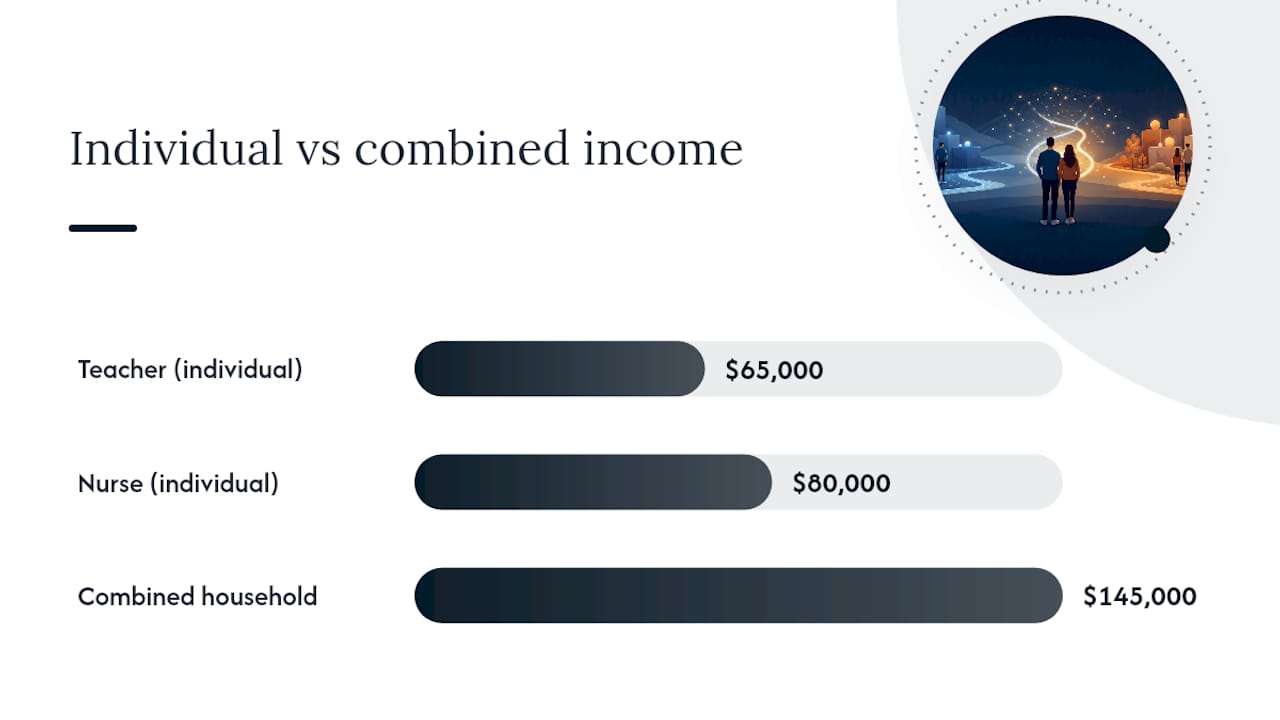
Once your spouse signs on as a co-borrower, the math is straightforward. Lenders combine both incomes into one gross figure and add both sets of monthly debts into the numerator when calculating debt-to-income ratio (DTI). A teacher earning $65,000 and a nurse earning $80,000 get treated as a single household earning $145,000, with both car payments, both student loans, and both credit cards factored in together.
Leave your spouse off the loan and the picture flips. Their paycheck generally disappears from the equation. Standard underwriting counts income only from people who sign the application, and most lenders will count combined earnings only of everyone listed on the loan, with narrow exceptions for specialized loan programs.
Here’s where it gets tricky. In community property states, which include Texas, a non-borrowing spouse’s debts don’t necessarily disappear along with their income:
- On FHA and VA loans, lenders are generally required to pull the non-borrowing spouse’s credit report specifically to identify their outstanding debts.
- Those debts then get added into the borrowing spouse’s DTI calculation, even though the non-borrowing spouse’s income was never counted.
- This rule exists because community property law treats debts incurred during marriage as a shared obligation, regardless of whose name is on the loan.
- Conventional loans typically don’t apply this same rule, which is one reason some couples in community property states lean toward conventional financing when one spouse has heavy debt and weak income documentation.
The HUD guidance on co-borrower and non-borrowing spouse liabilities lays out exactly how this plays out on government-backed loans, and it’s worth reading before you assume leaving a spouse off the application solves a debt problem. It often doesn’t. You lose the income boost and keep the liability drag, which is the worst combination for your approval odds.
The VA Lender’s Handbook FAQs confirm the same basic principle for VA loans: income from a spouse who isn’t on the application generally can’t be used, while specific documentation rules govern what other income types are acceptable.
Which Types of Spousal Income Qualify
Not all income is treated equally, and lenders apply different documentation standards depending on the source. Here’s how the main categories break down.
-
W-2 wages. This is the simplest case. Lenders want recent pay stubs (usually covering the last 30 days), the two most recent W-2s, and a verification of employment from the employer. Consistency matters more than the raw number. A spouse who just started a new job after a gap may need to show additional history before that income counts fully.
-
Self-employment and 1099 income. Most conventional investors want two full years of tax returns to establish a self-employment income average, and they typically use the lower of the two years or an averaged figure rather than the most recent year alone. This is exactly where self-employed spouses run into trouble, since tax returns after deductions often understate real cash flow. Bank-statement underwriting, which reviews 12 to 24 months of actual deposits instead of tax returns, gives self-employed spouses a way to document income that reflects what they actually bring home.
-
Alimony and child support. Lenders require a court order or signed agreement showing the amount and duration of payments, plus proof the payments have actually been received, commonly for at least 12 months. Many investors also want evidence the payments will continue for at least three more years from the date of the loan closing. A support order that expires in 18 months usually won’t carry full qualifying weight.
-
Social Security and disability benefits. An award letter from the Social Security Administration combined with bank statements showing the deposits hitting the account is typically sufficient. Because benefit income is considered stable and likely to continue, many lenders treat it as strong qualifying income, sometimes even grossing it up since it’s often not taxed.
-
Rental and investment income. This one depends heavily on paperwork. Underwriters look at Schedule E tax filings and current lease agreements, then apply a formula (often deducting a vacancy factor) to arrive at usable rental income. A spouse who just started renting out a property last month, with no tax history to show it, usually can’t count that income yet.
The common thread across every category: documentation and expected continuation decide whether income counts, not just whether the money is real. A spouse could be earning solid cash income from freelance work, but if it’s not documented in a way an underwriter can verify, it functionally doesn’t exist for qualifying purposes.
Joint Application vs Solo Borrowing: Which Wins?
Run the numbers both ways before you decide, because the “obvious” choice isn’t always the right one. A joint application combines both incomes and both debt loads, which usually raises your total borrowing power. But pricing on a joint loan gets set by the lower of the two middle credit scores between borrowers, not an average and not the higher score.
That single fact changes the calculation for a lot of couples. If one spouse has a 620 credit score and the other has a 780, adding the lower-scoring spouse to the loan can push your rate up meaningfully, even though their income helps you qualify for a larger loan amount.
- Joint application works best when both spouses have comparable credit and the combined income is needed to hit the target loan amount.
- Solo application can secure a better rate when one spouse’s credit or debt load would otherwise drag down pricing, but you sacrifice their income from the DTI math entirely.
- Community property states plus FHA/VA loans create a trap: going solo doesn’t necessarily remove your spouse’s debts from the equation, even though it removes their income. You could end up with a worse DTI than either scenario would suggest on its own.
- Conventional loans generally don’t require counting a non-borrowing spouse’s debts, which makes them a more predictable option when one spouse’s debt profile is the primary concern.
Pro Tip: Before choosing a path, ask your loan officer to price the loan two separate ways: joint with both incomes and debts, and solo with only your debts (plus any non-borrowing spouse debts required by program rules). Compare the resulting loan amount, rate, and monthly payment side by side rather than guessing which scenario wins.
Ownership adds another layer most couples overlook. Being on the loan and being on the title are legally separate decisions. A non-borrowing spouse can still be added to the property deed for ownership purposes without ever signing the mortgage note, preserving their legal interest in the home while keeping their income and debts out of the underwriting math entirely.
What Documents Do You Need for Spousal Income?
Lenders build their approval decision entirely around paper. Missing or inconsistent documentation is the single most common reason spousal income gets rejected outright, even when the money is genuinely being received every month.
Expect to gather:
- Recent pay stubs and the last two W-2s for wage-earning spouses.
- Two years of tax returns, or 12 to 24 months of bank statements for self-employed spouses using alternative underwriting.
- A divorce decree or child support order specifying the amount and duration of payments.
- SSA award letters for Social Security or disability income.
- Current bank statements showing the deposits actually landing in the account.
- Signed lease agreements for any rental income being claimed.
- Profit and loss statements for spouses who own a business.
Continuity is the underwriter’s real concern, not just the existence of the payment. A support order that shows a full 12 months of consistent receipt and at least three more years of scheduled payments carries far more weight than a support order that started two months ago.
Common pitfalls include names on bank statements that don’t match the name on the loan application, gaps in payment history that make a source look unreliable, and informal arrangements where a spouse contributes cash to the household but has no paper trail proving it. Underwriters generally won’t credit contributions they can’t independently verify, no matter how real they are in practice.
Strategies When a Spouse Has Low Credit or Irregular Income
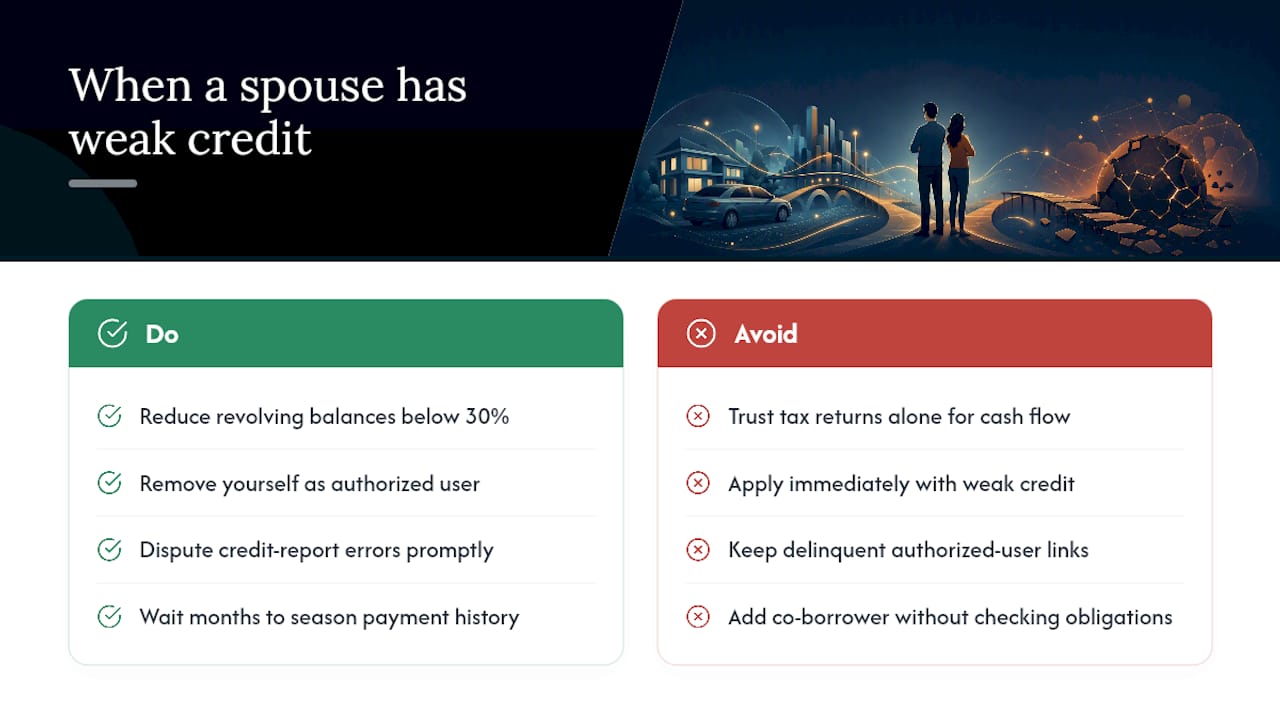
A weaker credit profile or lumpy income doesn’t have to sink your application, but it does require a plan rather than a hope. Start with the credit side if that’s the constraint. Paying down revolving balances below 30 percent of the limit, removing yourself as an authorized user on old delinquent accounts, and disputing any credit report errors can move a score meaningfully within a billing cycle or two. Sometimes the smartest move is simply waiting a few months before applying, letting a support payment history or a pay raise season into the file long enough to count fully.
When the issue is income structure rather than credit, bank-statement underwriting becomes the more relevant fix. A self-employed spouse whose tax returns show a modest net income after deductions, but whose bank account shows $12,000 a month in deposits, is a textbook case where reviewing 12 to 24 months of actual cash flow tells a very different story than the tax return does.
Ownership structuring is another underused lever. Adding a spouse to the title while keeping the mortgage note in one name only preserves their legal ownership stake without pulling their credit or debts into the underwriting decision, particularly useful when one spouse’s financial history simply isn’t ready yet.
Pro Tip: If you’re weighing a non-occupant co-borrower (a parent or family member helping you qualify), know that most programs require them to be on the note and typically the title too, and their debts get folded into your DTI the same as a spouse’s would. It can boost your approval odds, but it also means a third party takes on real financial exposure.
How Texas Bank Statement Loans Helps Couples Qualify
Self-employed spouses run into the same wall over and over: strong cash flow, weak-looking tax returns. Some lenders have underwriting approaches that evaluate 12 to 24 months of bank deposits instead of relying on tax returns to determine qualifying income.
That matters directly for couples working through the scenarios covered above. If one spouse is a 1099 contractor or business owner whose deductions make their tax return income look thin, the deposit history often paints a more accurate picture of what the household can actually afford. Qualification checks can be quick and some programs offer low down payment options starting at 10 percent, which can lower the barrier for households that have strong income but haven’t built up a large cash reserve.
Couples running the joint-versus-solo comparison described earlier can use the Self-Employed Affordability Calculator to see how bank-statement income changes the borrowing power math before ever talking to a loan officer.
What I’d Tell a Couple Before They Apply
The stance I keep coming back to: protect household stability first, and let documentation quality drive who signs the loan, not emotion or convenience. A spouse with irregular income isn’t automatically a liability. They’re a documentation problem, and documentation problems have solutions.
Before you call a lender, get three things ready: run the joint and solo scenarios side by side, confirm how your state treats non-borrowing spouse debt on the loan type you’re considering, and pull together the paperwork for every income source you plan to claim. Ask specifically about alternative underwriting if either spouse is self-employed. That one question separates couples who get denied from couples who get approved on a loan that actually fits their real finances.
- Saad
Use Bank-Statement Tools When Spousal Income Is Irregular
If one spouse’s income is self-employed, seasonal, or otherwise hard to pin down on a tax return, bank-statement underwriting solves a problem conventional lenders can’t. Instead of averaging two years of net income after deductions, this approach looks at 12 to 24 months of actual deposits, which is often the only way to get an accurate picture of what a self-employed household can really afford.
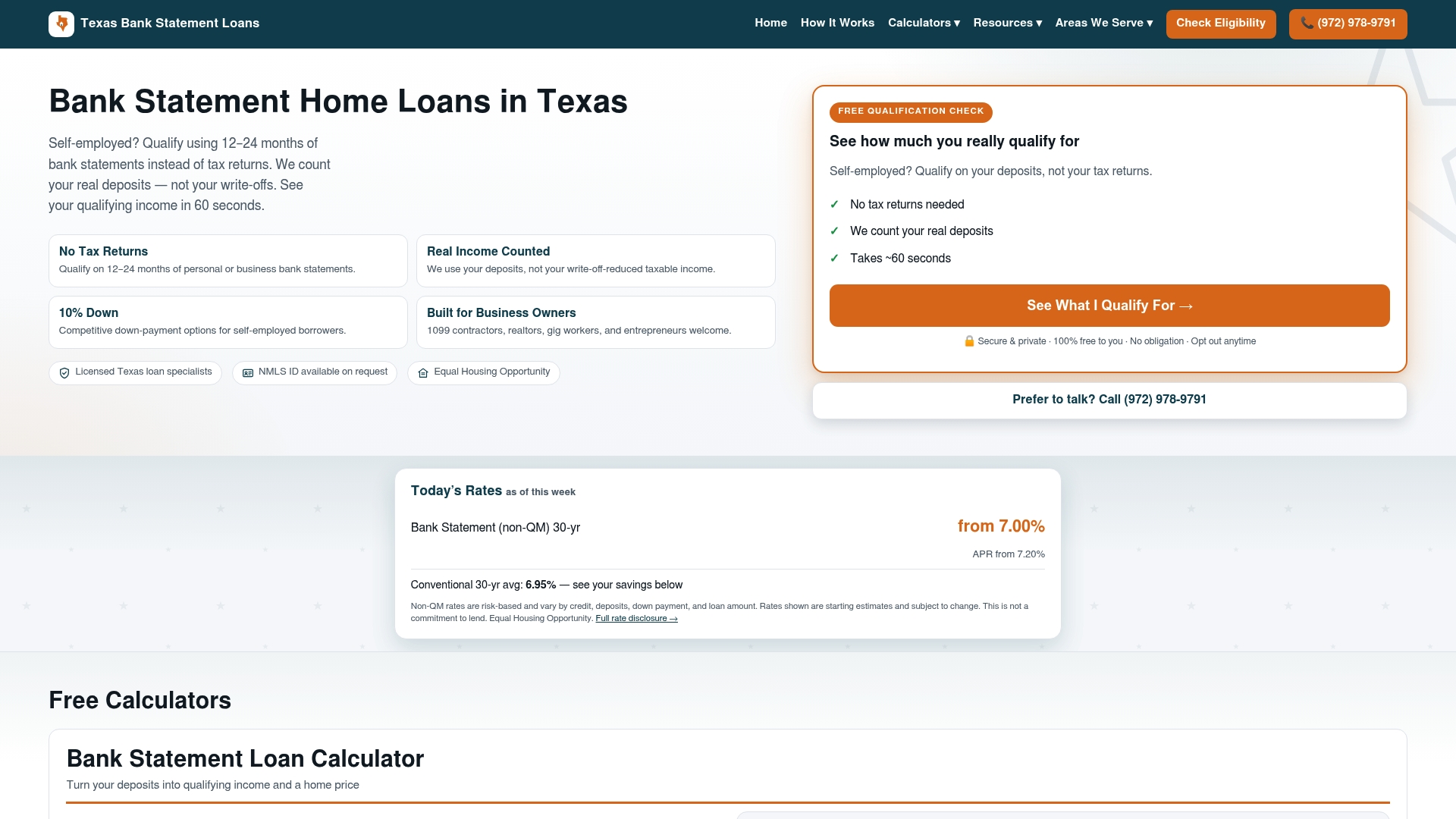
Some programs are built around exactly this scenario, with down payment options starting at 10 percent and a qualification check that can take about a minute with no obligation attached. Run your numbers through the Bank Statement Loan Calculator to see how deposit-based underwriting compares to a standard tax-return approach for your household. It’s worth comparing against other lenders and programs too, but if a spouse’s income doesn’t fit neatly into a W-2 box, this is one of the more practical paths to explore before you assume you don’t qualify.
Sources
- HUD guidance on co-borrower and non-borrowing spouse liabilities
- VA Lender’s Handbook, FAQs on income and credit
- Leaving a spouse off the loan: what still counts
This article is general information, not a substitute for advice from a qualified financial advisor. Consult a qualified financial professional about your own circumstances before acting on anything here.
FAQ
Can I use my wife’s income for a mortgage?
Yes, if she’s a co-borrower on the loan, her income gets added to yours for qualifying purposes. If she’s not signing the loan, her income generally can’t be counted, though rules vary by loan program.
What is the $100,000 loophole for family loans?
This refers to IRS rules on interest-free family loans, not mortgage qualification. It’s a gift and estate tax provision, not a mortgage underwriting rule, so it doesn’t affect whether a spouse’s income counts toward your loan.
How long can I keep my house in loss mitigation?
Loss mitigation timelines vary by servicer and program, and they depend on the specific hardship plan you’re enrolled in. This falls outside standard purchase-mortgage qualification and is best confirmed directly with your loan servicer.
How much income do you need to qualify for a $250,000 mortgage?
It depends on your interest rate, debt load, down payment, and DTI limits, but many lenders want your total housing and debt payments to stay within typical debt-to-income limits. Running your specific numbers through a mortgage calculator gives a far more accurate answer than a flat income figure ever could.
Recommended
See what you qualify for in 60 seconds, free and no credit check. Use the eligibility check at the top of this page.