
Yes, lenders can combine W-2 and 1099 income when each source is documented and shows stability or a reasonable likelihood of continuance. The two qualifiers that matter most are a verifiable paper trail for both income streams and an earnings history that typically spans 12 to 24 months. Heavy Schedule C deductions can shrink your qualifying number even when your bank account tells a different story.
TL;DR:
- Lenders require documentation and a stable earnings history of 12 to 24 months to combine W-2 and 1099 income for mortgage qualification.
- Underwriters evaluate each income stream separately, focusing on stability and likelihood of continuance, especially with contracts and recurring clients.
- Accurate matching of deposits to income sources and transparency about tax deductions significantly affect the qualifying income calculation.
- When Schedule C deductions reduce taxable income, alternative paths like bank-statement loans may increase the qualifying number but often at higher rates.
- Proper preparation includes reconciling paperwork, annotating bank statements, and running DTI calculations both with conventional and non-QM options before applying.
Table of Contents
- How lenders evaluate combined W-2 and 1099 income
- Documentation lenders typically require and how to assemble it
- How lenders calculate qualifying income and debt-to-income with mixed sources
- Alternative underwriting options: bank-statement and other non-QM paths
- Step-by-step checklist for an application combining W-2 and 1099 income
- What combining W-2 and 1099 income really means for affordability
- How we help borrowers combining W-2 and 1099 income
- FAQ
- Sources
How lenders evaluate combined W-2 and 1099 income
Underwriters do not just add your gross W-2 wages to your gross 1099 revenue and call it a day. Each income stream gets evaluated on its own terms, then combined into a single qualifying figure once both pass muster. For W-2 income, that means recent pay stubs and W-2 forms showing consistent hours and pay rate. For 1099 or Schedule C income, it means tax returns, business records, and evidence that the work is likely to continue.
Stability and continuance are the two concepts underwriters keep returning to. Stability asks whether the income has been steady or trending upward. Continuance asks whether there is a reasonable basis to expect the income to keep coming in. A contractor who just lost their biggest client looks different on paper than one with a signed multi-year agreement, even if last year’s numbers matched.
Fannie Mae’s underwriting guidance generally expects a two-year history for each income source, but a shorter track record, sometimes as little as 12 months, can still work when compensating factors are present. One of the most useful compensating factors for mixed-income borrowers is a prior W-2 job in the same field as their current 1099 work. Freddie Mac’s guidance for self-employed borrowers echoes this: lenders respond well to documented transitions within the same industry, because the skill set and client base carry over even if the tax form changed.
Underwriters also look for specific signals that separate a resilient freelance business from a shaky one:
- Signed contracts or retainer agreements that extend beyond the application date.
- Recurring invoices to the same clients over multiple quarters.
- Client retention patterns rather than one-off gigs.
- Year-over-year revenue that holds steady or grows rather than declining.
None of these signals replace documentation, but they shape how an underwriter reads the numbers you provide.
Documentation lenders typically require and how to assemble it
Mixed-income files tend to generate more paperwork than a single-source application, mostly because each income type carries its own verification standard. Gathering everything before you apply saves weeks of back-and-forth with your loan officer.
Here is the core document set most lenders will ask for:
- Recent pay stubs covering at least 30 days, plus W-2 forms for the last two years.
- All Form 1099s received for the last two tax years, matched to the issuing clients or platforms.
- Two years of personal federal tax returns, including Schedule C and any related schedules.
- Two to three months of personal bank statements, and business bank statements if you run the 1099 work through a separate account.
- Signed client contracts or invoices that support ongoing work.
- A profit and loss statement for the current year if your most recent tax return is more than a few months old.
Matching deposits to income sources matters more than most applicants expect. If your 1099 payments land in a personal account alongside W-2 direct deposits, label or annotate the statements so the underwriter can tell at a glance which deposits are client payments and which are paycheck transfers. Unexplained large deposits are one of the fastest ways to stall a file, since the CFPB’s ATR-QM compliance guidance requires lenders to confirm that deposits used to qualify actually represent your personal income rather than transfers or loan proceeds.
When a document is missing or unusual, alternatives exist. A letter from a client confirming an ongoing relationship, a transcript of your 1099 filings from the IRS, or a year-to-date invoice summary can all fill gaps that a standard document checklist does not anticipate.
Pro Tip: Keep a simple spreadsheet mapping each bank deposit to its source (employer, client name, or platform) before you submit your application; it turns a confusing statement into a five-minute review for your underwriter.

How lenders calculate qualifying income and debt-to-income with mixed sources
Your tax return and your qualifying income are rarely the same number, and the gap usually comes from the 1099 side. W-2 wages are counted close to their gross amount, but Schedule C income goes through a conversion process that strips out nonrecurring items and adds back certain deductions that do not reflect real cash outflow, such as depreciation.
That adjustment process can work in your favor or against it. Common steps include:
- Adding back depreciation, depletion, and other noncash deductions.
- Subtracting one-time business losses or gains that will not repeat.
- Averaging income across two years when the trend is stable or improving.
- Flagging a declining trend for closer scrutiny rather than an automatic average.
This is why a freelancer who reports $90,000 in gross 1099 revenue but writes off $50,000 in business expenses may qualify on closer to $40,000 a year, even though their bank account shows far more cash flow. Your debt-to-income ratio, which compares monthly debt payments to gross monthly qualifying income, gets calculated on that adjusted number rather than the headline figure on your 1099s. The Legal Information Institute’s explainer on DTI describes this ratio as a measure of ability to repay rather than a single fixed cutoff, which means a strong W-2 income can sometimes offset a thinner 1099 number and still produce an acceptable ratio.
A lender’s written analysis of your tax returns, required under Fannie Mae’s self-employment guidance, determines exactly which deductions get added back before your DTI is calculated. That analysis is often the single biggest factor in whether your combined income qualifies you for the loan amount you want.

Alternative underwriting options: bank-statement and other non-QM paths
When Schedule C write-offs push your qualifying income too low for the home you want, a conventional loan is not the only route. Bank-statement underwriting, a form of non-QM lending, calculates qualifying income from 12 to 24 months of actual deposits instead of adjusted tax-return figures. For a contractor who legitimately earns strong cash flow but reports modest taxable income after deductions, this approach can produce a noticeably higher qualifying number.
This path tends to fit a few borrower profiles particularly well:
- Gig workers and contractors with large Schedule C deductions that suppress taxable income.
- Business owners whose bank deposits consistently outpace their reported net profit.
- Borrowers who recently transitioned from W-2 employment to 1099 work and have not yet built a two-year self-employment history.
Non-QM products are not free of tradeoffs. Rates tend to run higher than conventional financing, and down payment requirements can differ, so it is worth comparing the monthly payment math against what a standard W-2-plus-1099 conventional file would produce. A broader look at how bank-statement programs work is useful background if you want to understand the mechanics before applying.
We evaluate 12 to 24 months of personal or business bank deposits instead of relying solely on tax returns, which is built specifically for business owners, 1099 contractors, and gig workers whose write-offs would otherwise shrink their qualifying income on a conventional loan. A bank statement home loan qualification check takes about 60 seconds and carries no obligation.
Pro Tip: If your tax returns show a much lower number than your actual bank deposits, run a bank-statement scenario before assuming you do not qualify for the home price you want.
Step-by-step checklist for an application combining W-2 and 1099 income
A little sequencing goes a long way when two income types are involved. Working through these steps before you submit an application reduces the odds of a stalled file.
- Gather and reconcile your paperwork. Pull pay stubs, W-2s, 1099s, two years of tax returns, and bank statements, then cross-check that the numbers tell a consistent story.
- Annotate your bank statements and write a short explanation. A one-paragraph summary noting when you added 1099 work, why both income types exist, and how they relate gives the underwriter context before questions arise.
- Run your debt-to-income numbers both ways. Use a DTI calculator to compare your conventional qualifying income against a bank-statement affordability estimate so you know which path supports the loan amount you need.
- Prepare to address worker classification if both forms came from the same employer. When a W-2 and a 1099 are filed for the same tax year, especially from a related employer, the IRS examines whether the services were genuinely distinct. Be ready to describe the two roles clearly so your lender and the IRS see a legitimate separation rather than a misclassification issue.
Borrowers who work through this sequence before applying tend to spend far less time answering underwriter follow-up requests later.
What combining W-2 and 1099 income really means for affordability
Combining income types usually helps, but it rarely produces the number borrowers expect from simply adding two pay stubs together. The deductions that make your 1099 work tax-efficient are often the same deductions that shrink your qualifying income on paper, and no amount of paperwork organization changes that math under conventional underwriting.
My practical recommendation: if your tax returns and your bank deposits tell roughly the same story, pursue conventional underwriting first, since it generally offers better pricing. If there is a wide gap between what you report and what you actually deposit, a bank-statement or other non-QM path is worth exploring early rather than after a conventional denial. Either way, transparency wins. A short written explanation of your income structure, paired with clean documentation, builds more credibility with an underwriter than a thicker stack of unexplained paperwork ever will.
- Saad
How we help borrowers combining W-2 and 1099 income
When your tax returns understate what you actually bring home, we built our process around your real cash flow instead of your adjusted gross income. We evaluate 12 to 24 months of personal or business bank deposits in place of relying solely on tax returns, which means the deductions that shrink a conventional qualifying number do not have the same effect here.
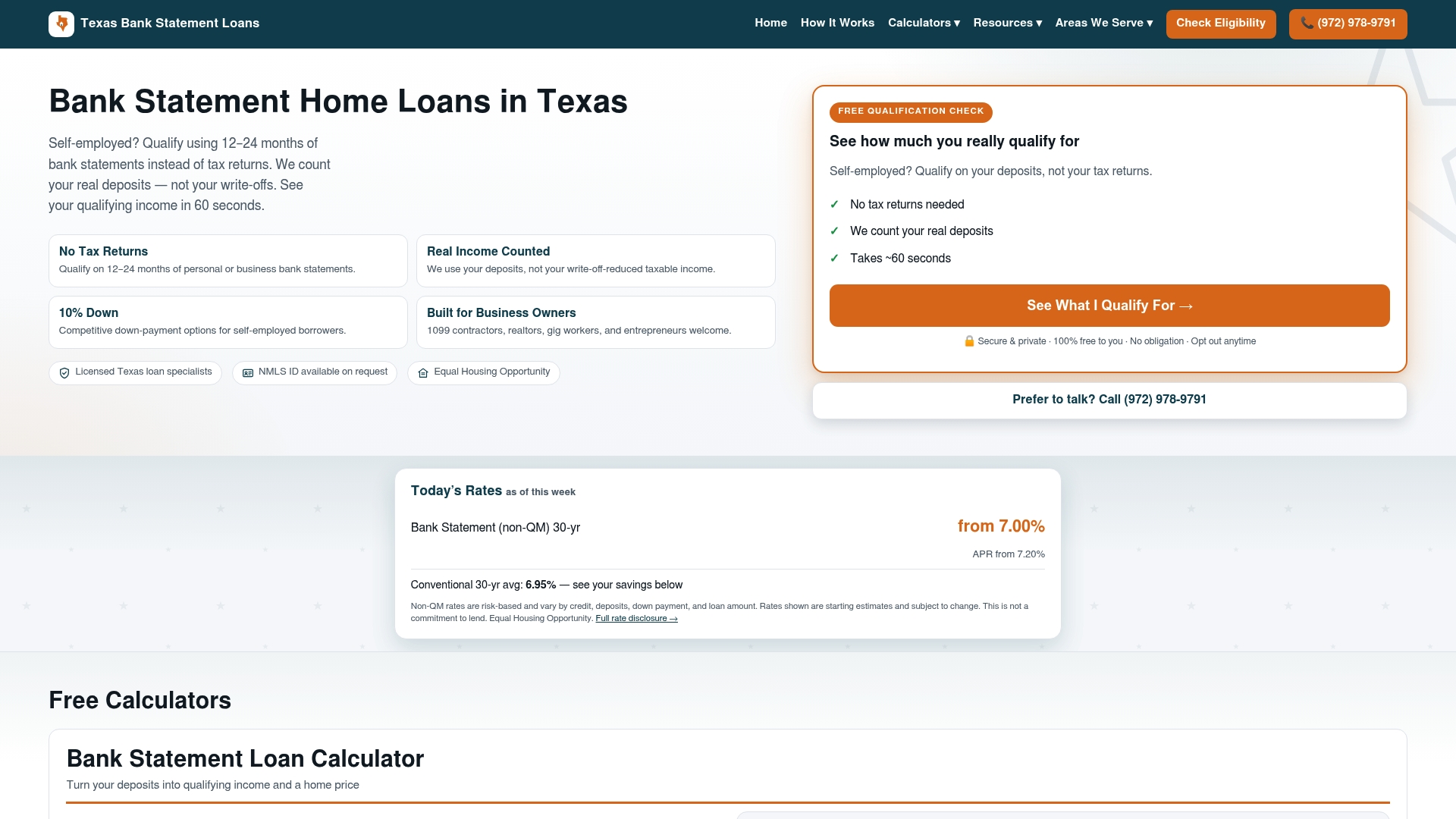
This approach tends to work best for business owners, 1099 contractors, and gig workers whose deposits run well ahead of their reported net profit, including borrowers who recently moved from a W-2 role into contract work and have not yet built a long self-employment history. Our qualification check:
- Takes about 60 seconds and carries no obligation.
- Offers low down payment options starting at 10%.
- Covers major Texas regions, including Houston, Midland, and Plano.
If you are financing an investment property rather than a primary residence, our DSCR loan tools qualify you based on property cash flow instead of personal income. For a full picture of your options, our Bank Statement (non-QM) 30-year rates page is the place to start.
This article is general information, not a substitute for advice from a qualified financial advisor. Consult a qualified financial professional about your own circumstances before acting on anything here.
FAQ
Can I file both W-2 and 1099 together?
Yes, you can file both on the same tax return. The IRS Self-Employed Individuals Tax Center confirms that 1099 income is generally reported on Schedule C alongside your regular W-2 wages, and net self-employment earnings of $400 or more require Schedule SE.
Can I get a mortgage with 1099 income?
Yes, 1099 income can qualify you for a mortgage once a lender verifies it through tax returns, business records, and evidence of stability. Fannie Mae’s underwriting guidance typically looks for a two-year history, though 12 months may be acceptable with strong compensating factors.
Can you combine income for a mortgage?
Yes, lenders routinely combine W-2 and wage income with 1099 or self-employment income as long as each source is documented and shows a reasonable likelihood of continuing. The combined figure used for qualifying, however, reflects adjusted income after underwriting add-backs, not simply the sum of your gross pay and gross 1099 revenue.
Does having both W-2 and 1099 income from the same employer cause problems?
It can raise a worker-classification question that the IRS will want explained. IRS guidance on W-2 and 1099 forms filed for the same year notes that overlapping payments from the same payer require fact development to confirm the services were genuinely distinct.
Sources
Gather pay stubs, W-2s, 1099s, two years of tax returns, and bank statements, then reconcile the deposits to each income source before applying. If your tax returns understate your actual cash flow because of business deductions, a bank-statement qualification check can show a more accurate picture.
- Fannie Mae selling guide, Underwriting factors and documentation: self-employed borrower
- Freddie Mac, Qualifying for a mortgage when you’re self-employed
- CFPB compliance guide, ATR/QM rule
- IRS, Form W-2 and Form 1099-MISC filed for the same year
See what you qualify for in 60 seconds, free and no credit check. Use the eligibility check at the top of this page.