
Interest-only loans usually fit investors with a short holding period, self-employed borrowers riding out an uneven income year, or anyone who needs lower payments now and has a real plan for what happens later. Principal and interest suits owner-occupiers and long-term holders who want equity building on autopilot. Choose IO and you’ll eventually face a payment jump and a bigger lifetime interest bill; choose P&I and you trade a higher monthly payment now for a paid-off house later.
TL;DR:
- Interest-only loans offer lower initial payments but can cause a payment jump and higher total interest if not managed carefully.
- The interest-only period typically lasts several years, with the loan balance remaining static until principal payments restart, causing potential payment shock.
- Borrowers planning to hold the property long-term or seeking stable equity benefits should prefer principal and interest loans to avoid higher costs later.
- Investors and self-employed borrowers benefit from interest-only loans’ cash flow flexibility, especially when they have a clear plan for managing the payment increase at the end of the period.
- It’s essential to model future payments and build a financial buffer before the interest-only period ends to prevent surprises and ensure affordability.
Table of Contents
- Interest Only vs Principal and Interest: The Quick Comparison
- How Payments and Amortization Actually Work
- Pros, Cons, and Who Each Option Fits
- Running the Numbers on a Real Loan
- Preparing for the End of the IO Period
- How Texasbankstatementloans Evaluates This Trade-off
- A Faster Path to Qualifying, Whichever Loan Fits
- Where to Verify the Numbers Yourself
- Sources
Interest Only vs Principal and Interest: The Quick Comparison
The mechanical differences between these two loan types show up in four places: what you pay monthly, what happens to your loan balance, how long the special terms last, and who actually benefits from picking one over the other.
- Monthly payment: an interest-only payment covers just the interest charge, so it’s noticeably lower than a principal-and-interest payment on the same loan amount and rate.
- Loan balance: with IO, the balance stays flat for the entire IO period; with P&I, it drops a little more every month starting on day one.
- Term length: IO periods typically run several years, often tacked onto the front of a standard 30-year loan, and lenders frequently charge a small rate premium for the privilege.
- Who it serves: IO tends to line up with investors managing cash flow and self-employed borrowers smoothing out lumpy income; P&I lines up with buyers who plan to stay put and want to own the home outright someday.
Nobody escapes the math forever. Every dollar of principal you don’t pay during the IO window gets pushed into a shorter amortization schedule later, which is exactly why the post-IO payment jump catches so many borrowers off guard.
How Payments and Amortization Actually Work
An interest-only payment is arithmetic, not magic: multiply your balance by the interest rate, divide by twelve, and that’s your bill. No slice of it touches the principal, so the balance you owe on month one of an IO loan is the same balance you owe on the last month of the IO period, even though official guidance from the Office of the Comptroller of the Currency confirms this is exactly how these loans are structured.
A principal-and-interest loan splits every payment between interest owed and a shrinking sliver of principal, with that split shifting more toward principal every year. Take a 30-year mortgage with an IO period lasting several years: you pay interest-only for five years, then the loan re-amortizes over the remaining 25 years. Because the same debt now has to get paid off five years faster than a standard schedule, the new payment lands meaningfully higher than what a plain P&I loan would have cost from day one.

Adjustable-rate IO products, sometimes called payment-option ARMs, carry a sharper risk. If the minimum payment offered doesn’t even cover the interest due, the unpaid interest gets added to your balance instead of subtracted from it, a trap known as negative amortization. You end up owing more than you borrowed.
Pros, Cons, and Who Each Option Fits
- Lower early payments and cash flow. IO frees up monthly cash for investors funding renovations, covering vacancies, or acquiring the next property, and it can smooth things over for self-employed borrowers whose income swings month to month.
- No equity building during IO. Every month you don’t pay principal is a month your ownership stake doesn’t grow, and if home values dip, you’re more exposed than a P&I borrower with the same purchase price.
- Higher lifetime cost. IO loans typically cost more in total interest over the full loan term, partly because you’re paying interest on a balance that never shrinks and partly because of the rate premium many lenders attach to IO products.
- Payment shock is real. The jump at the end of the IO period isn’t a footnote. It’s the whole reason IO loans get a bad reputation when borrowers don’t plan for it.
- P&I fits the risk-averse and the long-term holder. If you’re buying the home you’ll retire in, a predictable, amortizing payment beats a lower number today that turns into a bigger number tomorrow.
- Investors get a tax angle P&I owner-occupiers don’t. Interest on investment property loans is often deductible, which can shift the net cost math in IO’s favor for landlords, though every borrower’s tax situation is different and this is worth confirming with a tax professional rather than assuming it applies to you.
Running the Numbers on a Real Loan
A quick way to see payment shock in action: on a $400,000 loan with an interest-only period lasting several years, the IO payment covers interest only, while the payment for the remaining amortization jumps once principal repayment kicks back in, because that same balance now has five fewer years to get paid off. That jump, not the IO payment itself, is what trips people up.
To model your own scenario, a comparison calculator that shows both the during-IO and after-IO payment side by side is the only honest way to see the real trade-off. Change three inputs and watch what happens: the length of the IO term, the rate premium your lender is charging for IO versus a standard P&I loan, and any extra principal payments you might make voluntarily during the IO window. Texasbankstatementloans’s mortgage payment calculator lets you plug in your own loan amount and rate to see both numbers side by side before you sign anything.
Investors should also model the tax-deductible interest angle separately, since it can change which option actually costs less in after-tax dollars.
Preparing for the End of the IO Period
The payment jump at IO expiry is predictable, which means it’s preventable. Build a cash buffer sized to the higher post-IO payment well before the switch happens, not after the first bigger bill arrives.

Making occasional extra principal payments during the IO period, even small ones, chips away at the balance that would otherwise sit frozen, which softens the eventual payment jump and cuts total interest. Start pricing out refinance options 6 to 9 months before your IO period ends, so you have room to react if rates have moved against you. Rolling into a second IO period is sometimes possible, but treat it as a stopgap, not a plan.
Pro Tip: If a lender qualifies you only on the interest-only payment without checking whether you could handle the post-IO amount, that’s a red flag, not a feature. Ask what your payment looks like the day IO ends, not just today.
How Texasbankstatementloans Evaluates This Trade-off
Bank-statement underwriting, built around 12 to 24 months of actual deposits, often shows self-employed borrowers can service more than their tax returns suggest. That changes the IO versus P&I conversation entirely: some borrowers who look IO-dependent on paper qualify comfortably for P&I once real cash flow is on the table. We lean toward recommending IO only when there’s a documented plan for the payment jump, not as a way to stretch a shaky budget.
- Saad
A Faster Path to Qualifying, Whichever Loan Fits
If you’re self-employed, a 1099 contractor, or a gig worker and the IO versus P&I math above has you wondering whether you’d even qualify for either one under a traditional lender, that’s the exact problem Texasbankstatementloans exists to solve. Instead of tax returns that undersell your real income, underwriting runs on 12 to 24 months of bank deposits, which often reveals stronger serviceability than a standard mortgage application shows.
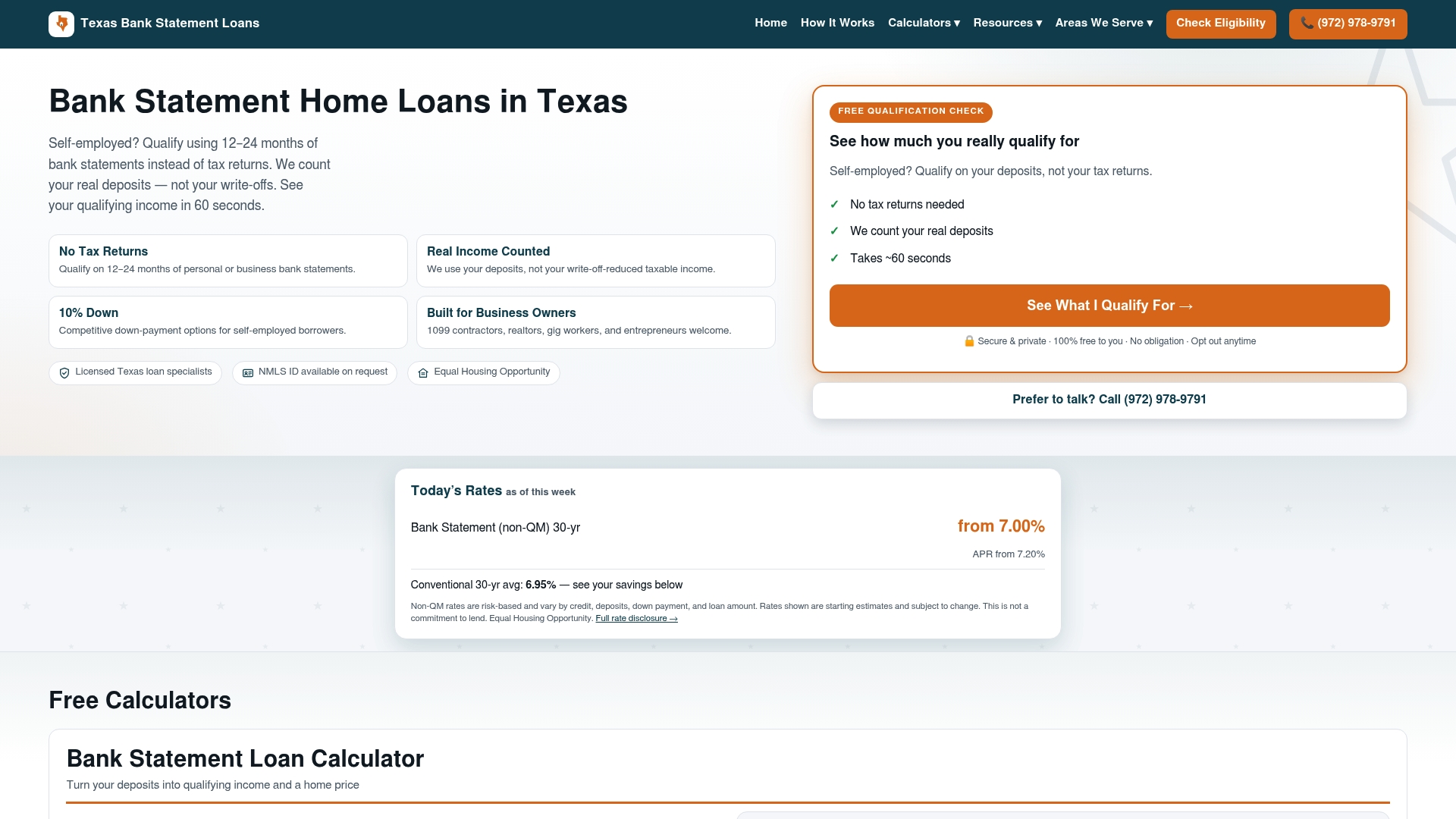
Down payments start at 10%, and you can check what you’d likely qualify for in about 60 seconds with no obligation attached. Want to see how an IO or P&I payment would actually land on your budget first? Run your numbers through the free mortgage calculators before you talk to anyone, then use that number to start a real conversation about what you can afford.
Where to Verify the Numbers Yourself
Cross-check anything a lender tells you against primary sources. The OCC’s consumer guide on interest-only and payment-option ARMs breaks down negative amortization risk in plain terms, and the FTC’s credit and loan resources cover how to compare APRs and disclosures across offers before you commit to either structure.
This article is general information, not a substitute for advice from a qualified financial advisor. Consult a qualified financial professional about your own circumstances before acting on anything here.
Sources
- Interest-Only Mortgage Payments and Payment-Option ARMs (OCC)
- Interest-only vs. traditional mortgages (MyFICO)
- Credit and loans information (FTC)
See what you qualify for in 60 seconds, free and no credit check. Use the eligibility check at the top of this page.