
Well-documented bank statement loans in Texas most often price in the 7.00%-8.50% range today, running roughly half a point to a point and a half above comparable conventional mortgage rates. Where you land in that band depends mostly on three things: credit score, down payment (loan-to-value), and whether the lender uses 12 or 24 months of statements. One option reviews actual deposits instead of tax returns for self-employed buyers statewide.
TL;DR:
- Rate quotes for bank statement loans in Texas typically range from 7.00% to 8.50%, generally 0.5 to 1.5 percentage points above conventional rates.
- Borrowers with lower credit scores, smaller down payments, or only 12 months of statements often face higher rates around 8.00% to 8.50%.
- A 24-month statement period usually results in better pricing and higher loan-to-value limits compared to a 12-month window, which involves less historical data.
- Improving credit scores above 720, increasing down payments, and providing CPA letters or P&L statements can help lower loan rates quickly.
- Rates depend heavily on confidence in income verification, loan purpose, property type, and documentation quality, making file preparation crucial.
Table of Contents
- Bank Statement Loan Rates in Texas Right Now
- What Determines Your Bank Statement Loan Rate in Texas
- 12-Month vs. 24-Month Programs: Which Fits Your File
- How Lenders Turn Your Bank Statements Into Qualifying Income
- What a Bank Statement Loan Actually Costs You
- Ways to Lower Your Bank Statement Loan Rate
- How Texas Bank Statement Home Loans Helps Self-Employed Buyers
- The Real Lesson Buried in Bank Statement Loan Pricing
- Get Your Rate Quote in Minutes
- Sources
- FAQ
Bank Statement Loan Rates in Texas Right Now
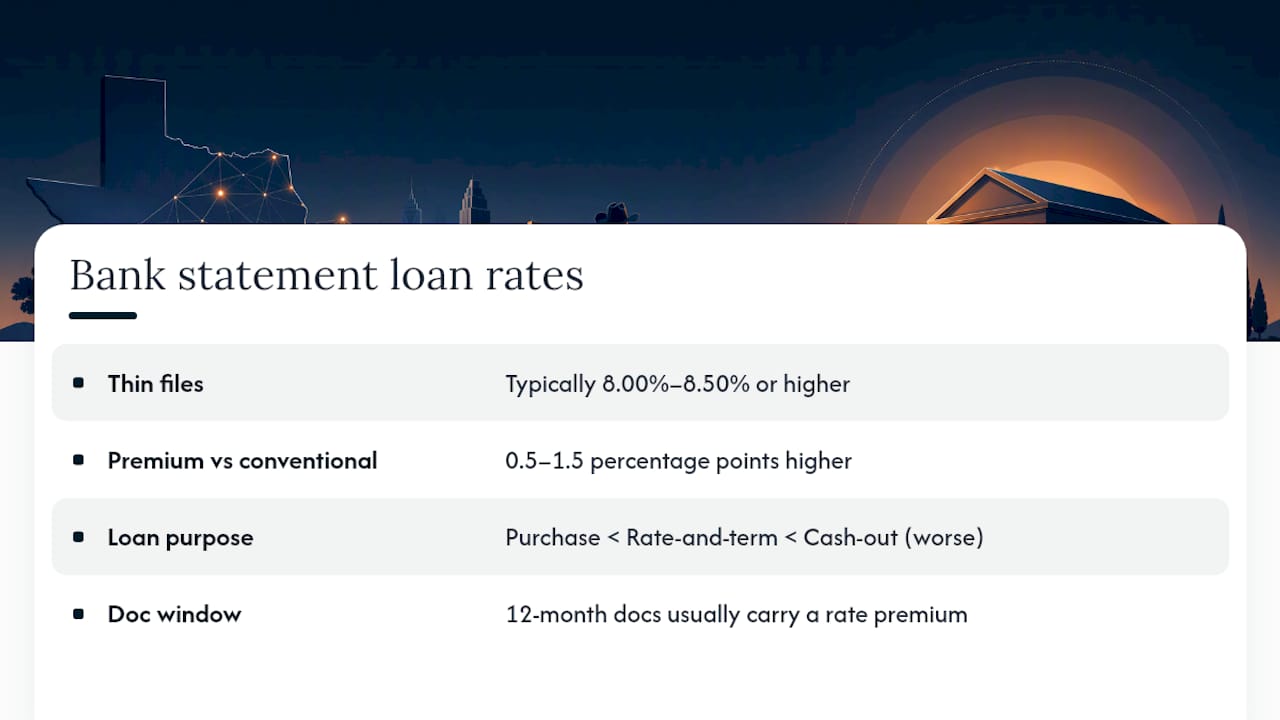
Rate quotes on bank statement loans move around more than conventional pricing because every lender weighs credit, down payment, and documentation differently. Still, three rough tiers show up consistently across Texas lenders quoting Non-QM programs.
Thin files, meaning lower credit scores, minimum down payments, or only 12 months of statements available, often see 8.00% to 8.50% or slightly higher.
By the Numbers: Bank statement loans typically price 0.5 to 1.5 percentage points above conventional mortgage rates, reflecting their Non-QM classification and the added underwriting work of verifying self-employed income.
A real-world example helps.
Loan purpose matters too. Purchase loans usually price a touch better than cash-out refinances, since cash-out carries more risk for the lender. Straight rate-and-term refinances tend to sit between the two. And the 12-month versus 24-month choice isn’t just about paperwork. Shorter documentation windows often carry a rate premium because the lender has less history to judge income stability.
Texas housing demand has stayed resilient enough that lenders continue competing for well-qualified self-employed buyers, according to the Texas A&M Real Estate Research Center’s 2026 Texas Real Estate Forecast. That competition keeps pricing somewhat responsive to your file quality rather than locked into a single number. The only way to know your actual rate is to run a live quote, since published ranges are starting points, not guarantees.
What Determines Your Bank Statement Loan Rate in Texas
Every pricing factor on a bank statement loan ties back to one question: how confident is the lender in your income and your ability to repay? Answer that convincingly, and the rate moves in your favor.
Credit score bands drive the biggest swings. Most Texas bank statement programs set a floor somewhere between 620 and 680, but pricing improves noticeably above 720. A 40-point credit score jump can shift your quote by a quarter point or more, sometimes enough to change your monthly payment by a meaningful amount over a 30-year term.
Down payment and occupancy shape both rate and loan limits. Putting more down lowers your loan-to-value ratio, which reduces lender risk and usually earns better pricing. Investment properties and second homes carry higher rates than owner-occupied primary residences, since owner-occupied loans default less often.
Other factors that move your quote:
- Statement period: 24 months of history generally prices better than 12 months, since it gives underwriters a longer income track record.
- Loan purpose: Cash-out refinances price higher than purchases; rate-and-term refinances sit in between.
- Expense factor: The percentage of gross deposits treated as business overhead directly shrinks or grows your qualifying income, which affects how large a loan you can support at a given rate tier.
- Reserves: Cash reserves beyond your down payment (often three to six months of payments) can offset weaker credit or thinner documentation.
- Property type: Condos, rural properties, and unique structures sometimes carry pricing overlays that standard single-family homes don’t.
Sometimes the rate improvement from that extra 5% down is dramatic enough to offset years of extra savings toward it.*
12-Month vs. 24-Month Programs: Which Fits Your File
Bank statement programs generally split into two documentation windows, and the choice affects both your rate and how much you can borrow.
24-month programs remain the more common standard and typically price better than their 12-month counterparts. Lenders get two full years of deposit history, which reduces uncertainty about whether your income is stable or a temporary spike.
12-month programs exist for borrowers who’ve been self-employed for at least two years but only want to submit a single year of statements, often because a recent year looked stronger than the prior one. The tradeoff is real: 12-month files often carry a rate premium and tighter LTV caps than the equivalent 24-month deal, since the lender has less data to lean on.
Typical eligibility ranges you’ll encounter across Texas Non-QM lenders:
- Credit score floors: Commonly 620 to 680 depending on the program, with scores above 720 unlocking meaningfully better pricing tiers.
- Down payment: Primary residences often start around 10% down; investment properties and jumbo loan amounts typically require larger down payments, sometimes 20% or more.
- Self-employment history: Most programs want at least two years of self-employment in the same business or industry, verified through business licenses, CPA letters, or 1099s.
- Entity types accepted: Sole proprietors, LLCs, S-corps, and partnerships are generally all eligible, though the documentation each requires can differ.
- Reserves: Two to six months of mortgage payments in reserve, with higher amounts sometimes required on investment properties or jumbo loans.
Jumbo bank statement loans, meaning loan amounts above conforming limits, generally come with stricter reserve requirements and sometimes a slightly higher rate floor. If you’re financing a higher-priced property in a market like Austin or Plano, expect your loan officer to ask for more reserve documentation upfront rather than midway through underwriting.
How Lenders Turn Your Bank Statements Into Qualifying Income
Bank statement underwriting follows a repeatable process, and understanding it before you apply lets you prepare a file that gets to closing faster and prices better.
- Sum eligible deposits. The lender totals deposits across your 12 or 24 statements, whether personal or business account. Bank statement loans are typically both offered, depending on the program you qualify under.
- Exclude transfers and one-time deposits. Money moved between your own accounts, loan proceeds, tax refunds, and other non-recurring deposits get stripped out before any income calculation happens, since these don’t reflect your actual business revenue, according to reporting from National Mortgage Professional.
- Apply the expense factor. For business accounts, lenders apply a set percentage as an assumed overhead cost, reducing gross deposits to a net income figure. This expense factor is arguably the single most consequential number in the entire calculation, since it directly shrinks or grows what counts as your income.
- Divide by the number of months. The remaining figure gets divided by 12 or 24 to produce a monthly qualifying income, which then determines how much loan you can support at a given debt-to-income ratio.
A CPA letter or year-to-date profit-and-loss statement can work in your favor here. When your actual overhead is demonstrably lower than the lender’s default expense assumption, supplying that documentation sometimes lets underwriters accept a lower expense factor, which raises your qualifying income without changing a single deposit.
Before you apply, build a simple documentation packet: monthly statements with any large or unusual deposits labeled by source, a short cover note explaining recurring versus one-off income, and, if you have one, a CPA letter summarizing your business’s typical margins.
Pro Tip: Highlight recurring client payments directly on your statements with a highlighter or PDF annotation before submitting them. Underwriters move faster when they don’t have to guess which deposits are your actual business income.
What a Bank Statement Loan Actually Costs You
The interest rate is only part of the math. Closing costs, lender fees, and how long the process takes all affect what you actually pay and when you can move.
Buying points lowers your rate but raises upfront cash needed, so the math only works if you plan to stay in the home long enough to recoup that cost through lower monthly payments.
Program overlays add cost in specific cases:
- Investment properties often carry higher fees and rate add-ons than primary residences.
- 12-month statement programs sometimes carry a pricing premium built into the rate rather than a separate fee.
- Jumbo loan amounts can trigger additional underwriting fees tied to the larger loan size.
Time-to-close on bank statement loans in Texas commonly runs three to five weeks, similar to many conventional loans, though incomplete documentation is the most common delay. Appraisal scheduling in fast-moving markets like Houston or Dallas can also add a week if inventory is tight.
When comparing offers between lenders, look at the annual percentage rate (APR) and total closing costs together, not just the headline rate. A lower rate paired with heavier fees can cost more over a five-year hold than a slightly higher rate with minimal fees.
Ways to Lower Your Bank Statement Loan Rate
Most of the rate movement available to you comes down to four levers, and you don’t need months to pull most of them.
- Improve your credit score before applying. Paying down revolving balances below 30% utilization and correcting any reporting errors can move your score enough to shift pricing tiers within a few weeks.
- Increase your down payment. Moving from 10% to 20% down often produces a more noticeable rate improvement than almost any other single change you can make quickly.
- Clean up your bank statement history. Separate personal transfers from business deposits, and write brief notes explaining any deposit that looks unusual to an underwriter seeing it cold.
- Add a CPA letter or year-to-date P&L. This can support a lower expense factor determination, which raises your qualifying income even if your rate stays the same.
- Get quotes from more than one lender. Non-QM pricing varies more between lenders than conventional pricing does, so shopping two or three quotes on the same file can reveal a meaningful spread.
Pro Tip: If your credit score sits just under a pricing tier, like 715 instead of 720, ask whether waiting 30 to 60 days to improve it is worth more than locking in today. Sometimes a short delay saves you thousands over the loan term.
How Texas Bank Statement Home Loans Helps Self-Employed Buyers
One service builds its approach around one idea: your tax returns don’t have to define what you can afford. It evaluates 12 to 24 months of personal or business bank deposits directly, which means write-offs and deductions that shrink your taxable income on paper don’t automatically shrink your borrowing power.
That approach matters most for the borrowers conventional underwriting tends to underserve:
- 1099 contractors whose income varies month to month but averages out strong over a year.
- Gig workers juggling multiple income streams that don’t fit neatly into a W-2 box.
- Small business owners who legitimately minimize taxable income through deductions but generate solid actual cash flow.
- Realtors with commission-based income that fluctuates seasonally across the Texas market.
The site also offers a quick qualification check that estimates what you can realistically afford in about 60 seconds, along with calculators for modeling qualifying income and monthly payments before you commit to a full application.
The Real Lesson Buried in Bank Statement Loan Pricing
Most guides on this topic obsess over the rate range and skip the part that actually changes your outcome: file preparation. The rate you’re quoted on day one of shopping isn’t fixed. It shifts based on how clean your statements look, whether you’ve bothered to source large deposits, and whether you’ve handed underwriting a P&L instead of forcing them to guess at your expense factor.

Conventional wisdom says shop for the lowest advertised rate. That’s backwards for Non-QM borrowers. The better move is spending two or three weeks tightening your documentation before you ever request a quote, because a well-prepared 24-month file with a clear expense narrative routinely prices better than a rushed application with a stronger credit score attached to messy statements.
If you take one thing from this guide, prioritize the expense factor conversation with your loan officer before anything else. It’s the variable most borrowers never ask about, and it moves your qualifying income more than a rate buydown ever will.
- Saad
Get Your Rate Quote in Minutes
This service is an alternative to the conventional mortgage process for self-employed Texans: instead of relying on tax returns, applicants provide bank statements so that their actual deposits can be used.
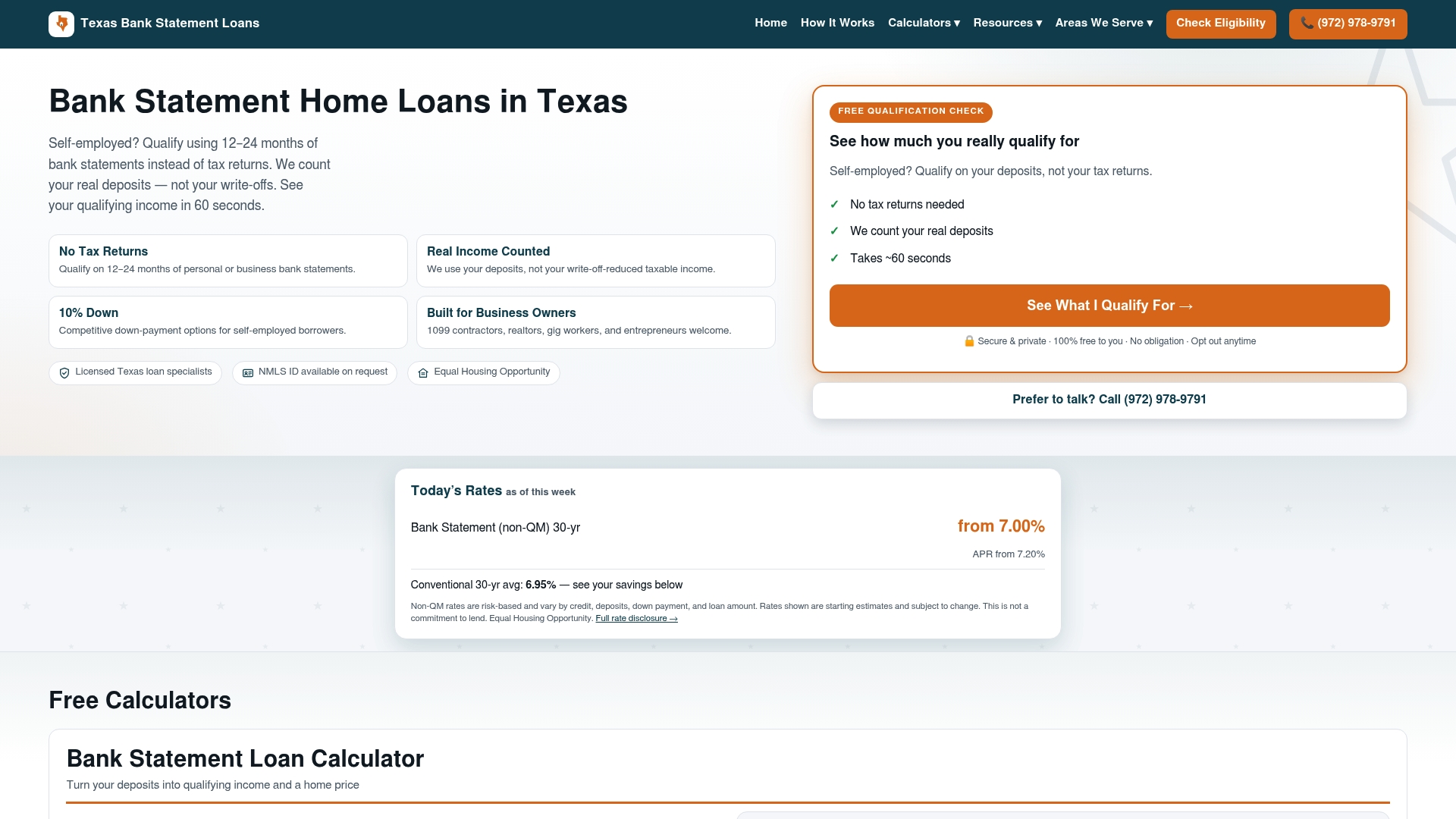
Before you request a quote, gather your last 12 to 24 months of bank statements, a CPA letter or P&L if you have one, and a rough idea of your target down payment. Then run the free, no-obligation qualification check to see where you likely land in today’s pricing tiers, no commitment required. If you’d rather model numbers first, the site’s mortgage calculators let you test different down payment and rate scenarios in a few minutes. Once you’re ready, a loan officer can turn that pre-qualification into a firm quote and walk you through next steps toward closing.
Sources
- Bank Statement Loans in Texas | Q Mortgage
- Bank Statement Mortgage Texas | Loankea
- Bank statement loans, documentation nuance for self-employed borrowers | National Mortgage Professional
- Texas Real Estate Forecast 2026 | TRERC (Texas A&M)
- NMLS Consumer Access
This article is general information, not a substitute for advice from a qualified financial advisor. Consult a qualified financial professional about your own circumstances before acting on anything here.
FAQ
What is the average rate for a bank statement loan?
Bank statement loan rates typically run 0.5 to 1.5 percentage points above comparable conventional mortgage rates, since they’re classified as Non-QM products.
Can I get a bank statement loan in Texas?
Yes, bank statement loans are widely available across Texas for self-employed borrowers, 1099 contractors, and gig workers.
What banks offer bank statement loans?
Bank statement loans are typically offered through Non-QM mortgage lenders and specialty loan officers rather than traditional retail banks, since these programs fall outside standard conventional underwriting. Always verify any lender or loan officer’s license through NMLS Consumer Access before applying.
Can I get a personal loan using bank statements?
Bank statement programs are designed for mortgage financing, not general personal loans, and they use 12 to 24 months of deposits to establish qualifying income for self-employed borrowers. If you’re looking to buy or refinance a home in Texas, a bank statement mortgage is the correct product to ask about rather than a personal loan.
How do 12-month and 24-month bank statement programs differ?
A 24-month program reviews two years of deposits and typically prices better with higher loan-to-value limits, since lenders have more income history to evaluate. A 12-month program uses one year of statements, which speeds up documentation but often carries a rate premium and tighter down payment requirements.
Recommended
See what you qualify for in 60 seconds, free and no credit check. Use the eligibility check at the top of this page.