
The self-employed mortgage qualification process requires documented proof of consistent income, employment history, and financial health through tax records and business financials rather than standard pay stubs. Where a W-2 employee hands over two documents, a self-employed borrower hands over a file. Fannie Mae and Freddie Mac guidelines set the baseline that most conventional lenders follow, and those guidelines demand at least 2 years of self-employment history with 25% or greater business ownership. That two-year rule exists because lenders want to see income stability across economic cycles, not just a good quarter. If you run your own business, work 1099 contracts, or earn gig income, knowing exactly what lenders look for puts you in control of the outcome.
What documents are required for self-employed mortgage qualification?
Documentation is the foundation of every self-employed mortgage application. Lenders cannot verify your income through an employer, so your financial records become your proof of employment and earnings combined. Two years of federal tax returns, both personal Form 1040 and business returns, are the standard starting point required by Fannie Mae and Freddie Mac guidelines.
The full document list lenders typically require includes:
- Federal personal tax returns (Form 1040): Two years, including all schedules. Schedule C shows sole proprietor profit and loss. Schedule E covers rental income and partnership distributions. Schedule K-1 documents income from S-corporations or partnerships.
- Business tax returns: Two years for any entity you own, including Form 1120S for S-corps or Form 1065 for partnerships.
- Year-to-date profit and loss (P&L) statement: Prepared by a CPA or licensed accountant. Lenders use this to verify that income is still active and consistent through the current year.
- Business and personal bank statements: Typically 12-24 months. These confirm that deposits match the income reported on tax returns.
- CPA letter or accountant certification: A signed letter confirming your business is active, its ownership structure, and that you have been self-employed for at least two years.
- Business license or professional certifications: Proof that your business legally operates in your state.
Pro Tip: Organize your documents into a single digital folder before you contact any lender. Delays in document submission are the most common reason underwriting timelines stretch from days into weeks.
How do lenders calculate qualifying income for self-employed borrowers?
Lenders calculate qualifying income by averaging your net income after business expenses over the past one to two years using your tax returns. This is where self-employed borrowers often get surprised. Your taxable income on paper is frequently much lower than your actual cash flow, because legitimate business deductions reduce the number lenders see first.

The calculation does not stop at the bottom line of your tax return. Underwriters add back certain non-cash or one-time expenses like depreciation, mileage deductions, and large equipment purchases. These items reduce your tax bill but do not represent money leaving your bank account, so lenders treat them as available income.
| Income Component | Lender Treatment |
|---|---|
| Net profit after expenses | Included as qualifying income |
| Depreciation | Added back to income |
| One-time equipment purchases | Added back if documented |
| Business mileage deductions | Added back to income |
| Owner salary from S-corp | Included as qualifying income |
| Business distributions | Included if consistent across 2 years |
Fluctuating income creates a specific challenge. If your income dropped significantly in year two compared to year one, most lenders use the lower year as the qualifying figure, not the average. A startup business with less than two years of history faces the steepest climb. Some lenders will accept one year of self-employment if you can show one additional year of prior work in the same industry or relevant formal education. That exception matters for newer business owners who have strong income but a short track record.
Pro Tip: Ask your CPA to prepare a written explanation of any large deductions before you apply. A well-documented P&L statement with clear notes on add-backs can meaningfully increase the income figure your lender uses.
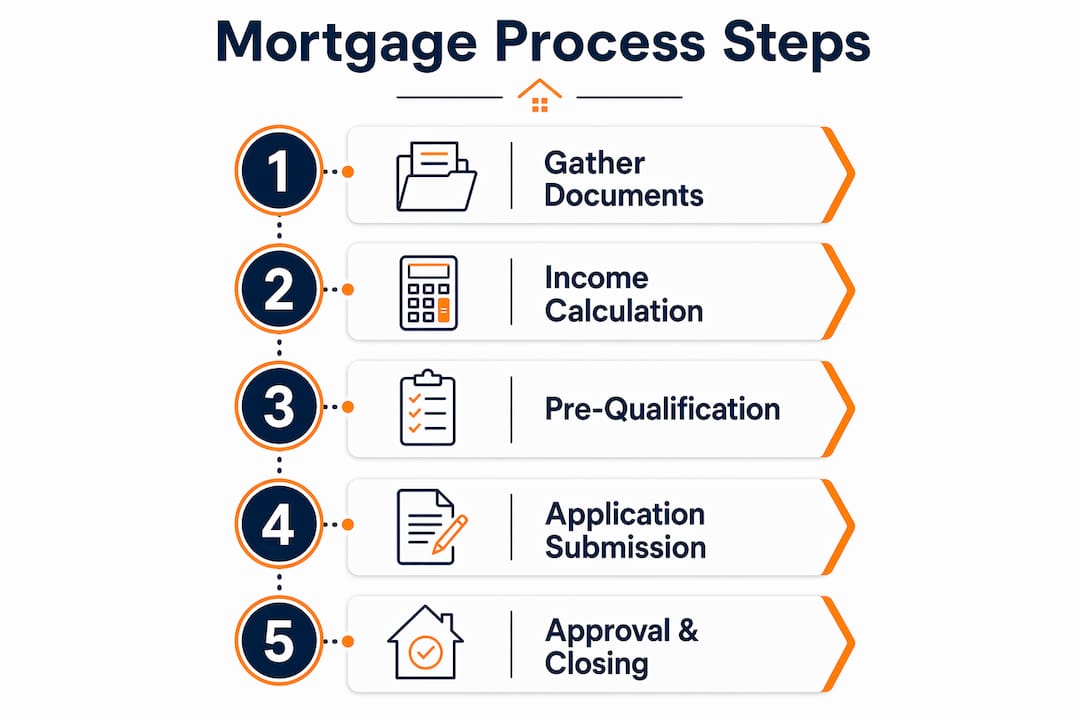
What is the typical self-employed mortgage pre-qualification and approval process?
The mortgage approval process for self-employed borrowers follows a defined sequence. Each stage has a different purpose and a different timeline.
-
Pre-qualification: You provide basic income estimates and business information. The lender runs a soft credit inquiry that does not affect your credit score. Results typically come back within 24-48 hours. This stage gives you a ballpark loan amount and helps you identify which loan products fit your profile.
-
Full pre-approval: You submit your complete document package, including tax returns, bank statements, and your P&L. The lender runs a hard credit inquiry. Underwriting review at this stage takes 1-7 business days depending on document completeness and lender volume.
-
Underwriting review: The underwriter verifies every document, calculates your qualifying income, checks your debt-to-income ratio, and orders an appraisal on the property. This is the stage where missing documents or income inconsistencies cause delays. Responding to underwriter requests within 24 hours keeps the process moving.
-
Conditional approval: The lender approves the loan subject to specific conditions, such as a final bank statement, updated P&L, or a letter of explanation for a large deposit. Clear each condition quickly.
-
Final approval and closing: Once all conditions are satisfied, the lender issues a clear-to-close. Closing typically happens within a few days. You sign the final documents, pay closing costs, and receive the keys.
The entire process from pre-qualification to closing commonly spans 30-45 days for self-employed borrowers who have complete documentation ready at the start.
What challenges do self-employed borrowers face and how can they improve approval odds?
The biggest obstacle self-employed borrowers face is the gap between actual cash flow and taxable income. Aggressive business deductions reduce taxable income and can complicate mortgage qualification unless every deduction is clearly documented. A borrower who earns $150,000 but deducts $60,000 in business expenses shows $90,000 in qualifying income. That gap directly affects how much home they can buy.
Practical strategies that improve approval odds include:
- Maintain consistent bookkeeping: Use accounting software to keep monthly records clean. Lenders trust borrowers whose income story is easy to follow.
- Build cash reserves: Six months of expenses saved in a personal account reassures lenders that you can cover payments during a slow business period.
- Protect your credit score: Self-employed borrowers with scores above 700 access better rates and more loan products. Pay down revolving balances before applying.
- Reduce your debt-to-income ratio: Paying off a car loan or credit card before applying can shift your ratio enough to qualify for a larger loan or better terms.
- Avoid large undocumented deposits: Any deposit that cannot be explained by your business records raises flags during underwriting. Keep business and personal accounts separate.
- Consider a bank statement loan: If your tax returns show low income due to deductions, a bank statement loan uses 12-24 months of actual deposits to calculate income instead. This approach reflects what you actually earn.
Pro Tip: Do not file your taxes for the current year until after your mortgage closes if your income is lower this year than last. Lenders use the most recent two years on file, and a lower year can reduce your qualifying income.
What alternative mortgage options exist for self-employed borrowers?
Self-employed borrowers have more loan options than most realize. The right choice depends on your income documentation, credit profile, and down payment.
Bank statement loans are the most direct alternative for borrowers whose tax returns understate income. Lenders analyze 12-24 months of business or personal bank deposits to calculate qualifying income. No tax returns required. Texasbankstatementloans offers this program with down payments starting at 10%, which makes it accessible for borrowers who have strong cash flow but aggressive deductions. You can use the self-employed affordability calculator to estimate how much you qualify for based on your actual deposits.
FHA loans are government-backed and allow lower credit scores and down payments, but they still require two years of tax returns and follow standard income calculation rules. They do not solve the low-taxable-income problem, but they help borrowers with thinner credit profiles access conventional-style financing.
VA loans are available to self-employed veterans and active-duty service members. They carry no down payment requirement and no private mortgage insurance, but income documentation requirements mirror conventional loans.
Mortgage calculators and affordability tools designed for self-employed borrowers help you run numbers before you apply. The bank statement loan calculator from Texasbankstatementloans estimates your loan eligibility based on deposit history rather than tax return income. Running these numbers early prevents the frustration of applying for a loan amount you cannot qualify for under standard methods.
Key takeaways
The self-employed mortgage qualification process succeeds when borrowers prepare complete documentation, understand how lenders calculate income, and choose the loan product that matches their actual financial profile.
| Point | Details |
|---|---|
| Two-year history is the standard | Most lenders require 2 years of self-employment with 25% or more ownership to qualify. |
| Tax returns understate income | Lenders add back depreciation and one-time deductions to calculate true qualifying income. |
| Documentation quality drives speed | Complete, organized documents at application prevent underwriting delays. |
| Reserves strengthen your application | Six months of expenses saved in a personal account reassures lenders during income reviews. |
| Bank statement loans fill the gap | Borrowers with low taxable income can qualify using 12-24 months of bank deposits instead. |
What I’ve learned after watching self-employed borrowers get this wrong
The most common mistake I see is borrowers walking into a mortgage application with the same mindset as a W-2 employee. They assume the lender will figure it out. The lender will not figure it out. The lender will decline the file and move on.
Self-employed borrowers who succeed treat the application like a business presentation. They prepare a clean document package before the first call. They know their qualifying income number before the underwriter calculates it. They have already spoken to their CPA about which deductions can be documented as add-backs. That level of preparation is not common, and it is exactly why it works.
The second mistake is fearing the documentation process. Transparency builds lender confidence. A borrower who submits a thorough P&L with clear notes on large deductions looks more credible than one who submits a bare tax return and hopes for the best. Lenders are not trying to disqualify you. They are trying to verify that you can repay the loan. Give them the evidence they need.
My honest advice: if your tax returns show significantly less income than you actually earn, do not waste time applying for a conventional loan. Go straight to a bank statement loan program. The process is built for your situation. Spending months trying to qualify under a system designed for W-2 employees is a frustrating detour when a better path already exists.
- Saad
How Texasbankstatementloans works for self-employed buyers in Texas
Self-employed borrowers in Texas have a direct path to mortgage approval through Texasbankstatementloans. The program uses 12-24 months of bank deposits to calculate qualifying income, which means your actual earnings matter more than your tax return bottom line.
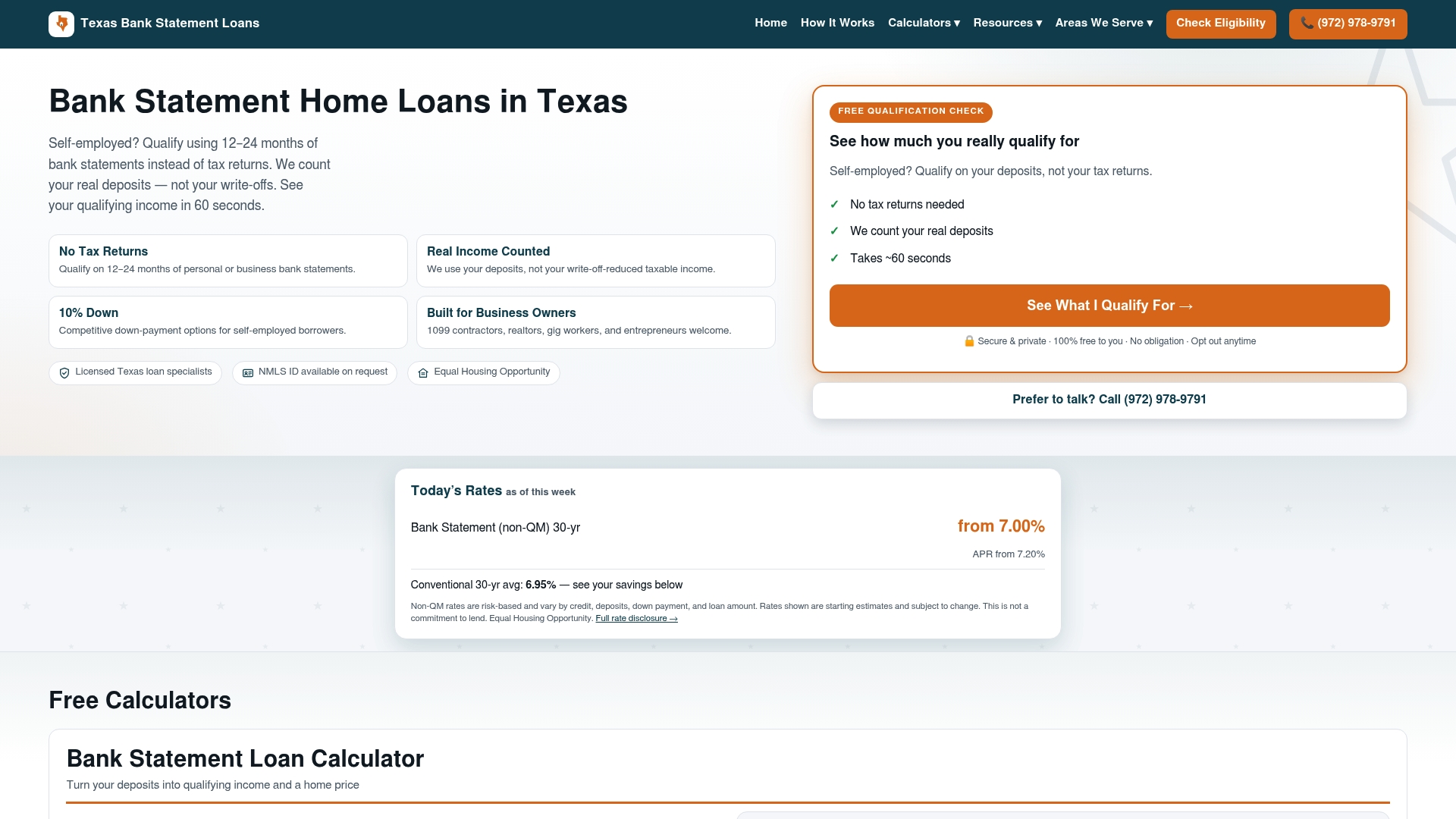
Down payments start at 10%, and the qualification check takes about 60 seconds with no obligation. Whether you are buying in Houston, San Antonio, or anywhere else in Texas, the program is built around how self-employed income actually works. Use the free mortgage tools to run your numbers before you apply, and connect with a loan specialist who understands 1099 income, business ownership, and gig work from the first conversation.
FAQ
How long do you need to be self-employed to qualify for a mortgage?
Most lenders require 2 years of self-employment history with at least 25% business ownership. Some lenders accept one year if you have one additional year of prior experience in the same field.
What income documents do self-employed borrowers need for a mortgage?
Standard requirements include two years of personal and business tax returns, year-to-date profit and loss statements, and 12-24 months of bank statements. A CPA letter confirming active business status is also commonly required.
Does a pre-qualification affect my credit score?
Pre-qualification uses a soft credit inquiry that does not impact your credit score. A hard inquiry occurs only during full pre-approval when you submit your complete document package.
What is a bank statement loan and who qualifies?
A bank statement loan uses 12-24 months of business or personal bank deposits to calculate qualifying income instead of tax returns. It is designed for self-employed borrowers, 1099 contractors, and gig workers whose taxable income is lower than their actual earnings.
How do lenders handle aggressive tax deductions when calculating mortgage income?
Lenders add back non-cash deductions like depreciation and one-time equipment purchases to increase qualifying income. Clear documentation of each deduction helps underwriters make accurate adjustments in your favor.
Recommended
- Self-Employed Affordability Calculator | Texas Bank Statement Loans
- Free Mortgage Calculators & Tools | Texas Bank Statement Loans
See what you qualify for in 60 seconds, free and no credit check. Use the eligibility check at the top of this page.