
Lenders and realtors use bank deposits to qualify self-employed borrowers because deposits show actual cash flow, and actual cash flow is often far higher than what a tax return reports after deductions. A business owner who writes off $80,000 in legitimate expenses may show $40,000 in taxable income but deposit $120,000 into their account. Deposits tell that story; W-2s and tax returns do not.
Three things to know right away:
- Lenders typically analyze several months of bank statements, averaging monthly deposits to arrive at a qualifying income figure.
- Business account deposits usually go through an expense factor reducing the qualifying amount, while personal account deposits can often count at or near the full deposited amount.
- These programs are often non-qualified mortgage (non-QM) products, which means they operate under different underwriting standards and have fewer automatic consumer protections than conventional loans.
Key Takeaways
Bank-statement deposits qualify self-employed borrowers by showing real cash flow that tax returns routinely understate, making deposit analysis the most direct path to an accurate qualifying income for business owners, 1099 contractors, and gig workers.
| Point | Details |
|---|---|
| Deposits reveal true income | Tax deductions reduce taxable income but not actual cash flow; deposits show what borrowers really earn. |
| 12-24 months of clean statements | Collect all pages, document large deposits, and separate business from personal accounts before applying. |
| Expense factors reduce business deposits | Business account deposits are typically reduced by 50%-85%; personal accounts often count at or near 100%. |
| Non-QM status means different protections | Bank-statement loans sit outside the CFPB’s Qualified Mortgage framework; compare terms and model affordability carefully. |
| Texasbankstatementloans for Texas buyers | Texasbankstatementloans offers 12-24 month deposit analysis with down payments starting at 10% across Texas. |
Table of Contents
- Why realtors qualify buyers using deposits instead of tax returns
- What do lenders actually look for in your deposit history?
- What documents do you need to gather before applying?
- What eligibility and terms should you expect?
- What regulatory protections apply to non-QM loans?
- How should realtors advise self-employed clients who plan to qualify on deposits?
- A worked example: turning deposits into qualifying income
- What are the concrete next steps to get pre-qualified?
- What advisors often get wrong about deposit-based qualification
- Texasbankstatementloans: deposit analysis for Texas self-employed buyers
- Sources
Why realtors qualify buyers using deposits instead of tax returns
The mechanics follow a clear sequence. Understanding each step helps borrowers prepare a cleaner file and helps realtors set accurate timelines.
-
Collect statements. The lender requests 12 or 24 months of complete bank statement PDFs, every page included. Twelve months works well when recent income is strong and consistent. Twenty-four months smooths out seasonal swings and often produces a more durable qualifying number, especially for contractors with variable project cycles.
-
Clean up the deposit register. Underwriters remove items that are not income: internal transfers between your own accounts, loan proceeds, tax refunds, and asset sale proceeds. Lenders exclude these deposit types unless you document and explain them. A transfer that shows up on both sides of two accounts you own gets counted once, not twice.
-
Calculate the monthly average. Remaining deposits are totaled and divided by the number of months in the window. A borrower with $180,000 in qualifying deposits over 12 months has a $15,000 monthly average before any adjustments.
-
Apply the expense factor or personal-account rule. For business accounts, lenders apply an expense ratio to estimate what portion of deposits represents net income after operating costs. Expense factors typically run 50%-85% depending on the program and the borrower’s industry. Personal accounts often receive a higher usable percentage, sometimes 100%, because the lender treats those deposits as already net of business costs.
-
Arrive at qualifying income. After the expense factor, the resulting monthly figure is what the lender uses for debt-to-income calculations and loan sizing.
Pro Tip: If you use a business account, ask your CPA to write a letter confirming your expense ratio. Some lenders will use a documented, lower expense ratio instead of their default, which can meaningfully increase your qualifying income.
What do lenders actually look for in your deposit history?

Consistency matters more than any single large deposit. Underwriters want to see a pattern that looks like a functioning business, not a series of unexplained spikes.
Key checks underwriters run:
- Deposit regularity: Are deposits arriving on a predictable schedule, or are there months with nothing followed by a large catch-up? Irregular patterns raise questions about income stability.
- NSF and overdraft history: Non-sufficient-funds events signal cash management problems. Even one or two in the statement window can slow approval or require written explanations.
- Large or unusual deposits: Any deposit that stands out in size needs a paper trail. A $30,000 deposit from a single client invoice is fine; a $30,000 cash deposit with no explanation is a red flag.
- End-of-month balances: Declining balances across the statement window suggest the borrower is spending more than they earn, even if average deposits look adequate.
- Business vs. personal commingling: Running personal expenses through a business account, or depositing business revenue into a personal account without a clear transfer trail, can reduce the qualifying income the lender will accept.
When deposits route from a business account into a personal account, personal account deposits may count at a higher usable percentage than business deposits, but the transfer must be visible and traceable on both sides.
Pro Tip: Pull your own statements before applying and flag any month with an NSF, a large unexplained deposit, or a sharp balance drop. Write a one-paragraph explanation for each. Lenders appreciate borrowers who show up prepared.
What documents do you need to gather before applying?
A lender-ready file has no missing pages and no unexplained items. Assemble these before you contact a loan officer:
- 12-24 months of complete bank statement PDFs (every page, not just the summary page)
- Government-issued photo ID
- Asset statements for reserves (retirement accounts, savings, investment accounts)
- Explanation letters for any large, one-time, or irregular deposits
- Invoices or contracts supporting large deposits when available
- CPA letter confirming your business expense ratio if you want to negotiate the lender’s default factor
- P&L statement (some programs request this as a supplement, not a replacement)
For file organization, label each PDF clearly: “Business Checking, January-December 2025.” Store supporting documents in a matching folder so the underwriter can cross-reference without asking for resends. A clean, organized file moves faster through underwriting than a complete but disorganized one.
| Document | Purpose | Notes |
|---|---|---|
| 12-24 months bank statements | Primary income evidence | All pages required |
| CPA expense-ratio letter | Adjusts business account factor | Can increase qualifying income |
| Deposit explanation letters | Clears irregular items | One paragraph per item |
| Invoices / contracts | Supports large deposits | Attach to relevant statement month |
| Asset / reserve statements | Confirms reserves | Most recent 2 months |
Pro Tip: Lenders typically need the bank statements and ID first to issue a preliminary deposit analysis. Get those two items ready before anything else.
What eligibility and terms should you expect?
Bank-statement programs vary by lender, but common parameters look like this:
- Credit score: Most programs start at 620-640 minimum; better terms typically require 680 or above.
- Down payment: Some programs start around 10%, though 20%-25% is common for investment properties or borrowers with lower credit scores.
- DTI: Debt-to-income expectations vary, but most lenders want to see the qualifying income support a DTI under 50%.
- Reserves: Lenders often require 3-12 months of mortgage payments in liquid reserves after closing.
- Loan types: Primary residence, second home, and investor/DSCR programs are all available, though terms differ.
Rate and fee tradeoff: Bank-statement loans carry higher interest rates than conventional loans because they sit outside the qualified mortgage framework. The spread varies by program and credit profile, so comparing current bank statement loan rates across programs before committing is worth the time.
For DSCR (investor) loans, the qualifying logic shifts entirely to rental income coverage rather than personal deposits, which suits real estate investors who want to keep personal and investment finances separate.
What regulatory protections apply to non-QM loans?
Bank-statement loans are non-QM products, which means they do not meet the Consumer Financial Protection Bureau’s Qualified Mortgage standards. That distinction has real consequences.
Non-QM loans are not subject to the same ability-to-repay safe harbor that protects lenders and borrowers under the CFPB’s Qualified Mortgage rule. Lenders still must assess ability to repay, but the specific documentation and underwriting standards differ, and borrowers have fewer automatic protections if a dispute arises.
Specific risks to weigh:
- Higher rates and fees than conventional or FHA loans
- Varied underwriting standards across lenders, so the same file can produce different outcomes at different institutions
- Some programs include 40-year terms or interest-only periods, which lower the monthly payment but extend the repayment timeline significantly
- Qualification can exceed sustainable affordability. Industry reporting notes that deposit-based qualification can produce numbers that exceed a borrower’s actual disposable income once business reinvestment and operating costs are accounted for.
Pro Tip: Ask every lender three questions upfront: What is the loan term and amortization structure? Is there a prepayment penalty? What happens to my rate if I refinance within three years? The answers tell you whether the program fits your actual financial plan.
How should realtors advise self-employed clients who plan to qualify on deposits?
Realtors who understand deposit-based qualification close more deals and avoid last-minute surprises. The key is running the deposit analysis before the client falls in love with a property.
Before referral, collect:
- 12-24 months of bank statements (business and personal)
- A rough estimate of monthly business expenses
- The client’s credit score range
- Any known large deposits that might need explanation
Questions to ask the loan officer:
- How many months of statements do you require, and does 24 months produce a stronger number for this client?
- What expense factor do you apply to business accounts, and will you accept a CPA letter to adjust it?
- How do you treat transfers between the client’s business and personal accounts?
- What reserves will you require at closing?
- What is the realistic timeline from deposit analysis to preapproval letter?
Timeline to set with clients and sellers:
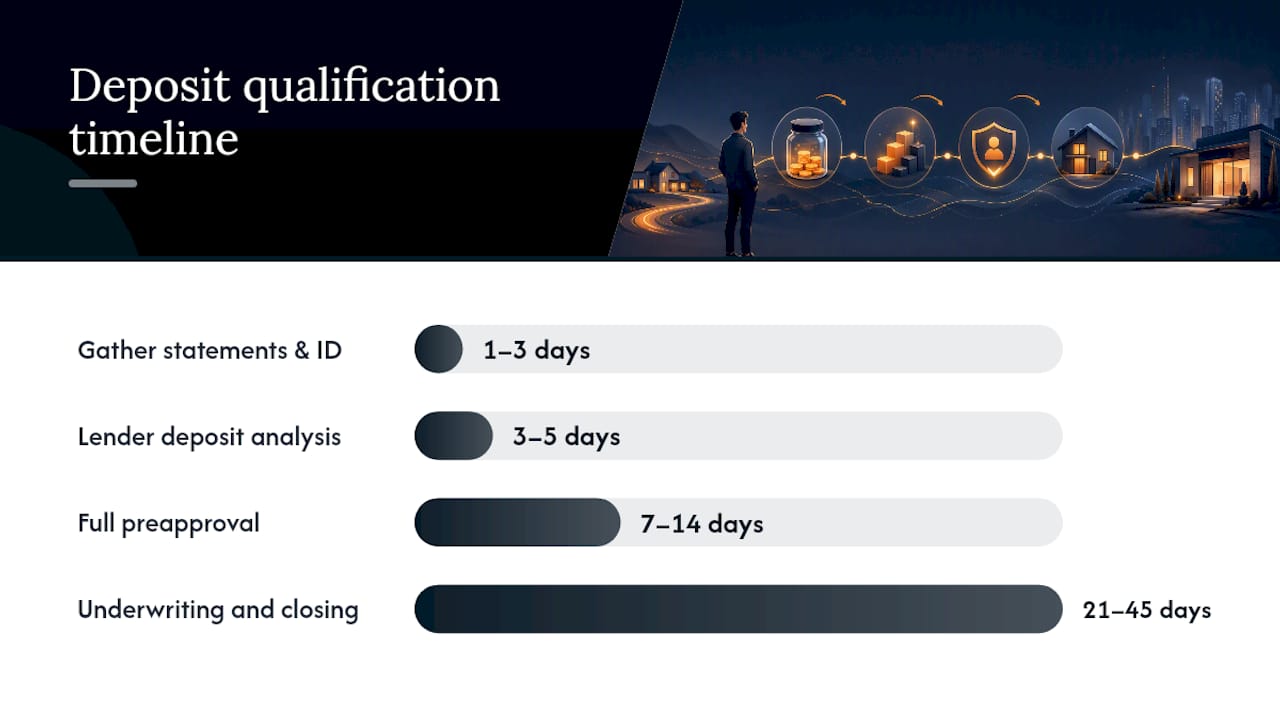
- Gather statements and ID (1-3 days)
- Lender runs deposit analysis and issues preliminary qualifying range (3-5 business days)
- Full preapproval with underwriting review (7-14 business days)
- Underwriting and closing (21-45 days depending on program)
Communicate this timeline to listing agents early. Sellers sometimes hesitate on self-employed buyers; a preapproval letter from a specialist lender with a clear deposit analysis behind it addresses that concern directly.
A worked example: turning deposits into qualifying income
This is an illustration only. Actual lender calculations vary by program, expense factor, and account type.
That difference can shift the maximum loan amount by tens of thousands of dollars. Use the bank statement loan calculator to model your own numbers before meeting with a lender.
What are the concrete next steps to get pre-qualified?
- Gather 12-24 months of complete bank statements for every account you plan to use. Business and personal, all pages.
- Request a deposit analysis from a specialist. A specialist runs both 12-month and 24-month scenarios; the stronger number is often not the one borrowers expect.
- Compare outcomes across statement windows. Running both periods is low cost and often reveals a meaningfully different qualifying income.
- Get prequalified and document reserves. Once you have a qualifying income figure, confirm your reserve accounts are liquid and accessible, then move to a full preapproval.
For a fast, no-obligation estimate, a 60-second qualification check can show you a realistic range before you commit to a full application.
What advisors often get wrong about deposit-based qualification
The most common mistake is treating qualification as the finish line. Industry analysis makes the point clearly: deposit-based qualification can make a borrower appear overqualified relative to their actual disposable income, because the deposits include money that will cycle back into the business.
A borrower who qualifies for a $600,000 loan based on gross deposits may only have $4,000 per month in true personal spending capacity after business costs, taxes, and reinvestment. That is a real affordability problem even if the underwriting math checks out.
The right advisory move is to model two scenarios before a client makes an offer: one at the qualifying rate, and one at a rate 1.5-2 points higher. If the payment becomes unmanageable in the stress scenario, the client should buy at a lower price point, not stretch to the qualification ceiling.
Texasbankstatementloans: deposit analysis for Texas self-employed buyers
Self-employed buyers in Texas who have been turned away by conventional lenders because of low taxable income have a direct path forward here.
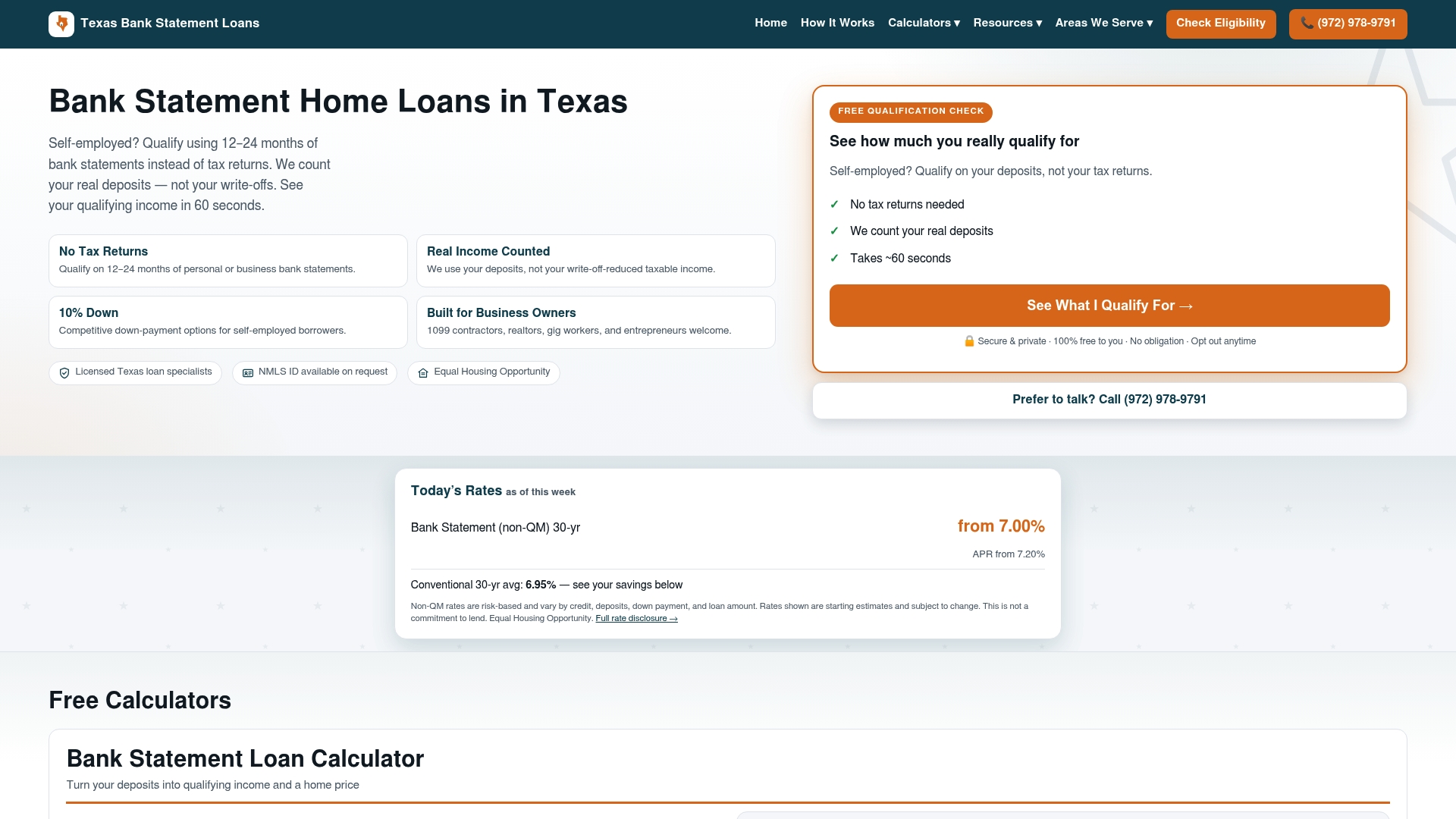
Texasbankstatementloans analyzes 12-24 months of bank deposits to produce a qualifying income figure that reflects what you actually earn, not what your Schedule C reports after deductions. Realtors can refer clients directly for a deposit analysis before listing appointments, which eliminates the preapproval gap that kills deals late in the process.
To get started, run a 60-second qualification check for Houston-area buyers or visit the main program page to see which program fits your situation. No obligation, no commitment, just a clear number.
Sources
- Why bank statement lending is forcing a rethink of qualification and advice | Mortgage Professional
- The Bank Statement Mortgage Master Guide 2026: Self-Employed Requirements | LoanWise
This article is general information, not a substitute for advice from a qualified financial advisor. Consult a qualified financial professional about your own circumstances before acting on anything here.
See what you qualify for in 60 seconds, free and no credit check. Use the eligibility check at the top of this page.