
Yes, FHA loans are legally assumable. A buyer can take over the seller’s existing mortgage, including the original interest rate, remaining balance, and remaining term, but loans originated on or after December 15, 1989 require the buyer to pass a creditworthiness review through the servicer. That one condition changes everything about how you plan for an assumption.
The catch is that you’ll need cash or secondary financing to cover the gap between the sale price and the outstanding loan balance. That equity gap, not the credit review, is what stops most assumptions from closing.
The three entities that govern how this works are HUD (specifically HUD Handbook 4330.1, Chapter 4), FHA through its published policy at FHA.gov, and the loan servicer, who is the one you actually contact to start the process. Understanding all three is the difference between a smooth assumption and a deal that drags for months.
- FHA loans originated before December 1, 1986 are freely assumable with no credit review.
- Loans from 1986 through December 14, 1989 fall under transitional rules.
- Loans closed on or after December 15, 1989 require full creditworthiness review.
- Servicers must complete the creditworthiness review in a timely manner as required by HUD, with practical timelines often extending beyond the official 45-day window.
- The equity gap (sale price minus outstanding balance) must be covered by cash, a second mortgage, or documented seller financing.
Key Takeaways
FHA loans are legally assumable, but post-1989 loans require full credit qualification, and the equity gap between the sale price and outstanding balance is the most common reason assumptions fall apart.
| Point | Details |
|---|---|
| Assumability is universal | All FHA-insured loans are assumable; post-December 14, 1989 loans require a full creditworthiness review. |
| 45-day review window | Servicers must complete the credit review within 45 days of a complete doc package, but 60-90 days is the real-world norm. |
| Equity gap is the main barrier | Cash, a second mortgage, or seller financing must cover the gap between sale price and outstanding balance. |
| MIP follows the loan | Post-June 2013 FHA loans with less than 10% down carry life-of-loan annual MIP, which affects your savings math. |
| Rate gap drives the decision | Pursue an assumption when the seller’s rate is at least 1.5-2 percentage points below current market rates. |
Table of Contents
- What do FHA assumable loans actually transfer to the buyer?
- Who can assume an FHA loan?
- How do you actually assume an FHA loan, step by step?
- How much cash do you need to close an FHA assumption?
- What are the pros and cons of assuming an FHA loan?
- What rules apply based on when the FHA loan originated?
- How long does an FHA loan assumption take?
- What are your options if you can’t qualify to assume an FHA loan?
- An honest take on when to pursue an FHA assumption
- Sources
What do FHA assumable loans actually transfer to the buyer?
When you assume an FHA loan, you’re stepping into the seller’s mortgage contract. The interest rate, remaining principal balance, and remaining loan term all transfer to you.
What does not transfer is the seller’s equity. That portion of the home’s value above the outstanding balance stays with the seller, and you must pay it separately. The seller also keeps any upfront mortgage insurance premium (MIP) they paid at origination; that money is gone and does not reduce what you owe.
Compared to originating a new FHA loan, an assumption skips the origination fees and rate-setting process entirely. You won’t pay discount points or an origination charge to a new lender. The tradeoff is that you inherit the existing annual MIP structure, which may or may not be favorable depending on when the loan was originated. A new FHA loan would reset your rate to current market levels, which in a high-rate environment is the exact thing you’re trying to avoid.
Who can assume an FHA loan?
The buyer, called the assumptor, must satisfy the servicer’s underwriting requirements for loans originated after December 14, 1989. These are not dramatically different from qualifying for a new FHA loan, but there are a few specific gates to clear.
Standard underwriting requirements:
- Credit score: 580 is commonly referenced as the floor, though many servicers prefer 620 or higher for assumptions. Check with the specific servicer early.
- Debt-to-income ratio (DTI): Most servicers apply FHA’s standard DTI guidelines, typically targeting a back-end ratio at or below 43%, though some allow higher with compensating factors.
- Income and employment: Two years of employment history, recent pay stubs, and W-2s for traditionally employed buyers. Self-employed buyers typically need two years of tax returns or an alternative documentation path.
- Assets: Sufficient reserves to cover closing costs and, in some cases, a few months of payments.
- Social Security Number or EIN: Required for the credit pull and identity verification.
Occupancy and investor restrictions are where things get more nuanced. For loans originated after December 14, 1989, investors face stricter LTV requirements, and secondary-residence buyers may face additional conditions depending on the appraisal date. Owner-occupant buyers generally face the fewest restrictions.
Self-employed buyers face a specific documentation challenge: servicers typically want tax returns, and if your returns underreport income relative to your actual deposits, you may not qualify under standard documentation. That’s a real problem worth solving before you get deep into the assumption process.
Pro Tip: Call the servicer before making an offer and ask for their published assumption checklist. Servicers vary significantly in what they require, and some impose higher credit score minimums or additional reserve requirements that aren’t in the HUD handbook. Getting that list early saves weeks.
Industry sources note that 580 is the commonly referenced minimum credit score for FHA assumptions, though servicer overlays frequently push that threshold higher in practice.
How do you actually assume an FHA loan, step by step?
The process has a clear sequence, but the servicer controls the pace. Here’s how it works from offer to closing.
Step 1: Confirm assumability before making an offer. Call the servicer (not the original lender, who may no longer hold the loan) and confirm the loan is FHA-insured and eligible for assumption. Get this in writing if possible.
Step 2: Include assumption language in the purchase contract. Your real estate attorney or agent should add a contingency that makes the sale conditional on assumption approval. Without this, you could lose your earnest money if the servicer denies the assumption.
Step 3: Request the assumption package. The servicer will send a packet of forms, disclosures, and a document checklist. This is the official starting point for the 45-day credit review clock.
Step 4: Submit a complete documentation package. Incomplete submissions are the single biggest cause of delays. Submit everything at once.
Step 5: Underwriting and credit review. The servicer reviews your credit, income, DTI, and assets. Per HUD Handbook 4330.1, they must complete this review within 45 days of receiving all required documents.
Step 6: Title work and closing. Once approved, a title company or closing attorney handles the transfer. The seller should receive a formal release of liability at closing; without it, they remain on the hook if you default.
Common documents the servicer will request:
| Document | Notes |
|---|---|
| Signed assumption application | Servicer-specific form |
| Credit authorization | Allows servicer to pull your credit |
| Recent pay stubs | Or equivalent income documentation |
| W-2s or tax returns (2 years) | Self-employed: may need bank statements |
| Bank statements (2-3 months) | For asset verification |
| Government-issued ID | SSN required for credit pull |
| Purchase contract | With assumption contingency language |
Who does what: The buyer assembles and submits the documentation. The seller cooperates with servicer requests and signs the release of liability. The listing agent coordinates with the servicer’s assumption department. The closing agent handles title insurance and the recorded transfer.
The most common bottleneck is servicer unfamiliarity. Many servicers process far more new originations than assumptions and may route your request through a general customer service queue. Ask specifically for the assumption department and follow up every five business days with a written status request. A practical buyer workflow confirms this cadence is what keeps transactions from stalling.
How much cash do you need to close an FHA assumption?
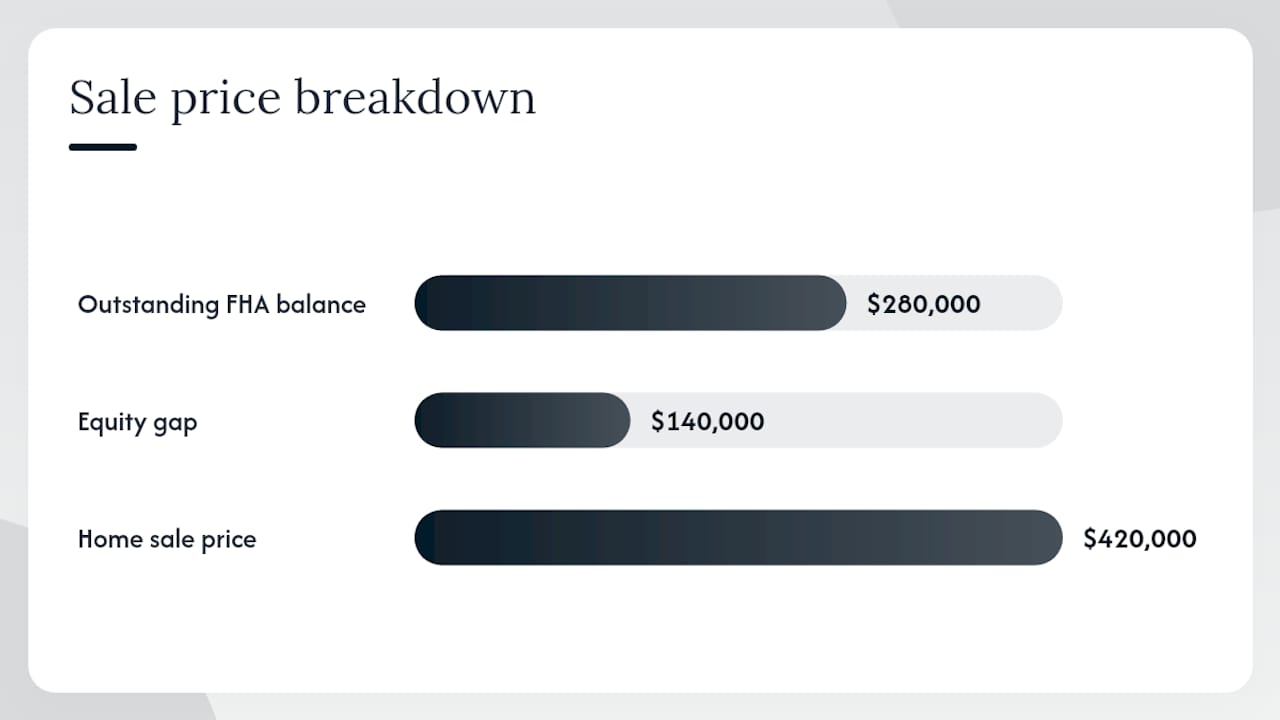
The equity gap is almost always the largest number on the closing statement. Here’s a simple example: if the home sells for $420,000 and the outstanding FHA balance is $280,000, you need $140,000 from somewhere other than the assumed loan. That money can come from cash, a second mortgage, or documented seller financing, but it cannot come from an undisclosed seller gift that reduces the mortgage balance.
Per HUD rules on seller contributions, sellers can pay normal closing costs but cannot contribute funds that artificially reduce the outstanding balance or circumvent the equity requirement.
Typical closing costs for an assumption:
- Servicer processing fee: Industry sources report this can run up to $1,800 for FHA assumptions, per EffectiveAgents reporting on updated fee figures.
- Title insurance: Varies by state and purchase price; typically $500-$2,000.
- Recording fees: County-specific, usually $50-$200.
- Prorated property taxes and homeowner’s insurance: Adjusted at closing based on the calendar.
- Second mortgage origination costs: If you’re using a second lien to cover the equity gap, add those fees.
Mortgage insurance math matters here. For FHA loans originated after June 3, 2013 with less than 10% down, the annual MIP continues for the life of the loan. If you’re assuming one of those loans, you inherit that ongoing MIP obligation. The math depends on your specific numbers.
Pro Tip: Use a mortgage calculator to model two scenarios side by side: (1) the assumed FHA loan plus a second mortgage to cover the equity gap, and (2) a new loan at current rates. The blended rate on the assumption path sometimes still wins, but not always.
What are the pros and cons of assuming an FHA loan?
Pros:
- Preserved low rate: The single biggest advantage. If the seller’s rate is 2-3 percentage points below current market, the monthly savings can be substantial over the remaining loan term.
- Lower origination costs: No discount points, no lender origination fee, and no rate-lock costs on the assumed portion.
- Potentially faster appraisal path: Some servicers waive or simplify the appraisal for assumptions, though this varies.
- Accessibility: Buyers with solid credit but limited cash for a full down payment may find assumptions more accessible when the equity gap is manageable.
Cons:
- Equity gap cash requirement: This is the deal-breaker for most buyers. A large gap with no secondary financing option makes the assumption impractical regardless of the rate savings.
- Inherited MIP: Life-of-loan MIP on post-June 2013 loans can erode the monthly savings from a lower rate, especially if current conventional rates are not dramatically higher.
- Servicer delays: The regulatory 45-day window is a floor, not a ceiling. Real-world timelines often run longer.
- Release of liability risk: If the servicer doesn’t formally release the seller, the seller remains liable for the debt. This can complicate the seller’s ability to get a new mortgage.
- Limited inventory: Not every seller has an FHA loan, and not every FHA loan has a rate worth assuming.
Quick decision filter: Pursue an assumption when the rate gap is at least 1.5-2 percentage points, the equity gap is manageable with available cash or a second lien, and the buyer can qualify under standard documentation. Walk away when the equity gap requires financing that makes the blended rate uncompetitive, or when the servicer cannot commit to a processing timeline that fits the contract.
What rules apply based on when the FHA loan originated?
The HUD Reform Act of 1989 created the framework still in use today. The origination date of the seller’s loan determines which rules govern the assumption.
| Origination Period | Creditworthiness Review | Key Restrictions |
|---|---|---|
| Before December 1, 1986 | Not required | Freely assumable; no credit review |
| December 1, 1986, December 14, 1989 | Required for some loans | Transitional rules; verify with servicer |
| December 15, 1989 and later | Required for all buyers | Full underwriting; investor and occupancy LTV rules apply |
Owner-occupants generally face the fewest restrictions.
HUD Handbook 4330.1, Chapter 4 states: “All FHA‑insured single‑family mortgages are assumable. However, mortgages closed on or after December 15, 1989 require a creditworthiness review of the proposed assumptor, and the mortgagee must complete the credit review within 45 days after receiving all required documents.”
The practical implication: if you’re looking at a home with an FHA loan originated before 1986, you could potentially assume it with no credit review at all. That’s rare in today’s market, but it does come up with older properties. For anything originated after December 14, 1989, treat the creditworthiness review as a given and prepare your documentation accordingly.
HUD Handbook 4330.1 is the authoritative source for these distinctions. The servicer’s assumption department should be able to confirm which origination-date rules apply to the specific loan.
How long does an FHA loan assumption take?
The regulatory baseline is clear: servicers must complete the creditworthiness review within 45 days of receiving a complete documentation package, per HUD guidance. In practice, industry reporting consistently shows that 60-90 days is a more realistic expectation for the full process from application to closing.
The gap between 45 days and 90 days comes from a few predictable sources. Servicers often route assumption requests through general servicing queues rather than a dedicated assumption team. Incomplete documentation packages restart the clock. Title work and closing scheduling add time after the credit approval.
Practical timeline checklist:
- Week 1: Confirm assumability with the servicer; request the assumption package.
- Week 2-3: Assemble and submit a complete documentation package in one submission.
- Week 3-7: Servicer underwriting (the 45-day window starts here).
- Week 6-10: Receive credit decision; begin title work.
- Week 8-12: Close and record the transfer.
Pro Tip: Build a 90-day assumption contingency into your purchase contract, not 45 days. Sellers sometimes resist, but a contract that expires before the servicer finishes underwriting puts both parties in a difficult position. A longer window protects everyone.
If the servicer goes silent for more than 10 business days after you’ve submitted a complete package, escalate in writing to the servicer’s assumption department manager and copy your real estate attorney. Documented follow-up creates a paper trail and tends to accelerate response times.
What are your options if you can’t qualify to assume an FHA loan?
Not qualifying for an assumption, or finding that the equity gap makes it impractical, doesn’t mean you’re out of options. Several financing paths can get you into the same home or a comparable one.
Alternative financing routes:
- New FHA loan: If you qualify under standard FHA guidelines, you can originate a new loan at current rates. You lose the rate advantage but gain a clean slate on MIP and terms.
- Conventional mortgage: For buyers with 20% down or strong credit, a conventional loan eliminates MIP entirely and may offer competitive rates.
- Seller-carried second mortgage: The seller finances part of the purchase price directly, which can help bridge an equity gap when combined with an assumed first lien.
- Piggyback or bridge loan: A second lien from a third-party lender covers the equity gap; the blended rate on the two loans may still beat a single new mortgage if the assumed rate is low enough.
- Bank statement mortgage: For self-employed buyers who can’t document income through tax returns, a bank statement loan uses 12-24 months of personal or business bank deposits to establish qualifying income. This is particularly relevant for 1099 contractors, business owners, and gig workers who would otherwise be disqualified from an assumption purely on documentation grounds.
Texasbankstatementloans evaluates self-employed applicants using 12-24 months of bank deposits rather than tax returns, with bank statement loan options in Houston and across Texas. The mortgage calculators at Texasbankstatementloans can help you model the blended rate on an assumption-plus-second-lien scenario versus a standalone bank statement loan, so you’re comparing real numbers before committing to either path.
When an alternative beats an assumption: The rate gap is less than 1 percentage point. The equity gap requires secondary financing that pushes the blended rate above current market rates. The seller needs to close faster than the servicer can process. Or the buyer simply cannot qualify under the servicer’s documentation requirements.
For self-employed buyers in Texas, the documentation barrier is often the deciding factor. A bank statement loan sidesteps that barrier entirely, and for general home financing guidance, resources like HAUS financing can help you understand your options across different loan structures.
An honest take on when to pursue an FHA assumption
The rate gap is the only reason to pursue an assumption. If the seller’s rate is within a percentage point of what you’d get on a new loan today, the equity gap cash requirement, the servicer delays, and the inherited MIP structure will almost certainly make the assumption more trouble than it’s worth.
The assumptions worth pursuing share three characteristics: the rate gap is at least 1.5-2 percentage points, the equity gap is small enough to cover with available cash or a reasonably priced second lien, and the buyer can qualify quickly with a complete documentation package. When all three line up, an assumption can save tens of thousands of dollars over the remaining loan term.
Red flags that suggest walking away: an equity gap above $100,000 with no clear secondary financing plan, a servicer that won’t confirm a processing timeline in writing, and life-of-loan MIP on a post-June 2013 loan that erodes the monthly savings to the point where a new conventional loan with no MIP would cost less over five years.
The next step is simple: before finalizing any offer on a home with an FHA loan, call the servicer, confirm the loan is assumable, ask for the assumption checklist, and get a pre-qualification started with your documentation ready. That sequence takes a few days and tells you whether the assumption is worth pursuing before you’re contractually committed.
Sources
Official HUD and FHA guidance:
- FHA Assumable Mortgage: How to Assume an FHA Loan in 2026 | The Assumable Guy
- How to Assume a Mortgage: FHA and VA Loan Assumption Process | EffectiveAgents®
Practical process guides:
First step: Contact the loan servicer directly and request their published assumption package before making an offer. The servicer’s own checklist supersedes any general guide, including this one.
This article provides general information about FHA loan assumption rules and is not a substitute for advice from a licensed mortgage professional, real estate attorney, or HUD-approved housing counselor. Confirm current rules and eligibility requirements with the loan servicer and appropriate professionals before making any financing decision.
Recommended
See what you qualify for in 60 seconds, free and no credit check. Use the eligibility check at the top of this page.