
Your credit score is the single most influential number in a mortgage application. Lenders use it to decide whether to approve you at all, which loan programs you can access, and what interest rate you’ll pay for the next 30 years. The two dominant scoring systems are FICO and VantageScore, and the government-sponsored enterprises Fannie Mae and Freddie Mac set the guidelines that most lenders follow when they price and deliver loans.
Three things your score directly controls:
- Approval chance: Most programs require a minimum score, and lenders often add their own thresholds on top of those program floors.
- Pricing: A 60-point difference in score can shift your rate by half a percentage point or more, adding tens of thousands in lifetime interest. For example, the average 30-year fixed conventional rate for a borrower with a 700 score was 6.91% as of July 2026.
- Program access: Conventional, FHA, VA, and USDA loans each carry different score requirements, down payment rules, and mortgage insurance costs.
Pro Tip: If you’re self-employed or have a thin credit file, bank-statement underwriting and newer models like VantageScore 4.0 can open doors that traditional documentation closes. More on both below.
Table of Contents
- What is a credit score and how does mortgage scoring work?
- Which credit scores do mortgage lenders actually use?
- How much does your score actually change your rate and payment?
- What are the score thresholds for each mortgage type?
- What else do lenders look at besides your credit score?
- How can you improve your credit score before applying?
- What are your options if your score is low or your income is non-traditional?
- Key Takeaways
- The part most guides skip about credit scores and mortgages
- Self-employed in Texas? There’s a mortgage built for how you actually earn
- Useful sources and tools
What is a credit score and how does mortgage scoring work?
A credit score is a three-digit number, typically ranging from 300 to 850, that summarizes how reliably you’ve managed debt. The higher the number, the lower the risk a lender assigns to you.
Five factors drive most scoring models:
- Payment history (roughly 35% of a FICO score): whether you pay on time
- Credit utilization: how much of your revolving credit you’re using
- Length of credit history: how long your accounts have been open
- Credit mix: variety across installment loans, credit cards, and other account types
- Recent activity: new applications and recently opened accounts
For mortgages specifically, lenders pull what’s called a tri-merge or bi-merge report, which combines data from all three major bureaus: Equifax, Experian, and TransUnion. Each bureau may report a slightly different score, so lenders typically take the middle of the three scores for a single borrower.
Know the difference between the score you see online and the one your lender pulls. Free consumer scores from apps like Credit Karma use VantageScore, while most mortgage lenders still pull Classic FICO variants (FICO 2, 4, or 5 depending on the bureau). The numbers can differ by 20 points or more, which matters when you’re right on a program threshold.
Newer models like FICO 10T and VantageScore 4.0 incorporate trended payment data, including rent history and other alternative data streams, that older models ignore entirely. For borrowers with thin files, that difference can be significant.

Which credit scores do mortgage lenders actually use?
Classic FICO has been the standard in mortgage lending for decades. Most lenders still use it for underwriting and rate pricing, and it remains the default for conventional loan origination.
The landscape shifted when the Federal Housing Finance Agency allowed approved lenders to use either Classic FICO or VantageScore 4.0 on an interim basis when delivering loans to Fannie Mae and Freddie Mac. The goal is to promote competition between scoring models and improve accuracy for borrowers whose credit histories don’t fit the Classic FICO mold well.
What this means in practice:
- Some lenders may now offer VantageScore 4.0 as an alternative, which can help borrowers with thin files or non-traditional credit histories.
- VantageScore 4.0 can expand credit access by incorporating rent payments and trended data that Classic FICO doesn’t capture.
- When two borrowers apply together, many lenders take the middle score for each person and then use the lower of those two medians to determine eligibility and pricing.
Pro Tip: Before you lock a rate, ask your lender which scoring model and which bureau they’ll use. The answer can affect the rate you’re offered, especially if your scores vary meaningfully across bureaus.
How much does your score actually change your rate and payment?
The average 30-year fixed conventional rate for a borrower with a 700 score was 6.91% as of July 2026. That’s a useful anchor. What changes dramatically is what happens above and below that number.

Moving between score bands can shift monthly payments by hundreds of dollars and lifetime interest by tens of thousands on a standard loan.
| Score Band | Typical Rate Delta vs. 700 | Approval Likelihood | Down Payment / PMI Outcome |
|---|---|---|---|
| 760+ | Lower (best pricing tier) | High | Standard PMI or none with 20% down |
| 740-749 | Slightly lower | High | Standard PMI rates |
| 700-740 | Near average (6.91% at 700) | Moderate-high | PMI applies below 20% down |
| 660-699 | Moderately higher | Moderate | Higher PMI premiums |
| 620-659 | Noticeably higher | Lower; overlays common | Higher PMI; stricter terms |
| Below 620 | Significantly higher or declined | Low for conventional | FHA/government programs only |
On a $350,000 30-year loan, the difference between a 760+ rate and a 620-range rate can easily exceed $200 per month. Over 30 years, that compounds to more than $70,000 in additional interest paid. The math alone makes a case for spending a few months improving your score before applying.
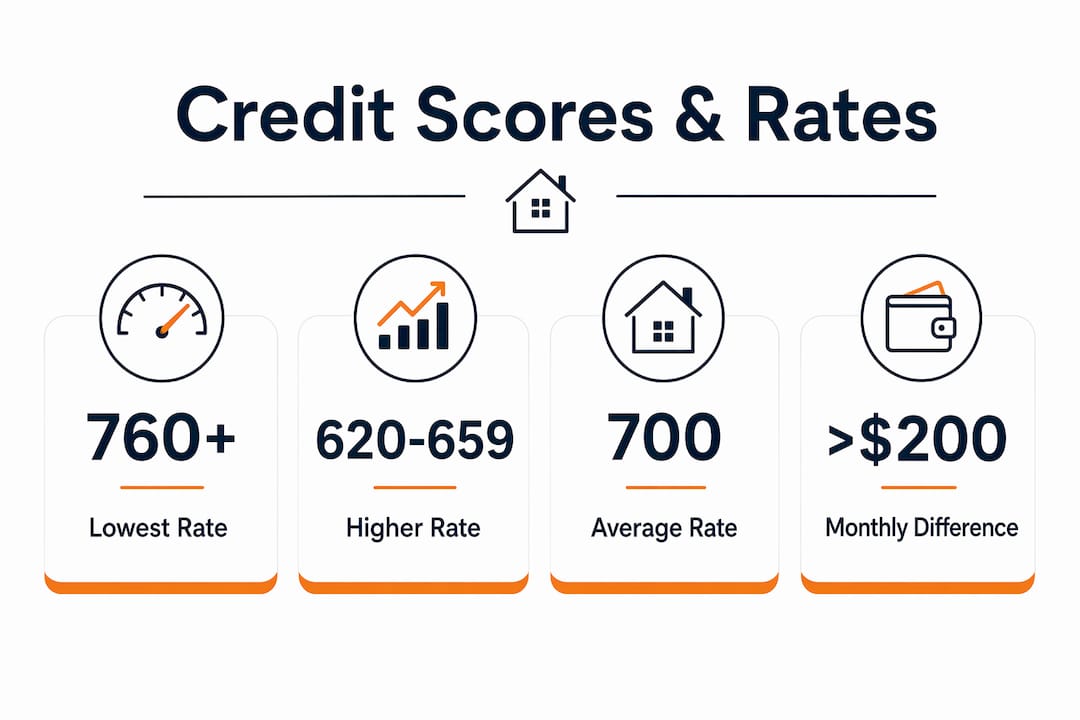
One thing worth knowing: once your score climbs into the mid-700s, the rate gains from pushing higher become smaller. Going from 620 to 680 moves you into a meaningfully better pricing tier. Going from 760 to 800 barely moves the needle on the rate sheet.
Three practical takeaways from the rate data:
- The biggest pricing jump happens when you cross from below 620 into the 620-659 band.
- The 700-740 range is where most borrowers sit, and a modest improvement can unlock noticeably better terms.
- Chasing a perfect 800+ score is rarely worth delaying a purchase if you’re already above 760.
What are the score thresholds for each mortgage type?
Each loan program carries its own floor, and lenders often add overlays on top of those program minimums.
- Conventional loans (Fannie Mae/Freddie Mac): typically require a minimum score around 620, though some lenders set their overlay at 640 or higher. Borrowers below 20% down pay PMI, and the cost rises as the score falls.
- FHA loans: the program allows scores as low as 500 with a 10% down payment, or 580 with a 3.5% down payment. In practice, many FHA lenders apply overlays that push the effective minimum to 580-620.
- VA loans: the VA itself sets no official minimum, but most lenders require around 620. VA loans carry no PMI, which makes them especially valuable for veterans with scores in the 620-680 range.
- USDA loans: designed for rural and suburban buyers, USDA typically requires 580-640 depending on the lender, and like VA, carries no down payment requirement.
| Loan Type | Typical Minimum Score | Down Payment | Mortgage Insurance |
|---|---|---|---|
| Conventional | ~620 | 3-20%+ | PMI if below 20% down |
| FHA | 500-580 (conditions apply) | 3.5-10% | MIP required |
| VA | ~620 (lender-driven) | - | None |
| USDA | ~580-640 (lender-driven) | - | Annual guarantee fee |
The score is only part of the story for government-backed loans. FHA underwriters look closely at the pattern of your credit history, not just the number. A 580 score with a recent bankruptcy reads very differently from a 580 score with a thin file and no derogatory marks.
What else do lenders look at besides your credit score?
Credit score is one piece of a broader creditworthiness picture. Lenders review income, assets, and employment stability alongside the score, and a strong profile in those areas can offset a modest number.
The major underwriting factors:
- Debt-to-income ratio (DTI): Most conventional lenders want total DTI below 43-45%. A lower DTI signals you can handle the payment even if your score isn’t perfect. Use a DTI calculator to see where you stand before applying.
- Cash reserves: Lenders want to see you have funds left after closing. Two to six months of mortgage payments in reserve is a common benchmark.
- Employment history: Two years of steady employment in the same field is the standard. Gaps or recent job changes raise questions.
- Loan-to-value (LTV): A larger down payment reduces the lender’s risk and can compensate for a lower score in some cases.
- Documentation quality: Clean, consistent paperwork speeds underwriting and reduces the chance of last-minute conditions.
A strong credit score cannot fully compensate for a very high DTI. Lenders may require a larger down payment or additional reserves instead of simply accepting the score. The relationship runs both ways: a modest score paired with low DTI, solid reserves, and stable income often clears underwriting more smoothly than a high score with stretched finances.
Pro Tip: When your score is in the 620-660 range, focus on reducing DTI and documenting reserves before applying. Those two factors give underwriters the most flexibility to approve the file.
How can you improve your credit score before applying?
Score improvement is mostly about time and consistency, but the order of actions matters. Here’s a prioritized plan:
Immediate (within 30 days):
- Pull your free reports from all three bureaus at AnnualCreditReport.com and dispute any errors.
- Stop all new credit applications, each hard inquiry can shave a few points.
- Pay down revolving balances to get utilization below 30%, ideally below 10%.
Short-term (1-3 months):
- Bring any past-due accounts current. A single account going from 30-days-late to current can move a score meaningfully.
- Avoid closing old accounts. Length of history matters, and closing a card you’ve had for years can hurt your average account age.
- Keep balances low on all cards, not just the highest-utilization ones.
Medium-term (3-12 months):
- Build a consistent on-time payment record. Payment history is the largest single factor in most scoring models.
- Add a credit mix carefully, an installment loan or secured card can help a thin file, but only if you can manage it without adding debt stress.
- Maintain low utilization month over month. Scoring models see the balance reported each statement cycle.
Pro Tip: Lenders typically re-check credit before closing. Opening a new credit card or financing furniture between preapproval and closing day can lower your score, trigger re-underwriting, and delay or kill the loan.
Realistic expectations: fixing errors and reducing utilization can produce noticeable gains within 30-60 days. Building a clean payment history takes longer, plan for 6-12 months if you’re starting from a damaged file.
What are your options if your score is low or your income is non-traditional?
A low score doesn’t automatically mean no mortgage. It means you need to match the right program to your situation.
Program options by score range:
- FHA with 10% down: Available at scores as low as 500, though lender overlays often push the practical floor higher.
- VA loans: No official minimum, no PMI, and no down payment requirement for eligible veterans and service members.
- USDA loans: Rural and suburban buyers with scores around 580-640 can access zero-down financing in eligible areas.
- Non-conforming / portfolio loans: Lenders who hold loans on their own books can set their own criteria, sometimes accepting lower scores with compensating factors.
For self-employed borrowers, the challenge is often less about the score and more about documentation. Tax returns frequently understate income because of legitimate deductions, which makes qualifying on paper harder than it should be.
Bank-statement loan underwriting solves that directly. Instead of tax returns, the lender reviews 12-24 months of bank deposits to establish income. That approach works well for:
- Business owners whose Schedule C shows modest net income after deductions
- 1099 contractors and gig workers with variable but substantial deposit history
- Borrowers with a solid FICO score but insufficient documented income under traditional methods
Pro Tip: A self-employed borrower with a 640 FICO score and strong, consistent bank deposits can often qualify for a bank-statement loan when a conventional application would stall. The score still matters for pricing, but it’s no longer the only path to approval.
For Texas buyers specifically, bank-statement loans in Midland and other markets are available with down payments starting at 10%, making this a realistic option rather than a last resort.
Key Takeaways
Your credit score shapes mortgage approval, rate, and program access, but compensating factors, loan type, and documentation approach all influence the final outcome.
| Point | Details |
|---|---|
| Score drives approval and pricing | Lenders use your score to set rates, approve programs, and determine PMI costs. |
| Lenders use specific scoring models | Ask which model (Classic FICO or VantageScore 4.0) and which bureau your lender will use before locking. |
| Program thresholds vary widely | Conventional requires ~620; FHA accepts as low as 500-580; VA and USDA thresholds are lender-driven. |
| Compensating factors matter | Low DTI, solid reserves, and stable income can offset a modest score in underwriting. |
| Texasbankstatementloans offers an alternative path | Self-employed borrowers can qualify using 12-24 months of bank deposits instead of tax returns, with down payments starting at 10%. |
The part most guides skip about credit scores and mortgages
Most articles on this topic treat the credit score as the whole story. It isn’t. The score is a shorthand that lenders use to start a conversation, not end one.
What I’ve seen repeatedly is borrowers who obsess over getting to 760 when they’re already at 720, delaying a purchase by six months for a rate improvement that amounts to maybe $40 a month. Meanwhile, they’re ignoring a DTI at 46% that’s the actual reason a lender might decline them. The score is visible and easy to track, which makes it psychologically satisfying to focus on. The underwriting picture is messier and less intuitive, which is why people avoid it.
The other thing worth saying plainly: the shift toward VantageScore 4.0 at the GSE level is genuinely significant for borrowers with thin files. Rent payment history showing up in a mortgage score is a real change, not a marketing claim. If you’ve been renting and paying on time for years but have limited credit card or loan history, that data now has a path into your mortgage score under the FHFA’s interim policy. That’s worth knowing before you assume your options are limited.
For self-employed borrowers, the credit score conversation is almost secondary to the documentation question. A 680 score with clean bank deposits and low DTI is a stronger mortgage application than a 720 score with a tax return that shows $40,000 in net income after deductions. Lenders who understand bank-statement underwriting read the full picture. Lenders who only do conventional loans see the tax return and stop there.
Self-employed in Texas? There’s a mortgage built for how you actually earn
Traditional mortgage applications were designed around W-2 employees. If your income runs through a business account, a 1099, or a mix of both, the standard process often produces a qualification number that doesn’t reflect what you actually earn.
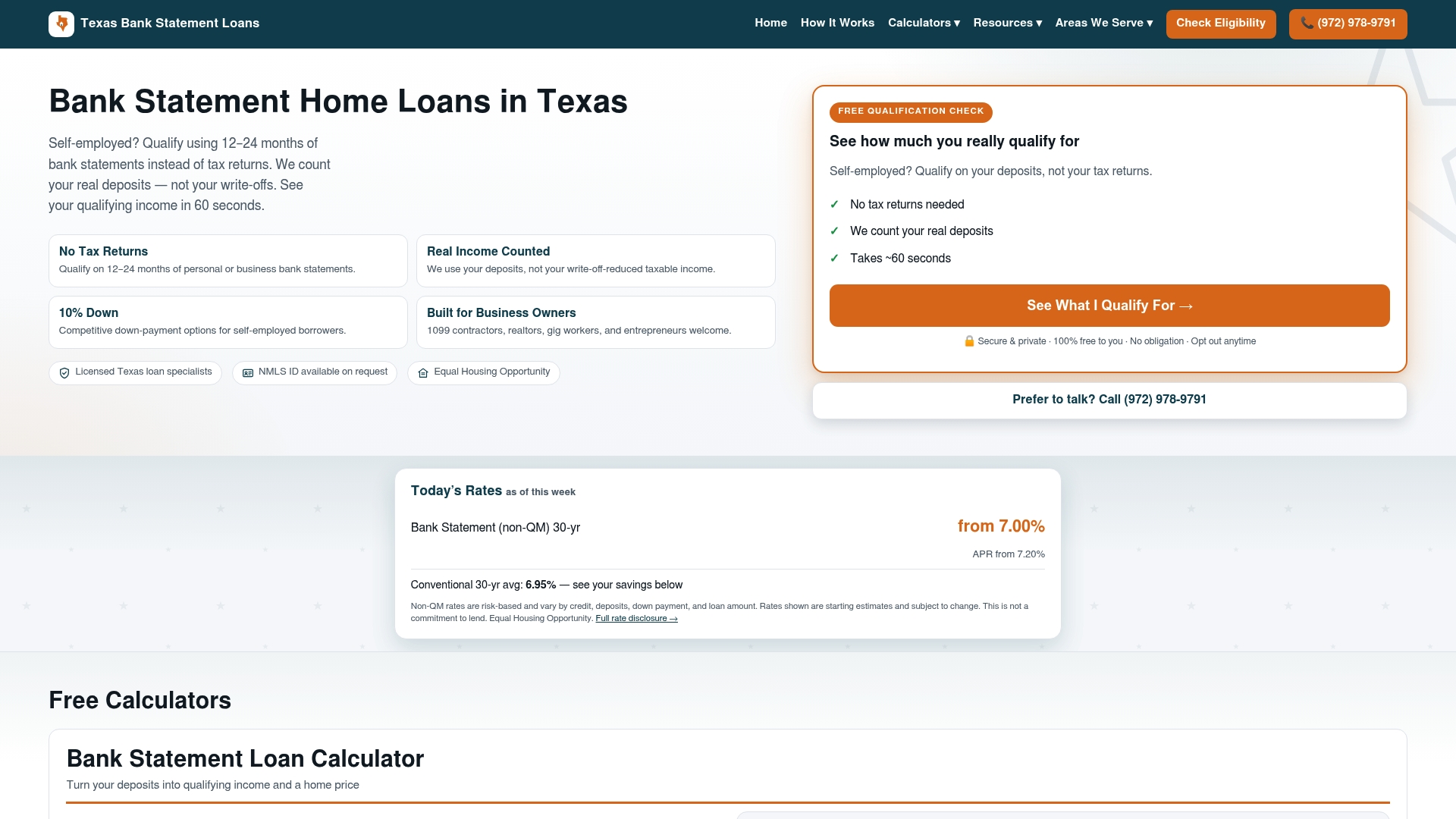
Texasbankstatementloans underwrites based on 12-24 months of bank deposits, not tax returns. That means your real income, the money actually hitting your account, is what determines how much home you can afford. Down payments start at 10%, and the qualification process takes about 60 seconds with no obligation.
Whether you’re buying in Houston, Plano, or anywhere across Texas, you can check today’s rates or run the numbers with the bank-statement loan calculator to see what your deposits qualify you for. When you’re ready to move forward, start your no-obligation qualification at Texasbankstatementloans.
Useful sources and tools
- CFPB: How credit scores affect mortgage rates, plain-language explanation of how lenders use scores and what else they consider
- FHFA: Credit Scores policy, official guidance on Classic FICO and VantageScore 4.0 for Fannie Mae/Freddie Mac loans
- Experian: Average mortgage rates by credit score, current rate data broken down by score band
- Experian: What credit score do I need to buy a house?, program minimums and practical thresholds
- Texasbankstatementloans: Mortgage calculators and tools, DTI calculator, affordability tools, and rate modeling for bank-statement loans
Check your credit reports for free at AnnualCreditReport.com before speaking to any lender. Errors are more common than most borrowers expect, and disputing them costs nothing but time.
This article is general information, not financial or legal advice. Confirm current program requirements and rates with a licensed mortgage professional for your specific situation.
Recommended
- Bank Statement Loan Rates Today | Texas Bank Statement Loans
- Free Mortgage Calculators & Tools | Texas Bank Statement Loans
See what you qualify for in 60 seconds, free and no credit check. Use the eligibility check at the top of this page.