
Classic no-doc “stated income” mortgages, the kind where a borrower simply wrote down a number and a lender took it on faith, are effectively gone for owner-occupied homes. What replaced them are documented alternatives like bank-statement loans, non-QM programs, and DSCR loans for investors, which verify actual cash flow instead of tax-return net income. They work differently than the old stated-income products, they usually cost more, and self-employed borrowers should run a Form 1084 add-back comparison before assuming a bank-statement loan is the cheaper path.
TL;DR:
- Self-employed borrowers should run a Form 1084 add-back analysis to determine if their tax returns qualify them for conventional mortgage rates before considering bank-statement loans.
- Banks typically require 12 to 24 months of deposit history with an expense ratio applied, making underwriting more detailed and rigorous than some might expect.
- Alternative-income loans, including non-QM and DSCR loans, usually charge 0.5% to 3% more interest than conventional mortgages and require higher down payments.
- DSCR loans for rental properties are based solely on the property’s cash flow and debt coverage ratio, not personal income documentation.
- Qualification standards vary widely by lender, with credit scores in the mid-600s, reserve requirements, and business seasoning impacting approval chances.
Table of Contents
- Stated Income Myths Vs. Reality
- How Bank-Statement, Non-QM, and DSCR Loans Actually Work
- Who Qualifies and What These Loans Actually Cost
- Your Pre-Application Checklist for Self-Employed Financing
- What This Looks Like When You Actually Apply
- What Self-Employed Borrowers Should Actually Do Next
- Get a Real Number Instead of a Guess
- Sources
Stated Income Myths Vs. Reality
Most of what circulates about stated-income lending is a decade or two out of date. Here’s what’s actually true in 2026, myth by myth.
-
Myth: You can still get a true no-doc stated-income loan for your primary residence. Reality: For owner-occupied mortgages, lenders must make a good-faith ability-to-repay determination under Regulation Z. A lender that skips verification entirely on your primary home isn’t offering a modern product. It’s exposing itself to compliance risk you don’t want anywhere near your loan.
-
Myth: Stated income loans are illegal now. Reality: not exactly. The old “liar loan” structure, where income was accepted with zero verification, is what got regulated out of the owner-occupied market after 2008. What’s legal and common today is documented alternative-income lending: bank-statement loans, asset-depletion loans, and P&L loans that verify income through a different method than tax returns, not through no method at all, according to Investopedia’s explanation of the liar loan era.
-
Myth: Bank-statement loans mean the lender just believes whatever you tell them. Reality: bank-statement underwriting is arguably more rigorous than a W2 file in some ways. Underwriters pull 12 to 24 months of actual deposits, apply an expense ratio, and calculate a real qualifying income number from money that actually moved through your accounts.
-
Myth: These loans are only for people hiding income from the IRS. Reality: they’re for people whose tax returns legitimately understate cash flow because of legal deductions. A contractor who writes off a truck, tools, and a home office isn’t hiding anything. Their accountant is doing exactly what accountants are supposed to do, which is why the resulting tax return often looks nothing like the borrower’s real spending power.
-
Myth: Approval is fast and easy because there’s less paperwork. Reality: bank-statement loans typically require more bank documentation than a conventional loan, not less. You’re trading tax transcripts for deposit history, not skipping verification altogether.
-
Myth: The rate is basically the same as a conventional mortgage. Reality: alternative-documentation borrowers commonly pay about 0.5% to 3% more in interest than conventional financing, and down payment requirements tend to run higher too.
-
Myth: DSCR loans for rental property work the same way as bank-statement loans for your home. Reality: DSCR loans qualify off the property’s rental income and debt coverage ratio, not your personal cash flow at all. An investor with weak personal income but a property that cash flows well can still qualify, which is a different mechanism entirely from personal bank-statement underwriting.
-
Myth: If one lender says no, no-doc-style financing isn’t available to you. Reality: non-QM guidelines vary enormously between lenders. One shop’s overlay on reserves or credit score can be a dealbreaker while another approves the same file without blinking.
How Bank-Statement, Non-QM, and DSCR Loans Actually Work
Modern alternative-income lending replaces a tax return with a different kind of paper trail, and understanding the mechanics clears up most of the confusion around “stated income.”
For a standard bank-statement loan, underwriters average 12 to 24 months of deposits into your personal or business accounts. If the loan uses business account statements, the lender applies an expense ratio, usually a percentage deducted to account for the cost of running the business, since not every dollar deposited is profit. What’s left after that ratio becomes your qualifying monthly income. It’s a documented, calculated number, not a figure you get to pick.

That process solves a real tension. Your accountant’s job is to legally minimize taxable income through deductions. An underwriter’s job is to find the actual cash flow that will support a mortgage payment. Those two goals point in opposite directions, and bank-statement analysis is the bridge that reconciles them by looking at deposits instead of net income after write-offs.
Non-QM is the broader category these loans live in. “QM” stands for qualified mortgage, a designation with strict rules on debt ratios and documentation. Non-QM loans fall outside that box, which gives lenders more flexibility to underwrite self-employed income creatively, but it doesn’t exempt them from the ability-to-repay requirement under 12 CFR § 1026.43. They still have to prove you can afford the loan. They just get to prove it with a different documentation set.
DSCR loans, common for rental property investors, work differently again. Instead of qualifying you based on personal income at all, underwriters compare the property’s expected rental income to its debt obligations, mortgage, taxes, insurance, and calculate a debt service coverage ratio. A ratio above 1.0 generally means the property covers its own costs. Investors with several properties often prefer DSCR loans precisely because personal income documentation barely enters the conversation. As WTOP’s rundown on modern no-doc alternatives points out, true no-doc lending is rare today; what’s replaced it is a menu of documented methods tailored to how different borrowers actually earn.
Who Qualifies and What These Loans Actually Cost
Bank-statement and non-QM loans tend to serve a specific slice of the market: self-employed business owners, 1099 contractors, gig workers, freelancers, and real estate investors whose tax returns don’t reflect their real spending power. If your W2 income covers your mortgage comfortably, you almost never need this category of loan. It exists for people whose income is real but hard to prove on paper the conventional way.
Qualification thresholds vary by lender, but a few patterns show up repeatedly: credit scores in the mid 600s or higher, two or more months of cash reserves after closing, and at least one to two years of business seasoning (proof the business has operated consistently, not just started last quarter). Reserve requirements climb for jumbo amounts or thinner credit files.
Statistic callout: Expect a rate roughly 0.5 to 3 percentage points above conventional financing, with down payments commonly landing between 10% and 25% or more depending on the program and your credit profile. On a $350,000 loan, even a 1.5-point rate premium adds real money to your monthly payment, which is why comparing your options before choosing is worth the hour it takes.
That’s also why Form 1084 add-back analysis deserves a look before you default to bank-statement financing. Form 1084 lets a conventional underwriter add back non-cash expenses (depreciation, depletion, certain business-use-of-home deductions) to your reported net income. If your tax return only understates your real income by a modest margin, a properly run add-back calculation can qualify you at conventional rates, no premium, no alternative-doc overlay. Bank-statement loans earn their keep when the gap between your tax return and your real cash flow is too wide for add-backs to close.

Your Pre-Application Checklist for Self-Employed Financing
Getting this right starts before you ever talk to a loan officer. Work through these steps in order.
- Run the Form 1084 add-back numbers first. Ask a loan officer or your accountant to calculate your income with standard add-backs (depreciation, depletion, home-office deductions) before assuming you need bank-statement underwriting.
- Pull 12 to 24 months of bank statements, both personal and business if you have separate accounts, and check them for large unexplained deposits or transfers that could complicate income calculation.
- Gather your profit and loss statement, 1099s, and any asset statements a lender might use to verify reserves or supplement income documentation.
- Confirm your reserve position. Most alternative-doc programs want two or more months of mortgage payments sitting in accessible accounts after closing.
- Ask every lender the same three questions: how they calculate qualifying income from deposits, what their minimum seasoning requirement is, and whether their rate floor moves based on credit score or loan-to-value.
- Run the numbers through a calculator before you apply anywhere, so you walk into the conversation knowing roughly what you can afford instead of finding out for the first time from a loan officer.
Pro Tip: Deductions that shrink your tax bill also shrink the income a conventional underwriter sees on paper. Understanding which deductions typically apply to your business before tax season helps you predict, months in advance, whether add-backs alone will get you to conventional pricing or whether you should plan for bank-statement documentation instead.
What This Looks Like When You Actually Apply
The mechanics above play out concretely at Texasbankstatementloans, which evaluates 12 to 24 months of personal or business deposits instead of tax returns, with down payment options starting at 10% for qualified borrowers.
A quick pre-qualification check can give you a ballpark of what you could realistically afford. Treat that result as a starting point for the conversation, not a final approval. Actual approval still depends on the deeper documentation review covered above: reserves, seasoning, credit, and the deposit analysis itself.
Before applying anywhere, run your numbers through the Self-Employed Affordability Calculator or the Bank Statement Loan Calculator to see how deposit-based qualifying income compares to what your tax return alone would suggest.
What Self-Employed Borrowers Should Actually Do Next
Run the Form 1084 add-back numbers before you touch a bank-statement application. If add-backs get you close to conventional pricing, take that route. It’s cheaper almost every time. Bank-statement and non-QM loans exist for the gap add-backs can’t close, not as a default first option.
Be skeptical of anyone still marketing true “no-doc” loans for a primary residence. That framing usually signals either outdated information or a lender cutting corners on the ability-to-repay determination they’re legally required to make.
Run your numbers through a calculator, then talk to a mortgage specialist who works with self-employed borrowers regularly. The math is knowable before you apply. Use that to your advantage.
- Saad
Get a Real Number Instead of a Guess
Comparing add-backs against bank-statement math on your own takes time most self-employed borrowers don’t have between running a business and hunting for a house.
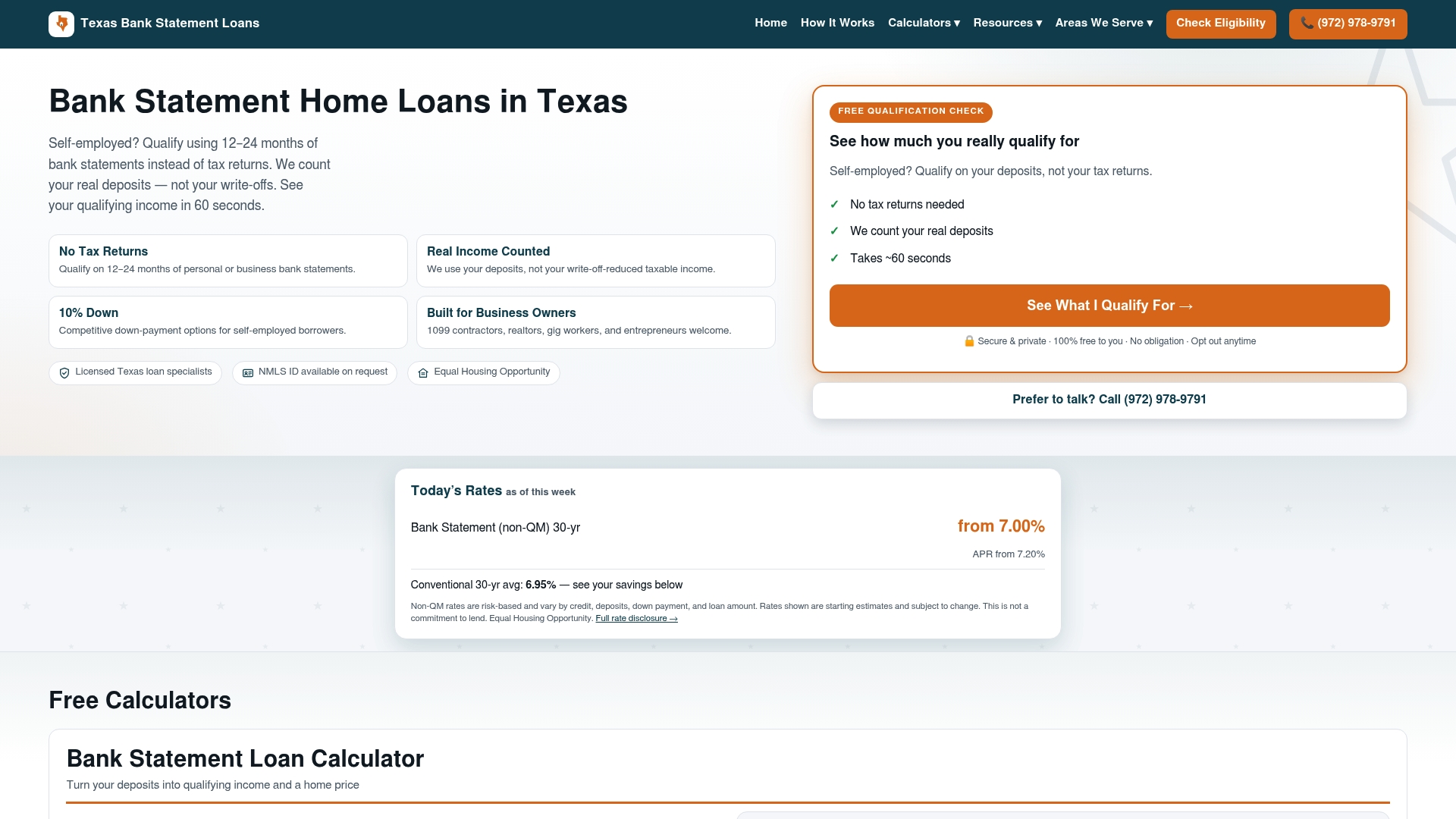
If you’re weighing whether your tax returns will support a conventional add-back approach or whether bank-statement underwriting fits your situation better, start with the Bank Statement Loan Calculator to see a real estimate based on your own deposit history. Texas borrowers in Houston, San Antonio, Midland, and other major metros can move straight from that estimate into a conversation with a loan officer who underwrites self-employed income for a living. Check your bank statement loan options today and see where your numbers actually land.
This article is general information, not a substitute for advice from a qualified financial advisor. Consult a qualified financial professional about your own circumstances before acting on anything here.
Sources
Recommended
See what you qualify for in 60 seconds, free and no credit check. Use the eligibility check at the top of this page.