
Yes, you can qualify for an investor property in Texas using bank statements instead of tax returns, and the right program depends on your deal. Bank statement loans look at an extended period of your deposits, generally over a year, while DSCR loans judge the property’s own rental income. The fastest way to find out which fits is to run a quick pre-qualification check with a Texas bank statement specialist.
TL;DR:
- A DSCR loan compares monthly rent with PITIA; a ratio above 1.0 indicates the property covers principal, interest, taxes, insurance, and association dues.
- Lenders average 12 to 24 months of deposits, apply an expense factor to business accounts, and assess income stability and trend.
- Submit official statements directly from your bank, explain unusual deposits, and provide leases plus rent records; new leases may require two months of deposit evidence.
- Alternative documentation does not remove ability to repay requirements; lenders still review credit, cash reserves, ownership history, and rental records before approval.
Table of Contents
- Bank Statement vs DSCR for Investors: Which Fits Your Deal
- How Lenders Calculate Qualifying Income From Bank Statements
- Preparation Checklist Before You Apply
- Start a Quick Qualification With Texas Bank Statement Home Loans
- A Texas-Focused View on Investor Bank Statement Lending
- FAQ
- Sources
Bank Statement vs DSCR for Investors: Which Fits Your Deal
Not every investor needs the same loan. The two most common non-QM routes solve different problems, and picking the right one up front saves weeks of back and forth with an underwriter.
A bank statement loan looks at your personal or business deposits over 12 to 24 months. Lenders apply an expense factor to business accounts to strip out overhead and estimate your real take-home income, according to HousingWire’s non-QM overview. That makes it a strong fit when your tax returns understate what you actually earn because of write-offs.
A DSCR loan instead measures the subject property’s rent against its expenses. The basic formula is monthly rental income divided by PITIA (principal, interest, taxes, insurance and association dues). A ratio above 1.0 means the property covers its own costs.
- Choose bank statement financing when your personal cash flow is strong but your tax returns are not.
- Choose DSCR when the property itself cash flows well, even if your personal income documentation is thin or you own many properties already.
A consultant who nets solid income after deductions but shows little on a Schedule C often does better with a bank statement loan. An investor buying a fourth rental property with strong local rents, but a complicated personal tax picture, usually fits DSCR better.
How Lenders Calculate Qualifying Income From Bank Statements
Underwriters do not just add up every deposit. They average deposits across the statement period and apply judgment about what counts as real, recurring income.
- Deposits are averaged over the entire statement period, smoothing out seasonal swings or one-time windfalls.
- Business account deposits get an expense factor applied, since not every dollar in is take-home pay, a practice HousingWire describes as standard across non-QM programs.
- Underwriters check stability and trend, looking for income that holds steady or grows rather than a single strong month propping up the average, consistent with the cash flow analysis principles in Fannie Mae’s self-employed borrower guidance.
- Lenders also verify ownership history, reserves and credit, since bank statement documentation replaces tax returns but not the underlying ability-to-repay checks required under CFPB rules.
Beyond deposit math, expect a lender to ask about credit score ranges typical of non-QM programs, several months of cash reserves, how long you have owned your business or rental portfolio, and documentation tying rental deposits to actual leases and PITIA obligations.
Bank statement loans rank among the largest categories within non-QM lending, according to HousingWire, largely because so many self-employed and investor borrowers have real cash flow that tax returns do not reflect.
Preparation Checklist Before You Apply
A clean file moves faster through underwriting. Before you apply, gather these items in order.
- Pull 12 to 24 months of statements from the accounts you plan to use, matching whichever window your target program requires.
- Request official PDF statements directly from your bank rather than screenshots, since underwriters want bank-issued documents.
- Flag any large or unusual deposits with a short written note explaining the source, especially one-time transfers that are not recurring income.
- Collect leases, rent ledgers and property management agreements for every rental property you own, since Fannie Mae’s rental income guidance notes that newly executed leases may need two months of bank evidence showing the deposit cleared.
- Pull together down payment and reserve documentation, such as recent statements on the accounts holding those funds.
- If you also earn 1099 or profit-and-loss income alongside rental cash flow, prepare that documentation separately rather than mixing it into the same narrative as your bank deposits.
Pro Tip: Label each statement file by account and month before you send it, so your loan officer can hand underwriting a clear, organized package instead of a folder they have to sort themselves.
A simple bank statement income calculator can help you model your qualifying income before you apply, giving you a realistic number to compare against what a lender ultimately calculates.

Start a Quick Qualification With Texas Bank Statement Home Loans
We built our Bank Statement Home Loans program for investors and self-employed borrowers whose tax returns do not tell the full story.
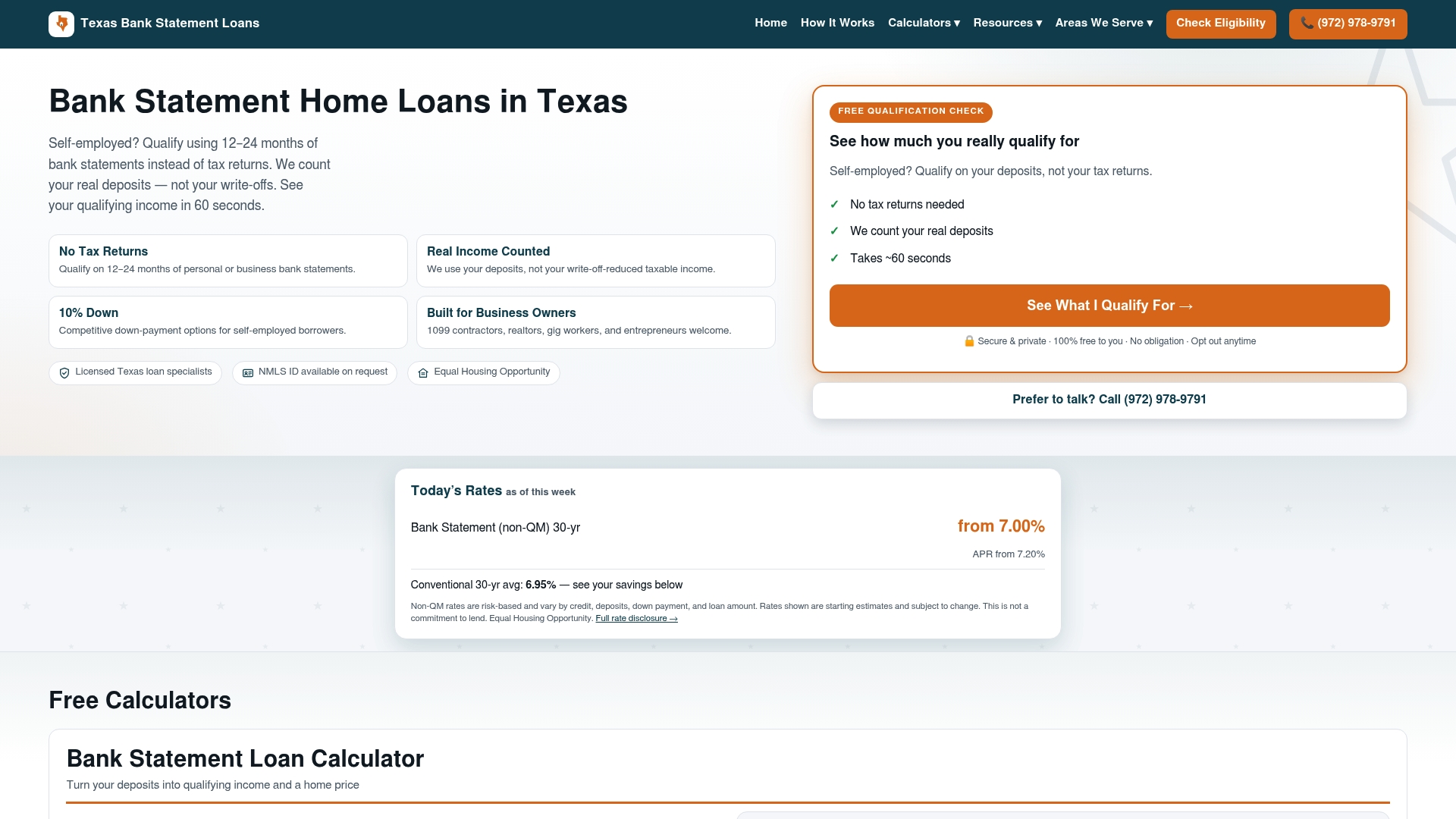
Our quick qualification check takes about 60 seconds and gives you a clear read on how much buying power you have, whether a bank statement loan or a DSCR program fits your next deal better. If you are weighing DSCR specifically, this explainer on DSCR mechanics covers how investors qualify on rental income alone.
Check your options now on our Bank Statement (non-QM) 30-yr rates page, where current pricing starts from 7.00% per year.
A Texas-Focused View on Investor Bank Statement Lending
Texas investors often assume a thin tax return means a dead end, but that assumption costs deals. The real obstacle is rarely income, it is documentation that does not match how self-employed and investor income actually works.
A bank statement or DSCR approach does not lower the bar, it changes which evidence counts. Lenders still verify ability to repay, still check reserves, still look for stability. What changes is that your bank deposits or your property’s rent roll get to speak for your income instead of a tax return built to minimize what you owe the IRS.
For investors across Texas markets, from Houston to Midland to Plano, that shift in evidence is often the difference between sitting out a deal and closing on it.
- Saad
This article is general information, not a substitute for advice from a qualified financial advisor. Consult a qualified financial professional about your own circumstances before acting on anything here.
FAQ
What credit score do I need for a Texas bank statement loan?
Non-QM bank statement programs typically require a higher minimum credit score than conventional loans, though exact thresholds vary by lender and program. Check your specific qualification details with a bank statement loan specialist before assuming you do not qualify.
How many months of bank statements do lenders require?
Most bank statement programs ask for 12 to 24 months of personal or business account statements, which lenders average to estimate your qualifying income, according to HousingWire’s non-QM guide. The exact window depends on the specific program you choose.
Is a DSCR loan better than a bank statement loan for investors?
Neither is universally better. DSCR works best when the property’s rental income alone covers its expenses, while bank statement loans fit when your personal deposits show stronger cash flow than your tax returns do.
What down payment do I need for an investor bank statement loan in Texas?
Your exact loan requirement depends on credit, reserves and the specific program, so a quick pre-qualification check gives you a firm number.
Do bank statement loans still require proof I can repay the loan?
Yes, lenders must still verify your ability to repay even when using bank statements instead of tax returns, as outlined in CFPB guidance on the ability-to-repay rule. Bank statements simply serve as the alternative documentation used to meet that requirement.
Sources
- Non-QM loans guide, HousingWire
- Underwriting factors and documentation for a self-employed borrower, Fannie Mae
- What is the ability-to-repay rule?, CFPB
Recommended
- Bank Statement Loans in Waller County, TX | Self-Employed
- Bank Statement Loans in Greater Houston
- Bank Statement Loans in Houston, TX | Self-Employed Mortgage
See what you qualify for in 60 seconds, free and no credit check. Use the eligibility check at the top of this page.