
Yes, in some cases you can waive escrow on a Non-QM loan in Texas, but two gates control the outcome. The first is whether the loan counts as a higher-priced mortgage loan under Regulation Z §1026.35. The second is whether your lender has a written waiver policy at all. Check both before you assume you qualify.
TL;DR:
- Escrow waivers are more likely if your loan is not classified as an HPML or if you qualify for specific federal or investor exemptions.
- Lenders require strong credit history, documented reserves, and sufficient equity, especially for bank statement and DSCR loans requesting waivers.
- You must provide a written request, proof of reserves, and confirm your loan’s HPML status before applying for an escrow waiver in Texas.
- Missing property tax or insurance payments after waiving escrow can lead to penalties or the lender revoking the waiver, increasing financial risk.
- Tax deadlines in Texas demand direct owner payments, requiring proactive management of property tax bills, especially when not managed through escrow.
Table of Contents
- What an escrow waiver actually changes about your payment
- The federal rules behind Non-QM escrow waivers
- Who typically qualifies for a waiver on a Non-QM loan
- Step-by-step: requesting an escrow waiver in Texas
- Weighing the upside against the real risk
- Texas property tax deadlines you cannot ignore
- How bank statement underwriting shapes the escrow conversation
- When a waiver actually makes sense for self-employed buyers
- Getting started with a bank statement loan in Texas
- Sources
- FAQ
What an escrow waiver actually changes about your payment
An escrow waiver means your lender stops collecting monthly reserves for property taxes and homeowners insurance as part of your mortgage payment. Instead, you pay the county and your insurer directly, on their schedules, not the lender’s. Without escrow, the lender still holds a lien on the property, so it protects that position by requiring proof you actually paid.
Lenders that allow waivers commonly:
- Require annual proof of tax payment and active insurance coverage.
- Reserve the right to revoke the waiver if a payment is missed.
- Advance funds on your behalf if taxes or insurance go unpaid, then bill you for it.
That last point matters. A missed payment does not just risk a penalty, it can trigger the lender stepping in and reversing your waiver entirely.
The federal rules behind Non-QM escrow waivers
Before any lender conversation, know the baseline. Regulation Z §1026.35 generally requires an escrow account for higher-priced mortgage loans, and once established, that escrow typically has to stay in place for a minimum of five years unless a specific exemption applies. Many Non-QM loans, including bank statement products, get priced as HPMLs because of their rate structure, which pulls them straight into this rule.
Under 12 CFR 1026.35, creditors must establish escrow accounts for HPMLs unless an exemption applies, and cancellation is restricted and conditional.
Exemptions do exist, and they are what make waivers possible at all:
- Small creditor and asset-threshold exemptions, including one created by federal law for insured depositories under certain volume limits, as detailed in CFPB rulemaking on the HPML escrow exemption.
- Rural or underserved area tests that some smaller lenders rely on.
- Loans that are not classified as HPML in the first place, which sidesteps the rule entirely.
On top of federal law, investor guidance adds another layer. Fannie Mae’s selling guide requires any lender that permits waivers to maintain a written policy and to evaluate whether the borrower can actually handle lump-sum tax and insurance bills, not just check the loan-to-value ratio.
Who typically qualifies for a waiver on a Non-QM loan
Lenders that allow escrow waivers are not being generous. They are managing risk, and they look for a specific profile before saying yes.
- Strong credit history with no recent late payments on housing debt.
- Documented cash reserves beyond the down payment, often several months of housing costs.
- Meaningful equity, commonly 20% or more, so the lender has a cushion if something goes wrong.
- No monthly mortgage insurance requirement, since MI often carries its own escrow mandate regardless of lender preference.
Bank statement and DSCR loans add a wrinkle. Because these products already lean on cash flow evidence instead of tax returns, underwriters reviewing a waiver request may weigh your deposit history and reserve levels more heavily than a traditional borrower’s W-2 income.
Some scenarios are close to automatic denials: first-time homebuyers, borrowers with thin reserves, anyone with a recent 30-day-late payment, and most HPML-classified loans where no exemption applies.
Pro Tip: Ask your loan officer to confirm your loan’s HPML status in writing before you submit a waiver request, it saves weeks of back-and-forth.
Step-by-step: requesting an escrow waiver in Texas
Getting a waiver approved is a documentation exercise as much as a negotiation.
- Ask for the lender’s written waiver policy up front. If they cannot produce one, a waiver is unlikely.
- Gather your paperwork: proof of reserves, a recent credit report, your homeowners insurance declaration page, and, for bank statement Non-QM loans, the same 12 to 24 months of statements used in underwriting.
- Submit a dated, written request rather than a phone call, and ask how and when you will be notified of the decision, as major servicer guidance recommends.
- Escalate to your loan officer if the servicer stalls, since loan officers often have more leverage on exceptions than a call center.
- Expect one of four outcomes: approval, denial, conditional approval pending more documentation, or a later revocation if you miss a payment.
Weighing the upside against the real risk
Waiving escrow gives you control, but control comes with responsibility.
- Benefit: a lower monthly mortgage payment since taxes and insurance are not bundled in.
- Benefit: you decide when to pay, and any interest your money earns while parked before the due date is yours.
- Risk: a missed tax or insurance payment can lead to penalties, a tax lien, or the lender stepping in to advance the payment, as outlined in Fannie Mae’s servicing guidance.
- Risk: the servicer can revoke your waiver after that kind of miss, putting you back into a monthly escrow payment.
Pro Tip: Open a separate savings account, set autopay to sweep a fixed amount into it every month, and treat it like a bill you cannot skip.
Texas property tax deadlines you cannot ignore
If you are paying property taxes directly instead of through escrow, the calendar becomes your responsibility entirely.
- County tax offices generally prepare and mail bills by October 1, with delinquency and penalty schedules that vary somewhat by county, according to the Texas Comptroller.
- You owe the tax whether or not the bill arrives. Texas rules make the property owner responsible for payment regardless of mail delivery, so confirm your bill directly with the county tax assessor-collector rather than waiting for it to show up.
- When escrow exists, the lender’s servicer typically receives and pays the bill on your behalf. Waiving escrow means that safety net disappears, and you become the one checking the county portal.
County tax bills go out by October 1 in most Texas jurisdictions, per the Texas Comptroller, which gives waiver holders a firm date to build a payment calendar around rather than guessing.
How bank statement underwriting shapes the escrow conversation
Bank statement loans evaluate 12 to 24 months of bank deposits instead of tax returns, which is exactly the kind of documentation a lender wants to see when weighing an escrow waiver request. A self-employed borrower with heavy write-offs might look thin on paper through a tax return, but a deposit history shows the real cash flow available to cover a lump-sum tax or insurance bill.
This approach serves self-employed individuals, 1099 contractors, gig workers, and business owners, groups that traditional underwriting often shortchanges. When one of these borrowers requests an escrow waiver, the same bank statements used to qualify for the loan can double as evidence of ability to pay taxes and insurance directly. The practical move is to request the lender’s written escrow policy early, before underwriting even finishes, using a quick qualification check to confirm eligibility first.

When a waiver actually makes sense for self-employed buyers
A waiver fits borrowers with steady deposit history, real reserves beyond closing costs, and enough equity to give a lender confidence. It does not fit someone stretching to close, without a cushion for a five-figure tax bill in January. Set a reserve target, keep documented proof of every tax and insurance payment, and get the lender’s waiver policy in writing before you sign anything. Confirm both your loan’s HPML status and your county’s tax calendar separately, since one does not guarantee the other is handled.
- Saad
Getting started with a bank statement loan in Texas
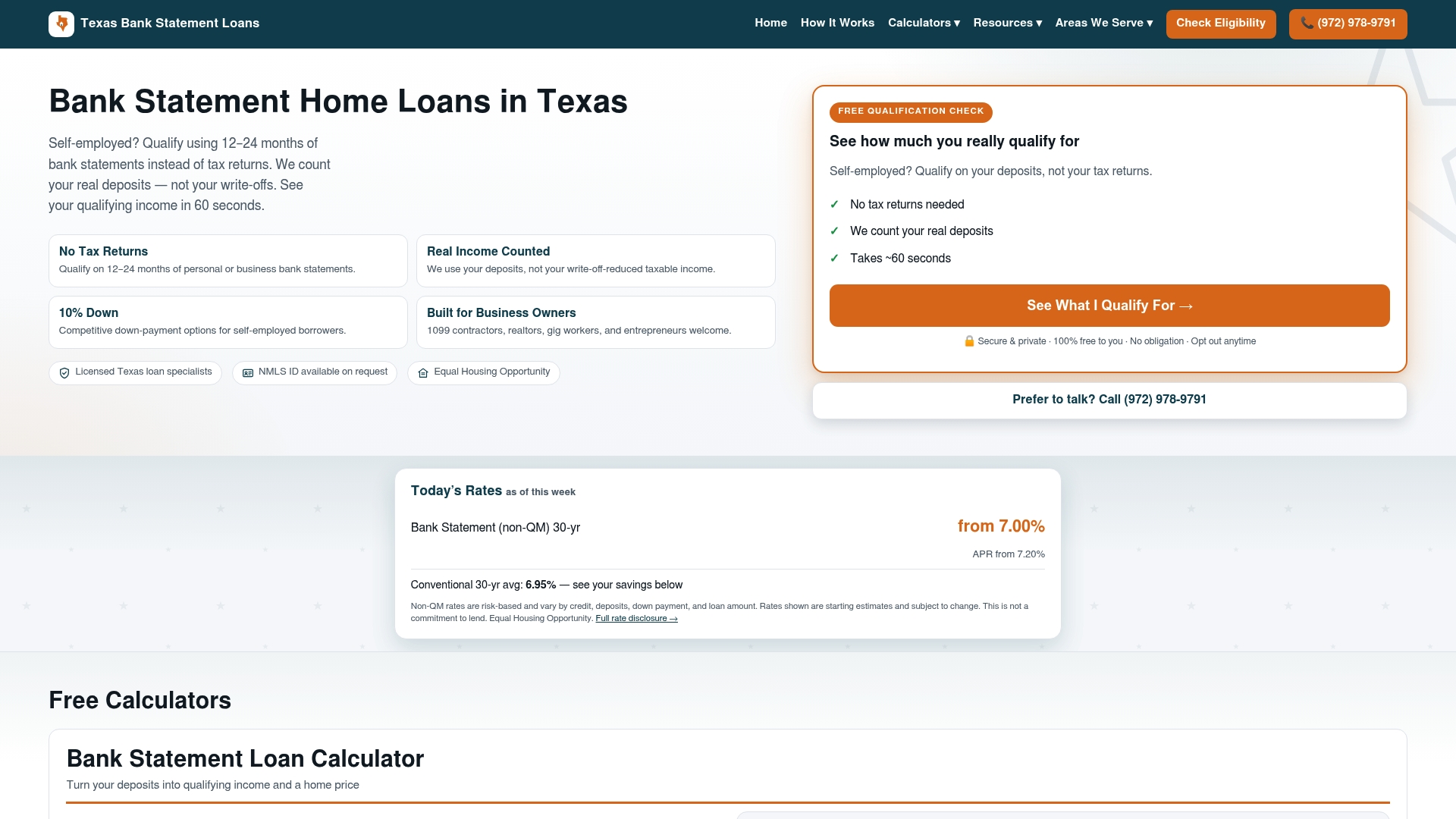
Texas Bank Statement Home Loans qualifies borrowers using actual bank deposits instead of tax returns, with down payment options starting at 10%, a path built for the self-employed buyer whose real income does not match their tax filings. If an escrow waiver matters to you, ask about the lender’s written policy the moment you start prequalification, not after you have already picked a house.
A few ways to move forward:
- Run the 60-second qualification check to see what you can afford before you talk to a loan officer.
- Compare rate and payment scenarios on the Bank Statement (non-QM) 30-yr page.
- Use the DSCR loan calculator if you are financing an investment property instead of a primary residence.
- Texas Bank Statement Home Loans also serves borrowers in Houston, San Antonio, and Plano.
Start your qualification check today and ask about escrow options as part of the process.
This article is general information, not a substitute for advice from a qualified financial advisor. Consult a qualified financial professional about your own circumstances before acting on anything here.
Sources
- CFPB, Regulation Z §1026.35 (Escrow accounts for higher‑priced mortgage loans)
- Fannie Mae selling guide, Escrow accounts (Escrow waivers)
- Texas Comptroller, Paying your property taxes
- Fannie Mae servicing guide, Administering an escrow account and paying expenses
FAQ
How do you qualify for an escrow waiver?
A written request confirming your loan’s HPML status and the lender’s own waiver policy is the starting point.
What are the requirements for a Non-QM mortgage?
Non-QM loans use alternative documentation instead of standard tax return income verification, such as 12 to 24 months of bank statements, a profit and loss statement, or rental cash flow for investment properties. Underwriting still weighs credit, reserves, and equity, just through different evidence.
What are some examples of Non-QM mortgages?
Common types include bank statement loans for self-employed borrowers, DSCR loans that qualify investment properties based on rental income rather than personal income, ITIN loans for borrowers without a Social Security number, and asset depletion loans that convert savings into qualifying income.
Can you waive escrow on a conventional loan?
Yes, conventional loans can sometimes waive escrow, subject to the same investor rules that apply to Non-QM loans, including Fannie Mae’s requirement that lenders maintain a written policy and assess the borrower’s ability to pay taxes and insurance directly. Loans with monthly mortgage insurance or HPML status usually cannot waive it.
See what you qualify for in 60 seconds, free and no credit check. Use the eligibility check at the top of this page.