
Yes, many self-employed Texans can qualify for a mortgage using bank statements instead of tax returns. The practical next step is simple: gather your recent statements and run a quick qualification check before you talk to anyone about rates.
TL;DR:
- Self-employed borrowers with steady deposit patterns over 12 to 24 months can qualify for a mortgage without relying on tax returns.
- Acceptable down payment sources include seasoned bank funds, verified investments, or documented gifts, with at least 10% required.
- Lenders scrutinize deposit consistency, source clarity, and matching invoices, requiring detailed bank statements and supporting documents.
- Using business funds for a down payment may be approved if underwriters confirm it won’t affect business operations.
- Applying now is advisable if deposit patterns are stable and down payment funds are available, as rates start at 7.00% and delays rarely improve approval chances.
Table of Contents
- Who qualifies for a bank-statement mortgage in Texas
- What underwriters check before approving your file
- How to gather and organize your bank statements
- Down payment realities and how to reach 10%
- How to apply with Texas Bank Statement Home Loans
- When to apply now versus when to wait
- Get a qualification check and see your options
- Where to read more on the rules behind this
- Sources
- FAQ
Who qualifies for a bank-statement mortgage in Texas
A bank-statement mortgage looks at what actually lands in your account rather than the net income your tax return shows after deductions. Traditional underwriting relies on two years of tax returns, which often understates income for business owners who write off expenses aggressively. Bank-statement loans, also called non-QM loans, instead average at least a year of deposits to estimate real cash flow.
Lenders favor longer, more consistent deposit histories because the Ability to Repay and Qualified Mortgage Rule requires them to reasonably verify a borrower’s ability to repay the loan. That guidance also makes clear that deposits used for qualifying must be confirmed as the borrower’s personal income, not loan proceeds or other unidentified transfers. A choppy deposit pattern, or one spike followed by months of silence, makes that verification harder and can slow or sink an application.
Borrowers who commonly fit this program include:
- 1099 contractors with variable monthly pay from multiple clients
- Sole proprietors and single-member LLC owners
- Gig workers paid through platforms like rideshare or delivery apps
- Licensed real estate agents whose commissions fluctuate seasonally
The common thread is a steady, traceable deposit pattern rather than a specific job title.
What underwriters check before approving your file
Underwriters working a bank-statement file look for the same thing a traditional lender wants: proof the income is real, recurring, and large enough to support the payment. The documents list is different, but the scrutiny is not lighter.
Expect to provide:
- Twelve to 24 months of personal or business bank statements, depending on how your income flows
- Signed invoices and client contracts that match deposit amounts and timing
- A year-to-date profit and loss statement, ideally reviewed or signed by an accountant
- Business ledgers or bookkeeping records that tie deposits back to specific jobs or clients
Freddie Mac’s guidance on self-employed income allows evaluation through bank statements or YTD P&L in certain programs, but requires lenders to reconcile those statements against the P&L or tax returns when available. Underwriters also check deposit stability, your debt-to-income ratio, available cash reserves, credit score, and whether your accounts show repeated overdrafts.
Common red flags include large unexplained deposits, periods of no activity, and personal accounts mixed with unrelated business transfers. Each of those invites extra questions and documentation requests, which adds time to your file.

Pro Tip: Keep a simple spreadsheet mapping each large deposit to its source before you apply. It turns a ten-minute underwriter question into a non-issue.
How to gather and organize your bank statements
The faster an underwriter can match your deposits to real income, the faster your file moves. Start by pulling full, consecutive statements covering at least a year, depending on the program.
Decide early whether you’ll show business accounts, personal accounts, or both. If client payments land in a business account and you pay yourself from there, both sets of statements usually need to come along for the ride. Annotate deposits larger than a few thousand dollars with a one-line note and attach the matching invoice, contract, or payment-platform report (Stripe, PayPal, or a rideshare payment summary all work).
A simple month-by-month income summary helps too:
- List each month’s total deposits in one column
- Note any one-time or non-recurring deposits separately
- Flag seasonal dips so the underwriter sees the full-year pattern, not just a slow quarter
Seasonal income over a two-year window tends to even out, which is one reason Freddie Mac’s self-employed income guidance permits averaging across a longer period and, in some cases, grossing up net or non-taxable income when calculating qualifying income.
If your business had an unusually strong or weak stretch, a signed YTD P&L from your accountant helps explain the pattern rather than leaving the underwriter to guess.
Down payment realities and how to reach 10%
Texas Bank Statement Home Loans lists Bank Statement (non-QM) 30-year rates from 7.00%, with the exact rate shaped by credit, reserves, and down payment size.
Funds for the down payment need a paper trail. Acceptable sources generally include:
- Funds already seasoned in your bank account for several statement cycles
- Investment or retirement account statements showing available balances
- Documented gifts, with a signed gift letter and the donor’s own account showing the withdrawal
A few habits reduce friction at closing:
- Ask about seller or lender credits that can offset some closing costs
- Move any gift funds or large transfers well before you apply, not during underwriting
- Avoid depositing a large, unexplained lump sum right before submitting your application
Pro Tip: If you’re planning to use business funds for part of your down payment, expect underwriters to check that the withdrawal won’t hurt your business’s ability to keep operating, a standard step under Fannie Mae’s underwriting guidance for self-employed borrowers.
How to apply with Texas Bank Statement Home Loans
The process starts with a free qualification check that takes about 60 seconds and gives you an estimate of how much home you can realistically afford based on your deposit pattern. It’s a planning tool, not a formal approval, but it tells you where you stand before you gather every document.
After that, expect the following:
- A request for your bank statements, P&L, invoices, and identification
- A review of credit, reserves, and deposit consistency against program guidelines
- Delivery of your Loan Estimate within three business days of submitting a full application, outlining projected costs and payments
- A Closing Disclosure at least three business days before closing, so you can review final terms without surprises
Keep your file clean during this window: avoid opening new credit accounts, moving large sums between accounts, or changing banks. Those changes often trigger fresh documentation requests and reset the clock.
When to apply now versus when to wait
If your deposits have been steady for a year or more and you have a reasonable down payment saved, apply now. Waiting rarely improves a file that’s already consistent, and rates can move while you sit on the sidelines.
If your last few months show gaps or unexplained spikes, pause. Spend 60 to 90 days building a cleaner pattern and gathering reserves. Three fixes tend to move a file from decline to approval fastest: smoothing out erratic deposits, separating business and personal spending into distinct accounts, and getting a signed YTD P&L from an accountant before the lender asks for one.
- Saad
Get a qualification check and see your options
Texas Bank Statement Home Loans built its process around the exact problem self-employed borrowers run into elsewhere: income that looks smaller on paper than it is in the bank.
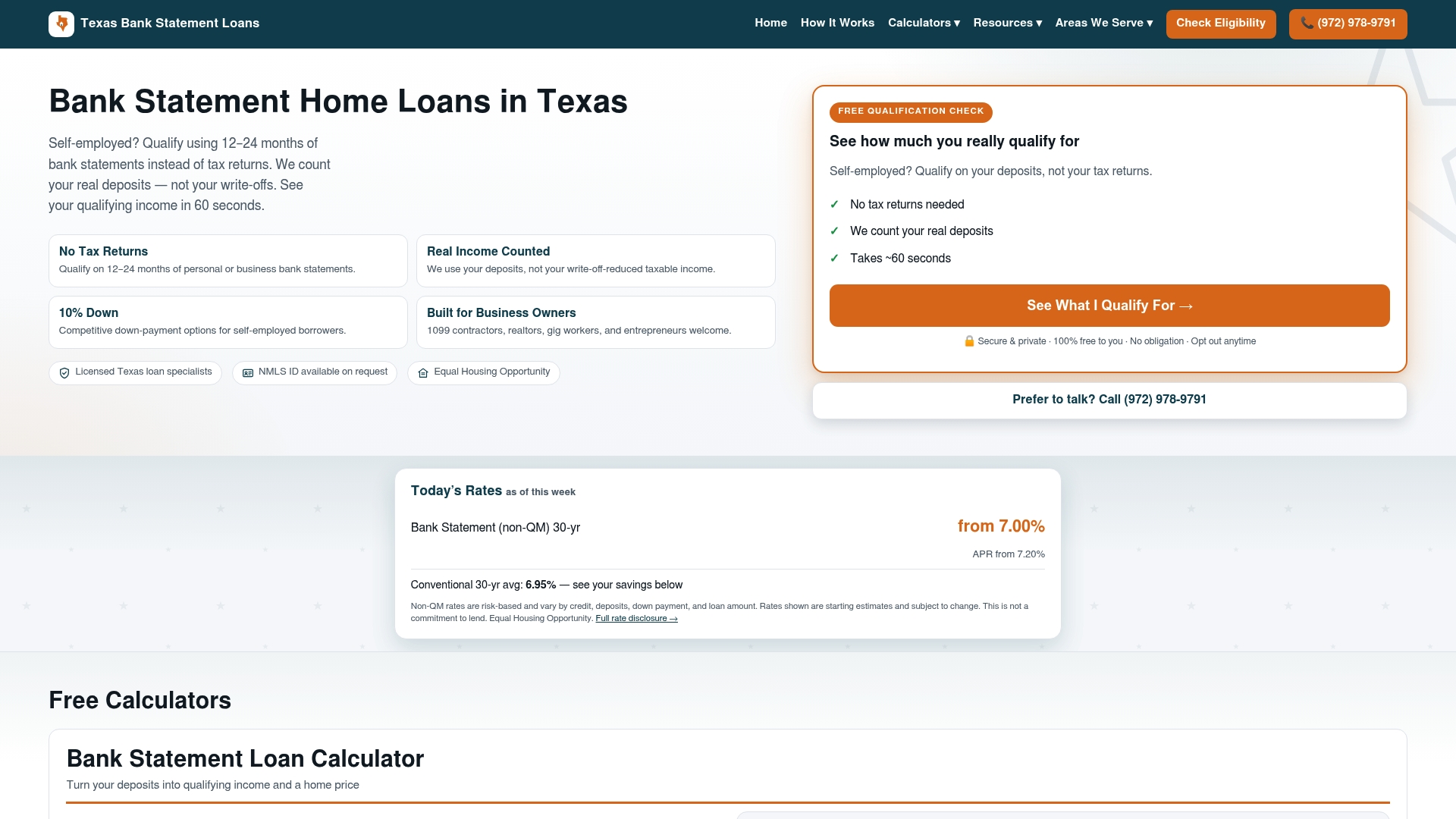
Several Texas markets have dedicated local pages with the same underwriting approach, including Houston, Plano, and Midland. Investors can also check numbers on the DSCR loan calculator if rental income rather than personal income is the qualifying factor.
- Run the qualification check and get an affordability estimate in about 60 seconds
- Gather 12 to 24 months of statements before you apply to avoid delays
- Compare current non-QM 30-year rates, listed from 7.00%
| What you get | Detail |
|---|---|
| Income review window | 12 to 24 months of bank deposits |
| Minimum down payment | 10% |
| Starting rate | 7.00% on the Bank Statement non-QM 30-year |
The qualification check itself takes about 60 seconds, according to Texas Bank Statement Home Loans, and gives a realistic read on affordability before you commit to a full application.
Start your bank statement home loan application today to see where your deposit history puts you.
Where to read more on the rules behind this
- CFPB Ability-to-Repay/Qualified Mortgage guide
- CFPB Loan Estimate explainer
- Fannie Mae DU Validation Service guidance
- First Choice Home Loan’s self-employed mortgage guide
Sources
- Ability to Repay and Qualified Mortgage Rule Small Entity Compliance Guide
- Freddie Mac Guide, Self-Employed Income documentation
- DU Validation Service: Using the service | Fannie Mae
FAQ
Can self-employed borrowers qualify for a mortgage without tax returns?
Yes, bank-statement loans let self-employed borrowers qualify using 12 to 24 months of deposits instead of tax returns, which is especially useful for anyone with heavy write-offs that shrink taxable income. Lenders still verify deposit consistency and reconcile income against supporting documents like invoices and a YTD P&L.
What is the minimum down payment for a bank-statement loan in Texas?
Texas Bank Statement Home Loans offers options starting at 10% down. The exact rate and terms depend on credit profile, reserves, and loan size, with current non-QM 30-year pricing listed from 7.00%.
How many months of bank statements do lenders need?
Most bank-statement programs ask for at least a year of statements, with longer histories sometimes smoothing out seasonal dips. Lenders use that window to confirm your income pattern is stable rather than a short-term spike.
How soon will I get a Loan Estimate after applying?
Lenders must provide a Loan Estimate within three business days of receiving a complete application. The Closing Disclosure then follows at least three business days before your closing date.
What documents besides bank statements will I need?
Expect to provide signed invoices or contracts, a year-to-date profit and loss statement, and business ledgers that tie your deposits to specific income sources. An accountant-signed P&L can help explain any seasonal swings in your deposit history.
Recommended
See what you qualify for in 60 seconds, free and no credit check. Use the eligibility check at the top of this page.