
A bank statement loan is a mortgage product that qualifies borrowers using 12-24 months of bank deposits instead of tax returns or W-2s. For self-employed workers and 1099 contractors, this distinction is the difference between getting approved and getting rejected. Tax write-offs that reduce your taxable income also reduce what conventional lenders see as your earnings. Bank statement loan benefits solve that problem directly by measuring what actually hits your account, not what survives your accountant’s deductions.
1. What are the core bank statement loan benefits?
Bank statement loans fill a critical gap for self-employed borrowers with legitimate tax strategies that reduce taxable income but have strong cash flow. A freelance designer earning $120,000 a year might show only $55,000 in taxable income after deductions. A conventional lender sees $55,000. A bank statement lender sees the full deposit history.
The core advantage is income accuracy. Your bank statements reflect real cash flow, not a tax-optimized number. That accuracy translates directly into higher qualifying loan amounts and better approval odds for borrowers with complex income structures.

Pro Tip: Keep your business and personal bank accounts completely separate before applying. Mixed accounts force lenders to manually exclude non-income deposits, which slows underwriting and can reduce your qualifying income.
2. How bank statement loans compare to conventional mortgages
The differences between these two loan types go beyond documentation.
| Feature | Bank statement loan | Conventional mortgage |
|---|---|---|
| Income verification | 12-24 months of deposits | W-2s and tax returns |
| Down payment | 10%-30% | 3%-20% |
| Interest rate | Typically 1%-3% higher | Standard market rate |
| Prepayment penalty | Possible, lasting 1-5 years | Generally none |
| Loan category | Non-QM | Qualified mortgage (QM) |
| Best for | Self-employed, gig workers | Salaried W-2 employees |
Bank statement loans fall outside qualified mortgage guidelines, which means they carry different underwriting criteria and generally higher costs. That classification is not a flaw. It is the mechanism that gives lenders the flexibility to approve borrowers who do not fit the standard mold.
Higher loan amounts and faster approvals are possible with bank statement loans, making them especially useful for buyers with recent income growth. A rideshare driver who doubled their income in the past 18 months benefits more from a deposit-based review than from a tax return that reflects last year’s lower earnings.
3. Who qualifies for a bank statement loan?
Eligibility criteria are specific, and meeting them requires preparation.
- Credit score: Typical requirements range from 640 to 720, slightly higher than some conventional programs but accessible to most self-employed borrowers with clean credit histories.
- Down payment: Expect 10%-30% down. The exact amount depends on your credit profile, loan size, and lender.
- Bank statements: You need 12-24 months of complete, consecutive statements. Missing pages or gaps in documentation will stall or kill your application.
- Deposit consistency: Lenders look for regular, identifiable income deposits. Transfers from other accounts, gifts, and refunds are excluded from income calculations.
- Self-employment history: Most lenders require at least two years of self-employment, verified through a business license or CPA letter.
Gig workers, freelancers, real estate agents, and small business owners are the primary beneficiaries. Each of these groups earns real money that does not translate cleanly into a W-2. The bank statement loan structure was built around that reality.
Not all deposits qualify as income. Transfers, gifts, and refunds are excluded, which makes clean record keeping non-negotiable. Borrowers who mix personal and business funds, or who regularly move money between accounts, create documentation problems that reduce their qualifying income.
4. What are the trade-offs and costs?
Bank statement loans cost more than conventional mortgages. Understanding where those costs appear helps you plan accurately.
- Higher interest rates. Rates run 1%-3% above conventional loans, reflecting the increased risk lenders take on non-QM products. On a $400,000 loan, that difference adds hundreds of dollars to your monthly payment.
- Origination fees. Expect fees between 1% and 3% of the loan amount at closing. These are negotiable in some cases but rarely waived entirely.
- Prepayment penalties. Penalties can last 1-5 years, which matters if you plan to sell or refinance within that window. Conventional mortgages generally carry no prepayment penalties.
- Reserve requirements. Lenders typically require 6-12 months of mortgage payments held in reserve after closing. That is cash you cannot use for the down payment.
- Expense factor defaults. Lenders apply a 50% expense factor to business bank statements by default. That cuts your qualifying income in half unless you provide a CPA letter documenting your actual expense ratio.
Pro Tip: Get a CPA letter before you apply. A letter documenting your real business expense ratio can significantly increase your qualifying income and reduce the loan amount you need to borrow.
A conventional loan is the better choice when you qualify for one. Bank statement loans are best viewed as a bridge to homeownership, not a permanent financing strategy. If your tax returns show strong income, pursue a conventional or government-backed loan first.
5. How bank statement loans work for gig workers
Gig workers face a specific income verification problem that bank statement loans solve better than any other mortgage product.
Income verification is more accurate with bank statements for gig workers because it captures real cash flow, overcoming the inconsistency of pay stubs or tax returns. A DoorDash driver, Uber operator, or freelance graphic designer does not receive a consistent paycheck. Their income varies by week, season, and client load.
Tax returns make that variability look like instability. Bank statements tell a different story. A gig worker who deposited $8,000 in january, $6,500 in february, and $9,200 in march shows a lender a real earning pattern, not a single annual number stripped of context.
- Rideshare and delivery drivers benefit because their gross deposits reflect actual earnings before platform fees and expenses.
- Freelancers and consultants benefit because project-based income that spikes and dips looks far better across 24 months than it does on a single tax return.
- 1099 contractors benefit because their deductible business expenses no longer work against them in the qualification process.
- Real estate agents benefit because commission income is irregular by nature, and 12-24 months of deposits smooths that irregularity into a qualifying average.
Bank statement loans require 12-24 months of complete statements with consistent deposits. Gig workers who have been operating for less than two years may face additional scrutiny or higher down payment requirements.
A gig worker’s tax return is a financial strategy document. Their bank statements are a financial reality document. Lenders who understand that distinction approve borrowers that other lenders turn away.
6. What alternatives exist to bank statement loans?
Bank statement loans are not the only option for self-employed borrowers. Knowing the alternatives helps you choose the right product for your situation.
| Loan type | Income verification | Best for | Key limitation |
|---|---|---|---|
| Bank statement loan | 12-24 months of deposits | Strong cash flow, high write-offs | Higher rates and fees |
| Conventional loan | W-2s and tax returns | Salaried or low-deduction self-employed | Requires strong taxable income |
| FHA loan | Tax returns, W-2s, or 1099s | Lower credit scores, smaller down payments | Mortgage insurance required |
| DSCR loan | Rental income only | Real estate investors | Property must cash-flow positively |
| No-doc loan | Minimal documentation | High-net-worth borrowers | Very high rates, rare availability |
Conventional loans remain the best option when your tax returns show sufficient income. FHA loans work well for self-employed borrowers with lower credit scores who can document two years of consistent income. DSCR loans serve real estate investors whose properties generate rental income.
No-doc loans carry the highest rates and the fewest protections. They suit a narrow profile of borrowers with large assets and minimal income documentation needs. For most gig workers and freelancers, a bank statement loan offers a better balance of accessibility and cost.
The self-employed affordability calculator at Texasbankstatementloans lets you run your numbers across scenarios before committing to any product. That comparison step takes 60 seconds and gives you a realistic starting point.
Key takeaways
Bank statement loans give self-employed borrowers and gig workers a direct path to mortgage approval by measuring actual cash flow instead of taxable income, making them the most practical non-QM option for 1099 earners with strong deposits.
| Point | Details |
|---|---|
| Income measured by deposits | Lenders use 12-24 months of bank deposits, not tax returns, to calculate qualifying income. |
| Higher costs than conventional | Rates run 1%-3% above conventional loans, with origination fees of 1%-3% and possible prepayment penalties. |
| CPA letter increases approval odds | A CPA letter documenting real expenses overrides the default 50% expense factor lenders apply. |
| Gig workers benefit most | Rideshare drivers, freelancers, and 1099 contractors qualify based on real cash flow, not tax-reduced income. |
| Clean statements are non-negotiable | Missing pages, gaps, or mixed personal and business deposits reduce qualifying income and slow approval. |
Why I think most gig workers apply too late
Most gig workers I talk to wait until they have “cleaned up” their finances before applying for a mortgage. They spend a year reducing deductions, paying down debt, and trying to look more like a W-2 employee on paper. That is the wrong move.
The bank statement loan structure rewards what you are already doing. If you have been depositing consistent income for 12-24 months, you may qualify right now. The documentation you need already exists in your bank account. The mistake is assuming you need to change your financial behavior before you can qualify. You do not. You need to present your existing financial reality clearly.
What actually matters is statement quality, not income perfection. I have seen borrowers with variable monthly deposits get approved because their 24-month average was strong and their statements were clean. I have also seen borrowers with higher income get rejected because their accounts were a mess of transfers, refunds, and unexplained deposits.
Work with a mortgage broker who specializes in non-QM loans. A general mortgage broker will default to conventional products and tell you to come back when your taxes look better. A non-QM specialist knows how to present your deposit history in the strongest possible light. That expertise is worth more than any rate negotiation.
- Saad
Texasbankstatementloans: mortgage solutions built for self-employed buyers
Self-employed buyers and gig workers in Texas have a direct path to mortgage approval through Texasbankstatementloans. The service evaluates 12-24 months of bank deposits instead of tax returns, which means your actual income drives the decision, not your tax strategy.
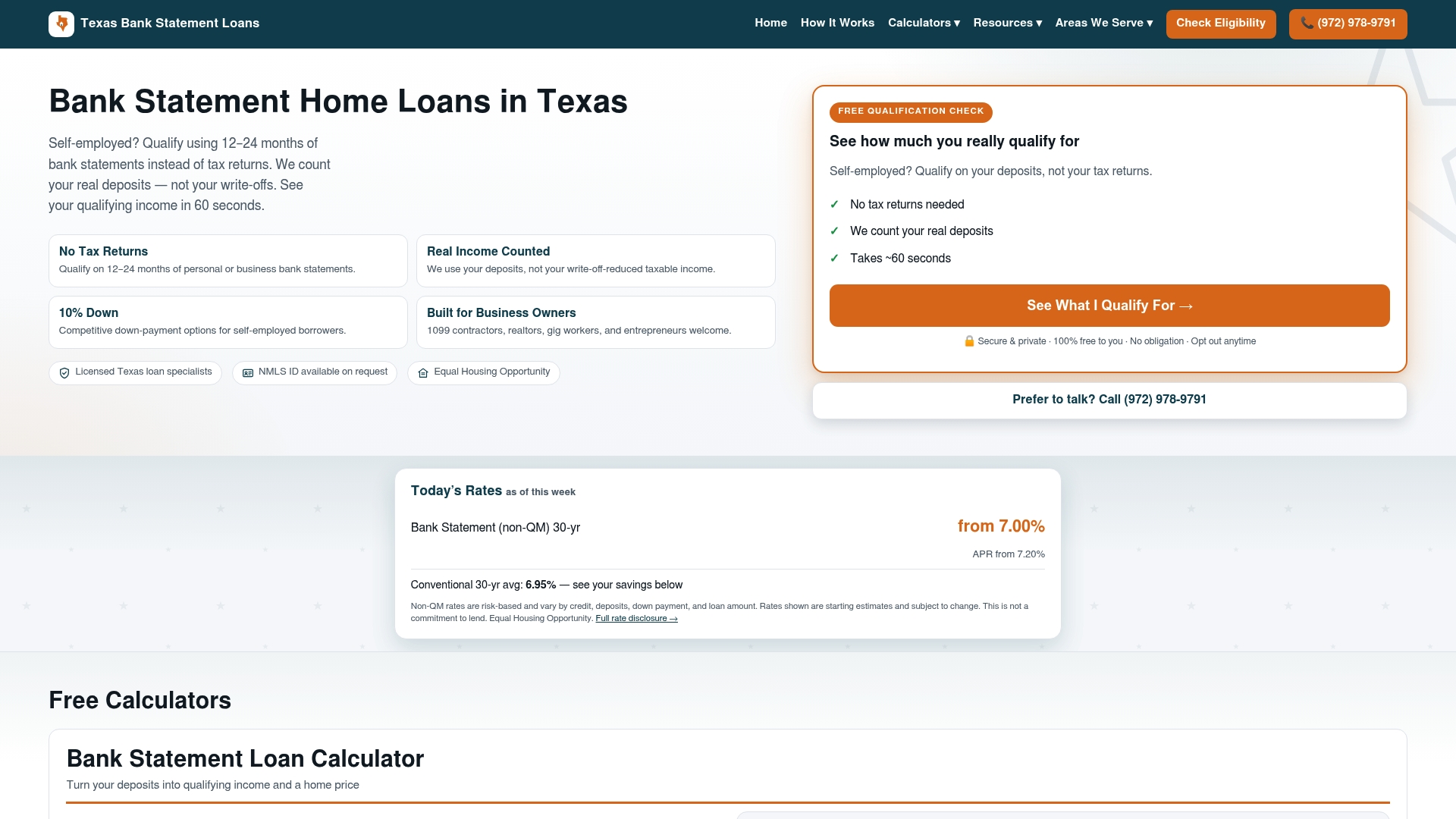
Down payment options start at 10%, and a no-obligation qualification check takes 60 seconds. Texasbankstatementloans works with business owners, 1099 contractors, freelancers, and rideshare drivers across Texas, including Houston and Plano. Use the loan calculator to estimate what you qualify for, or visit Texasbankstatementloans to get started with a personalized review.
FAQ
What is a bank statement loan and how does it work?
A bank statement loan qualifies borrowers using 12-24 months of bank deposits instead of tax returns or W-2s. Lenders calculate a monthly income average from your deposits to determine how much you can borrow.
Are bank statement loans more expensive than conventional mortgages?
Yes. Rates are typically 1%-3% higher than conventional loans, and origination fees range from 1%-3%. Prepayment penalties may also apply for 1-5 years after closing.
What credit score do I need for a bank statement loan?
Most lenders require a credit score between 640 and 720. Borrowers with scores above 700 generally access better rates and lower down payment requirements.
Can gig workers qualify for a bank statement home loan?
Yes. Gig workers are among the best candidates because their bank deposits reflect real earnings that tax returns often understate. Consistent deposits over 12-24 months are the primary qualification factor.
How do I prepare my bank statements for a mortgage application?
Separate your business and personal accounts, remove non-income deposits like transfers and gifts, and provide complete consecutive statements with no missing pages. A CPA letter documenting your actual expense ratio can also increase your qualifying income.
Recommended
- Bank Statement Loans for Self-Employed Buyers | Texas Bank Statement Loans
- Bank Statement Loans in Round Rock, TX | Self-Employed Mortgage
See what you qualify for in 60 seconds, free and no credit check. Use the eligibility check at the top of this page.