
Why 1099 workers choose Non-QM loans over traditional mortgages
Non-QM loans win for 1099 workers because they measure income the way contractors actually earn it: through bank deposits, profit and loss statements, and client contracts, not a W-2 that never existed. Traditional qualified mortgages, governed by the Ability-to-Repay rule set by the Consumer Financial Protection Bureau, were built around salaried employees with predictable paychecks. That framework leaves freelancers, independent contractors, and gig workers in a frustrating gap: strong real income, but numbers on a tax return that look thin after legitimate business deductions.
Here is what makes Non-QM loans the preferred path for 1099 workers:
- Alternative income verification: Lenders accept 12-24 months of bank statements or profit and loss statements instead of tax returns, reflecting actual cash flow.
- Write-off friendly: Heavy business deductions that shrink taxable income do not automatically disqualify you, because lenders look at deposits, not adjusted gross income.
- Multiple income streams accepted: Payments from several clients or platforms count as diversified income, not a red flag.
- Variable income accommodated: Seasonal or fluctuating monthly revenue is evaluated across a longer window, smoothing out the peaks and valleys.
- Higher borrowing potential: Because real cash flow drives the calculation, qualified borrowers can often access larger loan amounts than their tax returns alone would support.
- Accessible down payments: Some programs start at 10% down, lowering the barrier to entry for self-employed buyers.
What makes traditional mortgages so hard for 1099 workers?
Traditional mortgage underwriting was designed for one kind of borrower: someone with a steady employer, a consistent paycheck, and a clean W-2 at the end of the year. Independent contractors rarely fit that mold, and the documentation requirements make that mismatch painfully clear.
- Variable monthly income: A graphic designer who earns $12,000 in March and $4,000 in July looks unstable on paper, even if the annual total is strong.
- Multiple income sources: Payments from five different clients across three platforms require more documentation than a single employer’s pay stub.
- Business deductions reducing qualifying income: Writing off a home office, vehicle, and equipment is smart tax strategy, but it can push taxable income below the threshold a conventional lender needs to approve the loan.
- Seasonal revenue fluctuations: Contractors in construction, tourism, or retail often show dramatic income swings that conventional underwriting interprets as instability.
- Complex tax returns: Schedule C, Schedule K-1, and multiple 1099 forms require lenders to do more interpretive work, and many conventional underwriters are not set up for it.
- Two-year tax return requirement: Lenders average the last two years of reported income. If one year was slow or included a major write-off, the average pulls the qualifying number down significantly.
The core problem is structural. Conventional loan standards were built around predictable salaried income, and they have not kept pace with how a growing share of Americans actually earn a living.

What are 1099 mortgages and Non-QM loans?
A 1099 mortgage is a home loan designed for borrowers whose primary income comes through 1099 forms rather than W-2 employment. Most 1099 mortgages fall under the broader category of Non-QM loans, which are mortgage products that do not meet the Qualified Mortgage criteria set by federal guidelines. That distinction matters because it gives lenders flexibility to underwrite based on a borrower’s actual financial picture.
- Non-QM loans: Mortgage products that fall outside the Qualified Mortgage framework, allowing lenders to use alternative underwriting methods and documentation.
- 1099 mortgage: A specific type of Non-QM loan tailored to borrowers who receive 1099 income, such as freelancers, independent contractors, consultants, and gig workers.
- Alternative documentation: Instead of tax returns, lenders may use bank statements and P&L statements to verify income.
- Flexible qualification criteria: Credit score requirements, debt-to-income calculations, and income verification methods can differ from conventional loan standards.
- Who these loans serve: Self-employed business owners, real estate investors, freelancers, independent contractors, and anyone with nontraditional income structures.
Non-QM does not mean subprime. These are fully underwritten loans with real qualification standards. The difference is that the standards are built to reflect how self-employed borrowers actually manage money.
Who qualifies for a 1099 mortgage or Non-QM loan program?
Qualifying for a Non-QM loan requires documented financial stability, even if the documentation looks different from a conventional file. Lenders want to see that your income is real, consistent, and sustainable over time.
- Income history: Most lenders require at least two years of self-employment or 1099 income history with consistent cash flow.
- Credit score: Standards vary by lender and program, but most Non-QM programs expect a solid credit profile. Some programs accept scores in the mid-600s; others require higher.
- Organized financial records: Clean, well-documented bank statements, profit and loss statements, and business records are non-negotiable. Disorganized files slow underwriting and can kill approvals.
- Consistent cash flow: Lenders analyze average monthly deposits across 12-24 months. Steady deposits, even if the amounts vary, signal reliability.
- Accepted documentation types: Personal bank statements, business bank statements, CPA-prepared profit and loss statements, client contracts, and 1099 forms.
- Down payment: Many programs require 10%-20% down, depending on loan size, credit profile, and the lender’s risk assessment.
Use a self-employed affordability calculator to get a quick read on what loan amount your actual deposits might support before you start gathering paperwork.
Why Non-QM loans give 1099 workers a real advantage
The core appeal is straightforward: Non-QM loans measure what you actually earn, not what survives your accountant’s deductions. For contractors who run lean businesses and write off everything they legally can, that difference can mean qualifying for a mortgage versus being turned away entirely.
- Income verification that reflects reality: Bank statement analysis captures gross deposits, giving lenders a true picture of cash flow rather than a tax-reduced number.
- Write-offs do not work against you: Tax deductions that reduce reported income do not automatically shrink your qualifying loan amount under Non-QM underwriting.
- Multiple income streams are a strength: Non-QM underwriters often view income from several clients as diversified risk, not instability. That is a meaningful shift from conventional thinking.
- Higher borrowing power: Because gross cash flow drives the calculation, borrowers with strong deposits but modest taxable income can often qualify for larger loans.
- Built for gig workers and entrepreneurs: Whether you drive for a rideshare platform, run a consulting practice, or freelance across several industries, Non-QM programs are structured to accommodate your financial profile.
- Faster path to homeownership: Rather than waiting years to restructure your tax strategy to look better on a conventional application, you can apply now using the financial records you already have.
How 1099 borrowers use alternative documents to prove income
The documentation strategy under a Non-QM loan is different from a conventional application, but it is not complicated once you understand what lenders are looking for. The goal is to demonstrate consistent, reliable cash flow through records you already maintain.
Common alternative documentation types:
- 12-24 months of personal bank statements: Lenders calculate average monthly deposits to establish a baseline income figure.
- 12-24 months of business bank statements: For borrowers with a separate business account, lenders may use a percentage of business deposits after accounting for overhead.
- CPA-prepared profit and loss statement: A current P&L from a licensed accountant carries significant weight and can supplement or replace bank statements in some programs.
- Client contracts and letters of engagement: These demonstrate ongoing work relationships and future income potential.
- 1099 forms: While not the primary verification tool in Non-QM underwriting, they support the overall income picture.
Bank statement loans use 12-24 months of deposits to assess income, giving lenders a window into actual cash flow rather than the tax-adjusted figure on a return.
| Documentation Type | What Lenders Analyze | Primary Benefit |
|---|---|---|
| Personal bank statements (12-24 months) | Average monthly deposits, consistency | Reflects gross income before deductions |
| Business bank statements (12-24 months) | Deposit volume, expense ratio | Captures business revenue directly |
| CPA profit and loss statement | Net income, business health | Adds professional validation of financials |
| Client contracts | Ongoing income, client stability | Supports future earning capacity |
| 1099 forms | Total annual payments received | Corroborates deposit and income claims |
The key shift in Non-QM underwriting is that lenders focus on cash flow consistency rather than a single taxable income number. A contractor who deposits $9,000 every month, even if some months run $7,500 and others hit $11,000, demonstrates the kind of reliability lenders want to see.
Tips for 1099 workers to improve their Non-QM loan approval odds
Getting approved is less about finding the right loan product and more about showing up with the right documentation. Lenders who specialize in Non-QM programs know what a healthy self-employed file looks like, and they can spot a messy one just as fast.
- Separate your finances completely: Keep personal and business bank accounts entirely distinct. Mixing finances is one of the most common reasons Non-QM applications stall in underwriting.
- Build at least two years of documented income history: Lenders want to see that your income is not a one-time spike. Consistent deposits over 24 months tell a much stronger story than 12.
- Avoid large unexplained deposits: A $30,000 transfer from a family member right before your application raises questions. Lenders will ask for a paper trail, and if you cannot provide one, it complicates the file.
- Do not take on new debt before applying: A new car loan or business line of credit changes your debt-to-income ratio and can shift your qualification picture significantly.
- Work with a mortgage professional who specializes in Non-QM loans: Not every loan officer understands how to structure a self-employed file. A specialist knows which programs fit your income type and how to present your documents most effectively. Reviewing a business loan requirements guide can also help you understand what financial documentation lenders expect before you apply.
- Get your P&L prepared by a CPA: A professionally prepared profit and loss statement carries more credibility than a self-prepared spreadsheet.
Pro Tip: Start treating your bank statements as a mortgage document 12-24 months before you plan to apply. That means consistent deposits, clean transfers, and no unexplained large movements. Bookkeeping discipline before the application is the single most controllable factor in your approval outcome.
Non-QM loans are becoming mainstream for 1099 workers in 2026
The growth of the freelance workforce has pushed Non-QM lending from a niche product into a standard part of the mortgage market. An estimated 70.4 million Americans were freelancing as of mid-2026, representing 36% of the workforce, with projections that freelancers could reach 50% of the workforce by 2027. That scale makes Non-QM lending not just relevant but necessary.
The lending infrastructure has matured to match that reality. Product offerings are more refined, underwriting is more consistent, and the secondary market has evolved to support Non-QM loans at scale. What was once treated as a workaround for borrowers who “didn’t quite qualify” is now recognized as a product designed for how modern workers earn. For Black and Latino entrepreneurs, immigrant business owners, and gig economy workers, Non-QM loans are opening a path to homeownership and the wealth-building that comes with it.
How Non-QM loans compare to traditional QM loans for 1099 workers
The differences between Non-QM and conventional qualified mortgages come down to one thing: whose financial life the loan was designed for.
| Feature | Conventional QM Loan | Non-QM Loan |
|---|---|---|
| Income verification | W-2s and tax returns required | Bank statements, P&L, contracts accepted |
| Impact of tax write-offs | Deductions reduce qualifying income | Gross deposits used; write-offs have less impact |
| Variable income | Often disqualifying | Evaluated over 12-24 month average |
| Multiple income streams | Complicates underwriting | Treated as diversified income |
| Down payment | Typically 10%-20% | Often 10%-20% depending on program |
| Interest rates | Generally lower | Typically higher to reflect flexible underwriting |
| Regulatory framework | Must meet CFPB Qualified Mortgage standards | Falls outside QM guidelines; lender sets criteria |
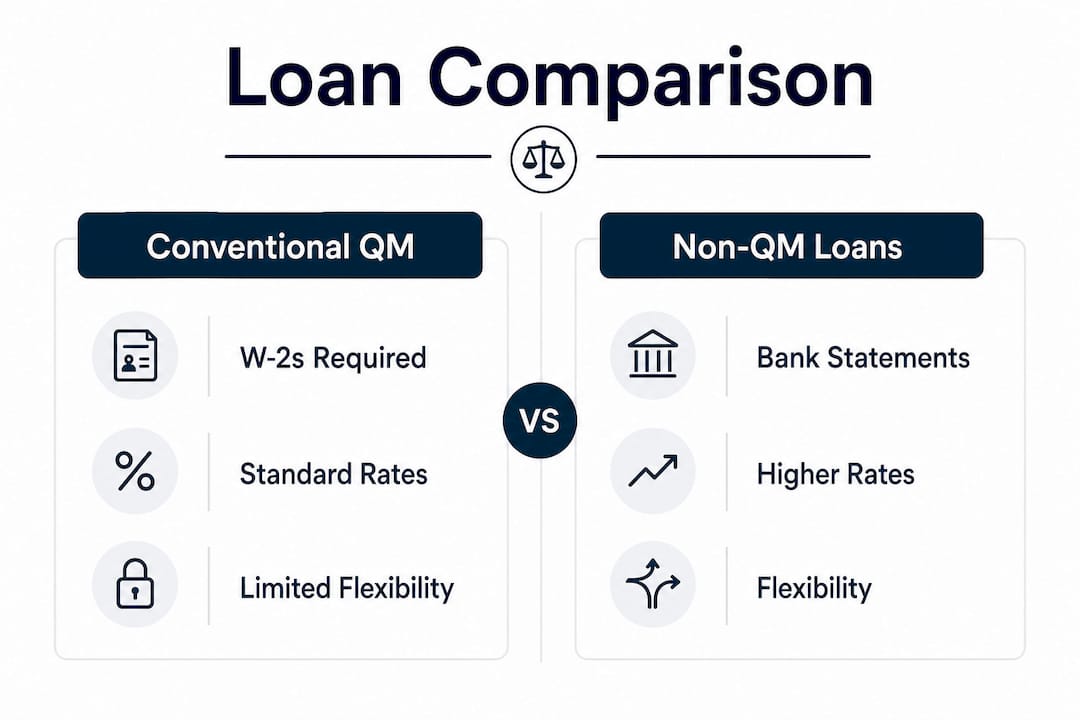
The trade-off is real: Non-QM loans typically carry higher interest rates than conventional loans because lenders take on more documentation risk. For many 1099 workers, though, the choice is not between a lower rate and a higher rate. It is between getting a mortgage and not getting one at all. Borrowers who plan to refinance into a conventional loan once they have two years of stronger tax returns often use Non-QM as a bridge to homeownership rather than a permanent financing structure.
Common pitfalls to avoid when applying for a Non-QM loan
Non-QM loans are more flexible than conventional mortgages, but they are not forgiving of sloppy financial habits. Several mistakes consistently derail applications that should have sailed through.
Mixing personal and business finances is the most common problem. When deposits from a client land in the same account as your grocery spending, lenders cannot cleanly calculate your business income. Keep those accounts separate, always.
Writing off too much income can backfire even in Non-QM underwriting. If you use a P&L statement rather than bank statements, your net income after expenses still matters. Aggressive deductions that push net income very low can limit your qualifying amount even when your deposits look strong.
Making large undocumented deposits before or during the application process creates questions lenders must resolve before closing. A $25,000 transfer with no clear source will require a letter of explanation and documentation. Avoid it entirely if you can. Common financing mistakes like these are well-documented and entirely preventable with a little planning.
Taking on new debt between pre-approval and closing is a fast way to lose your approval. A new credit card, car loan, or equipment financing changes your debt-to-income ratio, and lenders will pull your credit again before closing.
Working with a lender who does not specialize in Non-QM loans is an underrated risk. A loan officer unfamiliar with self-employed files may structure your application incorrectly, choose the wrong program, or miss documentation that would have strengthened your case.
What Non-QM loans cost compared to traditional mortgages
Non-QM loans carry higher costs than conventional mortgages, and that is a straightforward trade-off for the flexibility they provide. Understanding where the extra cost comes from helps you plan accurately.
Interest rates on Non-QM loans typically run higher than conventional rates. The exact spread depends on your credit score, loan-to-value ratio, documentation type, and the specific program. Borrowers with strong credit and clean bank statements will generally see rates closer to conventional pricing than borrowers with thinner credit profiles. Check current Non-QM rates to see where the market stands today.
Down payment requirements tend to be higher than the minimums available on conventional loans. Many Non-QM programs start at 10% down, with some requiring 20% or more depending on loan size and borrower profile. Texasbankstatementloans offers programs starting at 10% down, which keeps the barrier lower than many borrowers expect.
Origination fees and closing costs follow similar patterns to conventional loans, though some Non-QM lenders charge higher origination fees to offset the additional underwriting work involved in alternative documentation files.
The cost premium is real, but it needs to be weighed against the alternative. Renting while waiting to restructure your tax strategy for a conventional loan has its own cost: rising home prices, continued rent payments, and delayed equity building. For many 1099 workers in Texas, the math favors moving forward with a Non-QM loan now rather than waiting for a conventional approval that may be years away.
Key Takeaways
Non-QM loans are the practical mortgage solution for 1099 workers because they measure real cash flow rather than tax-reduced income, giving self-employed borrowers access to financing that matches how they actually earn.
| Point | Details |
|---|---|
| Alternative income verification | Non-QM loans use 12-24 months of bank statements or P&L statements instead of tax returns. |
| Write-offs do not disqualify you | Gross deposits drive qualification, so business deductions have far less impact on borrowing power. |
| Two-year income history required | Lenders expect at least two years of consistent 1099 or self-employment income with organized records. |
| Higher rates reflect flexibility | Non-QM loans typically carry higher interest rates than conventional loans as a trade-off for flexible underwriting. |
| Freelance workforce is growing fast | 70.4 million Americans freelanced as of mid-2026, making Non-QM lending a mainstream necessity, not a niche product. |
Ready to see what your bank deposits can qualify you for?
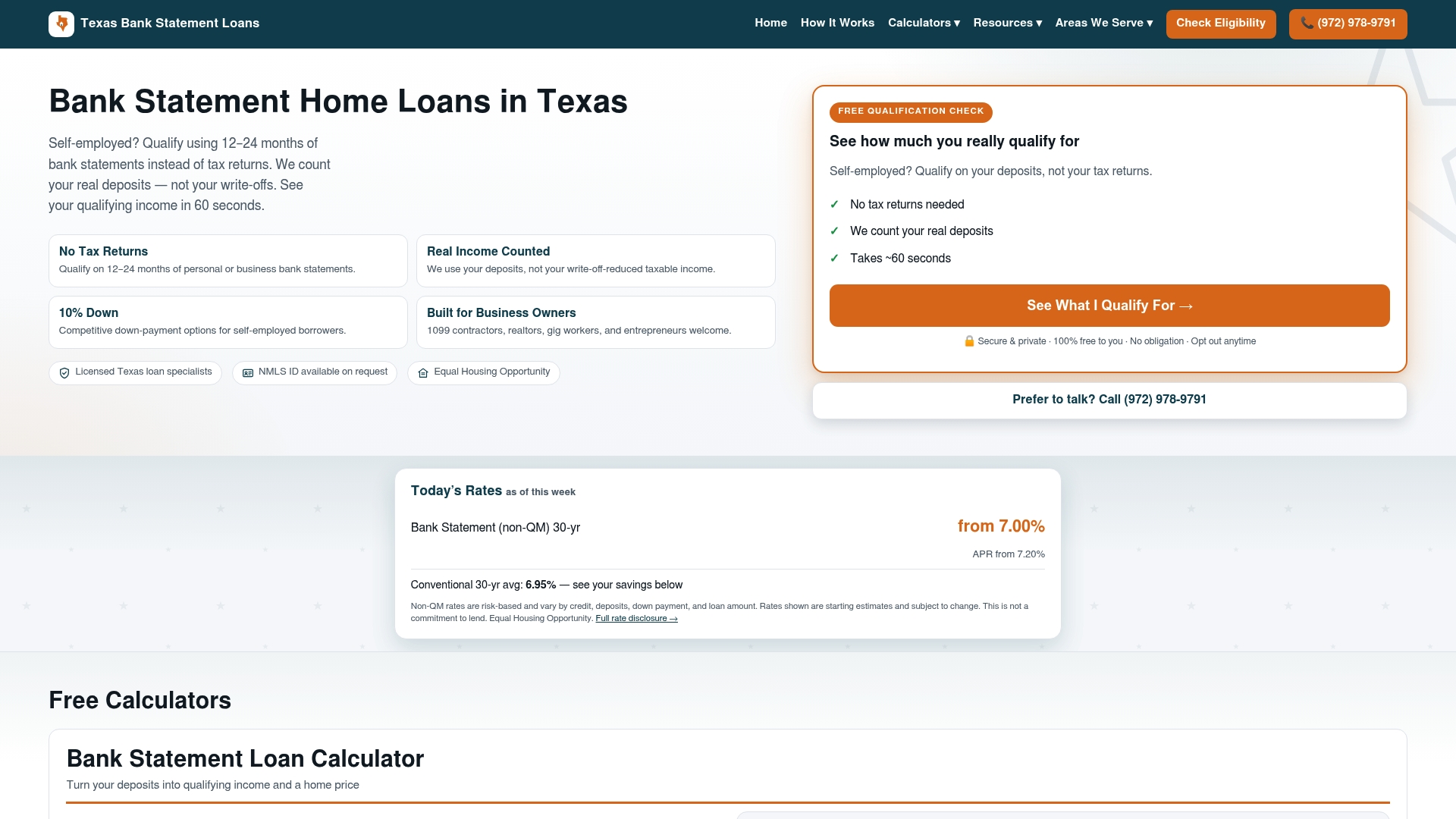
If you are a 1099 contractor, freelancer, or self-employed business owner in Texas, Texasbankstatementloans specializes in exactly this situation. The qualification process uses 12-24 months of bank deposits instead of tax returns, down payments start at 10%, and you can get a no-obligation qualification check in about 60 seconds.
Start your qualification today and find out what you can realistically afford based on your actual income, not your tax return. Texasbankstatementloans also serves buyers across Houston, Plano, and communities throughout Texas with programs built for the self-employed.
See what you qualify for in 60 seconds, free and no credit check. Use the eligibility check at the top of this page.