
A bank statement loan is defined as a Non-QM mortgage product that lets self-employed borrowers qualify using deposit history instead of tax returns. If you run a business and your tax returns understate your actual income due to deductions, you can use business deposits for home loan qualification and present your real cash flow to a lender. This approach is the standard solution for business owners, 1099 contractors, and gig workers who cannot meet conventional mortgage documentation requirements. Texasbankstatementloans specializes in exactly this path, evaluating 12-24 months of bank deposits to reflect what you actually earn.
How lenders treat business deposits for home loan qualification
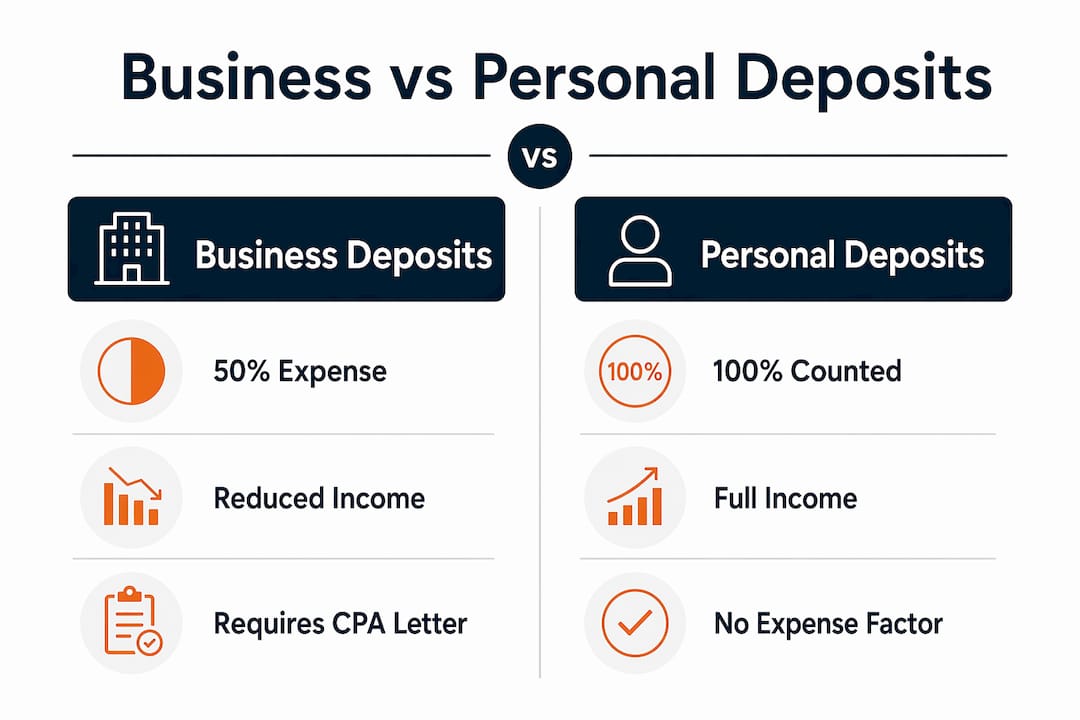
Lenders do not count business deposits the same way they count personal deposits. A 50% expense factor is the most common adjustment lenders apply to business bank statements. That means if your business account shows $20,000 per month in deposits, the lender counts only $10,000 as qualifying income.
The logic is straightforward. Business deposits include revenue that gets spent on payroll, supplies, rent, and other operating costs. Lenders apply the expense ratio to account for those costs, since not all deposited money is take-home income.

Personal deposits, by contrast, are counted at 100% for income purposes. A personal account showing $10,000 per month qualifies you on the full $10,000. That difference has a real impact on how much home you can afford.
Some lenders allow a CPA letter to reduce the expense ratio applied to your business account. If a licensed CPA certifies that your actual business expense rate is 30%, some lenders will use that figure instead of the default 50%. That single document can significantly raise your qualifying income.
| Income source | Expense factor applied | Qualifying income on $20,000/month |
|---|---|---|
| Business bank account | 50% (default) | $10,000 |
| Business account with CPA letter | 30% (CPA-verified) | $14,000 |
| Personal bank account | 0% | $20,000 |
Pro Tip: If your business expenses are genuinely low, get a CPA letter before you apply. That letter can increase your qualifying income by thousands of dollars per month without changing a single deposit.
What documentation do you need to qualify?
Bank statement loans require thorough, consecutive statements covering 12-24 months, including every page of every statement. Missing a single page can stall your application or trigger a denial.
The documentation list goes beyond bank statements. Lenders need proof that your business is real, that you run it, and that your income is consistent. A CPA or tax preparer letter verifying your self-employment status is standard across nearly all bank statement loan programs.
Here is the full documentation checklist most lenders require:
- 12-24 consecutive months of business or personal bank statements (all pages)
- CPA or tax preparer letter confirming self-employment and business ownership
- Business license or equivalent proof of active business operation
- Profit and loss statement (some lenders require this in addition to statements)
- Government-issued photo ID
- Minimum credit score of 620, though stronger scores improve terms
- Proof of reserves, typically 3-6 months of mortgage payments held in savings
- Signed borrower authorization forms
Some lenders accept exceptions for borrowers who have been self-employed for only 12 months if they have prior relevant employment in the same industry. In those cases, a CPA letter and industry experience documentation can substitute for a longer deposit history.
The quality of your documentation directly affects your approval odds. Gaps, inconsistencies, or missing pages give underwriters a reason to question your income. Treat every document as part of your case.
Step-by-step process to apply using business deposits
Applying for a home loan with business deposits follows a clear sequence. Skipping steps or submitting documents out of order slows the process and can create confusion with underwriters.
- Gather your bank statements. Pull 12-24 consecutive months of statements from your business account, personal account, or both. Download every page, including blank pages that are part of the statement cycle.
- Choose your statement period. Compare your 12-month average deposit against your 24-month average. Use whichever period shows a higher and more consistent monthly income. Lenders will use the period you submit.
- Get your CPA letter. Contact your accountant and request a letter on official letterhead confirming your self-employment, business type, and that your income is legitimate. Ask them to include your estimated expense ratio if it is below 50%.
- Compile supporting business documents. Gather your business license, any DBA filings, and your profit and loss statement. These confirm your business is active and operating.
- Review your statements for large or unusual deposits. Identify any deposits that are significantly larger than your average monthly amount. Prepare a written explanation and supporting documentation for each one.
- Document all transfers between accounts. If you move money from your business account to your personal account, label those transfers clearly. Lenders need to see that the same dollar is not being counted twice.
- Submit your application and work with your loan officer. Share all documents at once rather than in pieces. A complete package speeds up underwriting and reduces back-and-forth requests.
Pro Tip: Keep a simple spreadsheet that lists every large deposit by date, amount, and source. Hand it to your loan officer on day one. Underwriters ask about these deposits anyway, and having answers ready cuts weeks off your timeline.
You can use the bank statement loan calculator from Texasbankstatementloans to estimate your qualifying income before you apply. Knowing your number in advance helps you target the right price range.
Common challenges when using business deposits for mortgage approval
The biggest obstacle most business owners face is unexplained deposits. Lenders scrutinize large or unusual deposits and require written explanations before they can count that income. A single unexplained $15,000 deposit can freeze your file for weeks.
Mixing personal and business funds in the same account creates a second major problem. When both types of income flow through one account, lenders cannot cleanly separate business revenue from personal transfers. That ambiguity often results in a lower income calculation or a request for additional documentation.
Variable deposits are common for business owners, and lenders know it. The issue is not variability itself but the inability to explain it. If your deposits spike in december and drop in january, document the seasonal pattern with a short written explanation. Underwriters respond well to clear, honest context.
“A good candidate for a bank statement loan is a self-employed borrower with strong, consistent deposits and tax returns that understate income due to deductions. These loans aim to reflect true cash flow beyond tax return numbers.”
Bank statement loans carry tradeoffs compared to conventional mortgages. Interest rates run 0.5%-1.5% higher, and down payment requirements are larger. Texasbankstatementloans offers down payments starting at 10%, which is lower than many Non-QM programs. Knowing these tradeoffs upfront lets you decide whether the loan fits your financial situation.
Key pitfalls to avoid:
- Submitting incomplete bank statements with missing pages
- Depositing business revenue into a personal account inconsistently, which confuses income sourcing
- Failing to explain large one-time deposits before underwriting begins
- Applying without checking your credit score first, since a minimum score of 620 is typically required
- Choosing the wrong statement period without comparing 12-month versus 24-month averages
Check current loan rates before you commit to a loan program. Rates on bank statement loans vary by lender, credit score, and down payment size, and knowing the range helps you negotiate.
Key Takeaways
Business owners can qualify for a home loan using deposit history, but lender income calculations and documentation standards differ significantly from conventional mortgage rules.
| Point | Details |
|---|---|
| Business deposits are discounted | Lenders apply a 50% expense factor to business accounts; a CPA letter can reduce that ratio. |
| Personal accounts count more | Personal deposits qualify at 100%, making account choice a key income strategy. |
| Documentation must be complete | Submit all pages of 12-24 consecutive months of statements to avoid underwriting delays. |
| Large deposits need explanations | Prepare written documentation for any unusual deposit before submitting your application. |
| Tradeoffs exist | Bank statement loans carry higher rates and larger down payments than conventional loans. |
Why I think most business owners apply for these loans the wrong way
Most business owners I have seen come to a bank statement loan application the same way they approach tax season: they hand over documents and hope for the best. That approach costs them money and time.
The single most overlooked decision is which account to use. Depositing business income into a personal account can result in 100% of those deposits counting toward qualifying income, compared to the 50% default on a business account. That is not a loophole. It is a documented strategy that lenders accept, and most borrowers never hear about it.
The other mistake is waiting until the last minute to get a CPA letter. That letter is not a formality. It is a financial document that can change your qualifying income by thousands per month. Get it early, and ask your CPA to include your actual expense ratio.
Non-QM loans like bank statement loans exist because the conventional mortgage system was not built for people who own businesses. The tax code rewards business owners for writing off expenses, and then the mortgage system penalizes them for having a low taxable income. Bank statement loans fix that disconnect. If your deposits are strong and consistent, you have a real path to homeownership. Use it.
- Saad
How Texasbankstatementloans helps business owners qualify
Self-employed borrowers in Texas have a direct resource in Texasbankstatementloans, a lender built specifically for business owners who need to qualify using deposit history rather than tax returns.
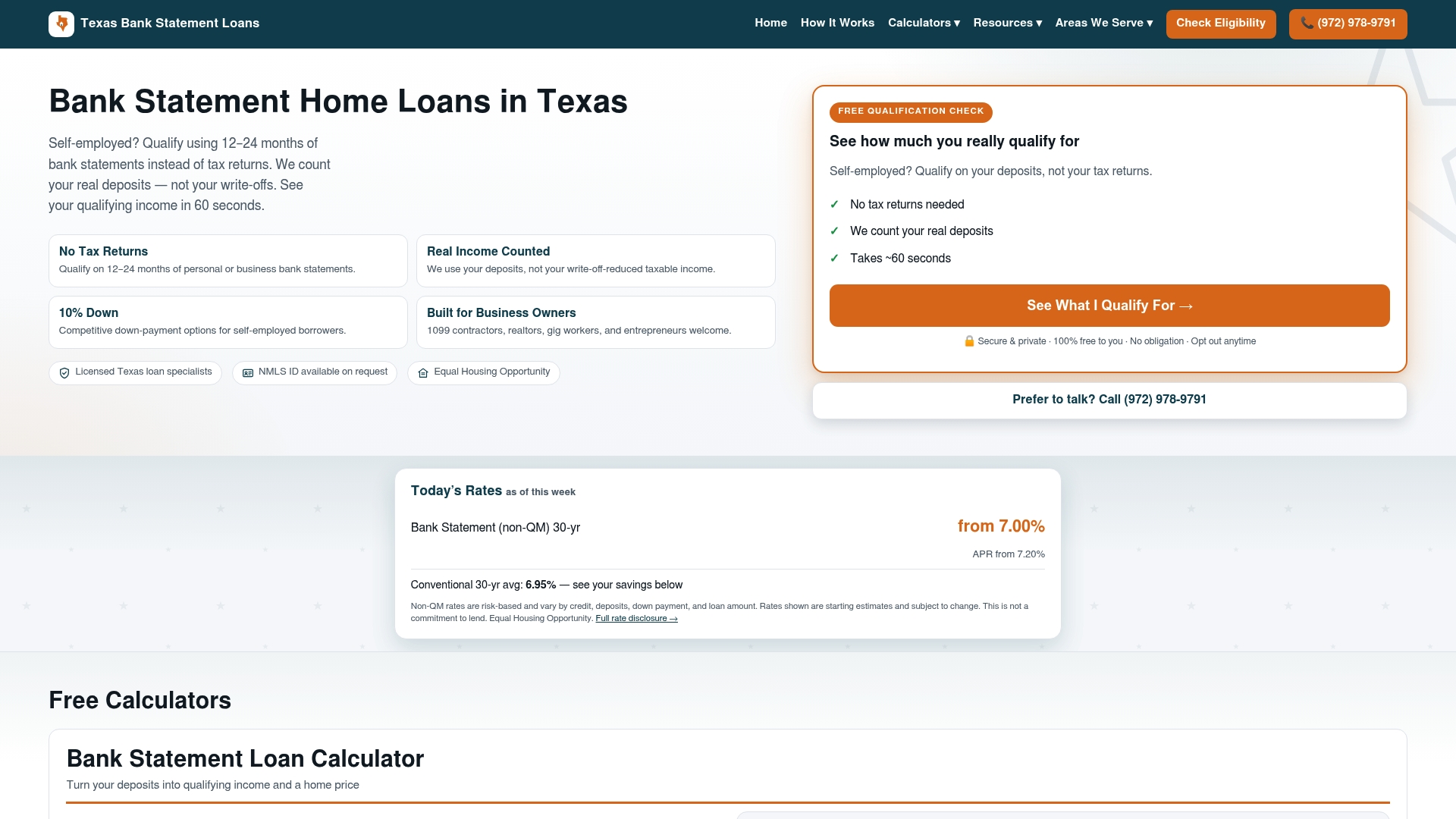
Texasbankstatementloans evaluates 12-24 months of bank deposits, accepts down payments starting at 10%, and offers a 60-second qualification check with no obligation. The programs cover borrowers across Texas, including dedicated options for self-employed buyers in Houston and self-employed buyers in San Antonio. If your deposits reflect strong cash flow that your tax returns do not capture, a consultation with Texasbankstatementloans is the logical next step. Visit texasbankstatementloans.com to see what you qualify for.
FAQ
Can I use business deposits to qualify for a home loan?
Yes. Bank statement loans let self-employed borrowers qualify using 12-24 months of business deposit history instead of tax returns. Lenders apply an expense factor, typically 50%, to calculate qualifying income from business accounts.
What credit score do I need for a bank statement loan?
Most bank statement loan programs require a minimum credit score of 620. Higher scores generally unlock better interest rates and lower down payment requirements.
Do lenders count business deposits the same as personal deposits?
No. Business deposits are typically reduced by a 50% expense factor, while personal deposits count at 100%. A CPA letter verifying a lower actual expense rate can increase the income counted from a business account.
How many months of bank statements do I need?
Lenders require 12-24 consecutive months of bank statements, including every page. The period you choose should reflect your highest and most consistent average monthly deposits.
Are bank statement loans more expensive than conventional mortgages?
Yes. Bank statement loans carry interest rates that run 0.5%-1.5% higher than conventional loans and typically require larger down payments. Texasbankstatementloans offers programs starting at 10% down, which is among the lower thresholds available for Non-QM products.
Recommended
- Bank Statement Loans in Houston, TX | Self-Employed Mortgage
- Bank Statement Loans in Frisco, TX | Self-Employed Mortgage
- Bank Statement Loan Calculator | Texas Bank Statement Loans
See what you qualify for in 60 seconds, free and no credit check. Use the eligibility check at the top of this page.