
Yes, bank-statement underwriting can overcome most conventional mortgage rejections for self-employed, 1099, and gig workers in Texas, provided your deposits show stable, recurring cash flow over 12-24 months. Lenders using this approach ignore your tax returns entirely. Instead, they calculate qualifying income directly from what actually hits your account. Minimum credit scores typically start at a moderate level, with better pricing available at higher scores, and down payments start from a modest percentage for primary residences.
- Tax returns are replaced by 12-24 months of personal or business bank deposits
- Credit score floor: 620 to qualify; 680+ unlocks better rates and more programs
- Down payment starting point: 10% for primary residence purchases
- Immediate action: pull your last 12 months of bank statements and run the 60-second qualification check
Pro Tip: Don’t wait until you have 24 months of statements. Many programs accept 12 months, especially if your industry experience predates your current business entity.
Table of Contents
- Do you qualify? A quick self-screen for Texas gig workers
- What documents do you actually need to submit?
- How lenders convert your deposits into qualifying income
- What loan products are available to Texas borrowers?
- How long does this take, and what does it cost?
- Worked example: turning 12 months of deposits into a payment estimate
- Common red flags and how to fix them before you apply
- Key Takeaways
- Why bank-statement underwriting actually reflects repayment ability
- Texasbankstatementloans: your next step toward approval
- Useful sources and tools
Do you qualify? A quick self-screen for Texas gig workers
Before you spend time gathering documents, run through this checklist. A “no” on any item doesn’t disqualify you outright, but it tells you where to focus first.
- Texas property taxes: Texas has no state income tax, which simplifies documentation. But property tax rates average 1.6-1.8%, which adds meaningfully to your monthly escrow. Factor that into your payment estimate before you set a purchase price target.
What documents do you actually need to submit?
A clean file moves fast. A messy one stalls in underwriting for weeks. Here’s what to prepare.
Core documents:
- 12 to 24 consecutive months of bank statements in native PDF format (no screenshots or scans)
- Government-issued photo ID
- Proof of down payment funds (statements showing the money has been in your account, typically 60+ days)
- Reserves documentation (same account statements work if the funds are there)
Business verification, bring at least one:
- CPA letter or equivalent documentation confirming self-employment and business viability
- Business license or DBA registration
- LLC operating agreement or articles of incorporation
- Recent invoices or contracts showing active revenue
Statement formatting rules underwriters care about:
- Months must be consecutive, no gaps
- Label large transfers and deposits with a brief written explanation
- Separate business and personal accounts before you apply. Commingled accounts force underwriters to guess which deposits are business income, and they’ll guess conservatively.
When to add a P&L: If you’re using business bank statements, a CPA-prepared year-to-date P&L can reduce the default expense factor applied to your deposits, which directly increases your qualifying income. More on that math below.
Pro Tip: Name your PDF files clearly before uploading: “Chase_Business_Jan2025.pdf” processes faster than “statement(3).pdf.” Small detail, real time savings.
How lenders convert your deposits into qualifying income
This is the math that determines how much house you can buy. Understanding it lets you estimate your own number before talking to anyone.
Bank-statement underwriting uses two main approaches depending on which account type you’re using:
| Scenario | Deposits Used | Expense Factor | Monthly Qualifying Income |
|---|---|---|---|
| Personal bank statements | 100% of consistent deposits | None | Total deposits ÷ months |
| Business bank statements (default) | 100% of deposits | 50% deducted | (Total deposits × 50%) ÷ months |
| Business statements + CPA letter | 100% of deposits | 30-50% deducted | (Total deposits × 60-70%) ÷ months |
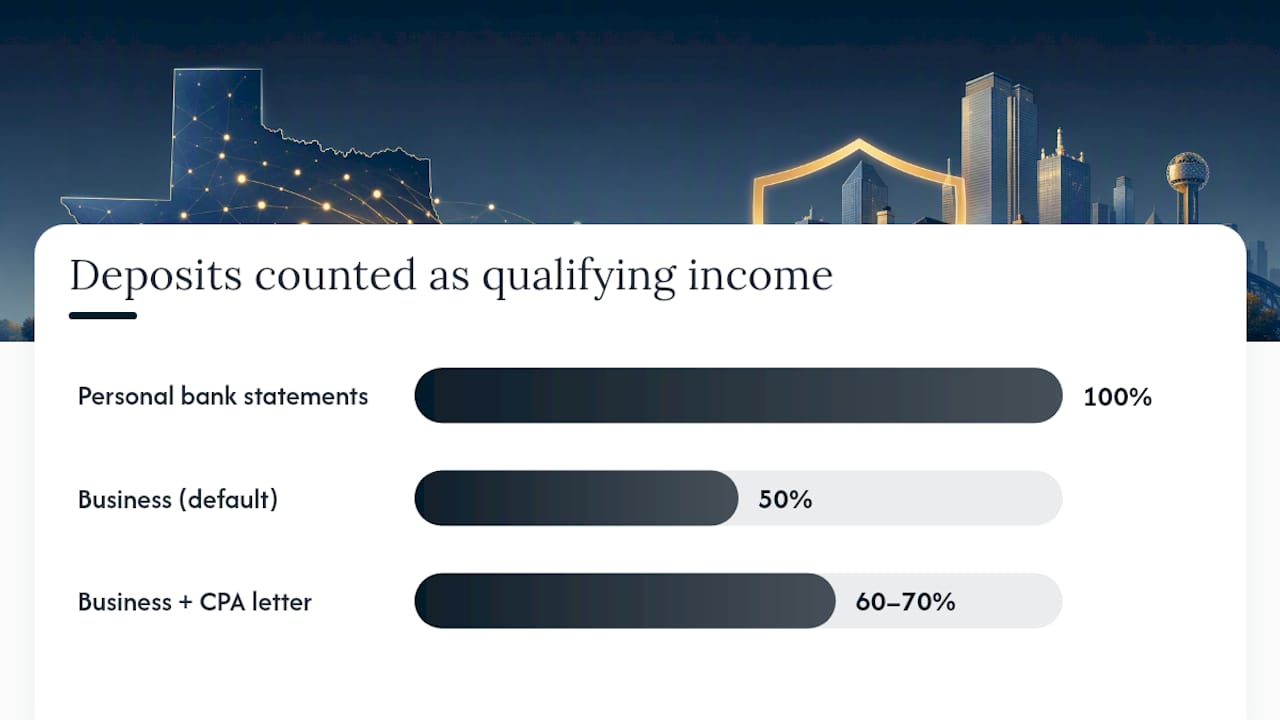
The 12-month vs. 24-month window matters for seasonal businesses. A 24-month look-back smooths out a slow quarter that would otherwise drag your monthly average down. If your income has grown significantly, 12 months may actually produce a higher qualifying figure.
One-time large deposits, a tax refund, a loan from a family member, a single large client payment, are excluded or must be explained in writing. Underwriters want to see recurring, business-related deposits, not spikes.
What loan products are available to Texas borrowers?
Bank-statement programs are non-QM (non-qualified mortgage) products, meaning they’re held in portfolio by lenders rather than sold to Fannie Mae or Freddie Mac. That’s actually an advantage: portfolio lenders write their own guidelines and can approve profiles that automated systems reject.
| Product | Best For | Min. Down Payment | Key Documents | Loan Types Supported |
|---|---|---|---|---|
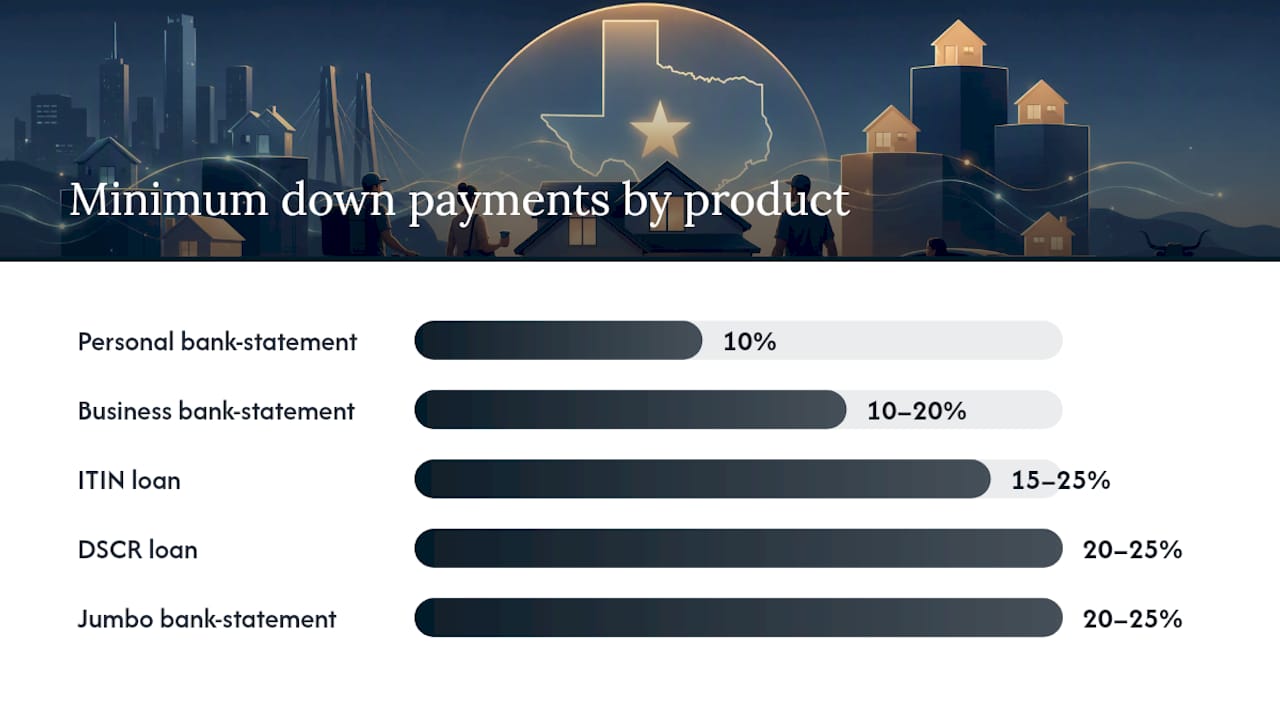
| Personal bank-statement loan | Sole proprietors, gig workers with clean personal accounts | 10% | 12-24 months personal statements | Purchase, refi, cash-out |
| Business bank-statement loan | LLCs, S-corps with dedicated business accounts | 10%-20% | 12-24 months business statements + CPA letter | Purchase, refi, jumbo |
| P&L loan | Borrowers with strong CPA-prepared financials | 10%-20% | P&L + 12 months statements | Purchase, refi |
| ITIN loan | Non-citizen borrowers without SSN | 15-25% | ITIN, 12-24 months statements | Purchase |
| DSCR loan | Real estate investors | 20-25% | Lease agreement, property income | Investment property |
| Jumbo bank-statement | High-value purchases | 20-25% | 24 months statements, full asset docs | Purchases up to $3.5M-$5M |
- Rates are generally higher than conventional loans, with the premium varying based on credit score and loan-to-value ratio.
- Programs support LTV up to ~90% for purchases, with fixed and interest-only term options
- Texasbankstatementloans covers all of these product types across Texas, with a 10% starting down payment for primary residence purchases
For contractors navigating documentation requirements, the approach to self-employed mortgage qualification shares common principles across markets: consistent income records and clean account separation matter everywhere.
How long does this take, and what does it cost?
- Pre-qualification: Minutes, using the 60-second qualifier
- Underwriting to conditional approval: 14-21 days with a portfolio non-QM lender when your file is clean
- Appraisal and clear-to-close: Add 1-2 weeks for appraisal scheduling and review
- Total time to close: 30-45 days is realistic for a well-prepared file
Cost expectations:
- Down payment varies depending on property type and credit profile
- Closing costs generally amount to a few percent of the loan total
- Rate premium vs. conventional: 0.5-1.5% higher, depending on credit score and LTV
- Reserves typically cover several months of mortgage payments kept in liquid assets after closing
Timing callout: Portfolio non-QM lenders often approve files faster than large banks because they underwrite to a bespoke risk profile rather than automated rule engines. A well-prepared file can reach conditional approval in under three weeks.
Worked example: turning 12 months of deposits into a payment estimate
Use the bank statement loan calculator to run your own numbers. Here’s how the math works manually:
| Step | Personal Statements | Business Statements (Default) | Business + CPA Letter |
|---|---|---|---|
| Total deposits (12 months) | $100,000 | $100,000 | $100,000 |
| Expense factor applied | 0% | 50% | 35% |
| Qualifying annual income | $100,000 | $50,000 | $70,000 |
| Monthly qualifying income | $3,000 | $3,000 | $6,000 |
| Max monthly payment (45% DTI) | $4,000 | $2,000 | $2,500 |
| Rough loan amount (7% rate, 30yr) | ~$600,000 | ~$300,000 | - |
The CPA letter scenario adds roughly $100,000 in purchasing power compared to the default business-statement calculation, for the cost of a few hundred dollars in accounting fees. That’s the highest-leverage single document in this process.
You can also validate these numbers with the self-employed affordability calculator before speaking with a loan officer.
Common red flags and how to fix them before you apply
Top underwriting triggers:
- Commingled personal and business deposits in one account
- Large, irregular deposits with no explanation
- Credit score below 620 or recent derogatory marks
- Insufficient reserves after the down payment
- Recent bankruptcy or foreclosure (most programs require 2-4 years of seasoning)
Fixes, prioritized by timeline:
- Next 30 days: Open a dedicated business checking account and route all business revenue through it. Pull your credit report and dispute any errors.
- Next 60 days: Run all client payments through the business account consistently. Get a CPA letter prepared. Document any large deposits with paper trails.
- Next 90 days: Build reserves to at least 3 months of your target payment. Pay down any revolving balances to below 30% utilization to lift your score.
Pro Tip: A CPA letter that reduces your expense factor from 50% to 35% can add more qualifying income than six months of additional deposits. Get it before you apply, not after.
Key Takeaways
Bank-statement underwriting is a direct path for Texas gig workers to overcome conventional mortgage rejection by using months of deposits, a CPA letter, and a clean account structure to qualify.
| Point | Details |
|---|---|
| Deposits replace tax returns | Lenders use 12-24 months of bank deposits to calculate qualifying income instead of W-2s or tax returns. |
| CPA letter is high-leverage | Reducing the expense factor from 50% to 35% can add roughly $100,000 in purchasing power on $100,000 in annual deposits. |
| Down payment starts at 10% | Primary residence purchases require as little as 10% down; investment properties typically need 20-25%. |
| Timeline is faster than expected | A clean, well-prepared file can reach conditional approval in 14-21 days with a portfolio lender. |
| Texasbankstatementloans | Offers 12-24 month deposit underwriting, 10% starting down payment, DSCR and ITIN support, and a 60-second no-obligation qualifier across Texas. |
Why bank-statement underwriting actually reflects repayment ability
The conventional mortgage system was built around W-2 employees. It treats a gig worker’s tax return, which often shows low net income after legitimate business deductions, as the full picture of their finances. It isn’t. A freelance designer depositing $12,000 a month into their business account has real repayment capacity, regardless of what Schedule C shows after deducting equipment, software, and home office costs.
What I find underappreciated is that bank-statement underwriting is arguably more predictive of repayment ability for self-employed borrowers, not less. Deposits are cash actually received. They’re harder to manipulate than reported income, and they reflect what a borrower actually lives on. The conventional system’s rejection of these borrowers isn’t a risk management decision, it’s a documentation mismatch.
That said, this path isn’t right for everyone. If your deposits are irregular, your accounts are commingled, or your credit is below 620, applying now will likely result in rejection and wasted time. Spend 60-90 days cleaning up the profile first. The loan will still be there.
Texasbankstatementloans: your next step toward approval
The biggest gap between a gig worker who gets approved and one who doesn’t usually isn’t income. It’s knowing which lender to approach and how to present the file.
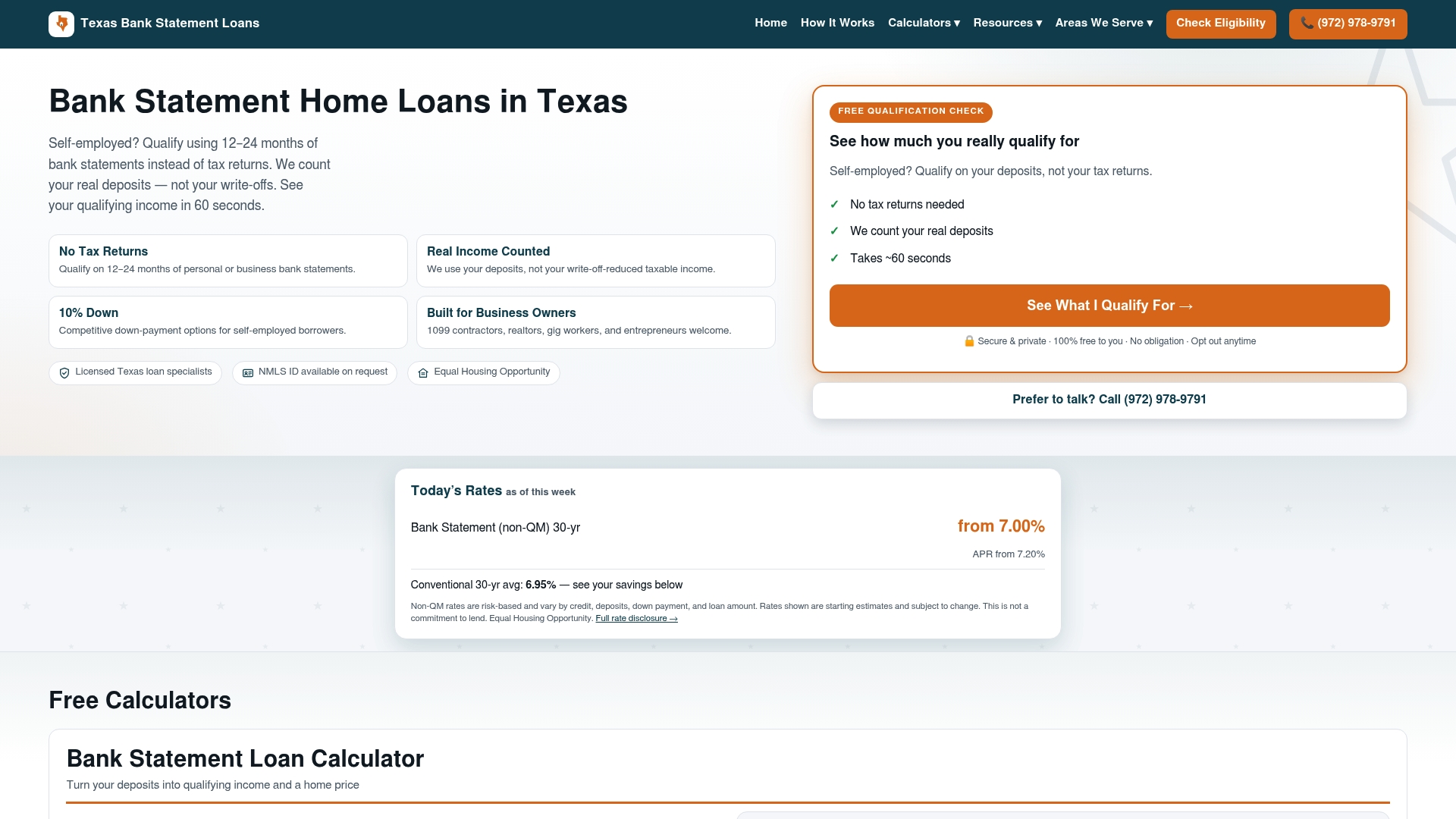
Texasbankstatementloans qualifies Texas borrowers using 12-24 months of personal or business bank deposits, with down payments starting at 10% and support for ITIN, DSCR, jumbo, and P&L loan structures. The 60-second qualifier tells you your likely program and qualifying range before you pull a single document together. No credit pull, no obligation.
If you’re in Houston, Plano, San Antonio, or anywhere else in Texas, the service covers your market with loan officers who understand non-QM underwriting and can walk you through the document checklist specific to your income type.
Run the 60-second qualification check now, or go straight to the bank statement loan calculator to model your qualifying income before your first conversation.
This article provides general information about bank-statement mortgage programs and is not financial or legal advice. Loan terms, eligibility, and rates vary by lender and borrower profile. Confirm current program requirements with a licensed mortgage professional.
Useful sources and tools
- Bank Statement Loans in Texas | Loankea
- Bank Statement Loans in Texas for Self-Employed Borrowers
- Bank Statement Mortgage Texas: 7 Proven Steps to Get Approved Without Tax Returns
- Bank Statement Loans Texas for Self-Employed | Kellibrooke
Recommended
See what you qualify for in 60 seconds, free and no credit check. Use the eligibility check at the top of this page.