
A jumbo bank statement loan is a non-QM mortgage that lets self-employed borrowers qualify for loans exceeding $832,750 using 12 to 24 months of bank deposits instead of tax returns. This product exists because conventional mortgage underwriting relies on W-2s and tax returns, which often understate the real income of business owners, 1099 contractors, and gig workers. Loan amounts commonly reach $3 million to $4 million, with down payments starting at 10% and credit scores near 660 to 700. For self-employed borrowers in a competitive housing market, this loan type is often the most direct path to high-value homeownership.
What is a jumbo bank statement loan and how does it work?
A jumbo bank statement loan qualifies borrowers based on actual cash deposits rather than taxable income. Traditional lenders look at adjusted gross income on tax returns, which often reflects deductions that reduce the number on paper. A business owner writing off $80,000 in expenses may show $60,000 in taxable income while depositing $140,000 into their accounts. The bank statement loan captures that $140,000.
Lenders review 12 to 24 consecutive months of personal or business bank statements to calculate average monthly deposits. They then apply an expense ratio, commonly around 50%, to estimate net usable income. That figure drives the debt-to-income calculation and determines how much you can borrow.

This product sits in the non-QM category, meaning it does not conform to Fannie Mae or Freddie Mac guidelines. Non-QM does not mean risky. Unlike the stated income loans that contributed to the 2008 financial crisis, bank statement loans require verifiable deposits and consistent business activity. Lenders verify the source of every deposit, so the income must be real and documented.
How do lenders qualify self-employed borrowers for this loan?
Qualification for a jumbo bank statement loan follows a specific checklist that differs significantly from conventional underwriting. Meeting each requirement before you apply saves time and improves your approval odds.
The core documentation requirements include:
- Bank statements: 12 to 24 consecutive months, personal, business, or both
- Proof of self-employment: At least 2 years of business operation, verified by a CPA letter, business license, or tax ID registration
- Credit score: Generally 680 or higher, though some lenders accept scores near 660 depending on loan size and down payment
- Liquid reserves: Typically 6 to 24 months of mortgage payments held in accessible accounts after closing
- Consistent deposit history: Irregular or unexplained large deposits raise underwriting flags
Lenders also verify that deposits come from legitimate business activity. A profit and loss statement prepared by a CPA can support the income calculation and clarify any deposit irregularities.
Pro Tip: Keep your personal and business bank accounts completely separate before you apply. Commingled funds force underwriters to manually trace every transaction, which slows approval and can reduce your qualifying income.
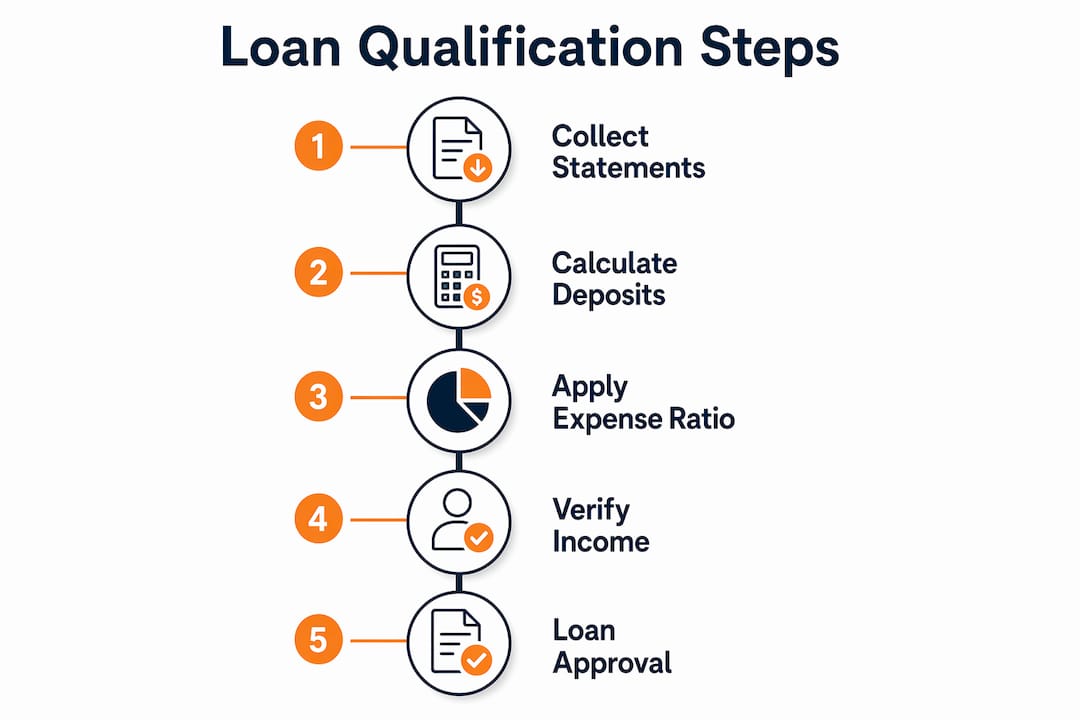
The expense ratio applied to business deposits varies by lender. A 50% ratio is common, meaning $200,000 in annual business deposits produces $100,000 in qualifying income. Some lenders offer lower ratios for certain industries, which increases qualifying income. Asking about industry-specific ratios before choosing a lender can meaningfully change your loan amount.
What are the loan terms and pricing differences?
Jumbo bank statement loans carry distinct terms compared to conventional jumbo mortgages. Understanding the cost structure helps you decide whether the flexibility is worth the premium.
The FHFA sets conforming loan limits at $832,500 for most counties and up to $1,248,750 in high-cost areas for 2026. Any loan above those thresholds is a jumbo loan. Bank statement jumbo products typically start at $1 million and extend to $4 million or more, with loan-to-value ratios between 80% and 90%.
The pricing premium for non-QM status is real. Bank statement jumbo loans carry interest rates 0.75% to 1.5% higher than traditional jumbo mortgages. On a $2 million loan, that difference adds several hundred dollars per month to your payment. That cost is the trade-off for qualifying without tax returns.
| Feature | Jumbo bank statement loan | Traditional jumbo loan |
|---|---|---|
| Income verification | 12-24 months bank deposits | W-2s and tax returns |
| Loan amounts | $1M to $4M+ | $832,500+ |
| Down payment | 10%-20% | 10%-20% |
| Credit score minimum | 660-700+ | 700+ |
| Interest rate premium | 0.75%-1.5% above conventional | Baseline jumbo rate |
| PMI requirement | Often waived | Often waived |
| Reserve requirement | 6-24 months | 3-12 months |
One notable benefit: many jumbo bank statement loans do not require private mortgage insurance even at higher loan-to-value ratios. That partially offsets the rate premium for borrowers putting down 10% to 15%.
What are the benefits and drawbacks of a bank statement jumbo loan?
The benefits of bank statement loans are clearest for borrowers whose tax returns do not reflect their real financial strength. The drawbacks are real too, and ignoring them leads to surprises at closing.
Key benefits:
- Qualifies based on actual cash flow, not taxable income after deductions
- Accepts income from multiple business streams, rental income, or 1099 sources
- Down payments starting at 10% make high-value homes accessible without liquidating investments
- No W-2 or employer verification required
- Works for borrowers with nontraditional or seasonal income patterns
Key drawbacks:
- Interest rates run 0.75% to 1.5% above comparable full-documentation jumbo loans
- Reserve requirements are stricter, often 12 to 24 months of payments
- Down payments of 10% to 20% are standard, and higher loan amounts may require more
- Fewer lenders offer this product, so rate shopping takes more effort
- Underwriting timelines can run longer than conventional loans
Pro Tip: Always request quotes for both a full-documentation jumbo loan and a bank statement jumbo loan at the same time. If your tax returns show enough income to qualify conventionally, the full-doc option will almost always carry a lower rate.
The right choice depends on your specific tax strategy and documentation. A borrower who aggressively deducts business expenses may show too little taxable income to qualify conventionally, making the bank statement route the only viable path. A borrower with cleaner returns might find the conventional route cheaper.
How do you prepare and apply for a jumbo bank statement loan?
Preparation determines approval speed and loan terms. Borrowers who organize their finances before applying move through underwriting faster and with fewer conditions.
-
Compile your bank statements. Gather 12 to 24 consecutive months of statements for every account you plan to use. Gaps in the sequence or missing pages will stall the process.
-
Verify your business documentation. Obtain a CPA letter confirming at least 2 years of self-employment and business ownership. A current business license or articles of incorporation also supports your file.
-
Check and strengthen your credit score. Most lenders require 680 or above for standard terms. Pay down revolving balances and resolve any collection accounts before applying. Higher scores unlock better rates and lower down payment requirements.
-
Build your reserves. Lenders want to see 6 to 24 months of mortgage payments in liquid accounts after your down payment clears. Move funds into accessible accounts at least 60 days before applying so they are properly seasoned.
-
Choose a lender with jumbo bank statement experience. Not every mortgage lender offers this product. Work with a lender who underwrites these loans regularly. Inexperienced underwriters create unnecessary conditions and delays.
-
Request side-by-side quotes. Mortgage professionals recommend pulling both full-doc and bank statement quotes to identify the better pricing path before committing.
Pro Tip: If you use a business account for qualifying, prepare a simple profit and loss statement with your CPA. It gives underwriters a clear picture of your business income and reduces back-and-forth requests during review.
Self-employed borrowers in Texas can use the self-employed affordability calculator at Texasbankstatementloans to estimate how much they qualify for based on their deposit history before speaking with a lender.
Key Takeaways
A jumbo bank statement loan is the most direct mortgage path for self-employed borrowers whose tax returns understate their real income, provided they can document consistent deposits and meet reserve requirements.
| Point | Details |
|---|---|
| Core qualification method | Lenders use 12-24 months of bank deposits, not tax returns, to calculate income. |
| Jumbo threshold in 2026 | Loans above $832,500 (or $1,248,750 in high-cost counties) require jumbo products. |
| Rate premium | Expect to pay 0.75%-1.5% more than a conventional jumbo rate for non-QM status. |
| Reserve requirement | Plan to hold 6-24 months of mortgage payments in liquid accounts after closing. |
| Compare both options | Always pull a full-doc quote alongside a bank statement quote before deciding. |
Why I think self-employed borrowers underestimate this loan type
Most self-employed borrowers I have seen come to the table assuming they cannot qualify for a high-value mortgage. They have spent years writing off every legitimate business expense, which is smart tax planning but brutal for conventional mortgage applications. The bank statement loan exists precisely for this situation, and yet many borrowers discover it only after a conventional lender turns them down.
The misconception I hear most often is that non-QM means subprime. It does not. The documentation standards are different, not lower. Lenders still verify income, employment history, and reserves. The difference is that they verify it through deposits rather than tax lines.
My honest advice: do not wait until you find a property to figure out your financing path. Pull both quotes early. If your tax returns show enough income, take the conventional rate. If they do not, the bank statement route gives you a legitimate, well-structured alternative. The rate premium is real, but so is the ability to buy a $2 million home that your tax return alone would never support.
The 2026 jumbo market has more lenders offering bank statement products than five years ago. That competition is good for borrowers. Shop aggressively, compare expense ratios across lenders, and do not accept the first rate you receive.
- Saad
Texasbankstatementloans: jumbo financing built for self-employed buyers
Self-employed borrowers in Texas have a direct resource for jumbo bank statement financing at Texasbankstatementloans. The service evaluates 12 to 24 months of bank deposits instead of tax returns, with down payment options starting at 10% and loan amounts reaching into the millions.
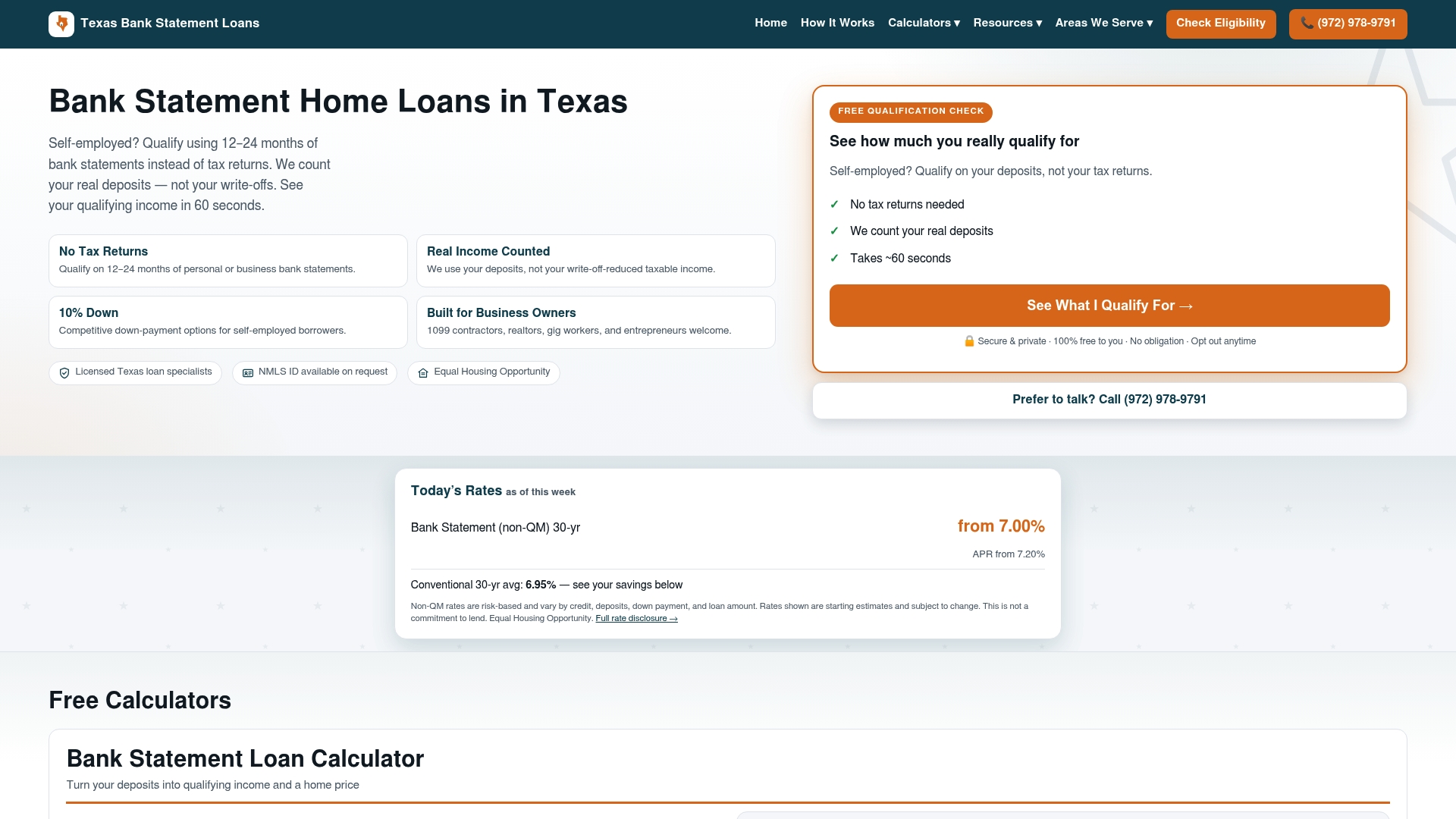
Texasbankstatementloans works with business owners, 1099 contractors, and gig workers across Texas, including Houston area borrowers and buyers in markets like Austin, Midland, and Tyler. A no-obligation qualification check takes 60 seconds and shows you a realistic loan amount based on your actual deposits. If you are ready to see what you qualify for, Texasbankstatementloans is the place to start.
FAQ
What is the minimum credit score for a jumbo bank statement loan?
Most lenders require a credit score of 680 or higher for standard terms, though some accept scores near 660 depending on loan size and down payment. Higher scores typically unlock lower rates and reduced reserve requirements.
How do lenders calculate income from bank statements?
Lenders average your monthly deposits over 12 to 24 months and apply an expense ratio, commonly 50%, to estimate net qualifying income. Business accounts typically use a higher expense ratio than personal accounts.
Are jumbo bank statement loans more expensive than traditional jumbo loans?
Yes. Bank statement jumbo loans carry a rate premium of 0.75% to 1.5% above conventional jumbo mortgages due to their non-QM status. Borrowers should compare both loan types to confirm which path offers better overall cost.
How much do I need in reserves to qualify?
Lenders generally require 6 to 24 months of mortgage payments in liquid reserves after your down payment. The exact amount depends on loan size, credit score, and the lender’s specific guidelines.
Can I use both personal and business bank statements to qualify?
Yes. Lenders accept personal statements, business statements, or a combination of both. Business accounts require proof of ownership and typically carry a higher expense ratio applied to deposits when calculating qualifying income.
Recommended
See what you qualify for in 60 seconds, free and no credit check. Use the eligibility check at the top of this page.