
Non-QM loans are mortgage products that fall outside the Consumer Financial Protection Bureau’s Qualified Mortgage standards but remain fully regulated under federal lending law. For realtors, self-employed buyers, and gig workers, realtor non-qm loan terms explained correctly can mean the difference between closing a deal and losing it. The two most common products are DSCR loans and bank statement loans, both of which replace W-2 income verification with real-world cash flow evidence. Texasbankstatementloans specializes in exactly this space, helping Texas borrowers qualify based on 12-24 months of bank deposits rather than tax returns.
What are the common Non-QM loan types and key terms?
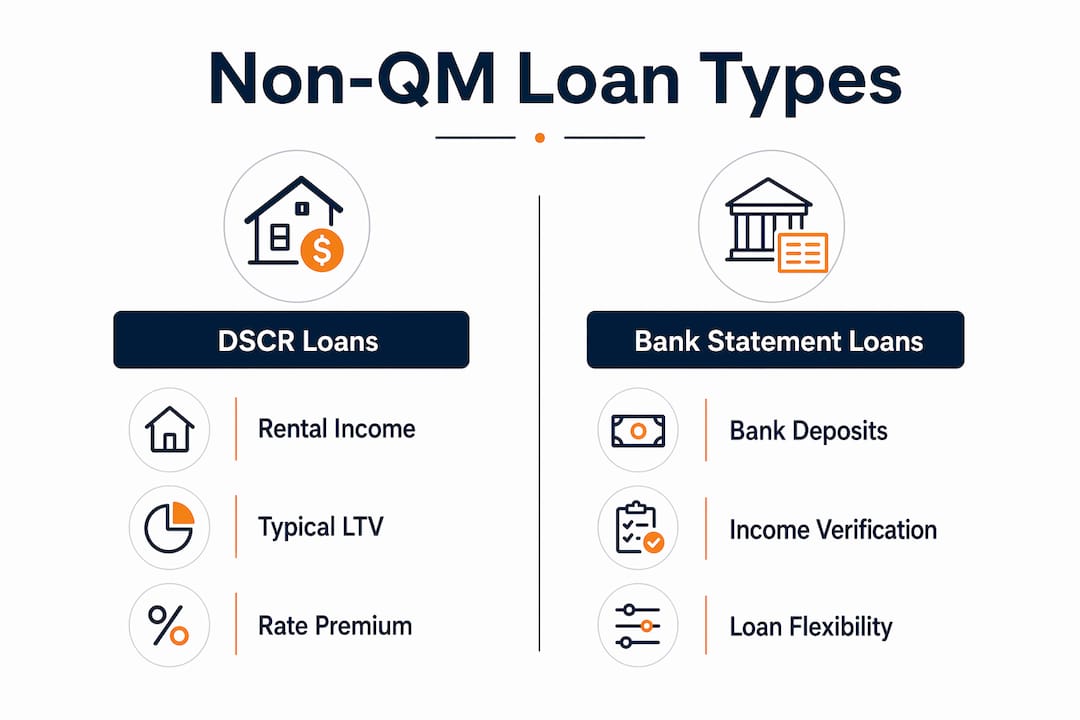
DSCR and bank statement loans dominate the Non-QM market, with 89% of mortgage brokers citing DSCR loans and 74% citing bank statement loans as their primary Non-QM products. That concentration reflects where borrower demand actually sits.
Debt Service Coverage Ratio (DSCR) loans
A DSCR loan qualifies a borrower based on the rental income a property generates, not the borrower’s personal income. Lenders require the property’s rental income to cover 1.0-1.25 times the monthly mortgage payment. A ratio of 1.0 means the rent exactly covers the payment. A ratio of 1.25 means the property earns 25% more than the payment, which most lenders prefer.

Bank statement loans
Bank statement loans replace tax returns with 12-24 months of personal or business bank deposits. Lenders also require a signed 4506-C IRS transcript verification to confirm the borrower’s tax filing status. This approach reveals true cash flow, which tax returns often understate due to legal write-offs.
Asset depletion loans
Asset depletion loans calculate qualifying income by dividing a borrower’s liquid assets over a set number of months. A borrower with $1,200,000 in liquid assets divided over 360 months generates $3,333 per month in qualifying income. This method suits retirees and high-net-worth borrowers who hold wealth outside regular income streams.
Key terms every borrower should know:
- Loan-to-Value (LTV): The loan amount as a percentage of the property’s appraised value. Non-QM lenders typically cap LTV at 75-90%.
- Debt-to-Income (DTI): Monthly debt payments divided by gross monthly income. Non-QM loans allow higher DTI thresholds than conventional loans.
- Prepayment penalty: A fee charged if you pay off the loan early, typically within the first 1-3 years.
- Interest-only period: A phase where you pay only interest, reducing monthly payments during the early loan years.
- Expense ratio: The percentage lenders deduct from business bank deposits to estimate net income.
| Loan Type | Income Verification | Typical LTV | Rate Premium |
|---|---|---|---|
| DSCR | Property rental income | Up to 80% | 0.5-1.5% above conventional |
| Bank statement | 12-24 months deposits | Up to 90% | 0.5-2.0% above conventional |
| Asset depletion | Liquid asset calculation | Up to 75% | 1.0-2.0% above conventional |
| 1099 income | 1099 forms, two years | Up to 85% | 0.5-1.5% above conventional |
Pro Tip: If your client runs a business, ask whether they want to use personal or business bank statements before the application starts. Lenders apply an expense ratio to business accounts, which reduces qualifying income. Personal statements often produce a higher qualifying figure.
How do Non-QM terms benefit self-employed borrowers and realtors?
The qualification gap between conventional lending and self-employed borrowers is not about financial capability. It is about documentation format. A realtor earning $180,000 per year who writes off $60,000 in business expenses shows only $120,000 on a tax return. A conventional lender uses the $120,000 figure. A Non-QM lender using bank statements sees the full $180,000 in deposits.
Non-QM loans carry rate premiums of 0.5-2.0% above conventional mortgage rates. Down payments typically range from 10-25%, with better rates available at higher down payment amounts. Texasbankstatementloans offers down payment options starting at 10%, which keeps entry costs manageable for first-time investment buyers.
Core benefits for realtors and self-employed borrowers:
- Qualify based on actual cash flow, not tax-adjusted income
- Finance non-traditional properties including short-term rentals, multi-unit homes, and investment properties
- Accommodate multiple LLCs and complex ownership structures
- Receive faster approval timelines compared to conventional underwriting
- Use 1099 income, commission income, or rental income as the primary qualification basis
Pro Tip: Identify Non-QM eligibility at the very start of a transaction. Early Non-QM identification prevents deal fatigue and avoids rate lock expiration, which is one of the most common and costly mistakes in complex borrower transactions.
What documentation and underwriting distinguish Non-QM loans?
Non-QM underwriting replaces the standard W-2 and tax return package with alternative documentation that reflects real income. The exact package depends on the loan type, but most lenders require a consistent set of core items.
Standard Non-QM documentation requirements:
- 12-24 months of personal or business bank statements
- 1099 forms for contract or commission income
- Signed 4506-C for IRS transcript verification
- Proof of self-employment, such as a business license or CPA letter
- Asset statements for reserve verification
Business bank statement loans apply an expense ratio to deposits, typically between 40-50%, to estimate net income. Personal bank statement loans use a higher percentage of deposits as qualifying income. Choosing the right statement type can significantly change the qualifying income figure.
DSCR loan underwriting skips personal income entirely. The lender analyzes the property’s lease agreement or market rent estimate and compares it to the proposed monthly payment. This makes DSCR loans especially useful for realtors who own investment properties and want to keep personal income documentation out of the file.
| Criteria | Non-QM Loan | Conventional Loan |
|---|---|---|
| Income verification | Bank statements, 1099s, rental income | W-2s, tax returns |
| Credit score minimum | Typically 620-660 | Typically 620-740 |
| Down payment | 10-25% | 3-20% |
| DTI tolerance | Up to 50-55% | Up to 43-45% |
| Prepayment penalty | Possible (1-3 years) | Not permitted on QM loans |
Non-QM underwriting also includes credit overlays, reserve requirements, and LTV discipline. These controls reflect institutional confidence in Non-QM performance, not a lack of rigor. The process is different from conventional underwriting, but it is not looser.
What Non-QM loan terms should realtors and gig workers know?
Realtors advising clients on Non-QM products need to understand the specific terms that appear in these loan agreements. Several of these terms do not exist in conventional QM loans at all.
Prepayment penalties are the most frequently misunderstood feature. Non-QM loans may include penalties of 1-3% on the outstanding balance if the borrower pays off the loan during the initial years. These penalties are negotiable. A borrower can often waive the penalty in exchange for accepting a slightly higher interest rate.
Extended loan terms give borrowers more flexibility in managing monthly payments. 40-year loan terms with interest-only payment structures reduce monthly obligations and improve cash flow for investment properties. A 40-year term on a $400,000 loan produces a meaningfully lower payment than a 30-year term at the same rate.
Common Non-QM loan features realtors should communicate to clients:
- Rate premiums reflect the lender’s risk, not the borrower’s creditworthiness alone
- Interest-only periods typically last 5-10 years before converting to fully amortizing payments
- Prepayment penalties can be structured as step-down penalties, decreasing each year
- Non-QM loans cannot be sold to Fannie Mae or Freddie Mac, which is why rates are higher
- Reserve requirements often equal 3-12 months of mortgage payments held in liquid assets
Pro Tip: When advising a client on a Non-QM loan, run the DTI calculation before the lender does. Knowing the DTI figure in advance lets you position the loan correctly and avoid surprises during underwriting.
Key Takeaways
Non-QM loans are the most practical mortgage path for self-employed borrowers and realtors because they qualify income based on cash flow, not tax returns.
| Point | Details |
|---|---|
| DSCR and bank statement loans lead | 89% of brokers use DSCR loans and 74% use bank statement loans as primary Non-QM products. |
| Rate premiums are predictable | Non-QM rates run 0.5-2.0% above conventional, with better pricing at higher down payments. |
| Documentation replaces tax returns | Lenders use 12-24 months of bank statements and a signed 4506-C instead of W-2s. |
| Prepayment penalties are negotiable | Penalties of 1-3% can often be waived in exchange for a slightly higher interest rate. |
| Early identification prevents deal loss | Spotting Non-QM eligibility at the start of a transaction avoids rate lock expiration and deal fatigue. |
Why I think Non-QM is no longer a fallback option
The industry has spent years treating Non-QM loans as a last resort for borrowers who could not qualify conventionally. That framing is outdated and, frankly, costs clients money.
I have seen realtors lose deals because they waited too long to identify a Non-QM borrower. The client spent weeks in a conventional underwriting process, the rate lock expired, and the deal fell apart. Non-QM as a first call is not a compromise. For 86.6% of core Non-QM clients who are self-employed, it is the most direct path to approval.
The process efficiency side still needs work. Industry process scores for Non-QM lending sit at 6.4 out of 10, which tells you there is real room for improvement. Technology is closing that gap, and lenders who invest in digital document collection and automated bank statement analysis are already pulling ahead.
My honest advice: if you are a realtor working with self-employed buyers, learn the Non-QM qualification criteria before your next listing appointment. Knowing whether a buyer qualifies via bank statements or DSCR before they apply saves everyone time and builds your credibility as an advisor who understands the full financing picture.
- Saad
Non-QM financing options at Texasbankstatementloans
Self-employed borrowers and realtors in Texas have access to Non-QM products built specifically for their income situations at Texasbankstatementloans.
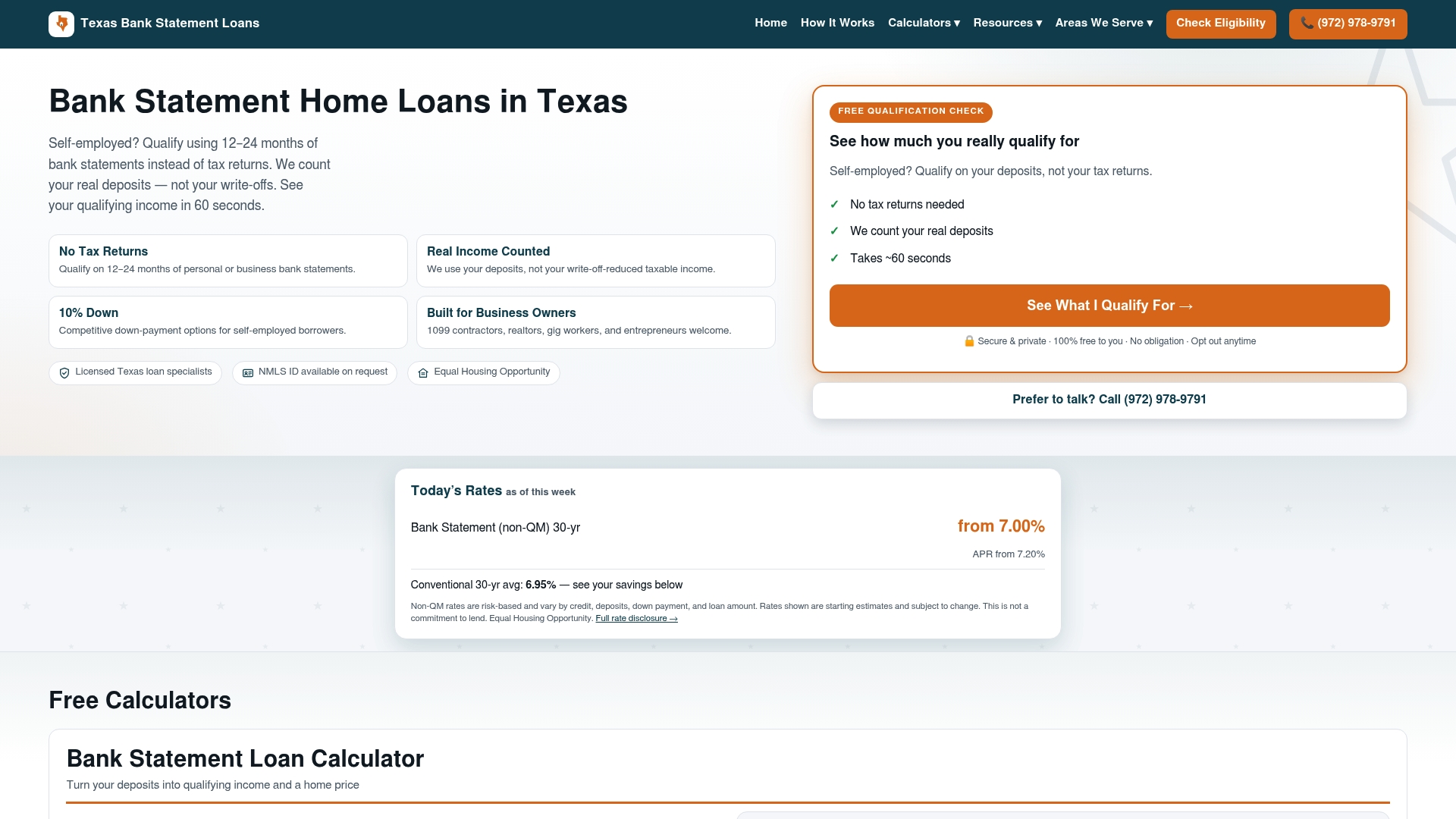
Texasbankstatementloans evaluates 12-24 months of bank deposits instead of tax returns, which means your actual income drives the qualification. Down payment options start at 10%, and the no-obligation qualification check takes 60 seconds. Whether you are buying in Houston, Dallas, or San Antonio, the bank statement loan options cover the full Texas market. Realtors looking to refer self-employed clients can also use the self-employed affordability calculator to show buyers a realistic purchase price before the first lender conversation.
FAQ
What is a Non-QM loan in simple terms?
A Non-QM loan is a mortgage that does not meet the Consumer Financial Protection Bureau’s Qualified Mortgage standards but is still a legal, regulated product. It uses alternative income documentation like bank statements or rental income instead of W-2s and tax returns.
Why do realtors benefit from understanding Non-QM products?
Realtors who understand Non-QM loan terms can qualify more buyers, including self-employed clients and investors who would not pass conventional underwriting. Early identification of Non-QM eligibility prevents deal fatigue and rate lock expiration.
What credit score do you need for a Non-QM loan?
Most Non-QM lenders require a minimum credit score of 620-660, though requirements vary by lender and loan type. Higher scores typically unlock better rates and lower down payment requirements.
Can a realtor use a Non-QM loan to buy investment property?
Yes. DSCR loans are specifically designed for investment properties and qualify the borrower based on the property’s rental income, not personal income. This makes them a strong fit for realtors building a rental portfolio.
Are Non-QM loan rates always higher than conventional rates?
Non-QM rates run 0.5-2.0% above conventional mortgage rates because these loans cannot be sold to Fannie Mae or Freddie Mac. Borrowers who put down more money or have stronger credit scores typically receive rates at the lower end of that range.
Recommended
See what you qualify for in 60 seconds, free and no credit check. Use the eligibility check at the top of this page.