
An “income gaps mortgage” is really a bank-statement mortgage: a loan that qualifies you on 12 to 24 months of deposits instead of tax returns. It exists specifically for people whose tax filings understate what they actually make, which covers most 1099 contractors, gig workers, small business owners, and Texas realtors. There are free 60-second affordability checks and calculators available that show, before you talk to anyone, roughly what you qualify for.
TL;DR:
- Using a 12-month window typically boosts qualifying income for fast-growing businesses, while a 24-month window better smooths out seasonal fluctuations.
- Excluding transfers, loan proceeds, gifts, refunds, and asset sales from deposits is standard practice for calculating real income in bank-statement loans.
- Credit scores below 660, low reserves, and unstable deposit patterns are common red flags that can hinder loan approval or increase costs.
- These loans are more expensive than conventional mortgages, with higher interest rates and stricter down payment and reserve requirements, but they better reflect actual cash flow.
Table of Contents
- How Bank-Statement Mortgage Programs Actually Work
- How Lenders Turn Deposits Into Qualifying Income
- What Lenders Typically Require for Approval
- Getting Your Bank Statements Ready for Underwriting
- Legitimate Ways to Raise Your Qualifying Income
- Conventional Loans vs. Bank-Statement Programs
- Finding a Lender Who Actually Understands This Program
- A Mortgage Specialist’s Quick Checklist for Self-Employed Borrowers
- Start With a Free Qualifying-Income Check
- Sources
How Bank-Statement Mortgage Programs Actually Work
Lenders pick a window, either 12 or 24 months, then average your deposits to build a qualifying income figure. A 12-month window suits a business that’s growing fast, since a shorter lookback won’t drag last year’s slower months into the average. A 24-month window works better for a business with seasonal swings, because it smooths out the rough patches.
Underwriters also strip out anything that isn’t real income: transfers between your own accounts, loan proceeds, gift funds, tax refunds, and one-time asset sales all get excluded from the count.
How Lenders Turn Deposits Into Qualifying Income
Here’s the math in practice. Say a contractor deposits an average of $12,000 a month into a business account over 24 months.
Now run the same deposits through a 12-month window during a stronger stretch, and the average might climb to $14,000 a month before the expense ratio, pushing qualifying income to $7,000. That single choice, window length, moved usable income by $1,000 a month.
A CPA letter changes the equation further. If an accountant documents that actual operating expenses run closer to 30% instead of the lender’s default 50%, qualifying income on that same $12,000 average jumps to $8,400 a month.

Your debt-to-income ratio and credit score then decide how much of that qualifying income actually converts into loan approval. A higher score generally buys more room on DTI and better pricing on the loan itself.
What Lenders Typically Require for Approval
Bank-statement programs are more flexible than conventional loans, but they still have firm guardrails. Before you contact a lender, check yourself against this list:
- Credit scores commonly start in the 620 to 660 range, with the best pricing reserved for scores above 720.
- Down payments often start at a moderate percentage, climbing higher if your credit score is on the lower end.
- Reserves, meaning cash left over after closing, typically need to cover a few months of payments.
- Lenders generally want a couple of years of self-employment history, verified through business licenses, a CPA letter, or a business bank account tied to your name.
- Red flags include frequent NSFs, overdrafts, unexplained large deposits, and a steadily shrinking account balance.
Getting Your Bank Statements Ready for Underwriting
Preparation is where most self-employed borrowers either save themselves weeks of back-and-forth or create their own delays. Work through it in order:
- Pull full statements, not summaries. Download every page for each account, even blank transaction pages, for the full 12 or 24 months your lender requires.
- Collate multiple accounts clearly. If you run deposits through more than one account, label each statement set by account and date range before you send anything.
- Document irregular deposits. Large or one-time deposits need a paper trail: invoices, signed contracts, or wire confirmations that explain where the money came from.
- Request a CPA letter early. Ask your accountant to state your actual expense ratio in writing; this step alone can take a week or more, so start it before you need it.
- Run the numbers yourself first. A bank statement loan calculator or the 60-second affordability check gives you a realistic number before a lender ever pulls your file.
Pro Tip: Scan and save your statements as one continuous PDF per account rather than dozens of separate files. Underwriters move faster on a clean, chronological file, and so does your loan.
Legitimate Ways to Raise Your Qualifying Income
A few adjustments, made honestly and on paper, can meaningfully change your number. Routing client payments into a personal account rather than a business account, and documenting that transfer, can raise qualifying income because personal deposits usually avoid the expense-ratio discount entirely.
A CPA letter is the other lever worth pulling.
Beyond documentation, clean up your cash management. Avoid overdrafts and NSFs in the months leading up to application, keep deposits reasonably consistent rather than lumpy, and build reserves ahead of time. None of this is cosmetic. It’s the same file underwriters are reading either way, just presented so it reflects reality.
Conventional Loans vs. Bank-Statement Programs
If your tax returns already reflect close to what you actually earn, a conventional or FHA loan is almost always cheaper: lower rates, lower down payments, and no non-QM pricing premium. Bank-statement loans exist because tax returns often tell a different story than your bank account, especially with heavy write-offs, depreciation, or K-1 income that shows a thin net profit despite strong cash flow.
Bank-statement loans are non-QM products, which means they typically carry higher rates and stricter down payment or reserve rules than a conventional loan. The tradeoff is real, but so is the alternative: a conventional lender underwriting your Schedule C might approve you for far less than your deposits actually support.
Finding a Lender Who Actually Understands This Program
Not every loan officer works bank-statement files regularly, so vet them before you commit time to an application. Ask directly:
- Which window lengths do you offer, 12 months, 24 months, or both?
- What’s your default expense ratio for business accounts, and do you accept a CPA letter to adjust it?
- What’s your typical timeline from application to closing?
- Can you walk me through exactly how you’ll analyze my deposits?
A broker can be useful here specifically because they compare multiple lender programs at once rather than pushing you toward one investor’s rulebook. Treat vague answers about deposit analysis or pricing as a reason to keep looking.
A Mortgage Specialist’s Quick Checklist for Self-Employed Borrowers
Three things get checked first on any bank-statement file: the consistency of deposits over the lookback period, whether large or irregular deposits have paper trails, and whether a CPA letter is going to move the expense ratio in the borrower’s favor. Files that arrive with those three already handled close noticeably faster than files that don’t.

Set realistic expectations on timing. The process itself mirrors a standard mortgage, but deposit analysis is a front-loaded step, and underwriting to closing commonly runs three to six weeks once the file is complete. Borrowers who show up with disorganized statements or missing documentation for large deposits are the ones who stretch that timeline.
Before contacting anyone, run your own numbers. A free calculator or a 60-second affordability check tells you where you stand without a hard credit pull or a stack of paperwork, and it gives you a realistic target to hand a lender on day one.
- Saad
Start With a Free Qualifying-Income Check
Texasbankstatementloans is built around one idea: your bank deposits, not your tax returns, should decide what you qualify for. The service reviews 12 to 24 months of personal or business statements to calculate real qualifying income, which means write-offs and K-1 quirks that shrink your tax return don’t shrink your buying power.
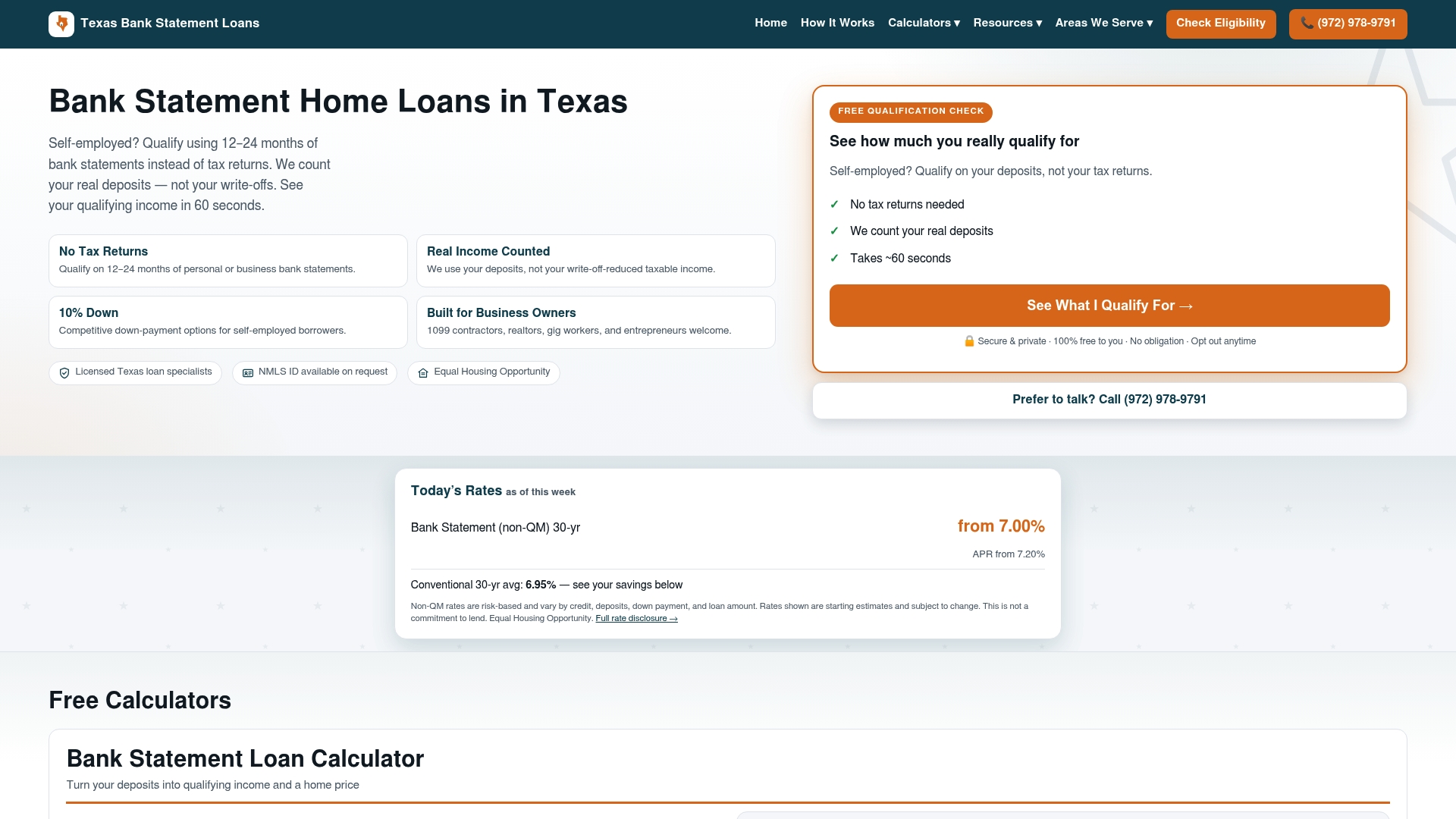
Start with the 60-second affordability check to see a realistic number before you commit to a full application, or run your deposits through the bank statement loan calculator to compare a 12-month window against a 24-month one. If you’re shopping current pricing, the rates page breaks down what non-QM pricing looks like right now. Whether you’re closing in Houston, San Antonio, or Plano, the next step is the same: check your number, then talk to someone who can turn it into an approval.
This article is general information, not a substitute for advice from a qualified financial advisor. Consult a qualified financial professional about your own circumstances before acting on anything here.
Sources
- Bank Statement Loan: What It Is And Who It’s For | Bankrate
- Bank statement mortgages overview | SoFi
- Bank Statement Mortgage: 2026 Guide to Qualify - JVM Lending
- The Bank Statement Mortgage Master Guide 2026: Self-Employed Requirements | LoanWise
Recommended
See what you qualify for in 60 seconds, free and no credit check. Use the eligibility check at the top of this page.