
Texas is the top destination for 1099 borrowers because it combines zero state income tax, a large self-employed economy, and specialized Non-QM mortgage programs that actually work for independent contractors. If you earn 1099 income and want to buy a home, Texas removes two of the biggest obstacles at once: the tax bite on your earnings and the underwriting bias against non-W-2 income. Here is what makes the state stand out for freelancers, consultants, and independent contractors shopping for a mortgage in 2026.
Why 1099 borrowers choose the Texas market comes down to three things: no state income tax on personal income, a growing network of lenders who specialize in Non-QM and bank statement loans, and metro economies like Dallas-Fort Worth and Austin where self-employment is the norm rather than the exception.
- Texas imposes no state income tax on individuals, keeping more of every dollar you earn
- Non-QM and 1099-only loan programs qualify you on gross cash flow, not the shrunken net income your tax return shows
- DFW, Austin, Houston, and San Antonio all have large concentrations of self-employed buyers, so lenders in these markets are fluent in 1099 underwriting
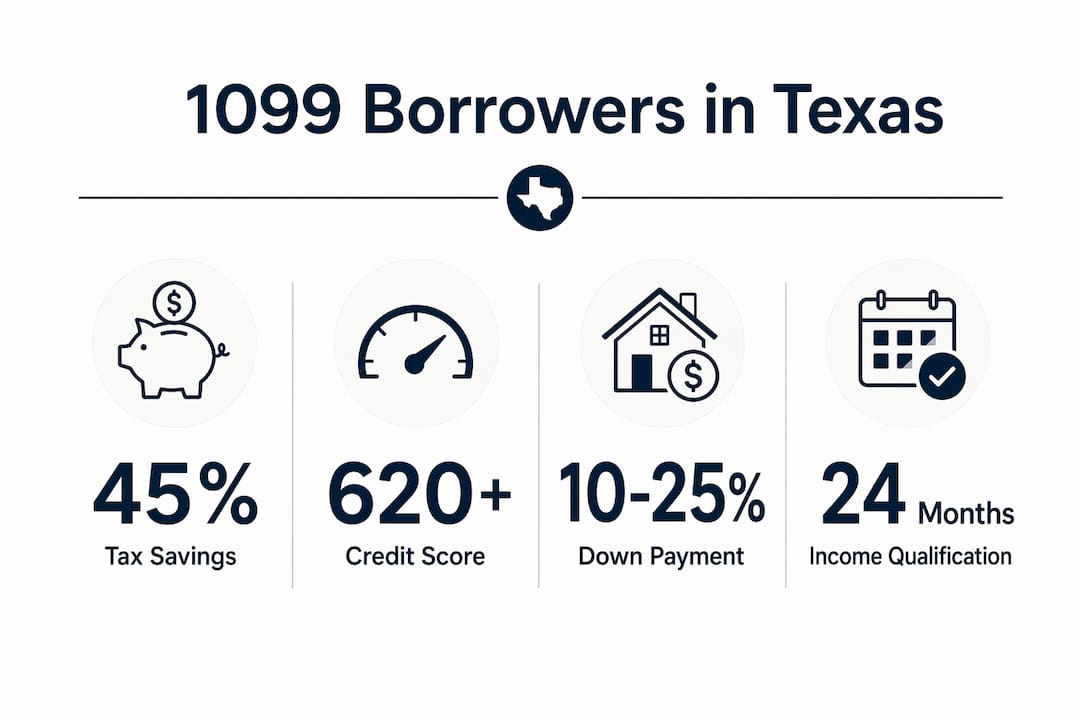
- Down payments start at 10%, and credit score minimums are typically above 620
- Specialized lenders evaluate 12-24 months of bank deposits, giving an accurate picture of what you actually earn
Table of Contents
- Who are 1099 borrower loans in Texas actually built for?
- How lenders calculate 1099 income for mortgage qualification
- What makes the Texas market uniquely suited to 1099 borrowers?
- What do 1099-only loan programs actually look like in Texas for 2026?
- When a 1099-only loan is not the right fit for Texas borrowers
- How bank statement loans capture true income for self-employed borrowers
- How Texas regulations and lender availability shape the 1099 borrower market
- Common challenges 1099 borrowers face in Texas and how specialized loans address them
- Real-world scenarios: how 1099 borrowers use Texas programs to close deals
- Texasbankstatementloans gives 1099 borrowers a faster path to qualification
- Key Takeaways
Who are 1099 borrower loans in Texas actually built for?
The short answer: anyone whose income does not show up cleanly on a W-2. That covers a wider group than most people realize.
- Freelancers and consultants who invoice clients directly and receive 1099-NEC or 1099-MISC forms
- Independent contractors in trades, tech, healthcare, real estate, and logistics
- Gig economy workers whose income flows through platforms and fluctuates month to month
- Small business owners who write off legitimate expenses, leaving taxable income far below actual earnings
- Recent business starters who lack two full years of tax returns but have strong, documented cash flow
- Buyers turned away by conventional lenders not because of bad credit, but because tax strategies reduce taxable income visibility
Conventional lenders built their underwriting around W-2 employees. That model creates a structural mismatch for self-employed borrowers who are financially healthy but look underpaid on paper. A 1099-only or Non-QM loan fixes that mismatch by looking at different documents.
How lenders calculate 1099 income for mortgage qualification
Traditional mortgage underwriting uses your net taxable income from IRS Form 1040. For a 1099 borrower who claims legitimate business deductions, that number can be dramatically lower than what actually hits your bank account. That gap is exactly why Non-QM loans use gross revenue or actual bank deposit cash flow instead.
- 1099 forms as primary documentation: lenders review your 1099-NEC or 1099-MISC forms from the past one to two years to establish income history
- Gross vs. net income: the qualifying income is typically your gross receipts or deposits, not the net figure after deductions
- Bank statements: 12-24 months of personal or business bank statements show actual cash flow and deposit patterns
- Profit and loss statements: a CPA-prepared P&L can supplement 1099s, especially when income has grown recently
- Business deductions: lenders recognize that write-offs for equipment, home office, and travel are legitimate, not signs of financial weakness
The practical result is that a contractor earning $180,000 in gross 1099 income but showing $90,000 in taxable income after deductions can qualify based on the $180,000 figure, or something close to it, depending on the lender’s specific program.
Pro Tip: Gather your 1099 forms, bank statements, and a current P&L before you talk to a lender. Borrowers who arrive with organized documentation move through underwriting faster and face fewer requests for additional paperwork.
What makes the Texas market uniquely suited to 1099 borrowers?
Texas is not just a state where 1099 loans are available. It is a state where the economic and tax environment actively rewards self-employed income earners in ways that most other states do not.
- Zero state income tax: Texas funds government through property and sales taxes, not personal income taxes. A 1099 contractor earning $150,000 in Texas saves roughly $12,000 a year in state taxes compared to a contractor in California. That savings compounds over time and directly affects how much mortgage you can afford.
- High self-employment density in major metros: DFW suburbs like Flower Mound, Southlake, and Frisco have high shares of business owners who rely on Non-QM loans, which means local lenders are experienced with these programs rather than treating them as edge cases.
- Competitive but accessible housing markets: Texas metros offer a range of price points, from entry-level homes in smaller cities to high-value properties in Austin and Dallas, giving 1099 borrowers options at multiple income levels.
- Lender specialization: the volume of self-employed buyers in Texas has pushed lenders to develop and refine Non-QM products specifically for this market. You are not asking a lender to figure out your situation from scratch.
- Pre-qualification leverage: in competitive markets like Austin and DFW, a solid Non-QM pre-qualification gives sellers and agents confidence that your offer is as solid as any W-2 buyer’s.
The combination of tax savings and lender sophistication is what separates Texas from states where Non-QM loans exist but are treated as niche products.
What do 1099-only loan programs actually look like in Texas for 2026?
Program terms vary by lender, but the core structure of 1099-only and Non-QM loans in Texas follows a consistent pattern for 2026. Here is what to expect.
- Down payment: typically 10%-25% of the purchase price, with lower down payments available at higher credit scores
- Credit score: most programs require a minimum score above 620, with better rates available above 700
- Income documentation: 1099 forms from the past one to two years, often supplemented by bank statements
- Loan-to-value limits: vary by program, but most Non-QM products allow up to 80%-90% LTV depending on documentation type
- Loan amounts: programs cover conforming and jumbo loan sizes, making them viable for higher-priced Texas markets
| Program Feature | Typical Range |
|---|---|
| Down payment | 10%-25% |
| Minimum credit score | 620+ |
| Income documentation | 1099 forms, 12-24 months bank statements |
| Loan-to-value | Up to 80%-90% |
| Income basis | Gross 1099 receipts or bank deposits |
| Loan types | Fixed and adjustable rate |
You can check current loan rates to see how today’s rate environment affects your monthly payment before you commit to a program.
When a 1099-only loan is not the right fit for Texas borrowers
Not every self-employed borrower in Texas is best served by a 1099-only program. There are situations where a different loan type makes more financial sense.
- Stable W-2 income alongside 1099 earnings: if you have a salaried job in addition to contract work, a conventional loan may offer lower rates and no PMI at 20% down
- Inconsistent 1099 history: borrowers with highly irregular earnings or less than 12 months of documented 1099 income may not meet program minimums
- High debt-to-income ratios: the Consumer Financial Protection Bureau defines a qualified mortgage DTI threshold that Non-QM lenders also watch closely; if your existing debt is high relative to income, even gross income qualification may not be enough
- Credit challenges: borrowers with scores below 620 typically need to address credit issues before applying, or explore asset depletion loan programs instead
- Down payment constraints: if you need a very low down payment and qualify for FHA or VA programs, those government-backed options may cost less overall
In these cases, a bank statement loan often fits better than a 1099-only product. Bank statement programs look at deposit patterns over 12-24 months rather than 1099 forms specifically, which gives more flexibility for borrowers whose income comes from multiple sources or flows through a business account. Strategies for underwriting variable income can help you figure out which documentation path fits your situation before you apply.
How bank statement loans capture true income for self-employed borrowers
The core problem with tax-return-based underwriting is that it penalizes good financial behavior. A contractor who writes off $60,000 in legitimate business expenses looks less creditworthy on paper than an employee earning the same gross income with no deductions. Bank statement loans fix this by measuring what actually moves through your accounts.
Texasbankstatementloans evaluates 12-24 months of bank deposits to establish qualifying income, bypassing the distortion that write-offs create. This approach directly addresses the “measurement mismatch” that mortgage professionals have identified in traditional lending models, where self-employed borrowers are turned away not because they cannot afford the loan, but because the standard income metric does not reflect their earnings.
- Deposits from all income sources are counted, not just net taxable income
- Lenders average monthly deposits over the review period to establish a stable income figure
- Fluctuations in individual months matter less than the overall trend across 12-24 months
- Business account deposits can be used with an expense ratio adjustment, or personal account deposits can be used at face value
- Borrowers with strong deposit histories but modest tax returns often qualify for significantly higher loan amounts than conventional underwriting would allow
For self-employed buyers in Central Texas and other competitive markets, this income verification method often means the difference between qualifying and not qualifying at all.

How Texas regulations and lender availability shape the 1099 borrower market
Texas has a well-developed regulatory framework for mortgage lending that actually works in favor of 1099 borrowers. The Texas Department of Savings and Mortgage Lending oversees lenders operating in the state, and its licensing requirements push lenders toward transparency and competence. You can verify any lender’s license status through the NMLS Consumer Access database before you commit to working with them.
Non-QM lending is legal and active in Texas. The state does not restrict alternative income documentation methods, which means lenders can freely offer 1099-only and bank statement programs without running into state-level barriers that exist in some other markets. That regulatory openness has encouraged a healthy number of specialized lenders to operate in Texas, creating real competition on rates and terms.
Texas also has a homestead exemption and specific home equity lending rules that affect cash-out refinances. For purchase loans, these rules generally do not create obstacles for 1099 borrowers, but they are worth understanding if you plan to tap equity later. The Texas Office of Consumer Credit Commissioner and the Texas Department of Savings and Mortgage Lending both maintain consumer protection resources and complaint processes if you encounter problems with a lender.
The practical result of this environment is that Texas has more lenders actively competing for 1099 borrower business than most states. That competition keeps rates and fees in check and gives you real options when shopping for a program.
Common challenges 1099 borrowers face in Texas and how specialized loans address them
The Texas housing market moves fast, especially in DFW and Austin. That speed creates specific problems for 1099 borrowers trying to compete with W-2 buyers who can get conventional pre-approvals in days.
Income documentation delays are the most common issue. Gathering 1099 forms, bank statements, and a P&L takes time, and many borrowers underestimate how much documentation a Non-QM lender needs. The fix is to start the documentation process before you find a property, not after.
Income averaging confusion trips up borrowers who had one strong year and one weaker year. Most 1099 programs average income over the review period, so a dip in one year pulls down the qualifying figure. If your income has grown steadily, some lenders will use only the most recent 12 months rather than a two-year average, which can produce a higher qualifying income.
Seller skepticism is real in competitive markets. A seller who has never seen a Non-QM pre-approval letter may hesitate to accept your offer over a conventional buyer’s. Getting pre-qualified through a lender who provides a clear, professional pre-approval letter that explains the program goes a long way toward solving this. In DFW specifically, Non-QM pre-qualifications are common enough that experienced listing agents recognize them without concern.
Rate expectations sometimes create sticker shock. Non-QM loans typically carry slightly higher rates than conventional loans because lenders price in the additional documentation flexibility. The offset is that you qualify at all, and in a zero-state-income-tax environment, the net cost of homeownership in Texas is often lower than in high-tax states even with a modestly higher mortgage rate.
Real-world scenarios: how 1099 borrowers use Texas programs to close deals
Consider a Dallas-based IT consultant who earns $200,000 in gross 1099 income annually but shows $110,000 in taxable income after deducting home office, equipment, and travel expenses. A conventional lender would qualify her on $110,000. A 1099-only program qualifies her on the $200,000 gross figure, which translates to a substantially higher loan amount and opens up neighborhoods that were previously out of reach.

Or take a Houston-based real estate photographer who started his business two years ago. His income grew from $65,000 in year one to $95,000 in year two. A two-year average gives him a qualifying income of $80,000, but a lender willing to use only the most recent 12 months qualifies him on $95,000. That higher qualifying income can help him move from a condo to a single-family home in a suburb with better schools.
A San Antonio-based freelance marketing consultant with a strong bank deposit history but a tax return showing minimal net income after S-corp distributions is another common profile. Bank statement programs let her document income through deposits rather than 1099 forms, which fits her business structure better. She closes on a home in a competitive neighborhood using bank statement loans in Greater San Antonio after being turned down twice by conventional lenders.
These are not outliers. They represent the typical 1099 borrower profile in Texas metros, and specialized loan programs exist precisely because this borrower type is common, not rare.
Texasbankstatementloans gives 1099 borrowers a faster path to qualification
Self-employed buyers in Texas do not need a lender who will try to fit their income into a W-2 mold. They need one who already knows how to read a bank statement and work with 1099 documentation.
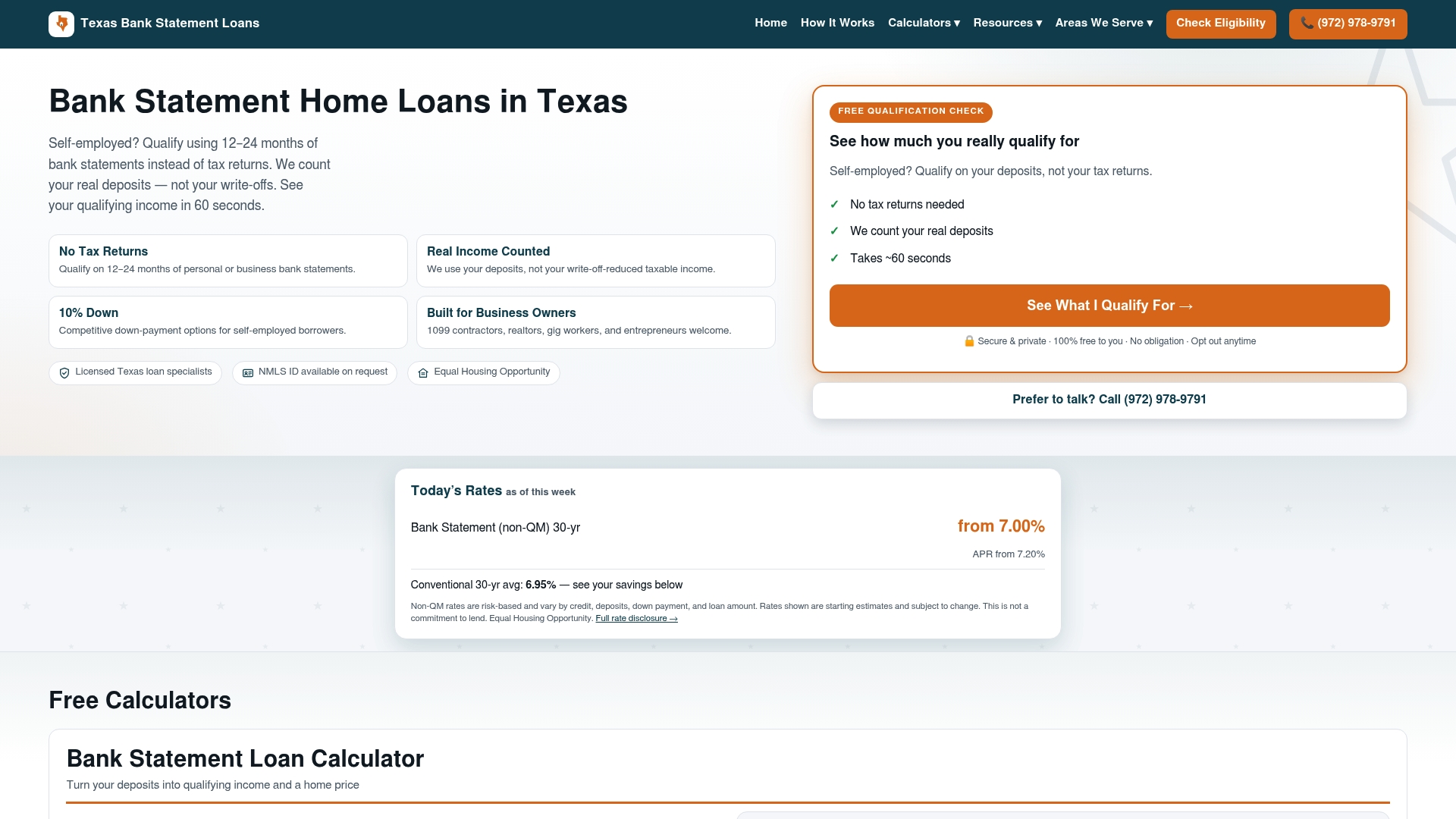
Texasbankstatementloans was built for exactly this borrower. The program evaluates 12-24 months of bank deposits to establish qualifying income, which means your actual cash flow counts rather than the reduced figure your tax return shows. Down payments start at 10%, credit score minimums are accessible for most established contractors, and the qualification check takes about 60 seconds with no obligation. Whether you are buying in Houston, Plano, or anywhere else in Texas, the program is designed to give you the same footing as a W-2 buyer in a competitive market. Check your qualification options today and find out what you can realistically afford before you start making offers.
Key Takeaways
Texas is the strongest state for 1099 borrowers because it combines zero state income tax with a mature Non-QM lending market and specialized programs that qualify borrowers on actual cash flow rather than taxable income.
| Point | Details |
|---|---|
| No state income tax | A 1099 contractor in Texas saves a substantial amount annually compared to California due to zero state income tax. |
| 1099 income calculation | Lenders use gross 1099 receipts or 12-24 months of bank deposits, not net taxable income. |
| Program requirements | Down payments run 10%-25%, with credit scores typically above 620 for most Non-QM programs. |
| When to consider alternatives | Borrowers with inconsistent income history or high debt ratios may fit bank statement or asset depletion loans better. |
| Texasbankstatementloans | Evaluates 12-24 months of bank deposits with down payments starting at 10%, giving 1099 borrowers a direct path to qualification. |
Recommended
See what you qualify for in 60 seconds, free and no credit check. Use the eligibility check at the top of this page.