
Many Texas content creators qualify for a mortgage through bank statement (non-QM) loans, which review bank deposits instead of leaning only on tax returns. Lenders still confirm that deposits are your personal income and ask for supporting records like a profit and loss statement and contracts. We offer bank statement options and a quick qualification check, so you can see where you stand.
TL;DR:
- Lenders average qualifying deposits across 12 or 24 months, exclude loans, gifts, refunds, and transfers, and may apply a 1.25 gross up when records support it.
- Prepare continuous personal or business statements, a current profit and loss statement, contracts or invoices, payout records, identification, and proof of down payment funds.
- Prequalification can take days, but underwriting often stalls over missing paperwork or unexplained deposits; label mixed account activity and answer lender requests promptly.
- Lenders must provide Loan Estimates within three days of application; compare fees and cash to close, since down payments vary by loan type and credit.
Table of Contents
- Which mortgage options work for content creators?
- What documents will lenders ask for?
- How do lenders calculate and verify creator income?
- What should you do first, and how long does it take?
- What will it cost, and how much down?
- Who counts as an eligible content creator?
- What are the pros and cons of bank statement loans for creators?
- How does the application process work for creators?
- How do credit scores affect approval for self-employed creatives?
- Can content creators refinance a bank statement loan?
- Why we recommend bank statement pathways for Texas creators
- How Texas Bank Statement Home Loans helps content creators qualify
- FAQ
- Sources
Which mortgage options work for content creators?
Standard conventional and FHA underwriting is built for W-2 paychecks. When you are self-employed, those lenders generally want a two-year history of self-employment income verified through federal tax returns or tax transcripts, as Fannie Mae’s selling guide describes. That is a problem if your write-offs shrink the income on paper while your bank account tells a stronger story.
Here are the paths creators usually weigh:
- Bank statement (non-QM) loans: Underwriting reads bank deposits to estimate income, which suits creators whose tax returns understate real cash flow.
- DSCR loans: Built for investment properties, these qualify the deal on the rental income the property can produce rather than your personal income.
- ITIN loans: An option for borrowers who file taxes with an Individual Taxpayer Identification Number instead of a Social Security number.
- P&L loans: These lean on a profit and loss statement to document income, often alongside other business records.
- Conventional or FHA with tax returns: Still worth a look if your returns show strong net income after expenses.
If you also earn from a rental, such as a short-term rental you list yourself, a partner case study on qualifying with Airbnb income shows how rental cash flow gets evaluated in a purchase.
The core trade-off is simple. Tax-return programs reward high reported net income. Bank statement programs reward steady, well-documented deposits.

What documents will lenders ask for?
Lenders want to see a business that is real, active and repeatable. The CFPB’s loan application packet guidance lists the basics for any borrower: bank statements, tax returns, proof of your down payment source and identity documents. Creators add business records on top. Here is a prioritized checklist:
- Bank statements. Personal or business, depending on the program. Continuity matters because gaps and sudden jumps invite questions. Bank statement programs lean heavily on these, while the tax-return route described by Fannie Mae rests on a two-year self-employment history.
- Signed federal tax returns, if you have them. Many bank statement programs accept alternatives, but a filed return still helps and some lenders will ask for one.
- A year-to-date profit and loss statement. Fannie Mae notes lenders may request YTD profit and loss statements and three months of business bank statements when income has dropped.
- Invoices, sponsorship contracts and platform payout records. These tie deposits to real work, including 1099s from brands and platforms.
- Proof your business is operating. An active website, recent invoices or ongoing payments all count.
- Down payment source and ID. Show where the money came from, plus a government ID.
- Estimated tax payment records. The IRS explains the self-employment filing rules and forms such as Schedule C and Schedule SE that creators use, and quarterly payment records show you are handling those obligations.
Pro Tip: Create one folder with a file for each month of statements and a one-line note next to any unusual deposit, such as a brand bonus or a refund. It saves days of back-and-forth later.
How do lenders calculate and verify creator income?
Variable income gets averaged. Fannie Mae’s guidance notes that lenders generally look at a two-year period of self-employment income. If your income jumped recently, expect to explain why and show it will last, often with a YTD profit and loss statement.
With bank statements, the math works differently:
- Averaging deposits: The lender totals qualifying deposits over the 12 or 24 months and divides by the number of months.
- Expense factor or gross-up: If deposits reflect net rather than gross income, servicing guidance commonly allows grossing up by multiplying by 1.25 when documentation supports it. Each program sets its own method, so ask which one applies to you.
- Excluding non-income deposits: Loans, gifts, refunds and transfers between your own accounts are removed.
Verification is where creators get tripped up. Under the CFPB’s Ability-to-Repay and Qualified Mortgage rule guidance, verification must confirm that deposits counted as income are the borrower’s personal income.
The CFPB’s rule guidance requires lenders to make a reasonable, good-faith determination of your ability to repay. That is why clean sourcing of every deposit speeds things up, and why a separate business account makes your cash flow easier to prove.
What should you do first, and how long does it take?
Preparation drives the timeline more than anything else. Here is the order that works:
- Pull your deposit history and separate business from personal accounts. If you mix them, label what each deposit is.
- Gather supporting documents: invoices, sponsorship contracts, platform payout records, your P&L and proof of estimated tax payments.
- Run a free qualification check and request a Loan Estimate. Compare estimates from more than one lender, and ask lenders how to shop for a mortgage while minimizing the effect on your credit.
For timing, prequalification can take days. Underwriting timing depends on how complete your file is, and closing dates vary by contract. The usual delays are missing documents and unexplained deposits.
Pro Tip: Answer every lender request the same day. Most slowdowns in self-employed files come from waiting on the borrower, not on underwriting.
What will it cost, and how much down?
We advertise low down payment options on our bank statement program. Your actual requirement depends on the loan type, your credit profile and the property, and a lower down payment can mean a higher rate or mortgage insurance.
Closing costs are where the CFPB’s Loan Estimate explainer helps. Lenders must give you a Loan Estimate within three days of receiving your application, showing estimated closing costs and cash-to-close. Budget for:
- Down payment and reserves: Some non-QM programs ask for several months of payments set aside.
- Appraisal and title fees: Paid at or before closing.
- Prepaid items: Homeowners insurance, property taxes and escrow deposits.
- Lender fees: Origination or underwriting charges that differ lender to lender.
Compare Loan Estimates line by line, and use our mortgage payment calculator to see what a monthly payment looks like before you commit.
Who counts as an eligible content creator?
Lenders care about the income stream and its stability, not whether you call yourself a streamer, YouTuber, podcaster, photographer or influencer. If you earn through ad revenue, brand deals, affiliate commissions, subscriptions or digital product sales, and the money lands in a bank account, a bank statement program can usually read it. Creators are typically independent contractors rather than platform employees, so you handle your own self-employment taxes and recordkeeping.
Expect these common eligibility checks:
- Operating history: Programs may look for a history of self-employment, though how a lender counts that history varies by program.
- Proof the business is active: A working channel or website, recent contracts or invoices, or ongoing payments show the business is open.
- Stable income: Lenders analyze whether income is steady or trending down. Wide swings call for an explanation, and heavy write-offs can reduce the income available to qualify on a tax-return loan.
- Minimum income levels: These differ by program and property price. Rather than guess a number, we recommend running a qualification check to see what your deposits support.
Because requirements shift by lender, the fastest way to see where you fit is to put your actual statements in front of an underwriter.
What are the pros and cons of bank statement loans for creators?
Advantages
- Income reflects reality. If write-offs lower your taxable income, deposits can show a truer picture of what you earn.
- Fewer tax-return hurdles. You are not locked into a pure two-year tax return calculation.
- Flexible documentation. Personal or business statements can work depending on the program.
- Fits irregular income. Averaging across many months smooths out viral spikes and slow seasons.
Disadvantages
- Pricing differs from conventional loans. Our rates page lists a bank statement 30-year program from 7.00% per year, and non-QM pricing may differ from conventional pricing.
- More paperwork on deposits. Every large or odd deposit may need an explanation.
- Possibly larger down payment or reserves than some government-backed programs.
- Not for every credit profile. Programs set their own score minimums.
For many creators, the question is whether a slightly higher rate is worth getting approved at all. If a conventional loan will not recognize your income, the answer is often yes, and refinancing later can reset the rate once your tax returns catch up.
How does the application process work for creators?
Here is how it typically goes with us:
- Run the quick qualification check. It carries no obligation.
- Share your statements. Send personal or business bank statements.
- Add supporting documents. Include your P&L, invoices, contracts and platform payout records.
- Get your Loan Estimate. It arrives within three days of the lender receiving your application and shows costs and cash-to-close.
- Underwriting review. Deposits are averaged, non-income items removed and your credit and assets verified.
- Appraisal and conditions. Respond quickly to any requests.
- Closing. You sign, fund and get your keys.
Local needs vary across the state. We serve major Texas markets, including pages for Houston, Plano and Midland, so a creator in a smaller city has a path too. If your plan includes a rental property, our DSCR calculator shows how that income is evaluated.
How do credit scores affect approval for self-employed creatives?
Credit still matters on a bank statement loan, even though income is read differently. Your score influences whether you qualify, your interest rate and how much you must put down. A higher score generally buys a better rate and more flexibility, while a lower one can mean a larger down payment, reserves or a higher price.
What lenders look for beyond the score itself:
- Payment history: Late payments can weigh heavily.
- Credit utilization: High balances on business cards used for personal spending can drag down your profile.
- Recent inquiries and new accounts: Avoid opening new credit before closing.
- Mixed personal and business debt: If business debt is paid from your personal account, it may count against your debt-to-income picture.
Practical steps help: pay cards down before you apply, dispute errors early and keep old accounts open. Creators often have thin personal credit because expenses run through a business, so a period of clean personal credit use before applying can make a real difference. Minimum scores vary by program, so check ours instead of assuming a cutoff.
Can content creators refinance a bank statement loan?
Yes, and for many creators it is part of the plan. A bank statement loan can get you into the house while your tax returns still understate your income. As your documented income grows, you can look at refinancing into a lower rate or a program with different terms.
Strategies worth considering:
- Refinance to a conventional loan once strong tax returns support your income and your credit has improved.
- Rate-and-term refinance when market rates fall, as long as the savings outweigh the closing costs.
- Stay in a bank statement loan if your write-offs remain heavy and your returns still understate cash flow.
- Refinance to shed mortgage insurance once your equity builds from payments and appreciation.
Before refinancing, compare the Loan Estimate against your current loan and work out how long it takes to recoup the closing costs. Keep your deposit records clean throughout, since a new lender will review them again.
Why we recommend bank statement pathways for Texas creators
We built our service around a common problem: creators earn real money, but their tax returns and their bank accounts tell different stories. The usual bottleneck is documentation, with scattered statements, mixed accounts and deposits nobody can explain. Reading deposits as well as returns lines underwriting up with how creators actually get paid. For most Texas creators whose write-offs mask real cash flow, that is the fastest fair route to a yes.
- Saad
How Texas Bank Statement Home Loans helps content creators qualify
We evaluate bank deposits instead of relying only on tax returns, so your income is judged by what actually lands in your account. Our low down payment options start at 10%, and our 60-second, no-obligation check shows what you can realistically afford.
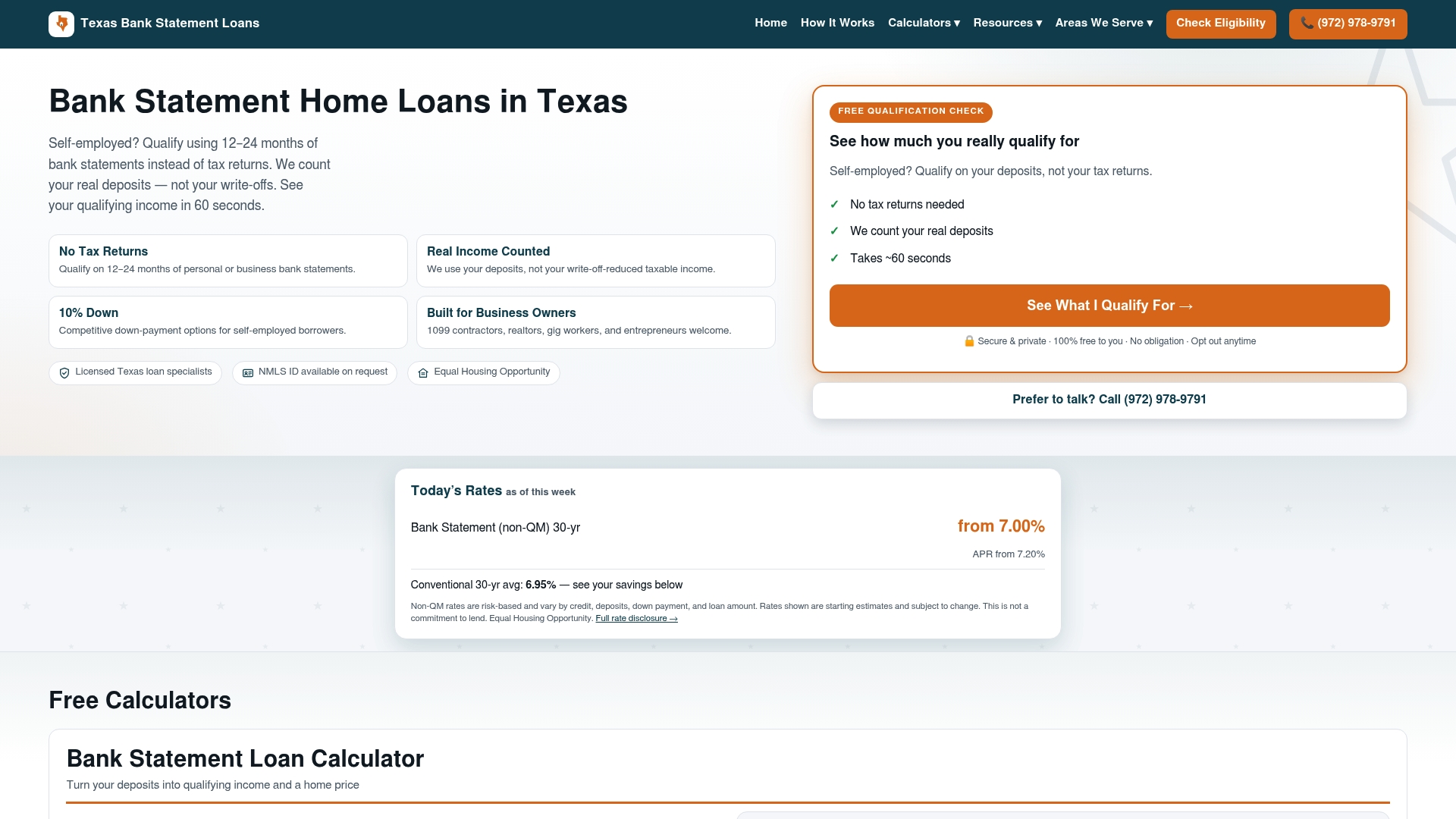
- Start with the free qualification check on our Texas Bank Statement Home Loans page.
- Review current terms on our bank statement rates page.
- Estimate payments with our mortgage payment calculator.
Run the check today and see what your deposits can buy.
This article is general information, not a substitute for advice from a qualified financial advisor. Consult a qualified financial professional about your own circumstances before acting on anything here.
FAQ
Can a content creator get a mortgage in Texas?
Yes. Many creators qualify through bank statement loans that review bank deposits instead of relying only on tax returns. You will still need supporting records such as a profit and loss statement and contracts.
What documents do I need as a self-employed creator?
Plan on bank statements, a year-to-date profit and loss statement, invoices or contracts, proof of your down payment and ID. The CFPB’s application packet guidance lists the core items, and creators add business records on top.
Do lenders count all my deposits as income?
No. Lenders must verify that deposits are your personal income, so loans, gifts and transfers between your accounts are excluded. Keeping business and personal accounts separate makes this easier to show.
How long does approval take?
Prequalification and underwriting timing vary depending on how complete your documents are. Missing paperwork and unexplained deposits are the most common causes of delay.
Do I still have to file taxes as a creator?
Yes. The IRS says you must file a return if your net self-employment earnings reach $400 or more. Lenders may also ask for proof of estimated tax payments.
Sources
- Underwriting Factors and Documentation for a Self-Employed Borrower | Fannie Mae
- Manage taxes for your gig work | Internal Revenue Service
- Create a loan application packet | Consumer Financial Protection Bureau
Recommended
- Bank Statement Loans for Self-Employed Buyers
- Bank Statement Loans in Cameron County, TX | Self-Employed
- Bank Statement Loans in Williamson County, TX | Self-Employed
See what you qualify for in 60 seconds, free and no credit check. Use the eligibility check at the top of this page.