
Most mortgage lenders require your funds to be seasoned for about 60 days and clearly sourced before they count toward your down payment or reserves. If a large or unexplained deposit shows up, expect a 90-day lookback and more paperwork. Self-employed borrowers pursuing bank-statement loans face a longer bar, often requiring an extended history of statements. Start pulling your statements now, flag any oversized deposits, and write down where that money came from before an underwriter asks.
TL;DR:
- Large or unexplained deposits often trigger a 90-day lookback period and require extensive documentation to verify legitimate source and seasoning.
- Conventional and FHA lenders typically require a 60-day seasoning period, but a single unexplained large deposit within this window can extend the review to 90 days.
- Self-employed borrowers using bank-statement loans must provide 12 to 24 months of deposit history, with careful sourcing and labeling of transfers between personal and business accounts.
- Underwriters look for patterns such as round number deposits, overdrafts, or unfamiliar transfer sources that signal potential issues or unverifiable funds.
- Proper preparation includes pulling complete statements, flagging large deposits, and organizing documentation early to avoid delays or last-minute issues before closing.
Table of Contents
- What Bank Statement Seasoning Means and Why Lenders Require It
- Standard Seasoning Timeframes: 60 Days, 90-Day Lookbacks, and Exceptions
- Sourced vs. Seasoned: Proving Where Your Money Came From
- Documentation Checklist by Scenario: What to Send and How to Organize It
- Self-Employed Borrowers and Bank-Statement Loans: Why 12 to 24 Months Matters
- Underwriter Red Flags: What Triggers Extra Scrutiny on Your Bank Statements
- Step-by-Step Checklist Before You Apply
- The Final Check Before Clear-to-Close
- How Texas Bank Statement Home Loans Approaches Seasoning for Self-Employed Borrowers
- Get a Realistic Number Before You Start Gathering Statements
- Where to Verify These Rules Yourself
- Sources
What Bank Statement Seasoning Means and Why Lenders Require It
Seasoning refers to how long money has sat in your account before you apply for a mortgage. Lenders care about the timeline because unsourced cash that appears right before closing raises a specific question: is this actually your money, or is it a loan, a gift you haven’t disclosed, or something tied to a transaction the lender needs to see?
That question isn’t paranoia. It traces back to anti-money-laundering rules under the Bank Secrecy Act and the PATRIOT Act, which push banks and lenders to verify where large sums of money originate. A mortgage underwriter isn’t running a criminal investigation, but the same logic applies at a smaller scale: money that can’t be traced to a legitimate source is money a lender can’t safely count.
There’s also a practical underwriting reason. If you borrow $15,000 from a relative two weeks before closing and deposit it into your checking account, that debt could change your debt-to-income ratio, even if nobody documents it as a “loan.” Seasoning periods give lenders a window to confirm your reserves reflect your actual financial position, not a temporary boost.
Program guidance shapes how strict this gets. HUD’s Handbook 4000.1 directs FHA lenders to document and verify any individual deposit exceeding 50% of your monthly effective income, regardless of how long it’s been sitting in the account. Fannie Mae’s guidelines on verifying deposits and assets set similar standards for conventional loans, and most private lenders build their own checklists around these baseline rules.
What this means in practice:
- Funds need a paper trail back to a legitimate source, not just a balance on a screen.
- Large deposits get flagged automatically by underwriting software, even in accounts that otherwise look clean.
- Borrowed funds used for a down payment must be disclosed, because they affect your qualifying debt load.
- Lenders vary in how aggressively they apply these rules, but the underlying standard comes from the same handful of agency guidelines.
Standard Seasoning Timeframes: 60 Days, 90-Day Lookbacks, and Exceptions
A period of about two months is the standard most conventional and FHA lenders use for verifying deposit accounts on a typical purchase loan. That means pulling your two most recent monthly statements, with consistent balances and no red flags, usually satisfies the requirement.
Ninety-day lookbacks kick in under specific conditions rather than as a blanket rule. According to LegalClarity’s breakdown of the 60 to 90 day standard, lenders extend their review window when a deposit looks unusual, when a loan program specifically requires a longer look, or when a refinance introduces different documentation standards than a purchase transaction. A single large, unexplained deposit inside the 60-day window is often enough to trigger the longer lookback on its own.
Program type changes the math too:
- Conventional and FHA purchase loans typically stick to the 60-day standard for asset verification.
- Refinances sometimes require a fresh look at more recent statements since there’s no purchase contract driving the timeline.
- USDA loans carry their own credit and asset documentation quirks worth checking against USDA Rural Development’s credit notes before assuming the FHA playbook applies.
- Jumbo loans frequently ask for more reserves and, by extension, more months of clean statements to prove those reserves are real.
- Bank-statement loan programs for self-employed borrowers operate on an entirely different scale, which we’ll get into shortly.
Quick fact: Lenders don’t average random 60-day windows. They pull two full, consecutive monthly statement cycles, typically the most recent two months as of your application date. If your bank’s statement cycle runs from the 15th to the 15th rather than calendar month to calendar month, that’s the window that counts, not the calendar month itself.
The practical move here is simple. Pull statements that show your full billing cycle, not partial screenshots or account summaries, and make sure the ending balance on one statement matches the opening balance on the next. Gaps or mismatches are one of the fastest ways to trigger extra scrutiny that has nothing to do with how much money you actually have.
Sourced vs. Seasoned: Proving Where Your Money Came From
Seasoned and sourced are two different requirements, and meeting one doesn’t automatically satisfy the other. Seasoned means the money has been sitting in your account long enough. Sourced means you can prove where it came from. A lender wants both.
Money that’s been sitting for 60 days but has no clear origin, say, a mysterious $8,000 cash deposit with no explanation, can still stall your file even though it technically passes the seasoning test. On the flip side, a gift that just arrived last week can sometimes work if it’s fully documented, because sourcing sometimes substitutes for seasoning when the paper trail is airtight.
Here’s what “sourced” actually looks like in practice:
- Gift funds need a signed gift letter stating the money doesn’t require repayment, plus the donor’s bank statement showing the withdrawal and your statement showing the matching deposit.
- Home sale proceeds get verified through the closing disclosure or settlement statement from the prior sale, tying the deposit directly to that transaction.
- Wire transfers require the wire confirmation showing sender, recipient, amount, and date, matched against your bank statement.
- Loan payoffs or refunds need a letter or statement from the paying institution confirming the reason for the deposit.
What typically doesn’t pass muster: cash deposits with no documentation, informal transfers between friends with no paper trail, and handwritten notes claiming a loan was “already repaid.” Underwriters have seen every version of these, and vague explanations almost always trigger a request for more proof rather than less.
Documentation Checklist by Scenario: What to Send and How to Organize It
Different sources of funds call for different paperwork, and sending the wrong combination is the single biggest reason files sit in underwriting longer than they should.
-
Gift funds from a family member. Provide a signed gift letter (name, relationship, amount, statement that repayment isn’t expected), the donor’s bank statement showing the outgoing transfer, and your own statement showing the matching deposit with dates and amounts that align.
-
Proceeds from selling a home. Submit the final closing disclosure or settlement statement from the sale, along with the bank statement showing the deposit landing in your account within a reasonable window of the closing date.
-
Inheritance. Include a copy of the death certificate, the will or trust distribution letter, and the bank statement or check stub showing the deposit, with names and amounts matching the estate documents.
-
Business account deposits (self-employed borrowers). Provide business bank statements alongside personal statements, and be ready to explain any transfers between the two so an underwriter isn’t double-counting or questioning commingled funds.
-
Loan payoff or refund. Attach the letter from the lender or institution confirming the payoff amount and date, matched against the deposit on your statement.
A few formatting habits make a real difference in how fast your file moves. Download PDF statements directly from your bank’s portal rather than submitting photos or scanned paper, since lender guides consistently recommend certified digital statements to avoid questions about authenticity. Name your files clearly, something like “Checking_Statement_Jan2026_JohnSmith,” rather than “Scan001.pdf.” Highlight or circle the specific deposit in question with a short note explaining what it is, and send documents in the order your loan officer requests them rather than as one large, unsorted batch.
Pro Tip: Ask your bank for an official letter or certified statement copy if your lender flags anything unusual. A bank-certified document carries more weight with underwriting than a self-printed PDF and often resolves a conditional approval faster than additional written explanations from you.
Self-Employed Borrowers and Bank-Statement Loans: Why 12 to 24 Months Matters
Self-employed applicants play by different rules, and it’s not because lenders are suspicious of entrepreneurs specifically. Traditional underwriting leans on tax returns, and tax returns for self-employed people often understate real income after deductions, depreciation, and business write-offs. A bank-statement loan solves that mismatch by looking at what actually moved through your accounts instead.
Rocket Mortgage’s guidance on bank statement programs confirms what most lenders in this space already practice: expect to provide 12 to 24 months of statements, either personal or business, depending on the program. Underwriters average your deposits over that period to establish a qualifying income figure, rather than relying on the net income line on a Schedule C.
That averaging process means a few things for how you prepare:
- Every consecutive month in the window needs to be accounted for. Gaps force follow-up requests and slow everything down.
- Reviewers separate legitimate business income from internal transfers, loan draws, or one-time windfalls that shouldn’t count as recurring revenue.
- Large, irregular deposits still get flagged even in a bank-statement program, so the sourcing rules from earlier still apply on top of the averaging math.
- Business owners running both personal and business accounts should be ready to show how money moves between the two, since commingled funds without labels tend to raise more questions than they answer.
Pro Tip: Label transfers between your business and personal accounts as you make them, right in your bank’s memo field. “Owner draw, March payroll” takes ten seconds to type and can save you a week of back-and-forth with an underwriter later.
This is the exact gap Texas Bank Statement Home Loans was built to close. Rather than penalizing business owners, 1099 contractors, and gig workers for a tax strategy that legitimately lowers taxable income, the evaluation looks at 12 to 24 months of actual deposits to reflect real cash flow. Running your numbers through the bank statement loan calculator before you formally apply gives you a realistic sense of qualifying income, so there are no surprises once an underwriter starts averaging your statements.
Underwriter Red Flags: What Triggers Extra Scrutiny on Your Bank Statements
Underwriters aren’t reading your statements line by line for fun. They’re trained to spot specific patterns that historically correlate with undisclosed debt, unverifiable income, or funds that don’t belong to you.
The most common triggers:
- Large deposits with no clear source, especially round numbers like $10,000 or $20,000 that don’t match your typical deposit pattern.
- Repeated overdrafts, which suggest cash flow problems that a snapshot balance doesn’t reveal.
- New debt or credit inquiries appearing near your application date, since a fresh car loan or credit line changes your DTI ratio right when it matters most.
- Transfers from unfamiliar names, particularly ones that don’t match any documentation already in your file.
According to The Mortgage Reports’ rundown of what lenders don’t want to see, these patterns are exactly what trip up otherwise qualified borrowers, not necessarily bad credit or low income.
When a flag comes up, the fix is usually faster than borrowers expect. A donor’s bank statement resolves a gift-fund question. A wire confirmation resolves a transfer question. A short written explanation, paired with supporting documents rather than standing alone, resolves most “explain this deposit” conditions. Submit these within a few business days of the request; the longer a file sits with an open condition, the more likely your closing date slips.
Step-by-Step Checklist Before You Apply
Getting your paperwork in order before you submit an application saves real time once underwriting starts.
- Pull two full months of statements for every account you’ll use for the down payment or reserves, downloaded as PDFs directly from your bank, not scanned printouts.
- Flag every deposit over $1,000 that isn’t your regular paycheck, and write a one-line note explaining what it is while the details are still fresh.
- Hold off on large transfers between accounts for at least 60 days before applying if you can avoid it, since unnecessary movement just creates more explaining to do.
- Avoid opening new credit accounts or making major purchases on existing cards between application and closing.
- For joint accounts, confirm both account holders’ names appear clearly on the statement and be ready to explain the relationship if only one person is on the loan.
- For gift funds, get a signed gift letter ready in advance, including donor name, relationship, dollar amount, and a statement that repayment isn’t expected, before the money even moves.
Pro Tip: If you’re combining funds from multiple accounts, consolidate them into one account at least two statement cycles before applying. It’s far easier to season and source $20,000 sitting in one place than to explain five smaller deposits scattered across three accounts.
The Final Check Before Clear-to-Close
Lenders don’t stop watching after your initial approval. Most run a “final verification” of employment, credit, and sometimes bank balances in the days right before closing, which means new debt or a sudden account change can still derail things at the last minute.
Common last-minute problems include a new credit inquiry showing up on a final credit pull, a large deposit made during escrow that nobody flagged, or a requested updated statement that reveals an overdraft. The fix is almost always the same one used earlier in the process: documentation that traces the transaction back to a clear, legitimate source.
If your lender asks for an updated statement close to closing, provide the most current one available immediately, and resist the urge to move money around in the meantime. A quiet, stable account in the final week is worth more than a clever transfer that looks fine to you but raises new questions for underwriting.
How Texas Bank Statement Home Loans Approaches Seasoning for Self-Employed Borrowers
The traditional seasoning rulebook was written with W-2 borrowers in mind, and it shows. Self-employed applicants often get penalized twice: once by a tax return that legitimately understates income, and again by a seasoning standard that assumes clean, predictable paychecks. Texas Bank Statement Home Loans built its evaluation around 12 to 24 months of actual deposits specifically because that history tells a more honest story than a single tax year ever could.
The process starts simple. We ask for your recent bank statements, personal or business depending on your situation, and walk through the same sourcing and consistency questions any underwriter would ask, just with realistic expectations for how business owners actually bank. Down payments start at 10%, and you can run the 60-second qualification check before committing to anything.
- Saad
Get a Realistic Number Before You Start Gathering Statements
If you’re self-employed, a 1099 contractor, or running a small business in Texas, chasing tax-return-based mortgage approval usually means underselling your real income. Texas Bank Statement Home Loans looks at your actual deposits instead, so the income on your loan application matches what you actually bring in.
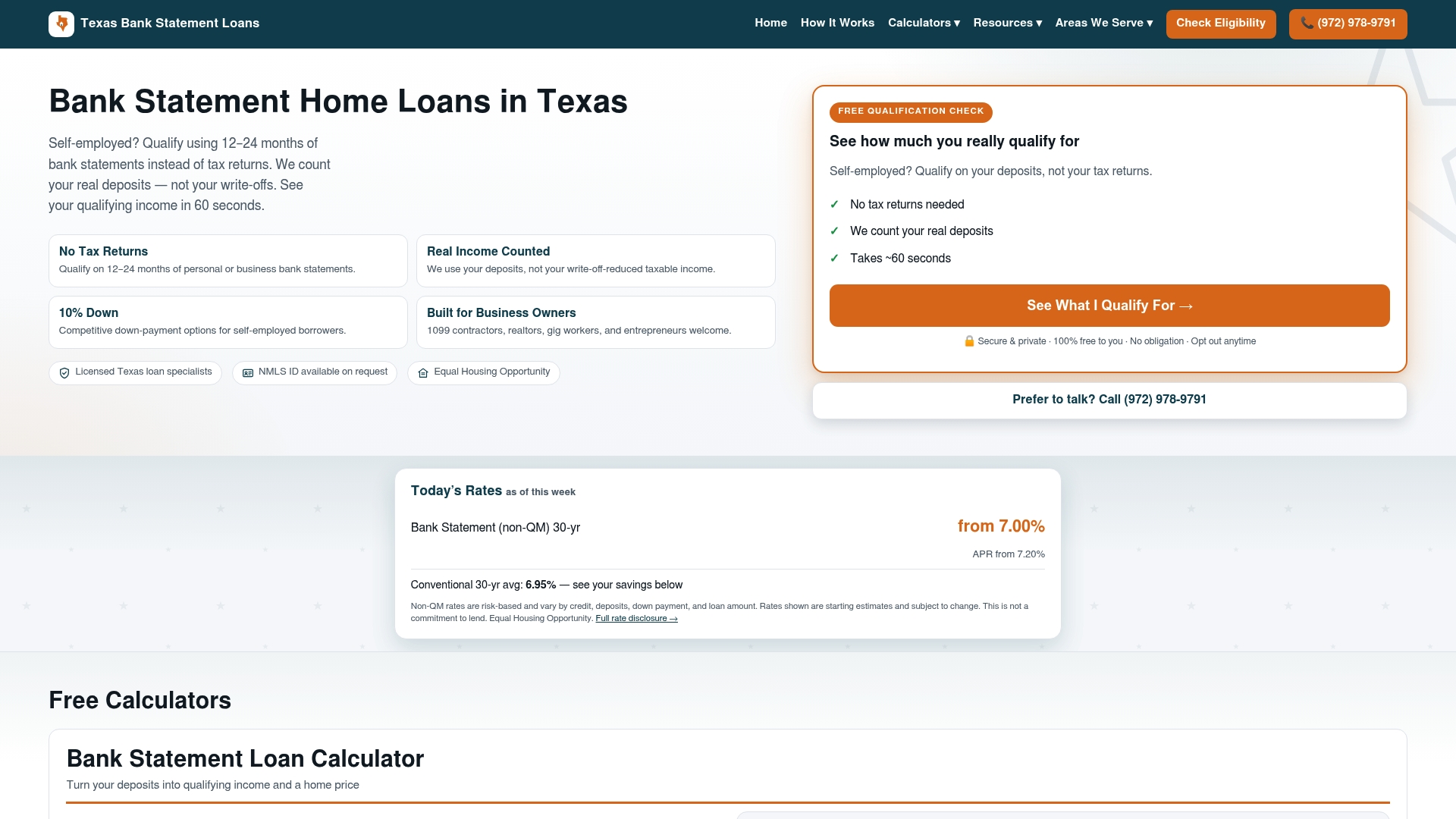
Start with the bank statement loan calculator to see roughly what you’d qualify for based on your deposit history, then check current rates so you know what to expect going into the conversation. If you’re in the Houston area, the local bank-statement loan program walks through coverage specific to that market. Run the numbers, see what you qualify for, and take the next step toward an application that reflects how your business actually performs.
Where to Verify These Rules Yourself
For the regulatory backbone behind deposit documentation, read HUD Handbook 4000.1 directly. The Consumer Financial Protection Bureau’s homebuying prep guide covers general documentation expectations, while LegalClarity’s explainer breaks down the 60 to 90 day standard in plain terms. Rocket Mortgage and The Mortgage Reports round out the practical, lender-facing side of these requirements.
This article is general information, not a substitute for advice from a qualified financial advisor. Consult a qualified financial professional about your own circumstances before acting on anything here.
Sources
- HUD Handbook 4000.1 update (deposit documentation guidance)
- Seasoning of funds: How the 60-90 day rule works, LegalClarity
- Bank statements for your mortgage: Rocket Mortgage guide
- Bank statements: things lenders don’t want to see, The Mortgage Reports
- Prepare to buy a home, Consumer Financial Protection Bureau
Recommended
See what you qualify for in 60 seconds, free and no credit check. Use the eligibility check at the top of this page.